• DSC_6852

    Oh, it's such a good week, isn't it? I love Martin Luther King Day, love hearing his beautiful voice on the radio all day long, love listening to the old gospel songs inevitably played after a particularly rousing speech, love hearing interviews with people who survived those awful days and are overcome with emotion about how far they, and we, have come. This year it was so especially wonderful to wake up the next morning, abuzz with anticipation and glee, to await the inauguration of our new president. I fairly vibrated with happiness all day long.

    And then the kind folks over at the Well Fed Network went and made my week that much better by announcing the nominations for their 2008 Food Blog Awards. My post about my friend Alessandro (remember him?) and his delicious roasted tomato bruschetta is a nominee in the Best Post category, which just tickles me to no end. If you'd like to (and I hope you do!), you can vote here. The polls close this Saturday, January 24th.
    DSC_6824

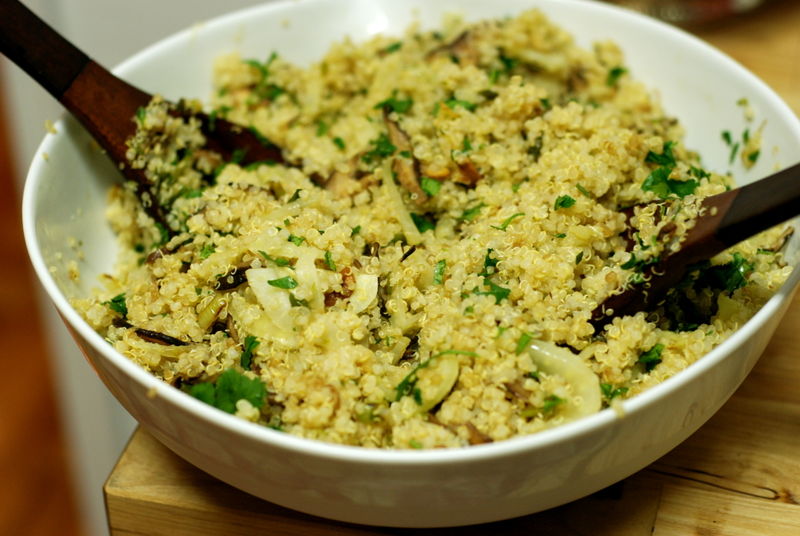
    Now, to make up for posting about those double chocolate cookies (that are, thankfully, all gone from my house) in this delicate month, I will tell you about a far more virtuous dish. Quinoa salad! It quivers with healthfulness, doesn't it? Far more appropriate for these days, I daresay.

    Quinoa, in case anyone is wondering, is an ancient grain from the Andes that is particularly high in protein when compared to wheat or rice, and chockful of amino acids (and dietary fiber!). In other words, it is good for you. Luckily it also tastes nice, which is a relief. You have to rinse it before cooking, because it's covered with saponins that taste bitter if not removed. You'd think a lazy bones like me would balk at that step, but I rinse my rice, too, to remove the starch so that the cooked grains are nice and separated. (Just to clarify, only long-grain and basmati, not arborio, is meant to be rinsed!)
    DSC_6835

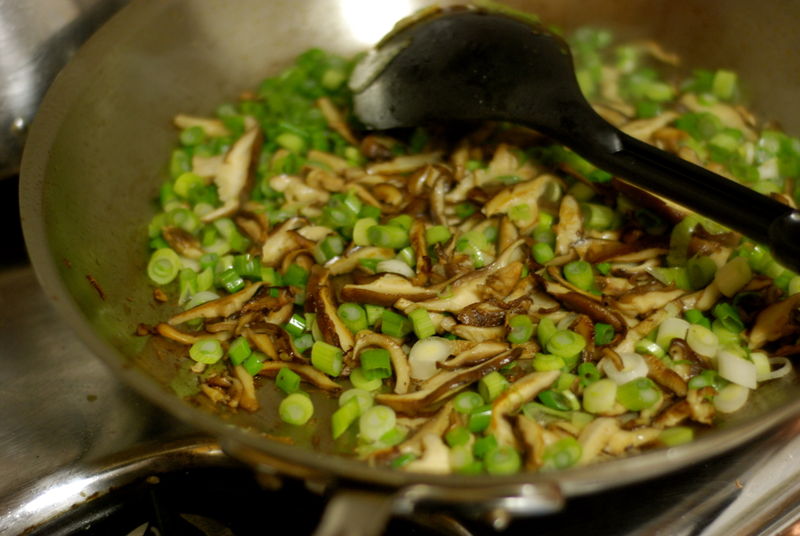
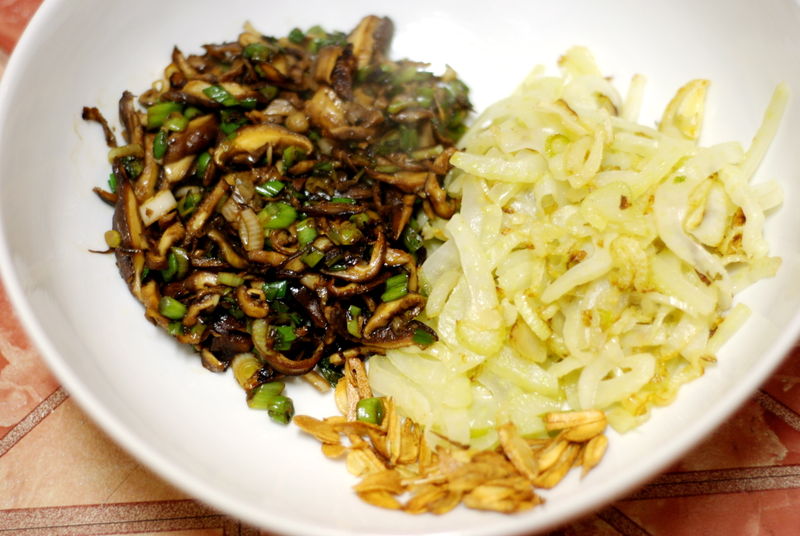
    Amy Scattergood wrote about grain salads in the LA Times the other day, including this recipe that has you cook up a whole bunch of shiitakes glazed with soy sauce and rice vinegar (just typing that makes me hungry again) and caramelized fennel and toss them both with cooked quinoa, fried garlic, herbs, lime zest and juice, and sauteed scallions. Hoo boy! Good stuff.

    It's a little fussy, because you have to cook everything – the garlic, the fennel, the shiitakes and scallions – in separate steps (technically, in a wok, but I used a steel skillet and it was fine). But fussy isn't always bad. Besides, all you need to do is prep properly. I didn't and I found myself frantically slicing shiitakes while the oil almost starting smoking. Typical. Oh, also, I would double the amount of soy sauce and vinegar with which you deglaze the mushrooms. I wanted this to be really strongly seasoned and it was more subtle than I expected. But it was a gorgeous combination, especially with the final finish of chopped green herbs and lime juice and zest.
    DSC_6859

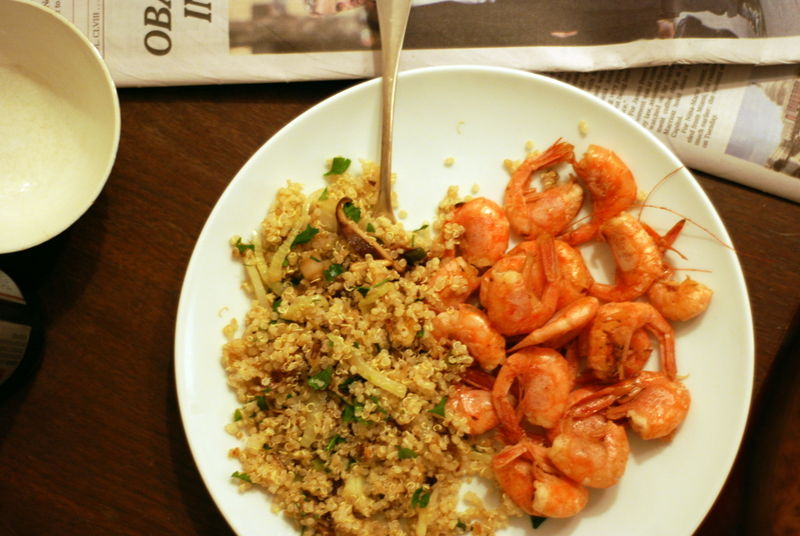
    You can serve this with roasted, salted cashews, says Amy, or with tofu or shrimp. Maine shrimp, those sweet, tiny, wild, pink specimens, are available here for a few short weeks now, and so unbelievably cheap that I bought a pound and quickly sauteed them in the pan I used for everything else. It was a lovely dinner: healthy and balanced and, best of all, eaten at the end of the first day of a new world order. I couldn't ask for anything more.

    Quinoa Salad with Shiitakes and Fennel
    Serves 6

    2 cups quinoa
    1 quart water
    Salt
    1/4 cup peanut oil
    5 cloves of garlic, thinly sliced
    2 cups thinly sliced fennel (about 1 large bulb)
    2 cups sliced fresh shiitake mushrooms
    1 cup sliced green onions, both white and green parts (about 1 small bunch)
    1 tablespoon soy sauce (I'd double this next time)
    1 tablespoon rice wine vinegar (I'd double this next time)
    1/2 cup toasted, salted cashews (optional)
    4 tablespoons minced fresh parsley
    4 tablespoons minced fresh cilantro
    Finely grated zest and juice of 1 lime

    1. Rinse the quinoa under cool running water, then drain well with a fine-mesh sieve or cheesecloth-lined strainer (the grains are very small and will slip through a coarse strainer). Heat a wok over medium-high heat and toast the quinoa, shaking the pan frequently, just until the grains dry, are just beginning to color and have a nutty aroma, about 4 minutes. Set aside in a bowl.

    2. In a medium, lidded pot, bring 1 quart of water to a boil over high heat. Stir in the quinoa with a pinch of salt, then reduce the heat to a simmer and cover. Cook the quinoa until the grains are translucent and tender and the germ has spiraled out from the grain, 12 to 15 minutes (be careful not to overcook). Remove from heat, drain and set aside.

    3. Meanwhile, heat the wok again over high heat. Add the peanut oil and heat until it just begins to simmer. Stir in the garlic and fry, stirring constantly, just until the garlic is golden, about 30 seconds (the garlic can burn quickly). Remove the garlic with a slotted spoon, keeping the oil in the pan, and set aside.

    4. Add the fennel to the oil and fry, stirring or tossing frequently, until it is caramelized, 5 to 7 minutes. Remove from the oil and set aside. Add the shiitakes to the oil and stir-fry until caramelized, 4 to 5 minutes. Stir the green onions in with the mushrooms and continue to stir-fry just until the green onions begin to wilt, 1 to 2 minutes. Add the soy sauce and vinegar to the mixture and stir or toss to combine, then remove from heat.

    5. In a large bowl, gently toss the quinoa with the warm shiitake-green onion mixture, the fennel, garlic, cashews, parsley, cilantro, lime zest and juice. Season to taste with additional salt if desired and serve immediately.
  • DSC_6605

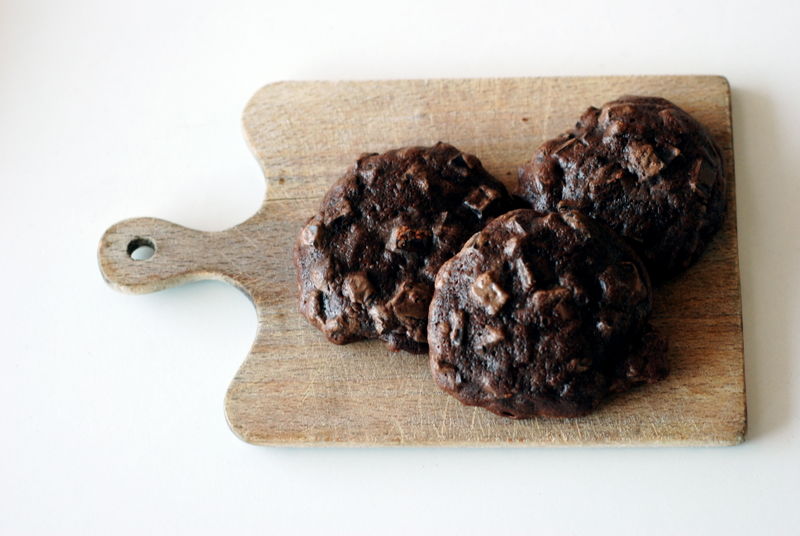
    Uhh. Looky there. Chocolate. On chocolate. More chocolate. Can't speak, can't think. COOOKIE.

    Is this what it feels like to be a 15-year old boy in the presence of a Sports Illustrated swimsuit model?

    The Culinary SOS column has struck again and with a vengeance. I read it last Wednesday and by Thursday night was in the kitchen, up to my elbows in chocolate. It's January! We're meant to be eating brown rice noodles and copious amounts of steamed spinach! Instead, these cookies – these insane, ridiculous, almost unbearably good cookies – will bewitch you. You will not be able to resist. Just try to! You won't.

    Think about this: 1 and 1/4 pounds (yes, pounds) of chocolate. To only 1/2 cup of flour and 1/2 stick of butter. Are you starting to sweat a bit? These cookies demand respect. And yet are easy enough to make on a school night. You don't even need an electric beater. I did the whole thing with a whisk and a wooden spoon.

    You know, melt chocolate and butter, whisk eggs and sugar, fold in dry ingredients, the usual deal. And then dump in one entire pound of chopped bittersweet chocolate. Yeah, that's where things get interesting.

    DSC_6553  
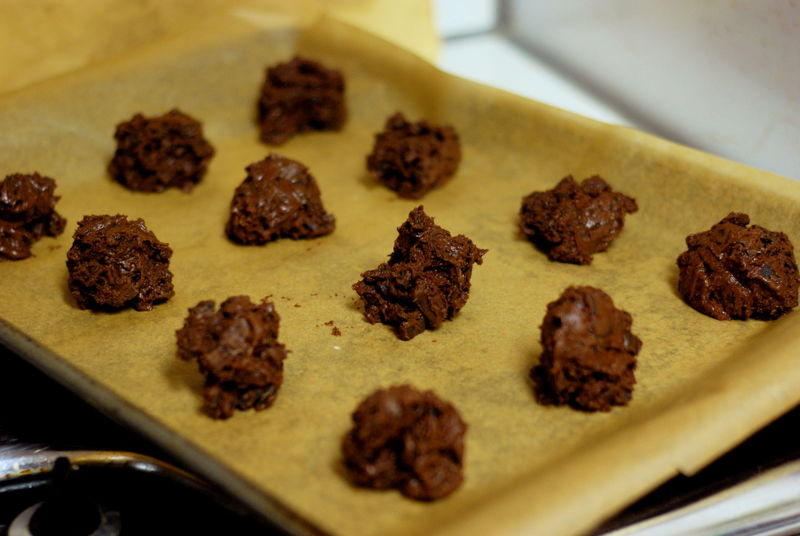
    Somehow I managed to keep my wits about me and, instead of following the instructions to make 16 cookies out of this batter, decided to make smaller cookies, 26 to be exact. You can fit about 12 spoonfuls of the dough on a regular baking sheet. I advise that you do the same, because 16 cookies out of this amount of batter will make monster cookies, ones that might just kill you.

    You have two choices when baking the cookies. You can slightly underbake them (5 minutes on each side), which leaves them ooey-gooey and you in desperate need of a napkin when eating them. Or you can let them go one or two minutes longer on each side, so that they firm up a bit. The benefit of doing this is that when you remove them from the oven, you don't have to (cruelly) wait until they cool completely, as per the recipe. You can pace for a few minutes, pour yourself a glass of milk and then dig in while they're still hot and the chocolate is molten. This is possibly the best thing since sliced bread.

    Not too sweet, velvety and complex and rich, tasting almost of coffee, though there's none in them, yes, these are possibly among the world's best cookies. There, I've said it.

    DSC_6591

    Now, the milk. You cannot – I repeat, cannot – eat these cookies without milk. Oh sure, you might try to, but you will fail. I tried, I really did, and I hit a chocolate wall after about my second bite. A chocolate wall that could only be scaled by having a glass of cold 1% milk nearby. Yes, they are that intense.

    Another thing: you should not eat more than two in one sitting. You might die of chocolate. When you try these, you'll see that it's totally possible. (My friend Seb managed three in one sitting, but he's 6 foot 8 and operates differently.) I have to warn you that in the presence of these freshly-baked discs, greed and insatiable desire will take over you and you will want to eat as many as you possibly can. It's practically evolutionary! You will be powerless. But try to resist. Will you believe me if I tell you that I almost regretted eating two in one go? And yet, couldn't help myself. So just be forewarned.

    These cookies are a force to be reckoned with.

    Double Chocolate Cookies
    Makes 26

    1/4 pound (4 ounces) unsweetened chocolate
    4 tablespoons (1/2 stick) butter
    3 eggs
    2 teaspoons vanilla extract
    1 cup sugar
    1/2 cup flour
    2 tablespoons cocoa powder
    1/2 teaspoon baking powder
    1/2 teaspoon salt
    1 pound bittersweet chocolate (chunks or chips)

    1. In a bowl set over a pot of simmering water, melt the unsweetened chocolate and butter. Remove from the heat and cool slightly.

    2. In the bowl of a mixer with a paddle attachment, or in a large bowl using a fork, combine the eggs, vanilla and sugar. Mix just until incorporated and set aside.

    3. Sift together the flour, cocoa powder, baking powder and salt into a medium bowl. Set aside.

    4. Add the melted chocolate to the egg mixture and mix just until combined. Stir in the sifted dry ingredients and mix just until combined, then stir in the bittersweet chocolate.

    5. Cover the batter with plastic wrap and refrigerate for at least 1 hour to chill thoroughly. Heat the oven to 350 degrees.

    6. Drop spoonfuls of the dough on a greased, parchment-lined sheet pan, leaving 2 inches between each.

    7. Bake until the edges of the cookies are just set and the center is still soft, 10 to 12 minutes, rotating the pan halfway through. Place the cookies, still on the parchment, on a rack and cool slightly.

  • DSC_6479

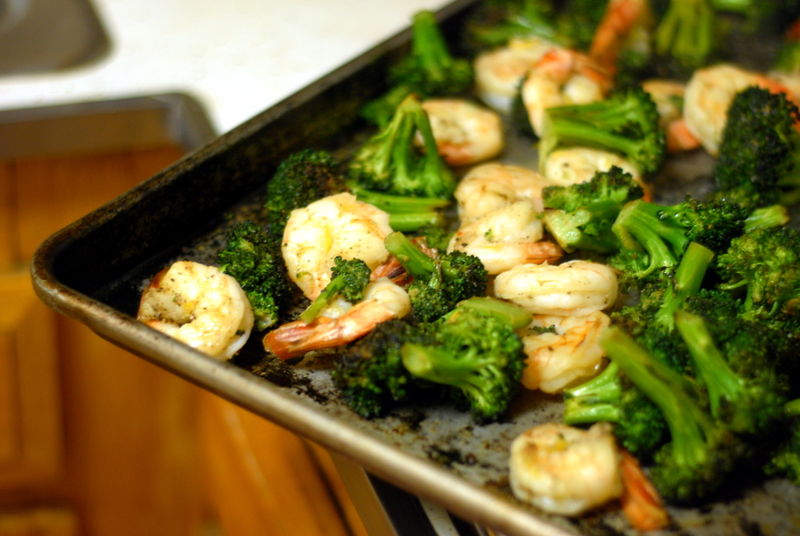
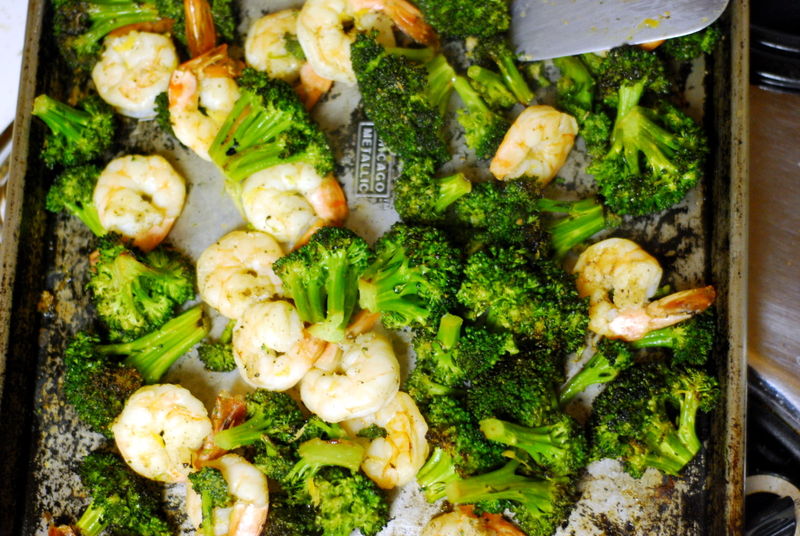
    You should totally make this for dinner tonight. No, really, you should. It's fast, it's delicious, it dirties only one pan (two, if you decide to make some rice, which I think you should), and it's so simple you can enlist your partner to help with measuring spices and seasoning the shrimp and opening and closing the oven door, proving that one day the two of you might find pleasure together in the kitchen at once. A minor miracle, if you ask me. And possibly my favorite meal of the past month.

    Did I mention it was delicious? We ate the whole mess between the two of us, despite the fact that it's meant to serve four. You probably already know how wonderful roasted broccoli is, and if you don't, you should. But did you know just how much roasting shrimp could imbue it with such sweetness and tenderness? I didn't. Those plump, pink curls fairly pop in your mouth. And the combination of shrimp and broccoli, well, the Chinese have long known it to be a felicitous pairing, so I suppose it was only a matter of time before the rest of us caught on, too.

    DSC_6481

    I had to make a few minor changes to the recipe, because I didn't have any whole coriander or cumin. So I halved the amounts and used ground spices instead. I liked the recipe so much that I'm not sure I'd make this any other way again. The ground spices spread out and subtly perfume everything. And then I made the mistake of using the same amount of regular salt instead of kosher salt. If you're going to use kosher salt, fine, follow the recipe. If you're going to use regular salt, go easy (halve it?). You can always add more salt afterwards, if need be.

    What I love is how two fairly pedestrian ingredients are combined with a few smart flavorings to incredible effect. The idea to roast, season with Middle Eastern spices, and finish with a Mediterranean double whammy of lemon peel and lemon juice (don't leave out that final squeeze – it's key) is inspired. Further more, it's the kind of thing I wish I saw more often in newspaper food sections: tasty inventiveness that really works for the home cook. I dare say this might become a weekly standard in our house.

    Roasted Broccoli with Shrimp
    Serves 4

    2 pounds broccoli, cut into bite-size florets
    4 tablespoons (1/4 cup) extra virgin olive oil
    1 teaspoon whole coriander seeds (or 1/2 teaspoon ground)
    1 teaspoon whole cumin seeds (or 1/2 teaspoon ground)
    1 1/2 teaspoons kosher salt
    1 teaspoon freshly ground black pepper
    1/8 teaspoon hot chili powder
    1 pound large shrimp, shelled and deveined
    1 1/4 teaspoons lemon zest (from 1 large lemon)
    Lemon wedges, for serving

    1. Preheat oven to 425 degrees. In a large bowl, toss broccoli with 2 tablespoons oil, coriander, cumin, 1 teaspoon salt, 1/2 teaspoon pepper and chili powder. In a separate bowl, combine shrimp, remaining 2 tablespoons oil, lemon zest, remaining 1/2 teaspoon salt and remaining 1/2 teaspoon pepper.

    2. Spread broccoli in a single layer on a baking sheet. Roast for 10 minutes. Add shrimp to baking sheet and toss with broccoli. Roast, tossing once halfway through, until shrimp are just opaque and broccoli is tender and golden around edges, about 10 minutes more. Serve with lemon wedges, or squeeze lemon juice all over shrimp and broccoli just before serving.

  • Dsc_6390

    (Do not reach to adjust the brightness dial on your computer: that is, indeed, the color of the soup. And the color of my silicone spatula. And the color of my bespattered linoleum counter. Oh, turmeric, you madden me with your lovely flavor and your ability to turn everything you touch to bright, unmoveable yellow.)

    Whenever I leave Europe after vacation, I arrive back in the States with a knot in my heart and a serious craving for fresh, spicy Asian food: clear broths, incendiary peppers, bright flavors. I'm not really sure why. Last summer, I read Fuchsia Dunlop's Shark Fin and Sichuan Pepper on the flight back from Italy and I arrived with a watering mouth and unholy hankering for dan dan noodles. I couldn't rest until I drove myself to Flushing one night after work to go down into the rabbit warren of food stands that is Golden Mall.

    This time I made a crucial mistake. I thought that making my own Asian food would be just as good as leaving it up to the experts. What I didn't realize is that part of what I look forward is the sheer ease of being able to show up somewhere in New York and have utter confidence that what you're about to order is authentic, delicious and not to be replicated at home. Berlin may have many things, but superb Asian food available at a moment's notice is not one of them.

    Anyway, instead of just hopping in the car and going to to Flushing one night, I read Julia Moskin's article about curried noodle soups and decided to cook my own happiness instead of buying it. Well. I won't be doing that again. Not when I'm in the still-delicate fog of jet lag and melancholy. It's not that the soup was bad. It wasn't. It was fine. Well, a little greasy, perhaps, and the flavors a bit muddied, it's true, but it wasn't awful.

    (What an endorsement, right?)

    I guess what I'm trying to say is that this soup just wasn't right for me this week. That's the silliest thing I might have ever written on this blog, but it just so happens to be true. I don't doubt that this soup soothes millions of souls, but all it made me feel was foolish and slightly cheated. I learn easily enough, though. Next time, I'm going directly from the airport to Chinatown and letting the professionals do my palliative cooking. Ooh, I'm excited already.

    Soto Ayam (Indonesian Chicken Soup with Noodles and Aromatics)
    Serves 4

    1 free-range chicken, about 3 pounds, quartered
    2 stalks fresh lemon grass, bruised with the handle of a heavy knife and tied in a knot
    6 kaffir lime leaves, fresh or frozen  (optional)
    1 teaspoon kosher salt, more to taste
    1 teaspoon black peppercorns
    1 1/2 tablespoons coriander seeds
    2 teaspoons cumin seeds
    5 shallots, peeled and halved
    3 cloves garlic, peeled
    2 teaspoons finely minced fresh turmeric, or 1 1/2 teaspoons ground turmeric
    2 tablespoons finely minced ginger
    3 tablespoons peanut oil
    4 ounces glass noodles or thin dried rice noodles, called vermicelli, bihun or bun
    1 tablespoon fresh lime juice
    2 tablespoons chopped celery leaves, mint, Thai basil or cilantro leaves
    2 shallots, thinly sliced and fried in vegetable oil until brown (optional)
    Quartered limes and chili paste (such as sambal) for serving
    Cooked white rice  (optional)

    1. Place chicken in a medium pot with lemon grass, lime leaves (if using), salt and 2 quarts water. Bring to a boil over high heat. Skim off any foam and reduce heat to a simmer. Cover and simmer until chicken is tender, about 45 minutes, skimming as needed to make a clear broth. Remove chicken pieces from broth and set aside. Remove and discard lemon grass and lime leaves; reserve stock in pot. When chicken is cool enough to handle, discard skin and bones and shred meat into bite-size pieces.

    2. Meanwhile, combine peppercorns, coriander seeds and cumin seeds in a small food processor. Pulse until ground. Add halved shallots, garlic, turmeric and ginger and pulse to a thick paste. (Add a little water if needed.)

    3. Heat peanut oil in a medium saucepan over high heat. When very hot, add spice paste and cook, stirring until paste is cooked and beginning to separate from the oil, about 5 minutes.

    4. Add cooked spice paste and chicken meat to stock. Bring to a simmer and cook 10 minutes.

    5. Cook noodles according to package directions.

    6. Turn off heat under soup and stir in lime juice. Taste for salt.

    7. To serve, divide noodles in large soup bowls. Ladle chicken pieces and soup on top and sprinkle with celery leaves or herbs, and fried shallots, if using. Pass lime and sambal at the table.

    8. Eat from soup bowl, or serve a scoop of rice on a side plate, sprinkled with more shallots, and put a mouthful of noodles and chicken on rice. Combine on a spoon, dab with sambal, and eat.

  • Firstly, buy yourself a small bottle of Austrian pumpkinseed oil (from here or here, for example). Then the next time you make squash soup, drizzle some of this deep-green oil over each serving. You can get creative by forming droplets and drizzles like modern art on the surface of the soup. It’s supremely nutty and rich and so beautiful against the orange soup. Oh, it tastes good, too.

    Dsc_5554

    Secondly, keep your cool when carving the Christmas goose. This is now my third or fourth time tackling the annual beast and I have to say that practice does indeed make perfect. More importantly, staying calm and taking your time seems to work wonders. The slices of breast meat fall away just so, the leg bones pop out just as they should and people gasp in wonder at your prowess.

    Dsc_5783

    Thirdly, forget ever cooking a New Year’s Eve meal again. Instead, buy oysters (if you can, several different kinds and then you can have oyster courses!), a few lemons (take a hike, mignonette) and make each guest bring a bottle of champagne. Do you need anything else? Fine, if you do, get a slab of sushi-grade salmon, slice it thinly and dress it with good oil and herbs. Oh, and toast some bread for that. That’s it! Crown roast, seafood bisque, whatever else one spends hours in the kitchen on New Year’s Eve for, nothing comes close to champagne and oysters.

    Dsc_6150

    Fourthly, here it is! The promised deliciousness from my Sicilian uncle, this year in the form of a torta di carciofi – an artichoke tart encased in puff pastry (storebought!) that is out-of-control delicious. I’ve got the recipe, too, and am going to be applying myself to test and translate it for you. Oooh, I am so excited for you!

    Dsc_6204

    Finally, there’s this ridiculously good-looking sformato of pasta and eggplant that my uncle made before I left. Unfortunately, the day he made it was also the day one of us ended up in the ER with an intestinal ailment, the other one was felled by near-pneumonia, and I just felt like death warmed over. So I took a few pretty pictures, watched my cousin’s son slurp it up happily and figured the recipe can wait until next year.

    Dsc_6267

    Dsc_6268

  • Dsc_5430

    Savoy cabbage at the organic market at Wittenbergplatz. So green, so frilly, so gorgeous.

    Dsc_5448

    Proof that blue skies in Berlin in winter aren’t a figment of my imagination.

    Dsc_5801

    Stolpersteine in my old neighborhood commemorating a family of Weiss’s (no relation) who took their own lives and those of their children in 1943.

    Dsc_5460

    Oddly beautiful lanterns hanging from the trees around Winterfeldplatz.

    Dsc_5820

    A snapshot of a day spent wandering the East with my mom, like tourists in our own city.

    Dsc_5955

    A Herrnhuter Stern, traditional Christmas decoration in Germany, that someone thinks looks like a mace.

    Dsc_5952

    A motorcycle I wanted to pack up and take with me, thank you very much. Could it be any cuter? I think not.

    More photos here.

  • Dsc_5539

    This will be a very quick dispatch indeed, frustratingly quick, I'm afraid, because – people, this is big – I have tasted manna and I have no recipe for you and I can only hope you're all very distracted with Christmas plans and travel itineraries and far more important things than checking in with me here so that you won't entirely hate me once I tell you about this elixir and how we all not only have to wait for summer to make it ourselves, but source ourselves an elderberry bush, which as you might know is not so easy at all, no sirree, Bob.

    I was at Joan's the other night, for the Springerle bake-off (more on that soon, I promise), when she innocently asked me if I wanted a cool drink. With her Holundersyrup, to be exact. Holunder is the German word for elderberry (and, more importantly, elderflower) and seeing as my mother, a very accomplished preserver, to be fair, was the source of some pretty gnarly elderberry preserves a few years ago, I wrinkled my nose (politely!) and said I'd try a small sip. You know, to be gracious. Well. Well. Yes. Let me try to explain what happened next.

    I took a sip of cool tap water that Joan had mixed with a spoonful of the golden syrup. And suddenly, like a gentle thunderclap or a small fissure in the space-time continuum, I was transported. Summer, Berlin summer, was in my mouth! How odd. I stood in the kitchen, the wintry scent of cinnamon hanging lightly in the air, candles aglow and darkness swirling about outside – all hallmarks of Christmas in Berlin – and yet there I was, with summer in my mouth. Birds chirping, warm breezes blowing, blooming branches dropping petals on the sidewalk. It was all quite marvelous. After all, I haven't been to Berlin in the summer since 2001 and to say I've missed it would be the understatement of the decade.

    So, now to explain to those souls out there who don't know the beauty that is summer in Berlin (seriously, dear readers, gas prices are plummeting, no one's traveling – book yourselves a flight already): elderflower syrup is fruity and sweet and cooling and refreshing, incredibly so, yet not cloying like rose water, even though it is floral. It's cool floral, not florid floral. Know what I mean? Am I making any sense? Should I shut up already? Just take it from me: elderfloral syrup is an absolute dream.

    I don't have an exact recipe right now, though apparently Joan found one on the internet that she improvised with. Next summer, I promise, I'll make this in Italy, where we have lots of elderberry bushes growing wild, and I'll give you exact proportions. But, roughly speaking, here's what you do: get yourselves a whole mess of elderflower blossoms, some sugar, lemons, citric acid and a bit of water. Put it all in a crock (earthenware, I guess) and cover it and let it macerate in the dark for four days. Strain it and voila! Wait, that doesn't sound right. Maybe you let the elderflower blossoms and the citric acid and the lemon juice macerate for a few days and then you make a simple syrup with the sugar and water and then you mix it together with the strained elderflower liquid, and then voila! Hmm. I don't know.

    But what I do know is that, man, I can't wait to have more of that stuff. And that I'm so happy to be here right now that I'd like time to stop. That's all.

  • Dsc_5142

    I am, shall we say, a little distracted these days. I'm leaving for Germany in a little less than three days. And I'm not coming back until the first days of January. That's the longest vacation I've taken in a good bit and I'm sort of agog at the prospect of so much (badly-needed) time off. Time to see old friends, show more bits and pieces of Berlin to Ben, figure out where and when we're getting married, have my mom cook me dinner, spend time with my family, literal and figurative, and simply be in my hometown. I've missed it so much this year that Heimweh turned into a perpetual ache in my chest. I'm ready to be rid of that.

    And though I'm not sure if this is entirely related to my distraction, my luck in the kitchen lately has been abysmal. Almost funnily so, though if you'd seen me yesterday, attacking an innocent pizza that had soldered itself to the baking stone in less than 25 minutes and was thus burned to an absolute crisp, rendering our casual late-afternoon lunch a blackened, unpleasant mess, you might have handed me a towel to mop my brow and commanded me to go take a walk around the block. Happy to oblige, thanks!

    Not to be outdone, there was also a lackluster savory rice pie that I loved when my stepmother made, but that ended up a bland, insipid, tragic waste of Carnaroli rice when attempted in my own kitchen, and the unforgettable pickled endives that had such promise, but were a deeply unpleasant combination of sweetness, bitterness and spice that was not meant to be eaten by anyone, at least not anyone in my home.

    Kitchen disasters, please be gone, would you?

    But Christmas comes early this year: a holiday dinner tonight with friends, a liquid dinner of cocktails tomorrow, one meal airborne over the Atlantic and then – boom – I'm absolved of the rest of the year's meals. Strangely enough, I'm sort of pleased. I think my kitchen and I need a break. (Oh, except there's this one amazing soup I have to tell you about before I leave…).

    I'm bringing my camera cable with me to Europe, since I'm going to be (finally!) documenting the annual Springerle bake-off with my friends Joan and Ann, and Ben's first encounter with a Currywurst (it might not happen, but I'll try – and in any case, after years of loyalty to the stand at Wittenbergplatz, it's time for me to branch out and try Konnopke's. Are there any Berliners out there who want to weigh in?). Then, best of all for you hungry folks, I'll be in Brussels for the last week of my holidays with my family who never fail to introduce me to some kind of stellar food. Last year, I brought back the focaccia di patate; this year, who knows? It will be delicious and I will share it: that is my solemn holiday promise to you.

    Oh! And these potatoes! Well, for those of you for whom Christmas is not Christmas without mashed potatoes, and for those of you who find leftover mashed potatoes – formed into patties and fried, for example, or eaten cold from the fridge – to be your own personal nirvana, this is the recipe you must make this year. It is, in a word, insane.

    After all, not only is there browned butter and fried sage (dreamy!) but there is Greek yogurt, too. Luscious, I tell you, and pleasingly different without being weird. Also, it makes mountains of mashed potatoes. Mountains! That is not an exaggeration. You will be inundated with thick, creamy, tangy, herby mashed potatoes. The good thing is they're so easy to keep eating, day after day. Croquettes, potato soup, shepherd's pie – is there anything that cannot be done with these leftovers? I have yet to find out.

    Brown Butter Mashed Potatoes with Sage
    Serves 6 to 8 with leftovers

    3 pounds baking potatoes, scrubbed, skin on, cut into 1-inch chunks
    1/2 cup (1 stick) unsalted butter
    24 fresh sage leaves
    1 cup whole milk
    3/4 cup plain Greek yogurt
    1 1/2 teaspoons sea salt
    1/2 teaspoon freshly ground black pepper

    1. Put the potatoes in a large pot or Dutch oven and cover with cold water by at least half an inch. Cover and bring to a boil over high heat. Lower the heat and simmer until tender, about 15 minutes.

    2. While the potatoes are cooking, heat the butter over medium-high heat in a medium skillet. When it begins to foam, add the sage leaves and gently fry until crisp, 2 to 3 minutes. Remove with a slotted spoon, place on a paper towel and reserve. Continue to cook the butter until it's golden brown and nutty, watching so that it doesn't burn, an additional 1 to 2 minutes. Remove from heat and reserve.

    3. In a small saucepan, heat the milk over medium-high heat just until hot, careful that the milk does not boil. Remove from heat and reserve in a warm place.

    4. Drain the potatoes and place them into a large bowl. Using a masher, mash the potatoes to the desired consistency. Stir in the hot milk, yogurt, salt and pepper and browned butter, making sure to get all the dark butter solids. (Recipe can be prepared to this point a day in advance; refrigerate the potatoes tightly sealed and keep the sage in a tightly sealed container at room temperature.)

    5. Garnish with the fried sage and serve. (If you have refrigerated the potatoes, gently reheat the mashed potatoes before serving, thinning if needed with additional milk. Garnish and serve.)

  • Dsc_5313_2

    Christmas is sneaking up on us unusually quickly this year. Or maybe it does this every year and every year I am surprised anew at how caught unawares I am. You'd think, by now, that the relentless reliability of it wouldn't quite discombobulate me so much, but it does. To make sure that gifts arrive before I take off for Berlin means I have to be done, really, with my shopping and crafting and noodling by – well – now. And that's just a kick in the pants.

    I've taken to making at least a few of my gifts for people edible ones. That way, if there's a last-minute emergency, I don't have to wait for something to priority ship, I can just run down to the store and buy more syrup or chocolate. Last year, I made cashew brittle, which was a huge hit. And so, so easy. I mean, do-it-in-your-sleep easy. That's my kind of Christmas gift. I might just make it again this year, maybe for the people who didn't get any last year.

    Dsc_5327

    But I'll also be standing at my stove this year, simmering and whisking, until a thick, glossy, chocolate sauce comes together in a pot and I pour it into little glass jars, beribboned of course, to be doled out to deserving folks who need a little bit of molten chocolate to sweeten their holidays, to drizzle onto ice cream or pound cake, or simply to eat, from the fridge with a spoon, cold and fudgy and rich and complex.

    Doesn't that sound like a lovely Christmas gift? Why, it's a good thing I can gift myself, too.

    Dsc_5331

    This might possibly be one of my oldest clipped recipes. It goes all the way back to 1998 and is a keeper, a category-killer, so to speak. First of all, it comes from Nancy Silverton, who happens to be a kitchen goddess of mine. Is there anything that lady touches that doesn't taste good? Second of all, it, too, is easy-peasy. You melt chocolate in one bowl, then boil together the rest of the ingredients (that most of us have lying about in our pantries already, thank goodness) in the other, then stir them together for a few minutes, whisk in some brandy and, hey presto!, you've got yourself a bubbling pot of hot fudge.

    I love the high-sheen gloss on this stuff. It's gorgeously rich and keeps for months in the fridge, so you can jar little glasses of it and drop them off with people who you love. You'll have some very grateful friends, I guarantee. Fudge sauce makes anything better, wouldn't you say? Even the fact that Christmas is almost here.

    Ba_blog_envy_bonaducce_green1_2

    Featured on Bon Appetit's Blog Envy slideshow!

    Hot Fudge Sauce
    Makes 2 cups

    7 1/2 ounces bittersweet chocolate, cut into 2-inch pieces
    1/4 cup sugar
    1/2 cup light corn syrup
    1/2 cup plus 2 tablespoons water
    3/4 cup unsweetened cocoa powder
    3/4 tablespoon instant coffee granules
    3 tablespoons Cognac or brandy

    1. Melt chocolate pieces in large stainless steel mixing bowl (or top of double boiler) over saucepan of gently simmering water. Be sure water does not touch bottom of mixing bowl to prevent chocolate from burning. Turn off heat and keep warm over warm water until ready to use.

       2. Bring sugar, corn syrup, water, cocoa powder and instant coffee to boil in large saucepan over medium-high heat. Reduce heat to medium-low and simmer 1 to 2 minutes, stirring constantly to dissolve cocoa powder and sugar and to prevent burning on bottom of pan.

       3. Whisk in melted chocolate. Boil hot fudge for few minutes to reduce to consistency you desire. It should be quite viscous and surface should have glossy shine. Cool slightly and beat in Cognac or brandy.

  • Dsc_5144

    I don't think I ever thanked you all for your myriad suggestions on what to do with the mountain of ricotta spilling from my fridge. My goodness! There were so many great ideas. If it were up to me, I'd do nothing but test my way through that list. But I have a blog to uphold! A mission statement! And a waistline! Ultimately, a recipe was waiting just under my nose, in the LA Times' Culinary SOS column. A towering cranberry-orange-cornmeal cake that used Two Whole Cups of Ricotta. Why, I'd get rid of it all and then some! Sold.

    (And suddenly, just like that, my desire to bake an apple pie for Thanksgiving was gone. Poof! Rather odd, really. I sort of thought pie baking urges were quite unshakeable. Shows you how much I know.)

    This cake is a monster. Seriously, get the biggest bowl you have to mix it in. There is so much batter it will possibly swallow you whole. Of course, it's entirely worth it. First of all, cranberries and orange – yes, please. Secondly, cranberries, orange and cornmeal – um, I said yes PLEASE. Thirdly, all of that, plus ricotta? Good grief, give me the mixer already.

    I used less ricotta than called for, less sugar, and less salt. The first two because it's all I had, the last because 2 1/4 teaspoons of salt just seemed excessive. The batter gets quite thick: this is actually one of those times when I wish I had a stand mixer. But my edits don't seem to have harmed this cake at all: in fact, I found it perfect.

    Dsc_5121

    You mix half of the fresh cranberries directly into that thick, rich batter, then spoon it into a baking pan (a 9-inch spring form was the best size, I found) and top it with the remaining cranberries and a flurry of granulated sugar. In the oven, the cake rises impressively and gets beautifully burnished, that top layer of sugar turning crunchy and irresistible in the heat. Cooled and turned out of its pan, the cake is simply gorgeous. Sweet and tart, moist and nicely textured from both the relative coarseness of the cornmeal and the fluff of the ricotta – it was a total hit. Ben's sister asked me for the recipe about five times.

    We ate it with slightly sweetened whipped cream after our Thanksgiving meal and for breakfast every day after that, oh, and for tea and as a pre-dinner snack and, well, let's just say that a cake this size, even with 8 hungry people in the house, lasts longer than you'd expect.

    Cranberry Orange Cornmeal Cake
    Serves 18

    2 cups flour
    1 cup cornmeal
    1 tablespoon baking powder
    1/2 teaspoon baking soda
    3 eggs
    1/4 cup maple syrup
    1/4 cup plus 2 tablespoons vegetable oil
    1 1/2 tablespoons vanilla
    3/4 cup plus 2 tablespoons (1 3/4  sticks) butter
    1 1/2 cups plus 2 tablespoons sugar, divided (I used 1 cup and 2 tablespoons sugar, divided)
    2 1/4 teaspoons salt (I used only 1 teaspoon)
    Zest of 1 orange
    2 cups ricotta cheese (I used 1 and 1/2 cups)
    2 1/2 cups cranberries, divided

    1. Heat the oven to 375 degrees. Grease a 9-inch round by 3-inch springform pan and line the bottom with parchment paper.

    2. In a medium bowl, whisk together the flour, cornmeal, baking powder and baking soda. In a separate medium bowl, whisk together the eggs, maple syrup, oil and vanilla. Set aside.

    3. In the bowl of a stand mixer with the paddle attachment, or in a large bowl with a hand mixer, cream together the butter, 1 cup sugar, salt and zest. Mix just until thoroughly combined; do not overmix.

    4. With the mixer running, slowly incorporate the egg mixture into the butter just until combined.

    5. With the mixer on low speed, add one-half of the flour mixture to the batter and quickly mix for 5 seconds. Turn off the mixer and add the rest of the flour, the ricotta and one-half of the cranberries. Mix the remaining ingredients into the batter over low speed just until combined, being careful not to overmix.

    6. Gently pour the batter into the cake pan and smooth the top. Scatter the remaining cranberries over the top of the cake, and sprinkle with the remaining 2 tablespoons sugar.

    7. Bake the cake until a toothpick inserted comes out clean, about 1 hour and 15 minutes. Place a loose piece of foil over the top of the cake if it starts to darken. Cool the cake on a wire rack before removing it from the pan.