• Polpettine

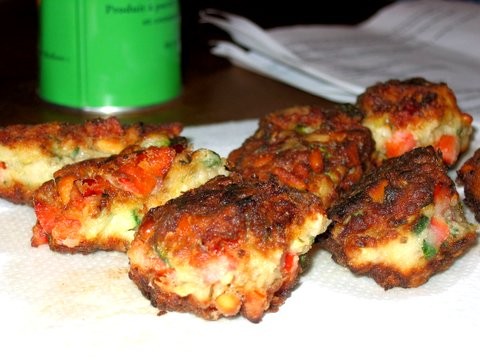
    This morning, I'm feeling dejected. Yet another L.A. Times recipe that kind of stank. It had so much promise! Delectable vegetables, freshly grated cheese, crispy breadcrumbs to bind it all together before a toasty roll in hot oil. What came out, though, were odd little balls that were too garlicky (I promise, there is such a thing) in places, and too bland in others. Regina Schrambling wrote her article about the triumvirate of vegetables that define a ratatouille and decided that while ratatouille was over the hill (seriously? I didn't get the memo), there was still a chance for the eggplant-pepper-zucchini trio to shine in other combinations. Well, I'm not convinced. Give me a good ratatouille anyday over the polpettine from last night.

    First, I lay a halved zucchini and a halved eggplant over a vegetable steamer in a stock pot. The zucchini were done after a few minutes, while the eggplant continued on for another twenty. Then, I draped the steamed eggplant over a colander to drain. Meanwhile, I finely diced the zucchini, one red pepper, several garlic cloves, a bunch of fresh thyme and then diced the eggplant flesh (after peeling it). To this, I added pine nuts, grated Grana Padano, panko, and a dash of salt and freshly ground pepper.
    Bowl
    This glorious combination was gently mixed together with one egg.
    Mixed
    Then came the real mess. I was instructed to shape little balls with my hands, then roll them gently in flour, shaking off the excess, before laying them in a pan of hot oil. No matter how finely diced the vegetables would have been, the balls did not want to stay together. Little dice of red peppers fell all over the place and so I found myself squishing the balls into submission, flour everywhere.
    Floured
    I slipped the little fritters into the pan (only burning my fingertips once!) and fried them in three batches, a few minutes on each side.
    Frying_1
    I drained them on paper towels, and ate one right away, piping hot, and another after it had cooled off. The pepper and garlic were still raw and far too strong against the eggplant that seemed to have been drained of all its flavor in the steamer basket. The pine nuts and cheese and thyme tasted good, but didn't manage to save these little polpettine. If you'd like a similar recipe that is far more delicious and easier to make, try Marcella Hazan's eggplant patties in this book.

  • Icam0027_7_1
    My mother was in Venice this past weekend. On her walks around the city, she came across this sign at a fish market. Most likely dating back to the 18th century, it stipulates the minimum length allowed for sale, in centimeters, for each type of fish. Then the sign lists the fish in Venetian dialect. It’s certainly more beautiful than this

  •  

    Full_cake 

    This upside-down cake, from Barefoot in Paris, was not a success, but I only partially blame the recipe. As some of you might know from The Food Network or her best-selling cookbooks, Ina Garten started a catering shop called Barefoot Contessa in the Hamptons 20 years ago. A few years back, she got her own television show and wrote several cookbooks. She mostly makes simple American food (and has only recently branched out to French) that tastes particularly good because of her emphasis on high-quality ingredients. She also has a strong reliance on terrifying amounts of butter and cream. Yes, some things taste better with extra fat, but it's not really the way I like to cook every day.

    However, I did have a glut of Italian plums in my kitchen the other day and stumbled on this recipe to use them up. It's a riff on the classic tarte tatin, which is an upside-down apple tart that has become a ubiquitous dessert (and sadly, often ruined) in French bistros. Instead of sauteeing apple chunks with butter and sugar and then covering them with a short crust, Ina Garten drizzles fresh plums with caramel, then covers them with a sour cream-enriched batter, fragrant with lemon and vanilla.

    First I halved the plums and laid them face down in a glass pie plate. Then I poured a simple caramel over them.
    Caramel_plums
    To make the caramel, I boiled sugar and water together, without stirring,
    Melted_sugar
    until the mixture turned a nice deep brown.
    Caramel
    For the batter, I creamed together butter and sugar until light and fluffy, then beat in a few eggs, sour cream, a heaping pile of lemon zest and some vanilla. In another bowl, I sifted together some flour, salt and baking powder. SCREECHING HALT. I had no baking powder. WHAT? Impossible – my kitchen is usually so well-stocked with baking supplies that I've been known in the past to have not one but two containers of baking powder. And now, none? Before having a meltdown, I raced to the living room to pluck out Regan Daley's In The Sweet Kitchen from my bookshelf. I remembered that she had a substitution chart in her book for just these kind of kitchen emergencies. Sure enough, there was a chart for substituting baking powder.
    Book
    I was supposed to use a combination of cream of tartar and baking soda. So, I carefully measured out and added them to the flour mixture, before combining the whole thing and pouring the batter over the plums.
    Batter
    I put the pan in the oven for close to an hour. When it emerged, the cake had risen slightly and browned. The smell of sour cream and lemon zest perfumed the room.
    Baked_1
    I let the cake cool on a rack for a while, then carefully turned the pan upside down and let the cake slide out onto a cardboard round. I cooled the cake to room temperature. When I cut in, though, it was clear something hadn't gone entirely right.
    Slice_2
    The cake had a strange rubbery consistency, and hadn't risen as I had expected it to. There were pockets of air here and there. The cake itself was blindingly sweet. The plums were only barely able to balance the sweetness out with their acidity. I blame the lack of proper baking powder on the cake's funny structure, but Ina Garten also needs to lay off the sugar. All in all, I wouldn't make this again. I will always prefer a real tarte tatin or a proper upside-down cake, perhaps from Ina's mentor?

  • Roasted_tomatoes
     
    With an abundance of tomatoes at various stages of ripeness languishing on my countertops, and not enough hours in the day to just slice and eat them sprinkled with olive oil and salt, I was getting desperate. Luckily, the last time I was in Boston, I pilfered a recipe for a pasta sauce made with roasted tomatoes from my stepmother's copy of Martha Stewart's Everyday Food.
     
    I cut and cored three pounds of tomatoes (a yellow and an orange one went in for effect), sliced up two onions, and peeled and sliced two Sugar Snax carrots – all from my CSA. The vegetables were tossed with peeled cloves of garlic, olive oil, some dried thyme, a grind or two of black pepper and a sprinkling of salt.

    Raw_tomatoes
     
    After 45 minutes in the oven, the apartment had filled with the smell of roasting onions and herbs. Everyone's mouth was watering. I took the pan out of the oven and slipped the browned and appetizingly shriveled skins off the tomatoes. The onions and garlic had caramelized in places. I scraped everything into a bowl, and coaxed all the leftover juices to run off the pan and into the bowl as well. With my immersion blender, I processed the vegetables to a chunky consistency.

    Puree

     
    Tossed with whole-wheat fusilli, and punched up a bit with some ground red pepper flakes, it was a great dinner. Some grated Parmigiano wouldn't have hurt!

    Fusilli
  • After complaining a few posts ago about the complicated recipes involving blueberries in a recent L.A. Times article, I felt badly about dismissing the recipes. After all, isn't that what this blog is supposed to be about? Trying new things, scouting out ingredients, figuring out whether you should clip and save a recipe forever, or throw it down the drain? So, I rummaged through my print-outs and decided to make Dorte Lambert's blueberry tart.

    Dorte Lambert is a pastry chef at Michael's, a restaurant in Santa Monica. I vaguely remember reading about this place in one of Ruth Reichl's memoirs. Blueberries are no longer available at greenmarkets in New York City, so I threw my cooking-with-the-seasons-and-preferably-local-ingredients sensibility to the wind and purchased the blueberries at D'Agostino's (at $3.99 a wee plastic container!). Not only were they expensive, but they looked a bit old and dull. And being mathematically-challenged, I bought too many. This is what I do for my blog! I buy expensive, sad-looking berries! I go broke! I sacrifice my values!

    At home, I set about preparing the crust. First, I cut two sticks of butter into a bowl of flour and sugar. Using two knives, I mixed the ingredients together until the mixture looked like a bunch of large peas or clumpy cornmeal.
    Large_peas_1
    Then I added a sludge of beaten egg yolks and heavy cream to the bowl. This resulted in an oddly dry, yet simultaneously sticky dough. I somehow managed to squish the dough into equal-sized portions and wrap them in clingfilm for a rest in the refrigerator.
    Plastic_wrap_1
    I hoped an hour of cold would discipline the discs into more cohesive blobs. This was wishful thinking. After unwrapping the discs and trying to roll them out, crumbly dough shot everywhere. So I took a deep breath, cast my pie crust skills to the wind, and pressed the dough into my tart pan with my fingers. This resulted in several pockets of soft butter and a not particularly professional-looking shell, but at least the pan was lined.
    Crust_2
    I set the pan back in the fridge while I prepared the filling. Eggs and sugar were beaten together with vanilla and a small amount of flour, while another stick and a half of butter were set to melt on the stove. Browned butter takes on an entirely different flavor from plain melted butter. It becomes nutty and deep. If not watched carefully on the stove, however, it can quickly burn, resulting in a bitter and dark-brown glop.
    Melting_1
    For a while, the butter bubbled away at a uniformly golden color. Then the solids separated from the liquids (this is also how you make ghee, Indian clarified butter), foam rose to the top, and the bottom browned, filling the kitchen with a toasty smell.
    Browned_1
    The recipe then instructed me to leave a whisk in the bowl of filling, so that adding the butter wouldn't spatter. An odd note, especially when there was no mention of cooling the butter so that you don't end up with scrambled-egg pie. I poured the butter into the bowl, then found I had to whisk quickly and thoroughly because the melted butter threatened to remain an oily stratum above the egg mixture. Luckily, the two eventually came together. I spread the washed blueberries onto the crust, then poured the filling over the blueberries.

    Filling_1

    I set the tart pan onto a baking sheet, then slid the whole thing carefully into the oven. An hour later, the top and crust were nicely browned. According to Dorte, this was what I was looking for. I cooled the tart in its pan on a rack before slicing. It looked so promising: a rich, sweet crust, sweet berries coaxed by the heat into jammy goodness, a vanilla-scented and butter-flecked filling.  The recipe instructs you to then blanch more blueberries in a simply syrup, mound those on top of the tart and cover the whole thing in a sprinkling of powdered sugar. I left this step out.

    Finished_1

    When I cut a slice, the crust crumbled into delicious little pieces. But the filling looked entirely raw!
    Slice_1_2

    I was grossed-out, annoyed and exhausted. So I went to bed, figuring my colleagues would be my unwitting guinea pigs. Today, the tart has sat out on a table for all of three hours and is almost gone. I tried a small sliver, and although totally overwhelmed by the amount of sugar, figure it doesn't taste terrible. The filling, as Ben pointed out, tastes like tapioca pudding (something I realize not everyone loves). The vanilla and the butter and the faint muskiness of the blueberries come together nicely. I just can't get over the raw-looking filling.  The crust is really wonderful – it melts in your mouth. I guess this is lucky for me, because I have another portion of dough in the refridgerator waiting to be "rolled" out. Any ideas for a filling?

    Altogether, I'd say the L.A. Times so far has been a qualified disappointment. Maybe next time I'll try something other than a baking recipe.

  • Oats
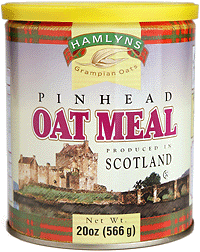
    Months ago, I bought a can of pinhead oatmeal. Pinhead oats are the Scottish name for steel-cut oats, which come from Ireland. I was going through a hot cereal phase during what seemed like an everlasting winter and had gotten sick of hot oat bran cereal (although with Wyman’s frozen wild blueberries and a splash of maple syrup, it can be the world’s fastest and most nutritious breakfast ever). My night-time reading during that time was Mollie Katzen’s Sunlight Cafe, and I found myself dreaming about the nutritious and complex breakfasts I’d whip up after rising each day. But in the cold, hard light of a winter morning, it was much easier to just pour myself a bowl of cold cereal with soymilk. Until I decided to work ahead. Cooking steel-cut oats is a lengthy process, but can be quickened by soaking the oats overnight. Even with this "short-cut" though, the can of oats languished in the back of my cupboard throughout the warm summer months.

    Then, just a few weeks ago, while watching Good Eats on the Food Network, I saw Alton Brown prepare a bowl of steel-cut oats that looked so good I could have forfeited my dinner plans right then and there, and just had oatmeal for dinner. Instead, I waited for an appropriate morning, armed with buttermilk, cinnamon and a heavy saucepan. Though this takes a bit more time than opening a packet of instant oatmeal and nuking it with water, the results are so much more satisfying and good for you.

    Toasted_oatmeal
    First, I toasted a cup of oats with a pat of butter in a saucepan. When the oats smelled nutty and almost like popcorn, I added several cups of boiling water and turned the heat down low.

    Midway_oatmeal
    Without stirring, I let it cook for 25 minutes, while I took a shower. When the time was up, I added a mixture of buttermilk and soymilk (Alton calls for whole milk) and cooked the oats for another 10 minutes.

    Finished_oatmeal
    After that, I topped the mixture off with a spoonful of brown sugar, a sprinkle of cinnamon and another splash of buttermilk. My bowl of oatmeal was tangy and creamy from the buttermilk, and the oats were both tender and toothy. It was an absolutely wonderful way to start the day.

    This makes four servings, so my breakfast is now taken care of for the rest of the week. Talk about fast food!

  • Ricotta
    At the dinner party I had last weekend, our menu started with Fresh Herbed Ricotta, served with slices of Amy's peasant bread. Buonitalia Italian Imports, in Chelsea Market, has the only ricotta worth buying in New York. While even this ricotta romana can't hold a candle to the stuff found in Italian caseifici, it certainly is better than the tubs of Polly-O lining American dairy shelves. If you can't find imported ricotta near you, then roll up your sleeves and make your own – it certainly looks easy enough. I'll be trying this soon myself. I snipped a handful of chives onto the plate of cheese, then gently forked the herbs into the cheese, taking care not to totally declump the ricotta. I sprinkled the white mound with salt and freshly cracked pepper, then drizzled it with a small amount of olive oil. I left off the Cherry Tomato Confit as some of guests loathe tomatoes (I will never understand this, but a chacun son gout), and there wasn't much room left in the oven anyway.
     
    Despite having planned the cooking schedule, I found myself still in the kitchen working when my guests arrived. Luckily, the ricotta was already plated and ready to go. I sliced some bread and had my friends go at the fresh cheese as we stood around in the hot kitchen, sipping white wine. The cheese was soft and milkily sweet, with a nice, oniony undertone from the chives. (Incidentally, the leftovers, swirled into a bowl of beaten eggs the next morning and fried up in a knob of butter, made for a tasty breakfast.) When the rest of the meal was ready, we moved to the patio outside, where the sun had already gone down and a cool breeze had set in.

    Zucchini

    We had Roasted Zucchini with Feta and Mint, an herbed pork tenderloin served with Plum Ketchup, and a brown rice salad. The recipe for the zucchini was simple and totally delicious. I cut up four large and two small zucchini, tossed them with olive oil, salt and pepper on a baking sheet, put them in the oven at 450 degrees and took them out when they were tender and browned. I sprinkled them with crumbled feta cheese and a handful of chopped mint. The dish was still warm when I served it, and the slightly melted but still cool feta was a nice counterpoint to the softened vegetables.
     
    Raw_pork
    Earlier that day, I had bought a 2-pound pork tenderloin at Frank's Butcher Shop, also in Chelsea Market. Once it had come to room temperature, I covered it with an herb rub from Barbara Kafka's Roasting – A Simple Art. Combining dried oregano, thyme, rosemary from my grandfather's yard in Italy, chopped garlic and a glug of oil, this rub is smeared all over the raw roast

    Closeup_pork_img_1137

    and the entire thing is put into the oven at 400 degrees for 40 minutes. When the forty minutes were up, I let the tenderloin come to room temperature in the kitchen. By the time we ate dinner, the pork was moist and juicy, barely pink and just delicious. I realize I might be the only person left on the planet who up until last week thought that pork was a dubious choice for those following a healthy lifestyle, but I'm thrilled to add that pork tenderloin has nearly the same nutritional content as white chicken meat.

    Compote

     
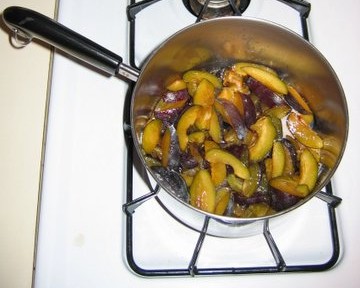
    To serve with the pork, I made the Plum Ketchup from Christopher Idone's odd article about an end-of-summer Thanksgiving feast. I cut up a bunch of Italian prune plums, squeezed in an orange juice and part of its rind, added a square of cheesecloth filled with spices and lemon peel,

    Plums_raw

    and brought the whole thing to a slow and careful simmer, until the liquids reduced and I was left with a concentrated sauce. To punch up the flavor a bit, I added a few grinds of peperoncino, something I regretted doing the next day. Because it's a lot easier to work your way through plum compote leftovers if you can spoon them into yogurt, instead of trying to find something savory to pair it with. In any case, the pork was flavorful enough without the extra sauce.

     
    The feast ended with the buttermilk pie from the previous post.

    So far, The New York Times has been winning the food section race. The L.A. Times last week published Nancy Silverton's burger recipe and two complicated recipes involving blueberries, which are no longer available at my farmer's market. I'll try my best to give any one of these a chance over the next few days, but secretly I'm hoping that tomorrow provides me a more inviting set of Californian recipes to choose from.

  • Pie_side_view

    Last Friday night, I had a dinner party for a group of girlfriends, replete with dishes culled from pages of the past few Dining In sections of The New York Times (an herbed ricotta appetizer, roasted zucchini, a buttermilk pie). To fill the gaps, I added some of my own creations (brown rice salad, roast pork tenderloin). I'll be blogging about all these dishes, but I figured I'd start off where we ended, with dessert. Isn't that where most people want to start?

    Matt and Ted Lee wrote about Robert Stehling's buttermilk pie last Wednesday. Stehling is the chef at Hominy Grill in Charleston, South Carolina. It sounded like just the right kind of dessert to make for an outdoor, end-of-summer dinner. The addition of lemon and nutmeg made it sound light and refreshing, while the lusciousness of the buttermilk custard promised something slightly more substantial.
    I started out by making a pie crust from Cooks Illustrated. I don't own a food processor (but am frenziedly working towards collecting enough D'Agostino award points to get one!), so pie crust is something I'm determined to master without a machine. Besides, all those wonderful frontier women who made scads of pies daily never needed a Cuisinart. I like to tell myself this when I'm knuckle-deep in iced butter and flour, straddling a desperate line between too much hand warmth! not enough cold steel! But amazingly, this recipe was not difficult at all. In a bowl of flour, salt and a bit of sugar, you add several tablespoons of iced butter. After cutting those pats of butter into the flour until the mixture resembles a mass of large peas, you add some spoons of sour cream mixed with ice water. With no more than a few twists of the wrist, this dough comes together very quickly. Patted out into a disc, the dough is refrigerated for a few hours. It's then rolled out between two pieces of parchment paper.

    Pie_dough

    Once out of the refridgerator and rolled out on a table, the lumps of butter quickly lost their chilled form and I had to very gently tug the parchment paper off the sticky butter to ease the crust into the Pyrex dish.  The dough-lined dish was chilled again, then lined with aluminum foil, filled with rice and baked. When the dough was set, I removed the rice and foil and finished baking the shell until light golden-brown.

    Pie_crust

    I let the crust chill while working on the filling. Butter and sugar are creamed together (my hand-held mixer is on the fritz – only the highest setting works, which makes for a butter-bespattered kitchen each time I try to use it. This makes for both amusing and totally frustrating baking attempts), then eggs and flavorings are added. I prefer freshly grated nutmeg, but eyeballing the proper amount is always tricky. And too much nutmeg can be overpowering, despite its delicate nature. I figured the lemon juice was there to balance it all out. Egg whites are whipped to a soft peak and then both mixtures are folded together. I poured the filling into the cooled crust, then stuck the whole thing into the oven. 

    Filled_pie_crust

    The picture accompanying the article showed a much browner pie, and the separation of the filling into cakey top layer and custardy bottom layer didn't really happen with mine.

    Pie_birds_eye

    I served the pie still warm, with a few raspberries alongside each slice. The filling was light and airy from the beaten egg whites, and sort of melted in our mouths. The crust was flaky, but could have stood to be rolled thinner than I had managed to. My guests were clamoring for the recipe at the end of the night.

  • Food_issue

    The September 5th issue of The New Yorker is an absolute pleasure to read. Usually, I get through the magazine pretty quickly – I have no problem easily skipping over articles that don’t captivate me within the first page, and the articles that do catch my attention, well, I read through those quickly, too. Just because I’m enjoying them so much.

    But this week’s issue really had me hooked. From a beautifully written article on the ancient art of making tofu to a profile of Esca’s David Pasternack, I was totally enthralled.  Calvin Trillin was as understatedly hysterical as always, with his search for the perfect Ecuadorian fish soup, fanesca. If you have not yet read his book, The Tummy Trilogy, take my advice and get it – from a store, from the library, wherever. I also loved reading Jane Kramer’s piece on our obsession (and her own) with cookbooks. My cookbook collection is nearing 80 (if it hasn’t already surpassed that), so it makes me feel better to know there are other similarly obsessed people out there. She wrote the article while summering in a house in Umbria – and found that cooking from Asian cookbooks in Italy proved pretty much impossible, surprise surprise (although why one would want to is another question entirely).

    If the issue is still on newsstands today, grab it! I throw old issues out with impunity, but this one I’ll be holding on to.

  • Image0_1

    In last week's New York Times, Florence Fabricant adapted a pasta recipe from Barbuto to pair with Sicilian red wines in the "Wines of the Times" segment. Buried in the article is a method for oil-poaching tuna that sounds delicious. I might come back to that at some point, but for convenience's sake and because I couldn't afford fresh tuna yesterday, I stuck with the canned stuff last night, and made a few other adjustments.

    And now for a side note (or, ahem, paragraph) on adjustments, substitutions, and adaptions. I used to get highly annoyed by the cooks on the reader comments of Epicurious who would tweak and adjust and leave out and put in ingredients other than the ones listed, and then leave comments about how the dish tasted bad or didn't work or took too long to cook. I figure that in most recipes, the instructions and ingredient lists are there for a reason. Improvisation should be left to people who are really pretty skilled in the kitchen (just this past weekend, I had the good fortune of spending time in the kitchen with someone whose prowess and cooking skills with nary a cookbook in sight taught me quite a bit). That having been said, there are obviously always times when a cook has to take matters into his or her own hand. Think cilantro tastes like industrial-strength rat poison? Leave it out of the guacamole. Don't have a shallot around? Use a small onion. And so on…

    In this recipe, I started out by halving the recipe – it served 6 originally. I smashed a small garlic clove and minced a very small sweet onion (I didn't have a shallot) from my CSA basket and slowly cooked both in a small amount of olive oil over low heat, while the water for the pasta came to a boil.  I used whole wheat penne instead of bucatini (I like the toothier consistency of the whole wheat and couldn't find bucatini anywhere). When the onion and garlic softened, I added the hot pepper flakes, olives and (soaked) capers, stirring the whole mixture together (I left out the chickpeas. I didn't think they really belonged.) Then I flaked a can of As do Mar tuna into the pan. The whole thing got shook around in the skillet together while the pasta finished cooking.

    I saved some of the pasta water, then poured the drained penne into the skillet along with the water, some more olive oil, and small handfuls of chopped parsley and mint. I then went on to toast the breadcrumbs to sprinkle on top (in old times, this was the poor man's sprinkling of Parmigiano), but a friend called with an emergency and I ended up burning the breadcrumbs. Luckily, the dish tasted delicious without them.

    It was pretty salty – the capers and olives and tuna all contribute to the saltiness, so I kept a light hand when salting the pasta water. Still, not for the high blood-pressured among us. The addition of the mint is a small touch, but really elevates the flavor of the dish – don't skip it! Although you could, and it would still taste good. In total, I would make this again, and don't think I'll even need to clip the recipe. It's so simple that once you make it, it's pretty easy to remember.

    Bucatini With Tuna
    Yields 6 servings

    Salt
    1 pound bucatini (or penne)
    5 tablespoons extra virgin olive oil
    1 clove garlic, smashed
    1 small shallot, minced
    2 large pinches chili flakes, or to taste
    ½ cup pitted oil-cured black olives, sliced
    ¼ cup large salt-cured capers, well-rinsed
    ½ cup canned chickpeas
    12 ounces imported canned solid tuna, drained
    ¼ cup chopped flat-leaf parsley leaves
    ¼ cup chopped mint leaves
    Freshly ground black pepper
    ½ cup coarse, lightly toasted bread crumbs.

    1. Bring a large pot of salted water to a boil. Cook bucatini for about 8 minutes, until al dente.

    2. Meanwhile, heat 2 tablespoons oil in a very large skillet if using bucatini, a large skillet for penne. Add garlic and shallots. Sauté until soft. Add chili flakes, olives, capers and chickpeas and cook another minute or so. Break up tuna in flakes and add. Cook until ingredients are warm. Remove from heat.

    3. Drain pasta, reserving about a cup water. Add pasta, parsley and mint to skillet. Return to low heat and toss well. Add remaining olive oil and pasta water to moisten ingredients. Season with salt, black pepper and more chili flakes if desired. Transfer to a warm serving bowl, top with bread crumbs and serve.