• Beets_1

    Doesn't that look dull? And trust me, this post probably won't be much of anything either. I've been back for three days and the closest I've come to cooking was getting on Ben's nerves as he kindly roasted a chicken for me on my first night home again, and then microwaving spinach in the plastic bag it came in last night. I almost passed out from the total grossness of this, but the convenience factor was huge, and besides, after ten days of not a single fruit or leafy green vegetable passing my lips, I could not be picky about how I prepared my vitamins before getting them into my system. Time was of the essence.

    Before I left on my trip, I put a sack of beets in the fridge, figuring one of my roommates might cook them up while I was gone. But she hadn't and so last night, I decided to use them up, after making sure they hadn't gone to rot in the crisper. I used a recipe from Food and Wine that was contributed by an American woman who teaches at a Moroccan cooking school near Marrakech. The recipe is not anything earth-shattering, but I loved the method for preparing the beets.

    You plunk three pounds of beets (or 1.5 pounds, if that's all you have, like me) in a cake pan. No oil, no cleaning, no nothing. You cover the pan with aluminum foil. You stick the pan in a preheated oven. An hour and a half later you have tender, full-flavored, delicious beets that you cool off for a bit before peeling.

    The recipe has you cut the beets into strips and toss with paprika, cumin, lemon juice, oil and salt. It's a perfectly serviceable salad and especially good if you've been deprived of fresh vegetables for some time. Did it blow my mind, this recipe? Not really. But I did like how easy it was to prepare. And that is that (I warned you).

    An aside: I am so happy to be home again. Ah, the glory of pouring myself a bowl of organic cereal for breakfast, and dousing the flakes with skim, skim!, milk. And having a crunchy apple to snack on. Whenever I like! Morning, noon, night. It's a luxury we take for granted until we're stranded in some massive convention center that makes the Javits Center look like someone's postage stamp garden, eating only cardboard Broetchen filled with one limp slice of cheese and a forlorn little disc of cucumber. Yes, it's good to be back.

  • Mixer_2
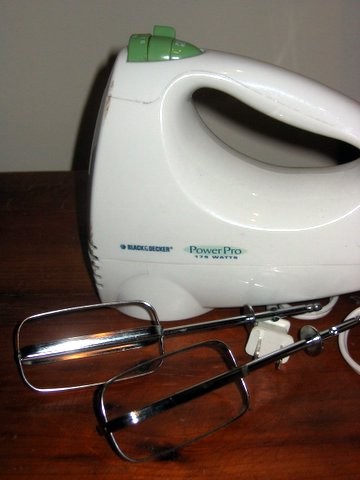
    Way back in the beginning days of this blog, I mentioned in a post off-handedly that my hand-held mixer was stuck at the highest stage, making whipping egg whites and creaming butter exercises in frustration and rendering my kitchen bespattered every time I had to use it, which was often. Little did I know that an attentive reader would read this aside and decide to help me out.

    Cath, at A Blithe Palate, is in possession of several mixers, both hand-held and standing (and if you have to ask if this isn’t overkill, you obviously know nothing about kitchen appliance obsession. Or how important it is to have his-and-hers mixers. Because it is! Very important.) Cath decided that instead of letting one of her mixers languish unused in a drawer somewhere, she’d send it off to me.

    I can’t really put into words how this makes me feel. I’m obviously grateful, but it’s not just about a total stranger sending me a gift for no good reason except for her own kind-hearted sweetness. I’ve also made my very first Internet friend. So, "stranger" doesn’t really feel right anymore.  Cath, my dear, thanks a million!

  • Bourbonnais_1
    During my Paris weekend, I stumbled across a bakery on the rue des Deux Ponts on l’Ile Saint Louis. The windows were filled with the kind of old-fashioned baked goods which set a special boulangerie apart from the more quotidian ones. I couldn’t help but go inside and poke around for a bit. I ended up buying something I’d never seen before, a croquet bourbonnais. Made with pulverized almonds, salted butter and sugar, it was a flat and hard and square confection, only about an eighth of a inch thick. We broke off shards of it and crunched away while standing on one of the two ponts. The croquet was a satisfying snack, with a nice snap to it and not too sweet. I haven’t quite figured out yet where it comes from or how you make it, but for now I’m savoring the memory of my mother and I, standing in the sun and breaking off piece after piece until there was nothing left but a square of waxed paper. Thanks for the lovely weekend, Mami.

  • Cake
    For this month's Sugar High Friday, Kelli at Lovescool decided that we all should use deep, dark chocolate as the main ingredient for our entries. To prevent boredom, she stipulated that we try something new and interesting, not the everyday workhorse recipes that are foolproof and deja-vu (and –lu). I guess there is such a thing as too many molten chocolate cakes.

    To cap off a Sunday dinner I had for some friends, I decided to make a recipe from an old issue of The New York Times Magazine – cut out and glued into my trusty little book. Once again, I don't remember much about the article, but the recipe came from Maida Heatter, a doyenne of American baking. In addition to calling for 24 ounces of chocolate and 10 whole eggs (I kid you not), it included honey as the sweetener. I thought this was an interesting twist on the average flourless chocolate cake recipe. An aside: the recipe heading says Robert's Redford Cake. But Googling it punctuated that way turned up nothing. So I have to assume that Maida intended this cake for Robert Redford himself and that The New York Times might have printed a typo. Minds blowing left and right on that one.

    The cake was gorgeous to look at and tasted just fine. Of course, anything with that amount of chocolate and butter and eggs would be bound to taste just fine. But it didn't blow us away. The ganache was incredible – especially since it was still fresh and warm and sort of flopped luxuriously over each slice. But the cake itself was oddly devoid of much deep chocolate flavor. The consensus was that, all in all, this dessert wasn't all that special.

    Robert Redford Cake
    (Adapted from Maida Heatter)

    For the cake:
    1 1/2 sticks unsalted butter, plus additional for greasing the pan
    flour for dusting
    1 cup blanched hazelnuts or almonds
    12 ounces semisweet chocolate
    1/2 cup honey
    10 eggs, separated
    1/4 teaspoon salt

    For the frosting:
    3/4 cup heavy cream
    12 ounces semisweet chocolate

    1. Preheat the oven to 375 degrees. Butter a 10-by-3-inch round or springform cake pan. Line bottom with parchment. Butter parchment. Dust with flour. Shake out excess.

    2. Grind nuts to a powder in a food processor. Set aside.

    3. Break up chocolate and melt in the top of a double boiler over shallow, warm water on moderate heat. Transfer to a bowl and let cool.

    4. Meanwhile, in the bowl of a mixer, beat butter until soft. Gradually add honey; beat until smooth. Add egg yolks, two or three at a time, beating until mixed after each addition. The mixture will look curdled, but this is OK). Add nuts and cooled chocolate. 

    5. In another bowl, beat egg whites with salt until whites barely stand up when beater is raised. Fold egg whites into chocolate in three batches. Pour into pan. Bake at 375 degrees for 20 minutes. Reduce temperature to 350 degrees and bake for 50 minutes more, or until a cake tester comes out clean. Remove and let cool. Remove from pan. With a long sharp knife, level top.

    6. Break up the chocolate for the frosting. In a saucepan over medium heat, cook cream until it forms a skin on top. Add chocolate, reduce heat to low and stir with a whisk until smooth. Transfer to a bowl and stir occasionally until cool and slightly thick. Pour icing over cake and smooth top and sides until covered. Serve immediately, or store at room temperature overnight.

    *To see all the other entries in this month's Sugar High Friday, go to Lovescool for Kelli's exhaustive round-up and the glorious chocolate whatsits that everyone else created for the event.

  • Forkandknife_1
    Dear reader, I must confide in you a small secret you might not have known about me. For the past two months, I have been using plastic flatware. Gasp! Can it even be called flatware if it’s not made of some kind of metal? I don’t know. But silverware it certainly is not. The circumstances of how this came to pass are not interesting enough to blog about. Apparently, though, my friends think it’s hysterical that even during dinner parties, I have had the audacity to present them with plastic forks and knives to eat with. I admit, it’s funny in an appalling kind of way (and appalling in a funny sort of way? Never mind).

    But now those barbarian days are over! Thanks to Ebay, I am the proud owner of six gorgeous forks and six gleaming knives – all tipped with a lovely bone handle. I feel all grown up again. I can have friends over for dinner with no shame. I can actually cut a piece of meat, twirl spaghetti, and hear the satisfying clink of metal against china when my plate is empty. But my enthusiasm is dampened (only somewhat) by the fact that the plastic isn’t out the window just yet. After all, I have yet to find matching spoons…

  • 113_1386
    I’m off to Paris to eat macarons, stroll through the narrow streets of the Marais, gaze longingly at store windows, and see various members of my family for a few days. I hope to fill my soul with enough joy and light to get me through the following week, in which I probably won’t see the light of day. Posting will be sporadic! Will my readers stick around? Only time will tell. I plan to drown my separation anxiety from the blog in a souffle

    A plus!

  • Gratin

    It's sort of difficult to see what's going on under that crispy brown crust, but let me tell you that this unassuming dish was the highlight of a gathering I had for friends last weekend. As one of my friends pointed out, it wasn't the kind of recipe that makes your eyes light up at first read, but the taste was really sensational. And it was, surprisingly, very fast to prepare. The leftovers were good, too (and that's coming from me, who finds most leftovers, no matter how delicious they were the day you made the dish, to be totally repulsive. I know, weird.).

    To round out the meatloaf dinner, I came across a recipe that was published in the NY Times almost three years ago, for a cabbage and potato gratin. I don't know what article it accompanied (a lot of my clippings are just that – the recipes cut out with no context, which is annoying when I'm writing about them, but hopefully you'll forgive and move on). For a group dinner, it's a great dish. It feeds a lot of people, and is really hearty and tasty – good cold-weather food. I don't usually cook with butter, cream and bacon, so I was glad to see that the huge amount of cabbage really means the casserole doesn't end up being too greasy.

    First, I cooked some chopped bacon in a pan,
    Bacononions
    then added onions and cubed potatoes and the seasonings, and let those cook down a bit. I sliced and diced my way through an entire head of green cabbage (and just eyeballed the right amount) and added that to the pan to wilt a bit.
    Cabbage
    The contents of the pan were then dumped into a baking dish, and I poured some cream into the hot pan to reduce a bit and get some of the scrummy browned bits off the bottom of the pan.
    Cream
    When the cream had reduced, I poured it evenly over the cabbage and put the pan, covered with foil, in the oven. Into the empty pan went then some butter, and then breadcrumbs (I used panko because they end up being a bit crispier). When the crumbs were toasty and golden, I added mustard, salt, pepper, chopped parsley and garlic.
    Breadcrumbs
    I grated some Gruyere onto the cabbage, sprinkled that with the breadcrumbs and put the whole thing back into the oven, uncovered this time, until it bubbled and browned.

    A programming note: I realize that the posts this week have been all-NY-Times-all-the-time and I promise to rectify the imbalance very soon…

  • Soup_2
    The days of stale bread soups are here in full force, and with a glut of San Marzano tomatoes ripening swiftly on my countertops, I figured there could be no better time to prepare Amanda Hesser‘s version of pappa al pomodoro. Hesser used to write the Pairings column in the New York Times, which finds recipes to accompany the featured wine in the Wine of the Times column each week (this particular recipe was meant to be paired with a gruener Veltliner).

    Pappa al pomodoro, like panzanella, is a perfect example of the kind of food that makes up la cucina povera. It’s economical because it uses up old bread and pantry staples like broth and herbs that you don’t have to look very far for or spend much money to get. This particular recipe is especially appealing because of how quick it is to prepare. The layerings of flavor (bacon, broth, herbs, tomatoes) give it a much deeper flavor than you would imagine possible after only a few minutes here and there of actual cooking time.

    First, you saute some bacon in a soup pot until it’s browned. The bacon goes in a small bowl, while the bacon fat gets drained off. Some olive oil is put in the pot, along with sliced onions, smashed garlic and a bit of salt. When this is good and browned, you add some sugar to caramelize the onions.
    Onions_2
    You add the chopped tomatoes and some chicken broth to cook for a bit, then in goes the bacon and herbs (Amanda calls for fresh rosemary and oregano. I used dried, but here I have to be a bit of a pedant about something: rosemary that comes in little glass jars from the grocery is totally forgettable and tastes mostly of dust, sometimes even soapy dust. While I will not be a pompous ass and expect that you ask your mother to go to your grandfather’s garden in Italy and clip rosemary from a large bush there, put it in an envelope and send it to you via aerea, I do urge you to buy fresh rosemary at the grocery store or farmer’s market or wherever, and lay it in a single layer someplace cool and dry to store for future use. It is completely worth it.). Boil this for a few minutes longer, while you toast some bread.
    Done
    The soup gets ladled on top of the toasted bread, then the whole thing is sprinkled with grated Parmigiano. At first you’ll be eating soup, but as the bread absorbs the broth, and you get further to the bottom of the plate, it will turn into more of a stew. Amanda says this recipe serves four, by the way, but I ate the whole pot divided between lunch and dinner. By myself.

    Tomato and Bread Soup
    Adapted from Amanda Hesser

    4 thick slices bacon, cut into 1/4-inch slivers
    2 tablespoons olive oil
    3 medium yellow onions, thinly sliced
    2 cloves garlic, smashed
    Salt
    1 teaspoon of sugar
    4 cups seeded and chopped tomatoes
    1 can of chicken stock (14.5 ounces)
    1 tablespoon chopped oregano
    1 tablespoon chopped rosemary
    4 slices of country bread, toasted
    1/3 cup freshly grated Parmigiano Reggiano
    Freshly ground black pepper

    1. Spread bacon in a soup pot over medium heat, and brown. Using a slotted spoon, move bacon to a bowl. and pour off fat from pot. Return pot to heat, and sprinkle in the olive oil, onions, garlic, and a pinch of salt. Stir to coat, and cook for 10 minutes. Sprinkle in the sugar and continue cooking until onions are silky and well caramelized.

    2. Add tomatoes and broth and bring to a simmer. Cook for a few minutes, then stir in bacon, oregano and rosemary. Season to taste with salt.

    3. Lay a piece of toasted bread in each of the four warmed bowls. Ladle soup on top. Sprinkle with cheese, season with pepper and serve.

  • Meatloaf
    There’s nothing like the picture of a bowl of raw meat to get people’s juices flowing in the morning, is there? Well, to be honest, there’s just no way a slice of cooked meatloaf can be photographed appetizingly. At least not within my skill level. I tried, valiantly, I did! But the slices just lay there, grayish and pale. Even a squirt of ketchup did nothing to gussy them up (well, aesthetically, at least). So, I present to you, raw turkey meat. Good morning!

    Back in my archives of New York Times recipe clippings, I had a recipe for turkey-spinach meatloaf. I recall nothing about the article it accompanied, nor am I entirely sure why I clipped this particular recipe. I mean, I like ground meat and spices just fine, but meatloaf has never really been something I’ve aspired to make. A good hamburger is one thing, but meatloaf? Since I was having friends over, I figured it would be an easy main course – lightened by the turkey and fresh spinach – and something everyone would like.

    First, I simmered six cloves of garlic in olive oil until they were tender (the garlic oil can be saved and used for pasta sauce or sauteed vegetables, for example). I squashed the soft cloves in a bowl along with the ground meat, chopped thyme, cayenne pepper, salt and freshly ground pepper. I also wilted and drained two large bags of spinach with a sauteed onion.
    Spinach
    I chopped up the wilted spinach (not finely enough, by the way) and added it to the raw meat mixture.
    Bowl_2
    This was all squished up together and patted into two loaf shapes. I heated some of the garlic oil in a pan and added the loaves to sear on each side.
    Loaves
    I think I should have probably done one at a time, instead of crowding the pan. Then I put the entire thing into the oven for a little less than an hour. When the inside of the meatloaf registered 160 degrees, I took the pan out. I also promptly burned my hands (not once, but twice!) on the searingly hot handle of the pan. No, I did not win the Smart Cook Award that day.

    I served the meatloaf sliced and with ketchup. My guests ate it gamely, but agreed it was nothing special (other parts of the meal were, but that is a story for another time). And after some deep thoughts and discussion, I’ve come to the following conclusion: meatloaf is a highly personal dish. It might be from a recipe that your mother or grandmother passed down to you. You could have deep cognitive memories attached to the memories of eating it or the smell of the kitchen as it was being prepared and you were too short to even see the counter. If some upstart comes along and tries to make you a lightened, newfangled version of this dish, with no metaphysical baggage attached its preparation and what it could possibly mean in the context of your family and your shared memories, it’s going to be pretty forgettable. Either that, or turkey meatloaf is just plain boring.

    My advice is: make your meatloaf your own. Don’t follow someone else’s recipe unless that someone is related by blood or by marriage to you. And if all else fails, eat the meatloaf with lots and lots of ketchup.