• Tortilla
    You might have noticed that I never post about recipes from Epicurious. It’s not because I don’t like their recipes, but rather it’s because the reader reviews do the job I’ve taken on for myself with the newspaper recipes. It’s a very useful place to find recipes and food information, though I have sometimes tired of the Bon Appetit-Gourmet aesthetic (oh, Lordy). When I went to my CSA last night (only 2 more weeks left, sob, before the barren earth stops sending us vegetables), it seemed like divine food intervention when a recipe for kale and potato tortilla that I’d been hoarding for some time was reprinted on the newsletter we get from the farmers each week.

    Off to home I trotted, with my sack of roots and tubers, to prepare my dinner. The recipe calls for what seems like an ungodly amount of olive oil. Partially out of pigheadedness and frugality, and partially because I am down to the last dregs of my oil supply, I only used a fraction of what was called for (incidentally, I finished my stash of garlic oil). The tortilla turned out just fine, but a bit dry. So, use all the oil and don’t be a health pedant like I was trying to be. Also, I only had 5 eggs and not 7, so you’ll see that my tortilla differs from the original shot. Still, it tasted delicious and was pretty easy to prepare. I had two wedges for dinner with a few silken leaves of prosciutto alongside it, but I could see the tortilla cut into smaller wedges still and served as an appetizer, with white wine, at a party.

  • Clafoutis
    A few weeks ago, Melissa Clark wrote an article for the NY Times about Pierre Reboul, the pastry chef at Kurt Gutenbrunner's new restaurant, Thor, in New York City. Gutenbrunner is also the chef at Wallse and Cafe Sabarsky, which is one of my favorite New York places. The atmosphere, the food, and especially the desserts transport me back to Germany (via Austria, I suppose). So, in a roundabout way, I expected Reboul's recipes to be something very special. The clafoutis with concord grapes that I tried was bizarre from start to finish. Not necessarily bad, mind you, but bizarre.

    The recipe called for a pound of Concord grapes to be peeled and seeded. PEELED AND SEEDED, PEOPLE. The things I do for this blog, I tell you. It's enough to make a girl want to poke her eye out with an Oxo cake tester. So, yeah, the process is about as fun as it sounds. And it takes forever. I warn you herewith, for God's sake, if you are intent on making this recipe, choose another fruit to make it with. The grapes are not that essential. Then, the recipe stipulates a few spoonfuls of cookie crumbs to be added to the batter. What? In a clafoutis? Whatever happened to plain old flour? I soldiered on. The batter was to be prepared with ground almonds and cookie crumbs, plus some butter and a mound of confectioner's sugar that would have struck fear into the heart of any dentist.

    Now, I understand that pastry chefs are under a certain amount of pressure to create desserts that must do many things at once: evoke memories, highlight seasonal ingredients, vary from run-of-the-mill desserts listed on other menus, and taste good. Sometimes the result is a dessert that transcends its previous state into something wondrous and new, yet still delicious and even familiar. And sometimes this pressure results in a dessert that leads you swiftly to think, why, oh, why did the original have to be messed with? Some things should not be improved. A classic clafoutis, fruit peeking through the delicate, pancake-y batter, is one of these things.

    In the end, this clafoutis was no clafoutis, it was a cake. I suppose this is what I disliked about it. An unleavened, buttery cake with a nubby, sticky, crumbly texture. My roommate liked it, Ben gave it the thumbs up, and I'm sure my colleagues will devour it when I present it to them in a little while. But for me, the clafoutis was a disappointment. 

    My pile of grapes, and their seeds and skins beside them:
    Grapes
    After creaming together softened butter and a mess of confectioner's sugar, I added eggs, some salt, pulverized almonds and the crumbs from four shortbread fingers whizzed to bits in a food processor.
    Batter_4
    I spread the batter in a pan, then covered the top with the grapes and some of the juices.
    Raw_4
    I baked it for just over an hour, until the top was golden brown and set.
    Baked_4

  • Cauliflower
    Are you getting sick of Russ Parsons yet? I'm not, though I realize it might sometimes make for monotonous blogging when I post entry after entry about recipes of his I've made with success. I'll try and be more varied, I promise. In the meantime, drown yourself in a plateful of this cauliflower. You might think I'm kidding, but I ate an entire head of cauliflower prepared this way, in one sitting. I'll admit that it's all I had for dinner, so it might not really be as gluttonous as it sounds, but still!

    Some people think cauliflower is a vegetable to be scorned, as it's usually cooked into a putrid state of wobbly cellulose. But I am here to tell you that this need not be the case. Caramelized cauliflower a la Orangette is a gorgeous thing, all crispy and nutty, but so is steamed cauliflower with a light and creamy mustard bechamel sauce (I'll post the recipe when I figure out where my stepmother found it) and definitely this braised dish, full of deep, sharp flavors and tender florets. I'd take out the capers next time, or at least use only those in brine and not the salted ones, as I practically burned my tongue off with the overload of salt (and lest you think I did not soak them enough, I am here to tell you that I did! Soak them for quite a while. Anyhoo.).

    Now for those of you who hate anchovies, you who think they are little devil fish, with their hairy bones and their pungently fishy taste, I tell you to fear not the wee anchovy. It wants to make your dinner better, not worse! Melted into a puddle of warm oil, these fishlets give the dish a deep and lovely flavor that has nothing to do with funky marine aromas. Trust me, once you're forking into the cauliflower at the end, you won't even remember that there are anchovies, albeit in a most deconstructed state, lurking about.

    To make this dish, mince up a few anchovies and let them melt slowly in a pan of hot oil.
    Anchovies
    Using a wooden spoon, I like to nudge the anchovies towards disintegration.
    Melted_1
    Add some chopped garlic and a healthy pinch of red-pepper flakes, cooking until the garlic has softened slightly. Then add a head of cauliflower florets and some water. With the top tightly on the pan, let the cauliflower cook over low heat for about 7 minutes, or until it's tender but not mushy. Remove the top and turn the heat up to cook off the water and concentrate the sauce. Add a handful of fresh, chopped parsley (and the capers, remembering my note from above). Eat with abandon.

  • Stalk_6
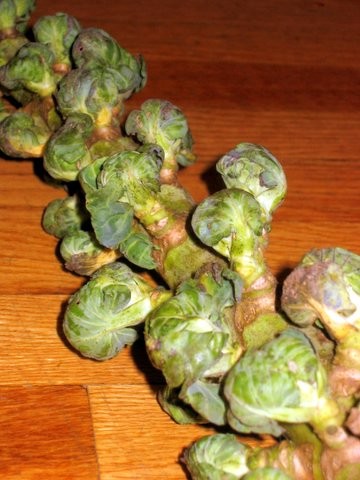
    I know that Jack climbed up a magical beanstalk, but when I saw this woody branch in my CSA basket a few days ago, I imagined him climbing up it instead, using the bulbous growths as steps all the way up to the hungry giant’s lair.

    Sprouts_4

    There are days when the newspaper cooking gets to be too much, and all I want is a plate of steamed vegetables for dinner. That majestic stalk yielded a small serving of delicate little brussels sprouts, perfect for one not-so-hungry girl. Aren’t they cute?

  • Image24

    These could also be known as My Bumpless Madeleines. The recipe was excerpted from Paula Wolfert's The Cooking of South-West France (which is being reissued now, and is gorgeous) in an article from the LA Times this summer about Wolfert's house and life in Sonoma. While I worship at the altar of Wolfert, these madeleines didn't really cut it.

    I feel terribly about what I'm about to do. Criticizing a recipe of Paula Wolfert's! She of the melting Fork-and-Knife Kale, the miraculous sardine-avocado toasts, the endless discussion threads on eGullet… I do not venture into this uncharted territory lightly. But it is my duty as a recipe-testing blogger to tell the truth. So the truth is, these madeleines had no bump. And a bumpless madeleine isn't much more than a cookie with a fancy name.

    Sure, the little suckers tasted okay. But delicious they were not. And I'm no madeleine virgin. In fact, a few years ago, I made a batch that, glorious bump and all, were revelations after years of eating packaged Madeleines de Commercy. (Of course, now, for the life of me, I can't remember where I put that recipe. I'll find it, never fear.) Wolfert's bumpless madeleines had the correct, barely dusty texture, but the flavor was oddly flat and, dare I say it, almost greasy.

    1. First, I beat together 2 eggs, a pinch of salt and 5 1/2 tablespoons of sugar until the mixture was thick and light (6-7 minutes). Then I added 1 1/2 teaspoons of orange flower water and 1 teaspoon of vanilla extract, whisking gently to combine.

    2. I sifted 5 1/2 tablespoons of all-purpose flour with 5 1/2 tablespoons of cake flour and 3/4 of a teaspoon of baking powder together, twice. I gradually stirred this into the egg mixture. I added 5 tablespoons of clarified butter that had melted and cooled, plus 2 tablespoons of heavy cream. I stirred the batter gently until smooth. The bowl was covered with plastic and refrigerated overnight.

    3. The next day, I heated the oven to 425 degrees Fahrenheit, and buttered the hollows of a madeleine pan. I filled the pan 2/3 of the way full, then rapped it against the table to let the batter settle. I baked the madeleines for 5 minutes, then lowered the oven temperature to 325 degrees, and baked for 6 minutes more, until the edges were browned and the madeleines were golden.

    4. After removing the pan from the oven, I loosened each cookie with the tip of a knife and cooled them on a rack. The recipe indicates that it will yield 18 (3-inch) cakes or 24 (2-inch) cakes.

  • Gratin_2

    Spaghetti: is there a more perfect food? I think not. So when it gets bandied about in certain food circles that spaghetti squash is a good, calorie-conscious substitute for those chewy strands made from durum flour, it makes my hackles rise. There's nothing wrong with a little pasta, people. In fact, I'd venture to say that a nice plate of spaghetti (whole wheat, if you like!) with a good, homemade tomato sauce and some gratings of cheese on top is a whole lot healthier and tastier than any low-carb concoction being whipped up by cooks of questionable talent. But this is hardly blogworthy news (at least I hope it's not).

    What is worth talking about is the lovely vegetal wonder that is spaghetti squash. This smooth, melon-colored squash has stringy flesh that separates into little strands when cooked (hence its name). It's wholly different from the melting, orange flesh of butternut or acorn squashes, so easily transformed into velvety soups or creamy pie fillings. My way of preparing spaghetti squash is totally delicious and very healthy as well, not to mention easy as pie. And just to spite the low-carb brigade, I serve this with roasted potatoes.

    Spaghetti Squash Gratin

    1. Take a 3-pound spaghetti squash and put it in a stockpot, covering it with water. Bring the water to a boil, then simmer with the top on, for 20 to 30 minutes or until the squash is tender. Remove the squash from the pot with tongs, and slice it lengthwise. Let the halves cool until you can handle the flesh with your bare fingers. Remove the seeds and discard. Using a fork, scoop out the strands and transfer them to a bowl, until the shells are empty.

    2. To the squash strands add 6 or 7 heaping spoonfuls of diced, canned tomatoes. Add the freshly stripped leaves of several thyme branches, 2 small diced garlic cloves, freshly ground pepper and some salt. Mix this all together and spoon into a gratin dish. Cover the squash mixture with shavings of Parmigiano.

    3. Slide the dish into an oven that's been preheated to 450 degrees Fahrenheit and let it bubble away for half an hour, or until the top has browned nicely. This serves 2 people as a side dish.

  • Quince_1
    I grew up snacking on chewy squares of quince puree, dried to leathery whips by a dear family friend, breakfasting on toast spread with quince jam made by my mother and a Greek colleague, who added blanched almonds to her batches, and finishing dinner with wedges of quivery membrillo eaten alongside pungent cheeses. It wasn't until I moved to New York that I realized quince was considered an exotic fruit.

    A few years ago, on a trip up to The Cloisters, I came across a quince tree, laden down with heavy fruit, in one of the interior gardens. I tried to find out who was the lucky harvester of the quinces, hoping against all odds that when my interest was noted by the tree's caretaker, he would exclaim with glee, "Finally, someone who wants those hard, sour things!". It will probably come as no surprise to you that this was not the case. Lucky Met Museum employees were entitled to gathering the fruit and that was that.

    So now I buy my quinces at the greenmarket just like everyone else, filling my plastic bag with the fuzzy yellow orbs, letting them sit out for a few days in my kitchen while their perfume fills the air. Last night I decided to try a different way of preparing the fruit, poaching chunks of them in a sweet, spiced syrup until rosy and fork-tender. The syrup ends up very sweet and I urge you to experiment with the amount of sugar you add. I'll be eating the soft quinces with yogurt spooned over them and stirring the syrup into tea.

    Poached Quince with Vanilla and Cinnamon

    Adapted from Regan Daley's In the Sweet Kitchen

    4 cups water, preferably filtered or still spring water
    2 cups granulated sugar
    1 large cinnamon stick
    1/2 plump vanilla bean, split
    3 to 4 large quinces

    1. Combine the water, sugar, cinnamon stick and vanilla bean in a heavy-bottomed 2 1/2- to 4-quart saucepan. Heat gently, stirring until the sugar dissolves, then bring to a boil and remove from the heat. Peel the quince with a vegetable peeler and cut them into quarters. Cut out the cores and cut each quarter in half.

    2. Add the fruit to the syrup. Return the pot to medium-low heat and bring the syrup to just below a boil. Reduce the heat and keep the syrup at a bare simmer for 40 minutes to 1 hour, or until a sharp paring knife slips easily into a slice of quince. The quinces will have turned a pale pinkish color. Cool the fruit in the syrup. Refrigerated, the fruit and syrup will keep for a week or more.

  • Cake_1

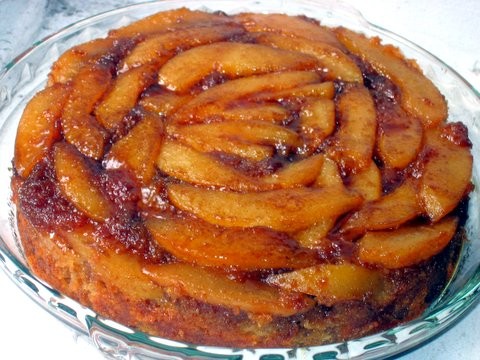
    Oh, LA Times, how swiftly you have redeemed yourself. Despite my attempts at being fair and balanced, I couldn't deny that the NY Times was winning out as of late. But with this here recipe,  the LA Times has managed a real comeback. In Betty Baboujon's (what a name – it wouldn't stop repeating itself in my head all weekend) article about pears two weeks ago, she published a recipe developed by one of the LA Times Test Kitchen cooks, Mary Ellen Rae.

    A simple white cake flavored with cardamom is baked on top of a brown-sugar caramel and a mess of sliced, peeled pears. The outcome was delicious – a crunchy, melty topping along with a tender-crumbed, delicately spiced cake. The recipe calls for fresh green cardamom to be pulverized in a spice grinder. For those of us who can't be bothered, I recommend just using the bottled stuff (I like a bottle of this, which I store in the freezer to give myself the illusion that it stays fresher than just hanging out in the cupboard). The LA Times has a bit of a love affair with cardamom and with good reason – it's lovely in northern European baked goods, but also in southeast Asian savory dishes.

    A slice still warm from the oven was total nirvana, but it was also pretty great hours later, at room temperature (and as an ending to a roast-chicken-mashed-potatoes-glazed-carrots-aren't-we-traditional-and-middle-American meal that was preceded by a definitely untraditional exhibition of a certain someone's ability to not only do the Running Man but, after some coaching from one of our dinner companions, the Roger Rabbit as well. And no, there are no pictures of this feat, you'll just have to take my word for it). According to my dear coworker (who got the only remaining slice this morning), the cake was good two days later, too.

    To make the caramel at the bottom of the cake, I melted some butter in a pan, then added the brown sugar. Oddly, this mixture seized up almost like a pate-a-choux batter and wouldn't really melt properly. I did my best to ignore this.
    Buttersugar
    When I had had enough of stirring this viscous mixture around in the pan, I spread it at the bottom of the cake pan, then arranged two sliced and peeled pears on top.
    Pears
    Using my spanking new mixer (It's amazing! It has six different power levels! Oh, the joy of creaming butter at a low speed and not besmirching my clean kitchen walls. It takes so little to make me happy, doesn't it?) I mixed up the cake batter and folded in the cardamom, which is almost overpowering sniffed at in the jar, but mellows out into this wonderful, exotic flavor when baked. The batter went on top of the pears and the whole thing went into the oven until it was golden brown.
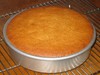
    Browned_4
    After resting for a few minutes on a rack, the cake pan was turned around onto a plate (or, you know, glass pie dish) and rested a bit longer there before I eased off the pan. Yum.

    Pear and Cardamom Upside-Down Cake
    Serves 8

    1 1/2 cups flour
    1/4 teaspoon salt
    2 teaspoons baking powder
    1/2 teaspoon freshly ground cardamom (from about 6 to 8 pods)
    3/4 cup (1 1/2 sticks) butter, room temperature, divided
    3/4 cup packed golden brown sugar
    2 firm-ripe Anjou pears
    1 tablespoon lemon juice
    3/4 cup sugar
    2 eggs, room temperature
    1 teaspoon vanilla extract
    1/2 cup milk, room temperature

    1. Heat the oven to 350 degrees. Generously butter a 9-by-1 1/2-inch round cake pan.

    2. Sift the flour, salt and baking powder together. Stir in the cardamom and set aside.

    3. Melt one-fourth cup butter in a small saucepan over medium heat. Add the brown sugar and stir for 2 to 3 minutes, until the sugar has melted and combined with the butter. Pour the mixture into the prepared cake pan, spreading it to reach the sides.

    4. Peel the pears, cut in half and remove the core and stem. Cut each half crosswise into one-fourth-inch-thick slices. Arrange the pear slices in a slightly overlapping circle around the cake pan, starting at the outer rim. Finish with several slices in the center. Sprinkle the pears with the lemon juice. Cover with plastic wrap and set aside.

    5. Beat the remaining one-half cup butter in the bowl of an electric mixer until soft and fluffy. Add the sugar and beat until smooth. Add the eggs one at a time, beating after each addition. Beat in the vanilla, scraping down the sides of the bowl when needed. Alternately add the flour mixture and the milk, beating after each addition just until combined.

    6. Gently spoon the cake batter on top of the pears, smoothing out to the edge of the pan and making sure the cake batter fills in around the pears.

    7. Bake until the top is a deep golden brown and a skewer inserted in the center comes out clean, about 40 minutes. Place the cake on a rack to cool for 5 minutes in the pan.

    8. Run a small spatula or knife around the edge of the pan and invert onto a cake plate, leaving the pan on the cake for 10 minutes. Carefully remove the pan. Serve warm or at room temperature.
  • Hash

    Well, it's just a veritable Russ Parsons lovefest around here, isn't it? I swear this isn't on purpose, at least not consciously (and yes, it might have something to do with the fact that I think his recipes are more reliable, but I realize I haven't tested enough from the other writers to really make this a waterproof statement). His recipes in the LA Times just keep jumping out at me. Sometimes the results are just okay, but sometimes they're stellar, like with this mushroom hash. Oh oh, is it good. I ate some off my plate last night and then ended up standing at the stove, munching on the hash directly from the frying pan, until I put the rest in a Tupperware for lunch today.

    I read Parsons' article about mushrooms on Wednesday, then popped out to the farmer's market on my break, where I found a little Japanese man selling mushrooms from wire baskets. Communicating with him proved somewhat difficult as his English was restricted to only a few words, most of which I didn't really understand. But there was a lot of smiling and pointing and more smiling, and five dollars later, I was clutching two paper bags filled with small white mushrooms, one large portobello, and a few ounces of hen-of-the-woods.

    At home, I chopped up the mushrooms into small pieces, after brushing off the dirt gently with a moist towel.
    Chopped
    Then I melted some butter in a pan and when it started to turn nutty brown, I added the mushrooms, covered the pan and let them cook for a few minutes.
    Firstfry
    When I uncovered the pan, the mushrooms had browned nicely and a delicious roasty scent filled the air. I added chopped garlic and parsley to the pan and cooked the mushrooms a bit longer, then transferred them to a bowl, while I poured white wine into the hot pan. That reduced for a bit before I added a splash of heavy cream and fresh thyme leaves.
    Sauce
    The reserved mushrooms went back into the pan and were tossed about with the sauce. I cubed up several new red potatoes and steamed them (by the way, I hadn't steamed potatoes before and I think I might not ever prepare them any other way again. So fast! So easy!) until they were tender, then added them immediately to the pan with the mushrooms. With Sherry vinegar sprinkled on top and some nice fat flakes of Maldon salt strewn about, the dish was ready to go.
    Plate_2
    Oh, it was good.

    But wait. I have a few points to make. Personally, when I make this again it will be with less potatoes and more mushrooms. And if you're wondering how to serve this, I'd say as a side dish, or if you wanted, with a poached egg on top for dinner. But that might be overkill. Because the flavor is just so perfect – just enough herbs, a tiny hint of cream and butter (I left out the final pat of butter meant to be swirled in, by accident, but when I realized my mistake I also decided I liked it with less butter), a nice bite from the vinegar and garlic and salt – you don't really need to add anything else to it. I can't wait for lunch.

    Mushroom Hash
    Serves 6

    1 pound mixed mushrooms (portabello, cremini, maitake, etc)
    3 tablespoons butter, divided
    Salt
    1 clove garlic, minced
    1 tablespoon minced parsley
    1/2 cup white wine
    6 sprigs fresh thyme
    2 tablespoons heavy cream
    1 1/2 pounds mixed small potatoes (fingerlings, boilers, etc)
    1/2 teaspoon sherry vinegar
    Freshly ground black pepper

    1. Wipe the mushrooms clean, trim any hard stems and cut them into roughly almond-size pieces. Try to use a mixture of sizes of mushrooms so you get a diversity of shapes. The small ones can be left whole, those that are a little bigger can be cut in half, and so on.

    2. Heat 2 tablespoons of the butter in a skillet over medium-high heat until the foam has subsided and the butter turns a light hazelnut color. Add the mushrooms, sprinkle with half a teaspoon of salt, cover tightly and cook, tossing occasionally until the mushrooms begin to glisten and give up their moisture, about 3 minutes. Remove the cover, add the garlic and the parsley, raise the heat to high and continue cooking, stirring constantly, until the mushrooms are richly aromatic and soft but not, but not flaccid, about 3 minutes.

    3. Transfer the mushrooms to a bowl. Add the white wine to the skillet. Cook over high heat until it reduces to a syrup, about 2 minutes. Strip the leaves from the thyme between your thumbnail and finger and add them to the syrup along with the cream. Cook, stirring to incorporate into a smooth liquid. Add the mushrooms back to the sauce, toss to coat well and set aside.

    4. Cut the potatoes into half-inch and steam in a tightly covered pot over rapidly boiling water until they are just tender, about 15 minutes.

    5. Warm the mushroom mixture over medium heat and add the potatoes as soon as they are done. Do not let the potatoes cool or they won't absorb the flavors. Add the sherry vinegar and stir everything together. Adjust the salt seasoning and season with a grinding of fresh black pepper. The dish can be prepared to this point up to 1 hour in advance.

    6. Before serving, warm the mixture over medium-high heat, add the remaining tablespoon of  butter and stir to mix well.

  • Soup_3

    I've told you a bit about my notebooks filled with clippings of NY Times recipes, but I also have ring-binders (plural, yes) filled with recipes from the LA Times. Back in January 2004, Russ Parsons wrote an article about winter greens that's sadly no longer available online. Accompanying the article were three recipes, including one for Southern Comfort Soup. I don't remember how the soup got its name (and no, there's no booze in it at all), and to me it seems more French than Southern, but either way, it's a real find.

    I made the soup very quickly last night (and ate it too quickly too, burning my tongue in the process, ouch) because I had to run out to see Flightplan, which, by the way, is pretty much a waste of a movie ticket, although Jodie Foster is amazing, as usual. The soup didn't seem to suffer from the rush. Russ has you chop up a bunch of different leafy greens, like mustard or kale or chard, but my farmers market only has largish bunches of the greens, so I used just chard. If you can buy small amounts of each green where you shop, I'm sure it would make the soup a bit more multi-dimensional in terms of bite and flavor. But I very much liked my mono-vegetable version, too.

    After sauteeing minced garlic in olive oil for a few minutes, the chopped greens are dumped into the pot.
    Chard
    The greens are cooked until they've wilted and darkened a bit. You'll note I didn't do a particularly good job of stemming my leafy greens. Did I mention my vegetable deprivation during the previous week? I need every little bit of fiber I can get.
    Wilted
    Then in goes all the stock and water, and some salt. While this bubbles away, the rice is boiled with water in a separate pot. When the greens are cooked through, you're supposed to puree them in a blender, but not being in possession of such an appliance, I just pureed my way through the pot with an immersion blender.
    Puree_1
    The resulting greenish goo looked pretty repulsive. It was very liquid and tiny green bits kept spattering up at me. But then I added the rice, which thickened the soup up a bit, and swirled in the Sherry vinegar. Along with the grated cheese and the floral rice, the soup got elevated from a plain old vegetable potage into something special. It was warm and filling and nutritious. Not the most beautiful soup I ever saw, but definitely one to make over and over again.