• Soup_14

    After self-medicating with chocolate-toffee cookies (truly a splendid way to pass the weekend), life does seem rosier. The apex of my work hysteria has been scaled, the family crisis in Italy has been defused, and Ben is no longer a hospital-bound invalid. I've also decided to be less of a glutton, so I brought in the remaining cookies to work today, where I've been watching wretchedly as the pile grows smaller and smaller with each passing hour.

    Generosity can be such a chore.

    In an attempt to defuse the havoc that chocolate-toffee cookies for breakfast, lunch and dinner could be wreaking on my waistline and in order to feed a convalescent Ben something other than chicken broth or dry toast, I decided to make a carrot soup enlivened with pomegranate molasses that Amy Scattergood wrote about last week in her article on cooking for Rosh Hashanah.

    It was my first time cooking with pomegranate molasses (found, quite cheaply, at Zabar's yesterday), though I feel like I'm about three years late to the party. Better late than never! What a find. In cooking, pomegranate molasses has the brightening effect that both lemon juice and vinegar have, but with a barely-there shimmer of exotic flavor and sweetness. I can't wait to use more of it.

    The soup is quite simple – you cook onions and carrots and pomegranate molasses and cumin (though I substituted 1/2 teaspoon of ground coriander, and could have used even a 1/4 teaspoon more) together until they begin to soften, then you simmer all of it in chicken stock until it's pureeable. I didn't bother straining the soup after I processed it; I just thinned it with the extra stock.

    No kosher salt was needed – the chicken broth I use is salty enough – and I left off the molasses drizzle at the end, too. The soup was smooth and delicious, savory and sweet, and with a faintly acidic backnote that really made the carrot flavor pop. The pomegranate seeds on top were pretty to look at, and for a special occasion it might be fun to use them for garnish, but for every day use, I find them a bit too fussy.

    It was the kind of Sunday meal, with a heel of crusty bread and a wedge of hard cheese, that I absolutely love: simple but interesting, satisfying and healthy. And as much as I enjoyed my bowl of soup for dinner, it was even better to see Ben eat it with gusto. I'm so glad he's better.

    Carrot and Pomegranate Soup
    Serves 4 to 6

    4 tablespoons olive oil
    2 cups coarsely chopped onion
    4 cups coarsely chopped carrots
    1 tablespoon pomegranate molasses, plus extra for garnish
    1 teaspoon ground cumin
    4 cups chicken stock
    3/8 teaspoon kosher salt
    1/8 teaspoon freshly ground pepper
    1/4 cup pomegranate seeds

    1. Heat the olive oil over moderate heat in a large heavy-bottomed stock pot. Add the onion, carrots, pomegranate molasses and cumin. Cover the pot and lower the heat. Cook for 15 minutes, stirring occasionally.

    2. Add 3 cups of stock and simmer, covered, until the carrots are very tender, about an hour. Take off the heat and let cool.

    3. Purée, in batches if necessary, in a blender, adding the final cup of stock. The purée should be very smooth; if it isn't, you may want to pour the soup through a strainer.

    4. Return to the burner and heat through until hot. Season with salt and pepper.

    5. Ladle the soup into soup plates, spooning extra pomegranate molasses around the center (about one-half teaspoon per bowl) and sprinkling with pomegranate seeds. Serve immediately.

  • Cookie_1

    Behold, the chocolate-toffee cookie. Isn't it a darling? All creviced and cracked and filled with nubby surprises? There are 26 more of those at home and I'm finding it very difficult to share them with anyone. Anyone at all.

    The structure of this cookie is pretty amazing: just a half cup of flour to an entire pound of chocolate. When I first read the recipe, I rubbed my eyes a few times. Would I really go to the expense of purchasing a pound of chocolate (not to mention run to every bodega in my neighborhood looking for those darn toffee bars) if the cookies would end up melting all over the pan?

    I trusted my gut. And Barbara. It's a good thing I did. The cookie batter was gorgeous – a bowlful of chilled fudge, practically, doled out on baking sheets (I couldn't bring myself to make 1/4 cup cookies as instructed in the article – who can eat half a cookie and save the rest for the next day? Just make a smaller cookie and eat it all at once. No?).

    It tasted a bit like a brownie with that delectable shattering crust – the structure is the same, I suppose. But a brownie studded with melty, buttery chips of toffee bars (not to mention those toasty walnuts – though I'm more of a brownie-cookie purist: no nuts for me. So if I made these again, you get the picture.).

    With the week I've had (work, work and more work, a trip to the ER with Ben, bad dreams about my work – did I mention the work? – and a bit of a family crisis in Italy) – baking these cookies was the closest I came to therapy. Eating them is helping, too.

    Chocolate-Toffee Cookies
    Makes 27 cookies

    1/2 cup flour
    1 teaspoon baking powder
    1/4 teaspoon salt
    1 pound bittersweet or semisweet chocolate, chopped
    1/4 cup ( 1/2 stick) unsalted butter
    1 3/4 cups (packed) golden brown sugar
    4 large eggs
    1 tablespoon vanilla extract
    5 (1.4-ounce) chocolate-covered English toffee candy bars (such as Heath or Skor), coarsely chopped
    1 cup walnuts, toasted, chopped

    1. Combine the flour, baking powder and salt in a small bowl; whisk to blend.

    2. Stir the chocolate and butter in the top of a double boiler set over simmering water until melted and smooth. Remove the mixture from the heat and cool to lukewarm. Using an electric mixer, beat the sugar and eggs in a large bowl until thick, about 5 minutes. Beat in the chocolate mixture and the vanilla. Stir in the flour mixture, then the toffee and nuts. Chill the batter until firm, at least 45 minutes and up to one day.

    3. Heat the oven to 350 degrees. Line two large, rimmed baking sheets with parchment paper. Drop the batter by ice-cream scoopfuls onto the baking sheets, spacing them about 2 1/2 inches apart. Bake the cookies just until dry and cracked on top but still soft to the touch in the center, about 15 minutes. Cool on the baking sheets. (The cookies can be prepared two days ahead; store in an airtight container at room temperature.)

  • Work is threatening to eat me alive. I don't seem able to do much more than stew some canned beans for dinner, or pour myself a bowl of cereal. And so, in order to feed myself something a bit more interesting, I resorted to a source I've usually turned my nose up at. Desperate times call for desperate measures, or so I thought.

    You see, I'm a bit of a snob when it comes to food. Well, you knew that already, right? A snob to some, a principled eater to others. When it comes to food magazines, there are only a few that print recipes I find appealing, and Bon Appetit always seemed a little too reliant on packaged foodstuffs to whet my appetite consistently (though it does have some damned fine contributers: Dorie Greenspan and David Lebovitz, I'm looking at you).

    But then Bon Appetit went and issued their 50th anniversary cookbook, and Leslie Brenner at the LA Times had lunch with Barbara Fairchild and forced her to name her favorite recipes. And lo, Barbara listed a dish of roasted bone-in chicken breasts with cherry tomatoes (is there a better tomato?) that sounded absolutely luscious (don't even get me started on the chocolate-toffee cookies named in the article – don't you worry, they're next. I went to five different stores last night seeking Skor bars.).

    And Barbara was absolutely right. This is one delicious dinner dish. You take bone-in chicken breasts, plop them on a rimmed sheet, and top them with cherry tomatoes that have been slicked with oil and sprinkled with fresh marjoram (I didn't have any, so I went with the dried rosemary from my grandfather's garden that my mother wrapped up in newspaper and I smuggled across the Italian ocean – shhh). There are some crushed garlic cloves in there as well, and then a judicious sprinkling of salt across the top.

    In the hot oven, the chicken crisps and blisters deliciously, while the tomatoes shrivel and caramelize and their sweet flavor intensifies. The rosemary scent blooms and the garlic toasts and the whole thing smells maddeningly good.

    It also tastes fantastic, and is so easy that you don't even really need the recipe once you've made it for the first time. I halved the recipe, because I was cooking only for myself last night, and now I've got glorious leftovers for lunch. (Oh, and if you steam up a pile of green beans to round out the meal, dribbling them with the pan juices is a lovely way to dress them. The fact that your dressing is partially made of chicken fat is completely beside the point. The salty, herbal, pungent drippings make for a delicious green-bean dunker.)

    I'm not signing up for a Bon Appetit subscription any time soon, but this dish is going in the vault.

    Spicy Roast Chicken
    Serves 4

    24 ounces whole cherry tomatoes (about 4 cups), stemmed
    1/4 cup olive oil
    5 garlic cloves, pressed
    1 1/4 teaspoons dried crushed red pepper
    2 tablespoons chopped fresh marjoram, divided (or 1 tablespoon dried rosemary, and none for garnish)
    4 bone-in chicken breasts (10 to 12 ounces each)
    Salt and freshly ground pepper

    1. Heat the oven to 450 degrees. Toss the tomatoes, olive oil, garlic, crushed red pepper and 1 tablespoon marjoram in a large bowl to combine.

    2. Place the chicken on a rimmed baking sheet. Pour the tomato mixture over the chicken, arranging the tomatoes in a single layer on the sheet around the chicken. Sprinkle generously with salt and pepper. Roast until the chicken is cooked through and the tomatoes are blistered, about 35 minutes.

    3. Transfer the chicken to plates. Spoon the tomatoes and juices over the chicken. Sprinkle with the remaining 1 tablespoon marjoram and serve.

  • Shakshuka

    I've had my appetite whetted for eggs cooked with tomatoes since Molly's gratin, and reading about Lindy's breakfast of champignons and Deb's version with lettuce pesto has only served to deepen this hunger as of late. So when the New York Times ran an article about hummus in July (not to be outdone, the Los Angeles Times swiftly followed suit six weeks later – though their article actually included a recipe for the stuff) and featured hummus guru Ori Apple's shakshuka – a North African breakfast dish of stewy tomatoes and peppers with just-set eggs – I considered the whole thing a fait accompli.

    But once I got around to actually reading the recipe and writing down my grocery list, it didn't take long for me to realize that something wasn't right. My first tip-off? Oh, I don't know, maybe those two entire 28-ounce cans of tomatoes in addition to eight fresh plum tomatoes in a recipe meant for two people? Obliging blogger that I am, I bought both cans, but in case you're wondering, one of them still stands unopened in my cupboard.

    The next thing that seemed odd was the entire honking tablespoon of salt. Now, as we all know (don't we?), canned tomatoes have salt added to them, so even if I had resorted to following the recipe and using both cans, that much salt would have been insane. And finally, I'm just not sure I understand the concept of za'atar being used as a garnish here. Not in this stewy, soupy dish. Why not just stir the fragrant mixture into the stew, so that when you eat a spoonful dusty, dry herbs don't get lodged in your windpipe while you try to chew?

    I made my shakshuka with two red peppers (because the green ones, well, I hate them), no jalapenos (and it was remarkably spicy all the same), eight fresh plum tomatoes, a cup of tomato juice, water instead of vegetable broth, 1 1/2 teaspoons of salt and still this dish was so salty that I found myself diluting the mixture at the end with water (I didn't have any potatoes around).

    I don't know – did Ori ever actually use these quantities for the stuff he serves at the Hummus Place? Do his customers leave the restaurant in water-starved delirium? People, I love salt. I'll happily sprinkle it on almost anything I eat. But for God's sakes, if you make this, start out with no salt at all and proceed cautiously. Okay? Let Mama Wednesday help you.

    With all those adjustments, this could be such a nice dinner meal, especially with warmed pita (we ate it with La Brea bread that I saw for the first time at D'Agostino's and was so overcome by that I had to buy it. The verdict? Oh, Nancy. What were you thinking?). But proceed with caution. That's all I'm saying.

    Shakshuka
    Serves 2

    5 tablespoons olive oil
    1 medium onion, roughly chopped
    2 garlic cloves, minced
    1 teaspoon minced, seeded jalapeño (optional)
    2 red or green bell peppers, roughly chopped
    8 fresh plum tomatoes, roughly chopped
    2 28-ounce cans peeled Italian plum tomatoes, strained (juices reserved) and roughly chopped (I used 1 cup of tomato juice instead of this)
    ½ teaspoon hot paprika or cayenne pepper
    2 teaspoons sweet paprika
    1 teaspoon turmeric
    1 tablespoon salt, more to taste
    1 teaspoon freshly ground black pepper, more to taste
    1 teaspoon sugar (I left this out)
    1 cup vegetable broth (I used water)
    4 large eggs
    Za'atar, for serving
    Warm pita bread, for serving

    1. Place a large sauté pan over medium heat, and heat oil. Add onion and sauté until lightly browned. Add garlic, jalapeño and bell peppers, and sauté 2 minutes more. Add fresh tomatoes and canned tomatoes. Reduce heat to low and simmer for 5 minutes.

    2. Add hot paprika, sweet paprika, turmeric, salt, pepper and sugar. Stir for 1 minute. Add 1 cup canned tomato juice, and ½ cup vegetable broth. Bring to a full boil, then reduce heat to low. Simmer uncovered until mixture is very thick and has little liquid left, about 1 hour; stir occasionally to make sure vegetables do not stick to bottom of pan, and add more tomato juice or vegetable broth as needed.

    3. To serve, season to taste with salt and pepper. Gently crack eggs into pan, taking care not to break yolks. Simmer until whites start to solidify but yolks remain runny, 6 to 8 minutes. Ladle equal portions of vegetables and eggs into two serving bowls. Sprinkle with za'atar to taste, and serve with warm pita bread.

  • Bread_2

    While googling Bill Granger's name in preparation for my post on his delectable corn fritters, I came across a restaurant review that Johnny Apple wrote when he visited Bill's cafe in Sydney. Not only did I discover that Bill apparently hates the way the first letter of his name, capitalized, looks and therefore insists on spelling it only lower-case (which, for some reason, I'm having a hard time imitating since apparently I take far grammar rules Far Too Seriously), but Johnny also included a recipe for B bill's coconut bread that is so popular he cannot take it off the menu.

    I hardly needed encouragement to clip that recipe, well, right that very minute. And what a recipe it is! It's so good, I'm wondering just how much else I've been missing by not owning a copy of one of B (dammit!) bill's cookbooks. Tell me, dear readers, what else am I missing?

    Not only does this coconut bread emerge toasty and golden and delicious from the oven, but it's resilient and versatile (toasted for breakfast? Check. Eating as is for mid-afternoon snack? Check. Sliced and covered with some sort of fruit salad or perhaps a glug of homemade chocolate sauce for dessert? Check.). I had to use cake flour instead of all-purpose, and unsweetened shredded coconut instead of that gluey Angel brand kind because it's what I had at home, and regular sugar instead of superfine – and still this bread turned out fantastically.

    Warmly spiced with cinnamon, agreeably textured from the small coconut flakes, moist and not too sweet – I think (dare I say it?) that this is my new favorite sweet bread. Move over, banana bread! There's a new kid in town.

    Coconut Bread
    Yields 8 to 10 servings

    2 large eggs
    1 1/4 cups milk
    1 teaspoon vanilla extract
    2 1/2 cups flour, more for dusting pan
    2 teaspoons baking powder
    2 teaspoons cinnamon
    1 cup superfine sugar
    5 ounces flaked coconut (about 1 1/2 cups)
    6 tablespoons unsalted butter, melted
    Vegetable oil or nonstick cooking spray
    Butter, optional
    Confectioners' sugar, optional

    1. Heat oven to 350 degrees. In a small bowl, whisk together eggs, milk and vanilla.

    2. In a medium bowl, sift together 2 1/2 cups flour, baking powder and cinnamon. Add sugar and coconut, and stir to mix. Make a well in the center, and pour in egg mixture. Gradually mix with dry ingredients, until just combined. Add melted butter, and stir until smooth. Do not overmix.

    3. Oil and flour an 8 1/2-by-4-inch loaf pan. Pour batter into pan. Bake until a toothpick inserted into center comes out clean, 1 to 1 1/4 hours. Cool in pan 5 minutes, remove bread from pan, and finish cooling on a rack.

    4. To serve, cut into 8 to 10 thick slices. If desired, toast lightly, spread with butter, and dust lightly with confectioners' sugar.

  • Plummer1
    Photo by Doug Plummer

    What wouldn’t I give to have them back again?

  • Corn

    Remember back when the Food Network was a cute little channel with quirky shows featuring those Two Fat Ladies with impenetrable English accents, roaring motorbikes and wacky recipes, and a lisping bloke named Jamie who bashed herbs together a lot and made good cooking seem a lot less daunting, and those two women who endured the hideous moniker of Two Hot Tamales to bring authentic Mexican cooking to the masses? That's the Food Network that used to be informative and funny and weird and delicious. Don't get me started on the mess that it's become, or I'll get completely thrown off point.

    After my recent delicious encounter with Mexican food, I've become a lot more amenable to trying the stuff out in my own kitchen, which is why I chose this tamale recipe out of the three recipes Regina Schrambling included in her article on corn husk cooking in the LA Times a few weeks ago. Well, that, and it meant I could use up some of the grits I've had sitting in my fridge since March, which for me is as good a reason as any. Regina adapted the recipe from Mary Sue Milliken and Susan Feniger's Mesa Mexicana. Which is what got me thinking about those too hot tamales and the state of food television these days in the first place. Anyway. Moving along.

    I thought the recipe sounded totally fantastic. Corn kernels cooked up with some cream and seasonings, then mixed with grits and cheese and hot peppers and steamed for an hour in delightful little husk packets tied up with darling husk strips. Arts and crafts and dinner in one go! A fresh corn dumpling of sorts! My first foray into the intricate world of corn husk cookery! I was totally sold. Of course, I should have known that things were amiss when the husks I was shucking and soaking in water instantly rolled up into themselves as they hit the water. Never mind! I thought, blithely as I ran my knife down corn cobs and corn juice spurted all over my kitchen. They'll soak and unroll in no time!

    Yeah. If you're wondering? They didn't.

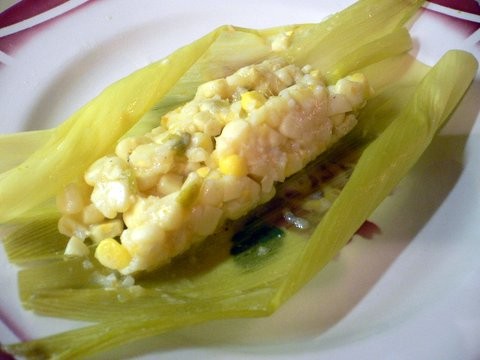
    I took a few of those rolled-up husks, flattened them out with my fingers, overlapped a few, and then, with one hand holding the suckers down and the other hand precariously tipping in a spoonful of cooked corn, attempted to dump that little mound of corn in the center and delicately fold it up. The second I lifted even a finger up from one edge of my husk packet, it flipped inwards. Grinding my teeth, I removed some of the filling and then with the determination of, well, I'm not sure what, I folded that packet into the One and Only Tamale I Could Bear to Make.

    Yes, ladies and gentlemen, I had the wherewithal to make one puny tamale and after huffing and puffing over several more flippy, unrollable husks and deciding that my life, dammit, was just too precious to spend an hour and countless gray cells on making twee little corn packets, I dug some cheesecloth out of a drawer and fashioned a snood of sorts that I filled with the remaining corn mixture and tied together with a few of my husk ties.

    I steamed my corn snood and my one silly tamale for an hour (replenishing the water) and the apartment filled with a delicious fresh corn scent. Which is good because my nerves were so frayed from the prep work (I might have been a leetle hungry by then, too) that if it hadn't smelled good, I probably would have just made myself a peanut butter and jelly sandwich and called it a night. Which, in retrospect, would have been the better choice.

    After removing both from the pot and letting them cool, I dug in. At this point, I should probably mention that I couldn't find canned Anaheim chiles, so I bought what seemed the next best thing (I have a lot to learn about chiles, obviously) – canned green chiles that had been roasted. They contributed next to nothing to the dish – I think that piquillo peppers are spicier than those were. I also substituted grated Parmigiano for the Monterey Jack cheese, because, well, it's what I had in the fridge.

    So what did it taste like? Like corn kernels mixed with grits and a bit of cheese and cooked for a long time. I'm not quite sure I get it. The grits were imperceptible and could someone explain just what the baking powder was doing in all of this? Why not just save yourself all the trouble of the prep work, grill up a few cobs of corn and slather them with mayo and cheese and spices like they're served at Cafe Havana? I don't even know.

    Green Corn Tamales
    Makes 12 tamales

    5 ears corn
    1 tablespoon unsalted butter
    1/4 teaspoon kosher salt
    1/8 teaspoon ground white pepper
    1/4 cup heavy cream
    1/4 cup grits (not quick-cooking)
    1/4 teaspoon baking powder
    1/4 cup roasted, peeled, seeded and diced Anaheim chiles, or 1 (4.5-ounce) can, drained well, rinsed and dried
    1/2 cup grated Monterey Jack, lightly packed
    Salsa and sour cream for garnish

    1. Remove the corn husks by cutting off both ends of the cobs, then peeling off the husks while trying to keep them whole. Scrape off the silk. Place the husks in a large bowl and cover them with warm water and let stand 15 minutes.

    2. Working over a bowl, run the tip of a sharp knife down the center of each row of kernels on each cob, then scrape with the dull side of the knife to remove the kernels.

    3. In a large skillet, melt the butter over medium heat. Add the corn and its juices, the salt, the pepper and the cream, and simmer until the mixture thickens, about 5 to 8 minutes. Remove from the heat and cool, then stir in the grits, baking powder, chiles and cheese. Chill 15 minutes.

    4. Drain the corn husks and dry them on paper towels. Make ties for the tamales by tearing a few husks into thin strips.

    5. Overlap 2 or 3 husks on a work surface and spoon 3 tablespoons of the filling into the center. Fold or roll into a package and tie each end with a strip of corn husk. Repeat with the remaining filling.

    6. In a steamer or a pot fitted with a steamer rack, make a bed for the tamales with the remaining husks. Add the tamales. Cover and steam over low heat for 1 hour, adding more water as necessary.

    7. Remove the tamales from the steamer and cool for 10 minutes. Serve them in the husks with salsa and sour cream.

  • Chicken_3

    I don't know what's come over me, but I can't seem to stop cooking exotic meals lately. I wonder if it's the chill in the air, and the sadness over summer ending that has me craving spicy food. Strong spices and forceful flavors promise a different kind of warmth these days. Soon, I'm sure, this will give way to a spate of bread-baking and long-cooked stews. And I am looking forward to those crisp days. But for now, I mourn the end of our hot and sultry summer. Wasn't it over in a flash?

    In the fall and winter, Ben and I cooked many a chicken for our Sunday night dinners, and somehow it seemed fitting to go back to that trusty stand-by last night, jazzed up substantially, when we returned to the city from our last summer weekend in Beacon. The jazzing-up of the standard roast chicken comes thanks to Madhur Jaffrey, whose recipe was excerpted from her Curries and Kebabs book in Florence Fabricant's Pairings column (apparently, this chicken tastes great with a nice, cool Beaujolais).

    You take a whole, raw chicken and skin it – which sounds fussy, but really isn't that bad. More annoying is the fact that Balducci's ran out of raw, whole chickens (how? Exactly how does a fancy food store run out of raw, whole chickens?), which condemned me to the questionable fate of having to buy our chicken from the dubious spot that is D'Agostino's poultry case.

    To make the spice paste that would be slathered all over the skinned and slashed bird, I blended together the juice of two lemons, chopped jalapenos, garlic, and ginger, coriander and curry powder (in place of cumin), salt and oil. Madhur says that the resulting puree should be a "thick paste", though mine was more of a wet sauce. If you make this, I'd only use the juice of one lemon and perhaps just one spoonful of oil.

    I slathered the greenish sauce all over my naked and rather undignified chicken and let the incendiary juices impregnate the meat for a half hour. I, meanwhile, nursed the pain of jalapeno puree smeared all over the rather delicate skin of my recently dermatitis-afflicted palms. All I can say is, OW.

    The chicken, after an hour of foil-covered roasting, and then basting, and then 15 minutes of uncovered roasting, came out incredibly fragrant and still juicy. The sauce had dried up into spicy little pockets of flavor here and there along the chicken's contours. It was intensely lemony, almost too much so, which further proves my point that less lemon juice in the spice paste would be fine. We ate our chicken with the coconut rice that blew my mind back in January and provided a cooling counterpart to the spicy heat.

    I liked this a lot, but I'm not sure I'd make it again. Perhaps because it feels like more of a fleeting-fancy dinner than the kind of thing to keep for posterity. Still, it's worth at least one meal. One that will warm you to the bone while the breeze outside picks up momentum and chill, and the first leaves start falling, brittle and faded, to the ground.

    Curried Roast Chicken, Durban Style
    Serves 3 to 4

    1 3 1/4-pound whole chicken, skinned
    1/4 cup lemon juice
    1 2-inch piece peeled ginger, chopped
    3 cloves garlic, chopped
    3 small fresh green chilies, chopped
    1 teaspoon salt
    2 tablespoons olive oil
    1 teaspoon ground cumin (I subbed 1/2 teaspoon curry powder)
    1 teaspoon ground coriander
    1/2 teaspoon chili powder
    Freshly ground black pepper

    1. Cut two deep diagonal slits, down to the bone, in each chicken breast and one in each leg and thigh. Place chicken, breast side up, on a sheet of heavy-duty foil large enough to enclose it. Place in a roasting pan.

    2. Place lemon juice, ginger, garlic, chilies, salt, oil, cumin and coriander in a blender and process to a thick puree. Rub puree over chicken, inside and out, and into slits. Set chicken aside for 30 minutes.

    3. Heat oven to 400 degrees. Dust chicken with chili powder and black pepper, enclose in foil and crimp to seal. Roast for 1 hour.

    4. Open foil and baste chicken. Return, uncovered, to oven for 15 minutes, basting twice more. Transfer chicken to serving platter. Pour juices from foil into a small dish and serve alongside chicken.

  • Flatbreads

    It is exceedingly difficult to photograph flatbreads appealingly. It is, however, exceedingly easy to consume said unphotogenic flatbreads at an alarming rate. Especially when smeared with a spoonful of yogurt or dipped into a greenish mound of smoked aubergine crush (I can't stop repeating this recipe title over and over in my head). Fragrant with herbs and sesame seeds, spiced chicken and the barely-there whisper of ground pistachios, the flatbreads bend and break in your hands. They're crunchy in some places, pliant in others. The yogurt adds a smooth textural note and a cooling sensation.

    The recipe comes from Ana Sortun's cookbook that has been featured in both the LA Times and NY Times. Sortun, the chef at Oleana in Cambridge, is a spice obsessed and her recipes are vehicles for all those spice-filled jars and packets you have stowed away in your kitchen (or freezer, though it might drive your co-habitants nuts to have all those little glass jars clinking up against frozen brussels sprouts and limeade concentrate).

    Despite the long list of ingredients, this recipe is quick and easy. You pulse together chicken with minced vegetables, dark-red sumac, aromatic Aleppo pepper, savory za'atar, toasted pistachios and some binding agents. This mixture is smeared onto Persian lavash (I bought a Lebanese version called pain du village that might have been a touch too thin, and got crispier results) and baked in a hot oven.

    I left off the garnish of roasted red peppers and didn't miss them at all. For two girls catching up on life, the flatbreads were good enough for dinner, along with the eggplant and yogurt. But for future reference, I'll slice the cooked flatbreads into thick strips and serve them as an hors d'oeuvre. As for the leftovers? I created sort of Indo-Mexican roll-ups, with a layer of eggplant and then a layer of yogurt smeared onto the warmed flatbread and folded.

    Tasty indeed – they could give Ilene Rosen's hot sandwich choices a run for the money.

    Flatbreads with Spiced Chicken and Pistachios

    Makes 8 servings

    1 pound skinless, boneless chicken breasts
    3 red bell peppers, 1 minced, 2 roasted, peeled, seeded and cut into strips
    1 small onion, minced
    3 scallions, minced
    2 teaspoons sumac, more for garnish
    2 teaspoons Aleppo pepper or 1/4 teaspoon cayenne
    1 teaspoon za'atar, more for garnish
    1 teaspoon salt, more to taste
    1 egg
    1/3 cup heavy cream
    1 cup lightly toasted, finely ground pistachio nuts
    4 large rectangles of lavash
    Pepper to taste
    1 cup thick yogurt

    1. Cut chicken into 2-inch chunks and place them in a food processor. Process to a smooth paste until it forms a ball, about 1 minute. Add minced red pepper, onion, scallions, sumac, Aleppo or cayenne pepper, za'atar, salt, egg, cream and pistachios, and pulse together just until incorporated, about 6 pulses.

    2. Preheat oven to 375 degrees; heat a pizza stone if you have one. Cut lavash into rectangles, about 5 by 6 inches. Cover each piece with about 1/3 cup chicken mixture, spreading to edges.

    3. Place on a heavy baking sheet or pizza stone and bake 12 to 15 minutes, until crips and chicken is cooked through. While still hot, sprinkle with additional sumac and za'atar. Serve warm with a dollop of yogurt, and strips of roasted pepper on each.

  • Now, with a name like Smoked Aubergine Crush, could this dish really go wrong? It's the most romantic thing I've ever heard a roasted eggplant puree called, and was at least half, if not three-quarters of the reason why I chose to make this for dinner last night (though it was less of a seduction attempt than a long-awaited catch-up dinner with Gemma). It also sent me on a foraging mission to Kalustyan's for a few more glass jars to add to my already over-stuffed cupboards.

    Kalustyan's is, of course, a charming place where you're likely to spend most of your disposable income, if you're a food-minded person, on all manners of jars and bottles and packets of spices and sauces and pastes and what-not. However, when the turmeric you buy goes and stains not only your frying pan, but your Kitchenaid spatula and your countertop, too, you find yourself less amusingly charmed and more completely irritated. But never mind. High is the price you pay for good food.

    The recipe originates from Pondicherry (a former French colony and trading post in India from 1670 to 1954) and was printed in the LA Times's review of La Porte des Indes (a London restaurant) cookbook.The cuisine that emerged from this hybrid culture featured French cooking techniques blended with traditional Indian foods and spices. The recipes Barbara Hansen mentioned in her review (Crab Malabar, Poulet Rouge, Shrimp Curry) sounded bewitching and reason enough to go out and buy the book (it's apparently well-tested and most of the recipes seem relatively simple to make).

    And if there's anything that makes me feel more capable in the kitchen than concocting an Asian recipe, it's concocting a Southeast Asian recipe. No? With all those various powders and seeds and aromatics, cooking Indian food is like a glorious sort of chemistry class, in which the final outcome will make your tummy very happy indeed.

    I roasted a one-pound eggplant until soft, let it cool and then processed it, sans skin, to a greenish puree. In a separate pan, I cooked mustard seeds (popping all the way), chopped onion, hot chiles and chopped ginger for a few minutes (but not long enough – in the final product some of these bits were a bit too crunchy for my taste). I added the accursed turmeric and then the eggplant, and let this mixture cook for 15 minutes over low heat before adding a few spoons of coconut milk and a spritz of lemon juice.

    The result? A creamy, spicy, smoky puree (albeit with some textural surprises) that lends itself quite nicely to being scooped with flatbreads (more on those tomorrow) and gobbled up for dinner in an ethnically incorrect, yet pretty tasty fashion. If you wanted to turn this into a square meal, a pot of hot rice and a simple fish fillet could be a good way of rounding it out. I sort of preferred eating the puree as part of a grazing dinner, with a dollop of yogurt to cool the heat, and the heady scent of spices in my house.

    Smoked Aubergine Crush
    Serves 4

    1 1-lb eggplant
    2 tablespoons oil
    1/2 teaspoon black mustard seeds
    1 onion, chopped
    1 3/4-inch piece ginger root, peeled and finely chopped (about 1 tablespoon chopped)
    1 teaspoon finely chopped red chile (jalapeno or serrano, seeded), or more to taste
    1 teaspoon finely chopped green chile (jalapeno or serrano, seeded), or more to taste
    1/2 teaspoon turmeric
    1/4 cup coconut milk
    2 teaspoons lemon juice
    Salt
    1 tablespoon chopped cilantro for garnish (optional, in my opinion)
    A few slivers red chile for garnish

    1. Heat the oven to 400 degrees. Pierce the eggplant on each side with the tines of a fork and bake for 50 minutes, or until very tender. Remove from the oven and cool. When cool enough to handle, halve it lengthwise, scoop out the flesh and blend or process it to a puree.

    2. Heat 2 tablespoons of oil in a saucepan. Add the mustard seeds and cover immediately to prevent the seeds from popping out of the pan. When the mustard seeds pop, add the onion and cook until translucent. Then add the ginger and chopped chiles and cook for 2 minutes.

    3. Reduce the heat and add the turmeric, followed by the pureed eggplant. Cook, stirring, over low heat for 15 minutes. Add the coconut milk and stir 2 minutes. Add the lemon juice and salt to taste. Serve hot, garnished with chile (and cilantro, if using).