• Blanched celery

    My love affair with Fuchsia Dunlop and Chinese food continues unabated. My latest discovery: how to use up that pesky bunch of celery stalks you're forced to buy when you need but a single one. Ooh, how I hate the sight of those pale green stalks down in the crisper, how they fill me with regret and fury, taking up precious space, growing limp and moldy by the day, an affront to my self-regard as a resourceful, responsible cook! But no more. Thanks to Fuchsia, I've actually gone out and bought a bunch of celery on several occasions now, to use up in one fell swoop, no less. It's nothing short of a culinary miracle.

    The dish has the lyrical name of "Send the Rice Down" in Chinese and the slightly more prosaic "chopped celery with beef" in English. But never mind the names – what you need to know is that this dish is one of the more addictive things to ever issue from my kitchen. Eating it is deeply pleasurable and almost painful because you cannot possibly eat as much of it as you would like to, lest you pop your trouser button after your third or fourth plate.
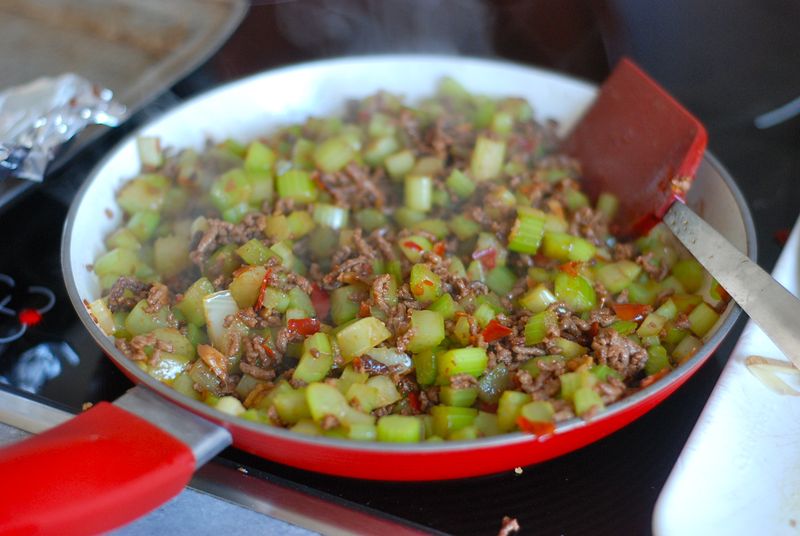
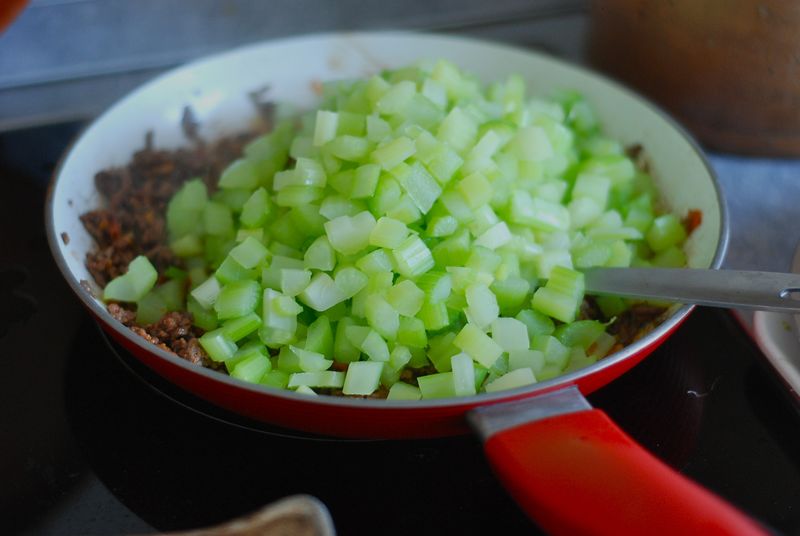
    Stirfrying celery and beef

    To make the dish, you need only two special ingredients (and special is a relative term depending on where you live): Sichuan chili bean paste, a reddish paste of fermented fava beans and chilis, and Chinkiang vinegar, a black, savory vinegar that you might recognize from your local dumpling shop. Buying both will only set you back a few dollars and will render you richer in the powerful-ingredient department. Besides, it can be fun to see what having these things in your home does to the people who live in it. Take, for example, my husband, who glances longingly, why almost lustfully, at the Chinkiang vinegar every time he passes it. If it were up to him, he'd be doing daily shots of the stuff.
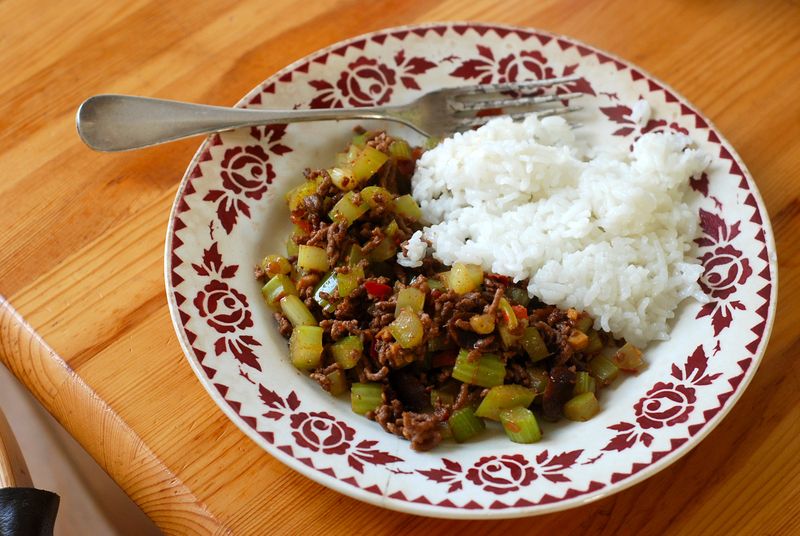
    Sichuanese chopped celery with ground beef

    The rest of the work is a walk in the park. There is the slightly fussy step of blanching the celery, but after that tell your eating companions to hoof it to the table, because once you start cooking the beef and the chili-bean paste and ginger hits the pan and goes incredibly fragrant, you won't want to waste any more time with extraneous breaths when you could be eating (or shoveling) this fabulous meal into your mouth.

    Oh, and one more thing: It should go without saying that this recipe is easily doubled. I think you'll need to do that.

    Fuchsia Dunlop's Sichuanese Chopped Celery with Beef
    Adapted from Every Grain of Rice
    Serves 2 as main with rice or 4 as part of a larger Chinese meal with other dishes

    300 grams (11 ounces) celery
    3 tablespoons cooking oil
    100 grams (4 ounces) ground beef
    1 1/2 tablespoons Sichuan chili bean paste
    1 1/2 tablespoons finely chopped ginger
    Light soy sauce to taste (optional)
    1 teaspoon Chinkiang vinegar

    1. Destring the celery, if necessary, and cut lengthwise into 1/2-inch strips. Finely dice the strips. Bring some water to the boil and blanch the celery for 30 seconds. Drain well.

    2. Heat the oil in a seasoned wok or pan over high heat. Add the ground beef and stir-fry until it is cooked and fragrant, stirring and pressing it to separate the strands. Add the chili bean paste and continue to stir until the oil has reddened. Add the ginger and stir-fry for a few seconds to release its fragrance, then add all the celery.

    3. Continue to stir-fry until the celery is piping hot and well-combined. Season with a little soy sauce, if desired. Finally, stir in the vinegar and serve immediately.
  • DSC_4820

    Thank you, darlings, for all your lovely comments and well wishes. It did me good to crawl off and act like a wounded animal for a bit. I took lots of hot baths, baked a bunch of delicious, comforting things and read all the back issues of the New Yorker I had lying around the house. It was very restorative and I'm happy to say that besides a sore chin and a few remaining issues with my jaw, I'm feeling back to normal.

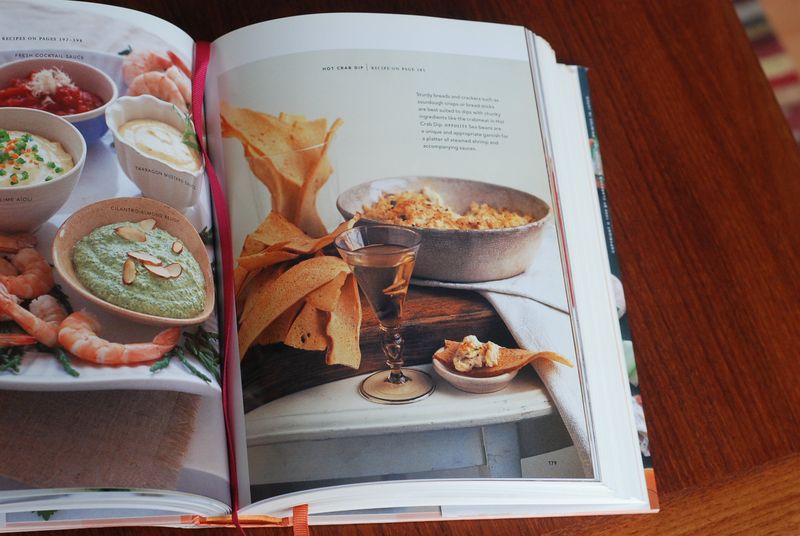
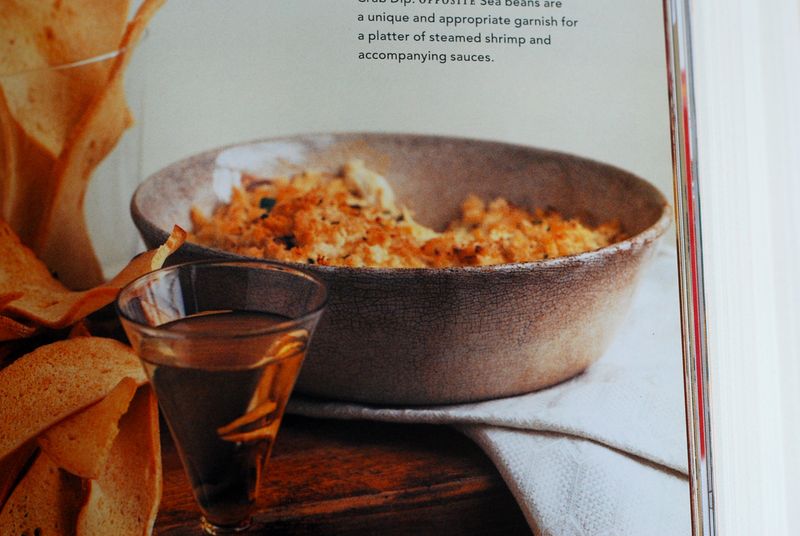
    As for the delicious baked things, I will tell you about all of them, I promise, but first things first: This hot crab dip, which comes from the pages of Martha Stewart's Hors d'Oeuvres Handbook, was the Number One Most Delicious Thing I made over the holidays (we had it for our Christmas Eve appetizer) and while I realize it may be snooze-y for you to read the words "Christmas" and "holidays" in February, please trust me. You need to have this in your repertoire.

    Hot crab dip was one of those things I'd vaguely heard about but had never actually seen in the flesh. I always assumed it had been very trendy and hip mid-century, but had gone the way of the three-martini lunch as the decades passed. When I was trying to think of what to serve to our guests on Christmas Eve (we always do a pretty simple fish-based meal that evening), I pulled down the Hors d'Oeuvres Handbook for inspiration. While much of the book's recipes are for much fussier (and more elegant) things than I'd ever have the energy to recreate, there are so many fantastic ideas for entertaining a crowd packed within its pages. Case in point, this hot crab dip.

    DSC_4821

    It's a silly-easy recipe and can be made in advance of serving, both big pluses for cooking for a crowd. You can make it with frozen crab meat as well as fresh, which is a boon to those of us who live in countries where fresh crabmeat is unheard of. (Berliners, I bought mine here.) And most importantly, of course, it is drop-dead delicious.

    This is not diet food or temple food or whatever you're going to call it. It's rich with butter and cream and cheese, but a little goes a long way and it is guaranteed to please the people you're feeding. I'd go so far as to say that as long as the days are short and the weather biting, you owe it to your friends to make them hot crab dip. Not to overstate things, but it's the kind of food that make you feel all is right with the world as you eat it. The rich savoriness will warm your bones and the conviviality of scooping and dipping bits of toasted bread into it while clustered around a table together will warm your soul. Just the thing to keep us going through this next gray month.

    (The Amazon links are affiliate.)

    Martha Stewart's Hot Crab Dip
    Adapted from Martha Stewart's Hors d'Oeuvres Handbook
    Serves 8 as an hors d'oeuvres

    3 tablespoons unsalted butter
    2 medium shallots, minced
    1/4 teaspoon cayenne pepper
    3/4 teaspoon Old Bay seasoning
    1 1/2 teaspoon dry mustard
    3/4 cup half-and-half
    8 ounces cream cheese, cut into small pieces
    4 ounces sharp white cheddar cheese, grated on the large holes of a box grater (about 1 3/4 cups)
    3 tablespoons freshly squeezed lemon juice
    2 teaspoons Worcestershire sauce
    10 ounces lump crabmeat, picked over for cartilage
    1/2 cup chopped fresh flat-leaf parsley
    2 slices white bread, crusts removed, torn into 1/4-inch pieces
    1/2 teaspoon paprika
    Toast points, for serving

    1. Preheat oven to 400 degrees with a rack in the center. Melt 2 tablespoons butter in a medium saucepan over medium heat. Add shallots and cook until soft, about 2 minutes. Add 1 tablespoon water and simmer for 30 seconds. Stir in the cayenne, Old Bay, and dry mustard until well combined. Pour half-and-half into saucepan and bring to a simmer. Slowly whisk in the cream cheese, a few pieces at a time. When the cream cheese is fully incorporated, whisk in the cheddar cheese, a handful at a time. Stir the mixture for 2 minutes. Remove from heat. Add lemon juice and Worcestershire sauce; stir to combine. Stir in crabmeat and half of the parsley.

    2. Transfer mixture to an ovenproof baking dish and sprinkle with bread pieces. Dot top of bread pieces with remaining tablespoons butter; sprinkle with paprika. Bake until bread pieces are golden and dip is hot, 18 to 22 minutes. Garnish with remaining 1/4 cup parsley and serve with toast points.

  • Sherry Yard's Quintessential Chocolate Chip Cookies

    I am having a very odd week. On Monday, just after I'd dropped Hugo off at daycare (thankgodthankgodthankgod), I slipped on some just-formed black ice on the sidewalk. There was no time to catch myself, no time to even register what was happening before I slammed my head against the cobblestones. It was all very upsetting, as you can imagine, what with bits of tooth suddenly loose in my mouth and blood on the sidewalk and a momentary loss of vision and all that pain, pain, pain.

    A good Samaritan helped me and I was the first in the ER that morning, so I was seen and treated in record time and in the grand scheme of things, of course, I was very lucky: The tooth I broke was a molar, the blood came from a cut under my chin, I don't have a concussion and Hugo was safe and sound in his cozy little Kita (thankgodthankgodthankgod) while all this happened. But I've spent the remainder of this week in an ugly little fog. Part of it is the pain – my jaw muscles are all seized up due to the shock and I have bruises all over my body – and part of it is a strangely thick feeling of sadness that I can't really explain. I mean, it was really just a harmless little accident. So why has it left me feeling so ravaged?

    What I'd like most right now is to crawl into bed and spend a few days being very, very quiet – but if someone came and offered me a few of these cookies, freshly baked – I wouldn't kick them out either.

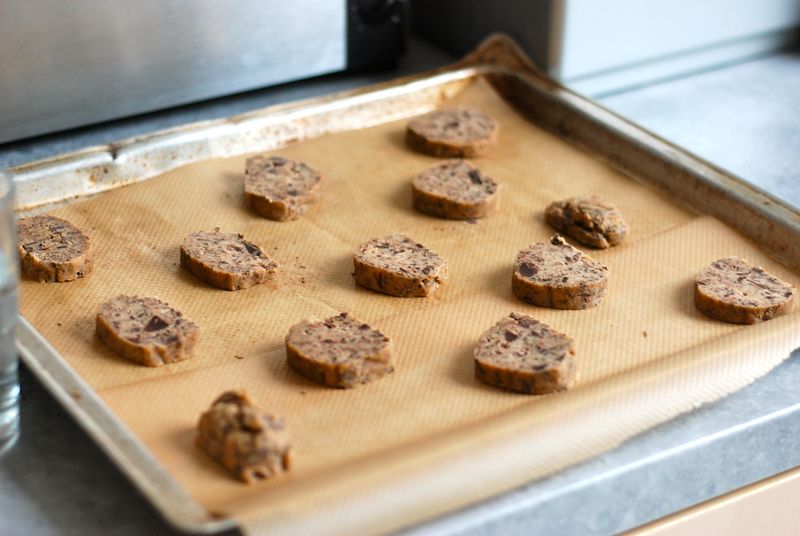
    Sliced cookies

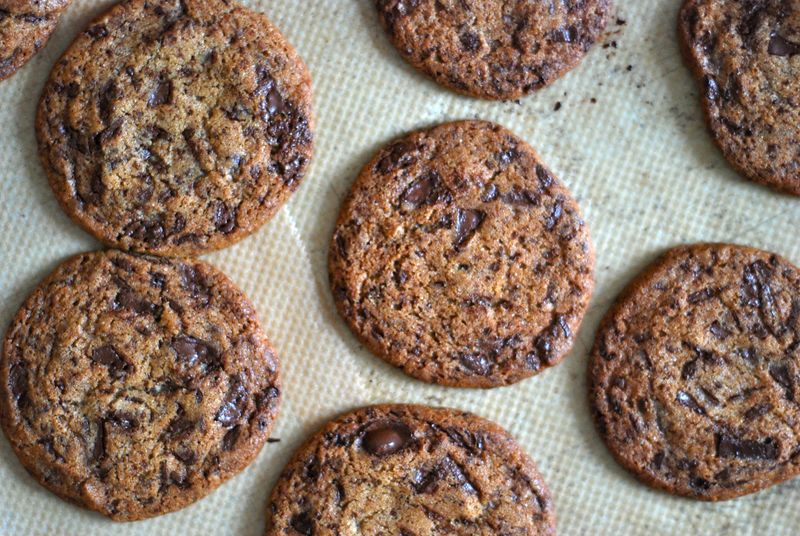
    I first made them a few months ago, after reading about Martha Rose Shulman's secret double life, and found them to be, in fact, quite perfect. They're chewy in the middle and just a tad crisp on the edges and because of the chopped chocolate, every bite you take is infused with chocolate and caramel flavors. They're pretty flawless. And as you probably know, once you find perfect chocolate chip cookies, it's sort of difficult to find much additional language about them. If they're great, they just are; if they're not, you have to keep looking. I herewith declare my search to be over.

    But my favorite thing about these cookies is that once formed into logs, they can hang out in your freezer for quite some time, resting until you have friends over and need a last-minute snack or dessert or have smashed your head on the sidewalk and are feeling fragile and in need of cosseting (provided you can still chew).

    And with that, folks, I'm off to be quiet and heal. Have a great weekend!

    Sherry Yard's Quintessential Chocolate Chip Cookies
    Makes 4 dozen cookies

    185 grams (1 1/2 cups) all-purpose flour
    2 grams (1/2 teaspoon) baking soda
    115 grams (4 ounces/1 stick) unsalted butter
    100 grams (1/2 cup) sugar
    80 grams (1/2 cup packed) light brown sugar
    2 grams (1/4 teaspoon) salt
    1 large egg
    5 grams (1 teaspoon) vanilla
    225 grams (8 ounces) bittersweet chocolate, cut in 1-inch pieces (or use coins)

    1. Sift together flour and baking soda and set aside. In the bowl of a standing electric mixer fitted with the paddle attachment, cream butter until lemony yellow, about 2 minutes. Scrape down sides of bowl and paddle. Add sugar, brown sugar and salt. Continue creaming mixture on medium speed until it is smooth and lump free, about 1 minute. Stop mixer and scrape down sides of bowl and paddle.

    2. Add egg and vanilla and beat on low speed for 15 seconds, or until they are fully incorporated. Do not over-beat. Scrape down sides of bowl and paddle.

    3. On low speed, add sifted flour mixture. Beat slowly until all of the flour is incorporated. Scrape down sides of bowl. Add chocolate chunks and mix in.

    4. Heat oven to 350 degrees with the rack positioned in the lower third of the oven. Line a baking sheet with parchment. Spoon heaping teaspoons of dough 2 inches apart onto baking sheet. If not baking right away, remove small handfuls or spoonfuls of dough from mixer and plop them down on the middle of a sheet of parchment or wax paper, creating a log about 1 1/2 inches wide and 12 inches long. Fold parchment over, creating a sausage. Chill for at least 1 hour, preferably overnight. Using a serrated knife, slice chilled dough into 1/3-inch-thick rounds and place them 2 inches apart, in staggered rows, on parchment-lined sheets and proceed. (Dough will keep, tightly wrapped, in the refrigerator for 1 week, or in the freezer for up to 1 month. Thaw frozen dough at room temperature for 30 minutes before slicing.)

    5. Bake for 12 to 15 minutes, until lightly browned, rotating the baking sheet front to back halfway through. Remove from heat and slide parchment off baking sheet and onto a work surface. Allow cookies to cool for at least 5 minutes before serving, or for at least 20 minutes before storing in an airtight container. Repeat with remaining dough. Cookies will keep for up to 3 days at room temperature.

  • Homemade vanilla extract

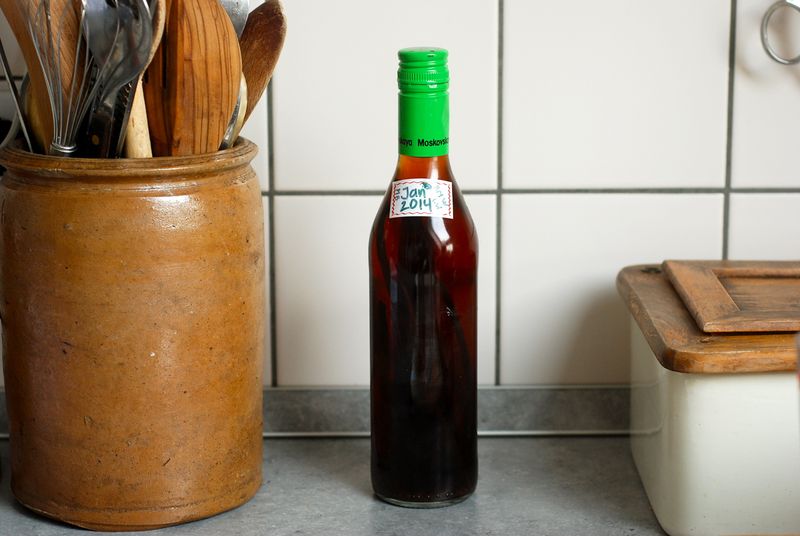
    New Year's resolutions! Do you make them? I do. I know, I know, yawn, but I can't help it. I do feel like there is something about turning the page from one year to the next that gives you the glorious sensation of having a clean slate in front of you to fill with all your wonderful scribblings. Like every year, I put down "exercise more" and "eat less sugar", but now I've started adding "be more patient", because oooh that little child of mine, and "get more organized" and "email less" and other exhortations that sort of kill me with their mundanity but are increasingly integral to my peace of mind. Once we get all those self-improvement things out the way, though, we get to the really fun stuff – like "make your own vanilla extract" and behold, it is only January 15th and I have already knocked this one off the list! ROAR!

    Though to be fair and honest, there could be nothing less challenging about making your own vanilla extract. In fact, it is so easy, so ridiculously nothing that I'm almost sort of appalled that we've all been keeping Nielsen-Massey and McCormick in business all these years. (And that us expats have been wasting precious suitcase space on meticulously wrapped bottles of extract.) No more!

    Okay, so here's what you do: First, get yourself some vanilla beans. Nowadays you can get amazing deals on vanilla on this here internet. For example:

    Shipping to the US:

    Vanilla Products

    Vanilla Saffron

    Beanilla

    Shipping to Europe:

    Madavanille or Madavanilla

    Cap d'Ambre Vanille

    Vanilla Mart

    Next, get yourself a bottle of alcohol. Vodka's a pretty great choice, since it's available everywhere and doesn't have much of its own flavor. I suggest getting a 500 ml bottle. (You can certainly use bourbon or rum, but for a neutral vanilla extract, vodka is good. If you happen to live in Italy or another country where pure alcohol is cheap and plentiful, you can buy that instead. Then use only 250 ml of alcohol and 250 ml of water.)

    Now for the hard work. Select eight plump vanilla beans. Open the bottle of alcohol. Split the beans lengthwise and carefully scrape out all the seeds. Put the seeds in the bottle of alcohol and then the split beans. Close the bottle. Shake. Store. DONE. See what I mean? Stupid easy.

    The recipe is easily doubled or halved or quadrupled or whatever. You can make many little bottles as gifts or one big bottle that you share with no one. It's up to you! Now, the longer you let the extract sit, the more flavorful it gets – but it's pretty much ready to use after a week or so of sitting. The best thing about this stuff is that every time you use some of your glorious homemade vanilla extract, you can top up the bottle with a bit more alcohol. Vanilla beans are so intense that they can handle being used a few times over.

    And with that, I'm off to work on my other resolutions. Like meal planning! On that list thanks to you helpful folks.

  • Steamed lemon pudding

    I'll tell you, up until the last minute it was going to be a pavlova. It was going to be crisp and marshmallowy and billowy and beautiful, spotted with ruby-red pomegranate seeds floating on top of a thick tide of yogurt cream. Spectacular, I tell you! And also way too much for a lunch party of five. I came to my senses just before dinnertime on Sunday evening, making a quick U-turn to steamed lemon puddings from none other than pastry queen Karen DeMasco (she of the cashew brittle and the carrot cupcakes which are among the best things to ever come out of my kitchen, well, until these lemon puddings).

    A big thanks goes to reader Jenny who reminded me of them – they'd been on the docket here for years, languishing away while I dallied with chocolate cakes and spice cookies and citrus salads. Back when the New York Times was still doing columns with chefs, Tom Colicchio wrote about his brilliant pastry chef and her lemon puddings. They were, Tom said, "not too rich" and "foolproof", which was all I needed to know this time around. I could make them in advance and then either warm them up or unmold them and serve them cool.

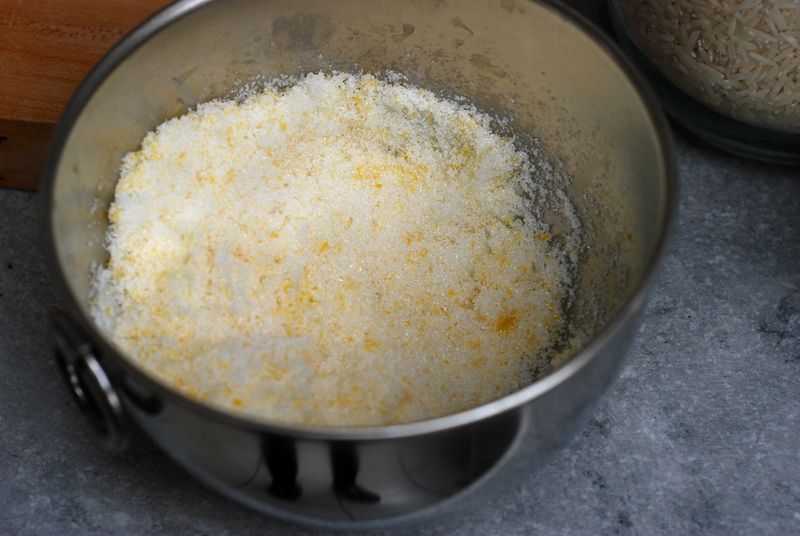
    Lemon sugar

    Steamed puddings are funny things, hybrids between a soufflé and a pudding and the lightest of cakes. Their name sounds wholesome and old-fashioned, at least to me, sort of like something I imagine Victorian ladies eating with tiny silver spoons, but the flavor is sharp and modern and bright – it fairly screams LEMON LEMON LEMON.

    To make them you first grate lemon peel into a bowl of sugar and add flour to that, but my tip to you, before you add the flour, is to massage the lemon peel into the sugar. The already fragrant oils are released even more as the sugar works as an abrasive and it's just one of those delightful little kitchen tasks that makes you happy to be working – a few extra seconds of work that feel good.

    Then you beat buttermilk and egg yolks and 1/4 cup of freshly squeezed lemon juice (which in today's case were precisely two very juicy lemons) together and in a separate bowl, whip the remaining egg whites until soft peaks form, nothing further.

    Soft peaks

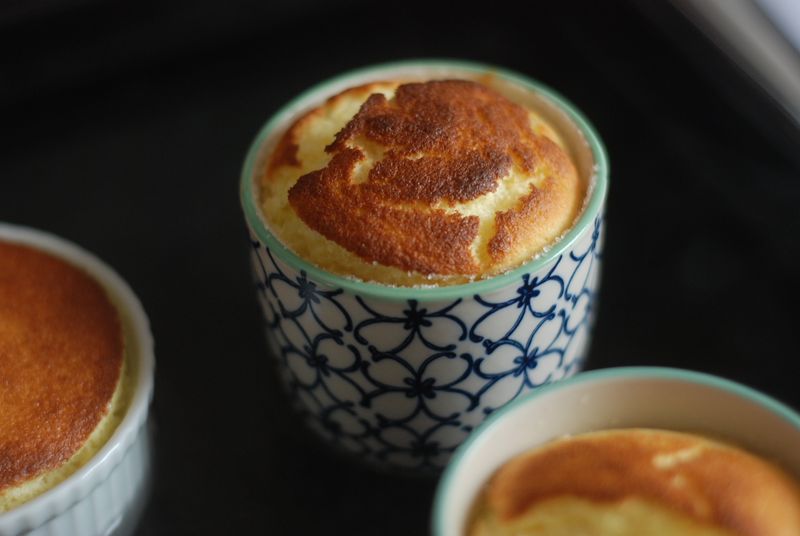
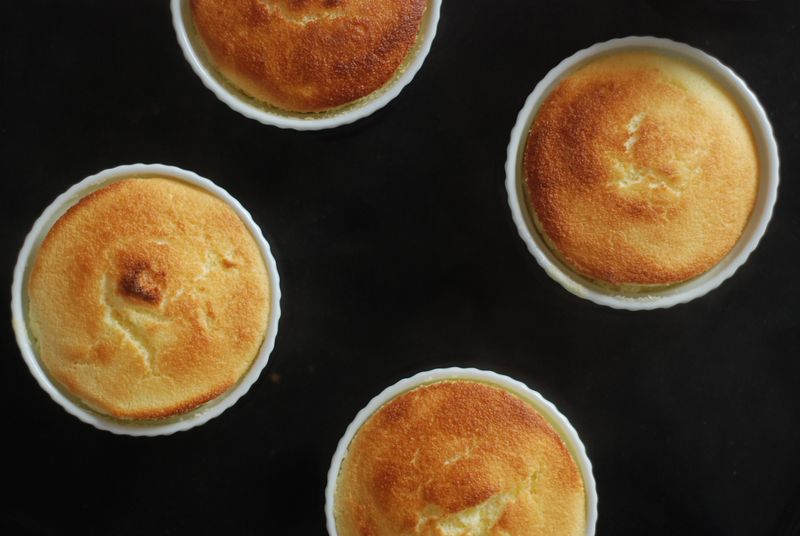
    The egg whites are carefully stirred (proper folding is difficult because the batter is so liquid) into the buttermilk mixture until it's light and cloudlike and then you ladle it into buttered and sugared ramekins which are placed in a water bath and baked until they're puffed and golden-brown and cracking slightly. I found the transfer of the water-and-ramekin-filled baking sheet into the oven to be the most stressful part of this whole thing. (Which is to say that a. I am clearly easily stressed and that b. this recipe is ridiculously easy.)

    Steamed lemon puddings

    The lemon puddings are spectacular when you take them out of the oven, quivering and burnished and puffed-up, but they lose height and slump down pretty quickly as they cool. Never you mind. When you take a spoon to the ramekins a little later, you'll find that what they've lost in beauty, they've gained in total deliciousness. You'll also find a tender, light little cake on top obscuring a silken lemon curd beneath and although you will try to eat your steamed lemon pudding just as those dainty Victorian ladies once did, politely and slowly, it will be very very hard, especially once you realize that the problem with individual servings is NO SECONDS.

    Happy birthday, Mami!

    Karen DeMasco's Steamed Lemon Puddings
    Serves 6

    1 tablespoon unsalted butter
    3/4 cup plus 2 tablespoons sugar
    5 tablespoons flour
    Finely grated zest of 2 lemons
    3 eggs, separated
    1 cup buttermilk
    1/4 cup lemon juice
    1 pint blueberries, optional
    2/3 cup heavy cream, whipped, optional

    1. Heat oven to 375 degrees. Lightly butter six four-ounce ramekins or foil muffin cups. Dust each with 1 teaspoon sugar, shaking out any excess.

    2. In small bowl, mix remaining sugar with flour and lemon zest. In large bowl, lightly beat egg yolks, and stir in buttermilk and lemon juice.

    3. Whip egg whites until softly peaked. Whisk sugar mixture into buttermilk mixture. Fold in beaten egg whites in thirds. Spoon batter into prepared containers. Place in baking pan, and add hot water to pan to come halfway up sides of ramekins or tins. Cover pan completely with foil.

    4. Bake about 15 minutes, until batter begins to puff. Remove foil, and bake another 15 minutes or so, until tops begin to brown and are springy to touch. A little cracking is fine.

    5. Remove from oven, and serve warm. If you make the pudding in advance, allow it to cool to room temperature, and unmold to serve, or reheat in warm water bath, and serve warm. Fresh blueberries and whipped cream can be served alongside, but I served them plain and they were divine.

  • David Tanis's Ambrosia

    Happy New Year! I hope you all had restorative, calming breaks. Max was home for 16 blissful days and we enjoyed every single one. Even Hugo played along and stopped waking up at 5:00 am, for which we are both endlessly grateful. We may even buy him a pony in gratitude? A tiny motorcyle? His very own African elephant baby?

    I know it is hopelessly unhip to admit to eating healthfully in January, but I can't help it. In the grand German tradition, we started eating piles of Christmas cookies all the way back on the first Advent and by the time New Year's rolled around, after the roasts and the jelly doughnuts and the Stollen and panettone and everything else, it would have been a freaking miracle if our pants weren't tight. Ahem. My pants. Also, I now have that sort of unpleasant sensation of being completely sugared out. Of being sated down to the tips of my toes. Best remedied by eating lightly and cleanly and by getting out and moving.

    But I was invited to a lunch party yesterday and was tasked with bringing dessert. What was I going to do? I couldn't bring myself to even make a pan of brownies. (The last pan I made, David's dulce de leche brownies, was just after New Year's and while they were perfect, I couldn't bring myself to eat more than a few bites. Like I said, sugared out! To the tips of my toes!)

    Instead, inspired by something I read online from Amanda Hesser about a reinvention of that old Southern dessert ambrosia, a mix of sliced oranges and shredded coconut, I turned to David Tanis's lovely book, A Platter of Figs. David Tanis updates the dish with just a few simple touches, turning it from simple and retro into something far more elegant, complex and delicious.

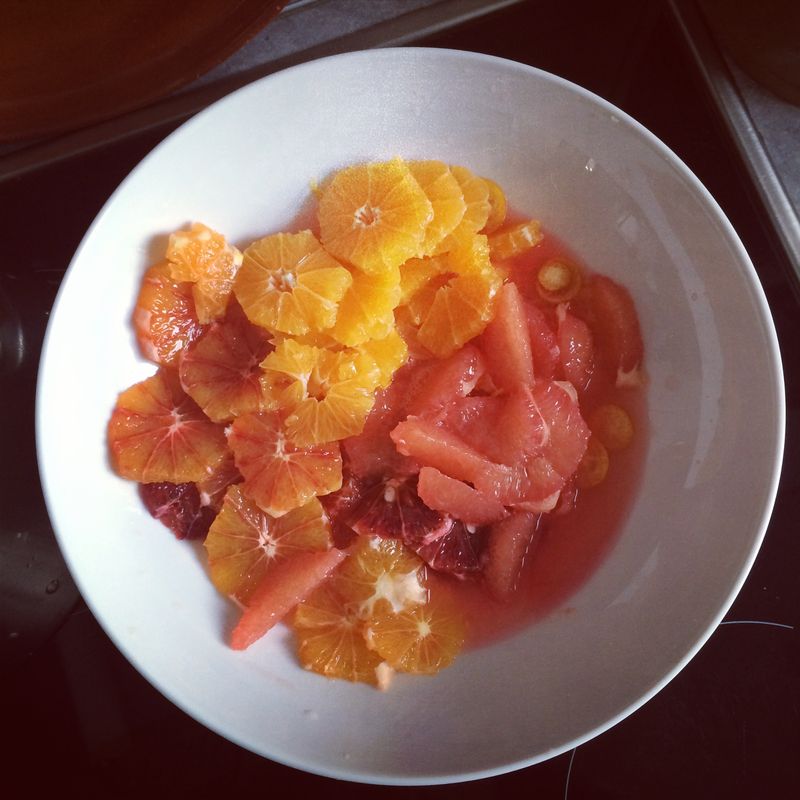
    Segmented citrus

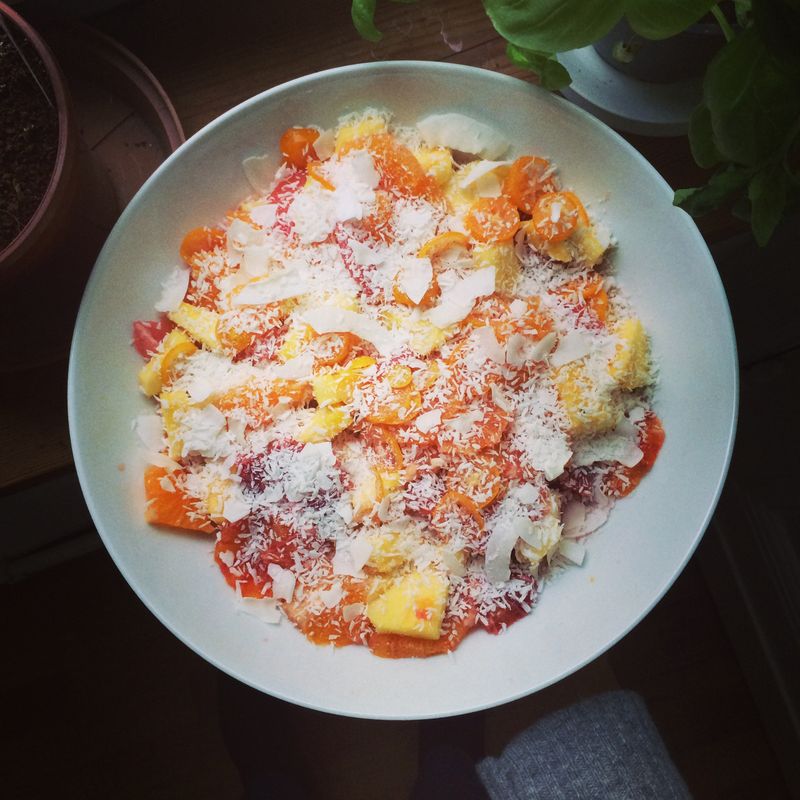
    Instead of just using oranges, David has you use grapefruits, blood oranges, kumquats and navels (I didn't have navels, so used clementines). The grapefruits are segmented, the oranges are peeled and sliced and the kumquats are sliced, so you not only have a whole dance of different citrus flavor going on, but layers of texture too, especially once the soft pineapple and spiky coconut are tossed in. Some versions of the old ambrosia add canned crushed pineapple to the mix, but here, David has you dice up fresh pineapple, which adds an element of pure sweetness to the dish. And instead of sweetened shredded coconut, use unsweetened shredded coconut (I used a mix of flaked and shredded, just for fun). David's original recipe makes an enormous amount of ambrosia, so I scaled down the citrus a bit to the quantities below and it served 6 of us at the end of a 3-course lunch quite well.

    David's ambrosia is the perfect winter dessert – seasonal and juicy, deeply satisfying and delicious, and beautiful to boot. I'm in love.

    But next week is my mother's birthday and I am, of course, in charge of dessert. And while I adored the ambrosia, I'm not sure it's birthday party material. I want to find something that's celebratory and special, but still relatively light. So what can I make? A wintery pavlova? An angel food cake? A towering croquembouche filled with nothing but sweet, delicious air? Help a girl out, folks!

    David Tanis's Ambrosia
    Adapted from A Platter of Figs
    Serves 6

    2 pink grapefruits
    2 blood oranges
    2 clementines
    8 kumquats
    1/2 ripe pineapple
    Sugar, if necessary
    1 cup unsweetened shredded coconut

    1. With a sharp knife, cut off the tops and bottoms of the grapefruits, blood oranges and clementines, then peel, making sure to remove all the white pith. Working over a bowl, section the grapefruit into wedges, cutting between the membranes. Before discarding, squeeze out the grapefruit carcasses into the bowl, they should yield quite a bit of juice. Slice the blood oranges and clementines into 1/4-inch rounds and add them to the bowl. Slice the kumquats into the thinnest rounds possible and add to the bowl. Peel and core the pineapple, then cut into small pieces and add to the bowl. With your (clean) hands, mix the fruits very gently. Taste the juice and if absolutely necessary, add a bit of sugar. Cover and set aside for up to several hours.

    2. Just before serving, sprinkle the coconut over the salad. Toss gently and serve immediately.
  • Photo-2

    Dearest readers and bidders,

    Woah. WOAH.

    It is my profound honor to announce that we raised a whopping $3,565 for the Invisible Child Trust at the Legal Aid Society.

    $3,565!

    (!!!!!!!!)

    Thank you for all your bids and your tweets and your spreading the news. A big, big thanks also to Ruth Reichl and Russ Parsons for unexpectedly stepping in with their wonderful books to add to the offerings and to Ten Speed Press and Sarah Copeland who jumped in as well. I'm totally humbled by their enthusiasm and generosity – and by yours. The auction exceeded my wildest expectations.

    I'll be in touch with the winners by email – invoices will be sent via Paypal – and once all the payments are in, I'll write the check and send it off to New York (you can also donate online). And in the meantime, I'm going to just about burst with pride at what we did this week together. Thank you for that.

    Thank you also for making me realize yet again that nothing ventured is nothing gained. I worried that no one would care about this auction. I worried that I was putting myself out there and that it'd be embarrassing to raise nothing and fail. Instead, you all rose up and made this thing explode in such a wonderful and hugely gratifying way. Lesson learned, universe!

    Elsewhere, because it's been too long,

    Gesine Bullock-Prado recalls the smell of her mother (I dare you not to cry).

    A week in the life of Nigel Slater.

    A movie on food waste.

    Great interview with Yotam Ottolenghi.

    These quick videos on five iconic holiday roasts are so inspiring.

    Will this finally be the year I make my own vanilla extract? No time like the present.

    Salted. Rye. Chocolate. Cookies. All you need to know.

    Loved reading more about Caroline Campion while I covet her new book.

    Catherine never fails to make me laugh, even when talking about crock-pot pork.

    Darling people, I hope you have warm and cozy and happy holidays. May your travels be safe. I'm thinking of you and am, as ever, so grateful to have you in my life! Much love, Luisa

  • DSC_4336

    Last week, hurrying about my errands and to-do lists, in between work and answering emails, I clicked on a link on Twitter that led me to this article, this epic piece really, a 5-part series about a homeless family in New York City. The article focused on one of the family's daughters, a little girl named Dasani. Dasani, born into a different kind of life, would have the regular bright things ahead of her that we all, most of us at least, take for granted. Home-cooked dinners, new clothing and the ability to go to the bathroom alone and without fear to start, followed by regular school attendance, a high school diploma probably, college and a life – stable, regular, quotidian – thereafter. Instead, Dasani lives a life that would crush most of us. If you haven't already read about Dasani and her family, I urge you to. It will take some time, but it is worth it.

    I haven't been able to stop thinking about the family – and the thousands like it – since. When I take a shower alone and unmolested, when I watch Hugo eating his dinner that I have no trouble putting on the table, when I lie back in my clean, quiet bed at night to read, I think about all these silly little things that make up my everyday life and how completely out of reach they are for a girl, and a family, that has simply had the bad luck to be born into different circumstances than I have.

    DSC_4330

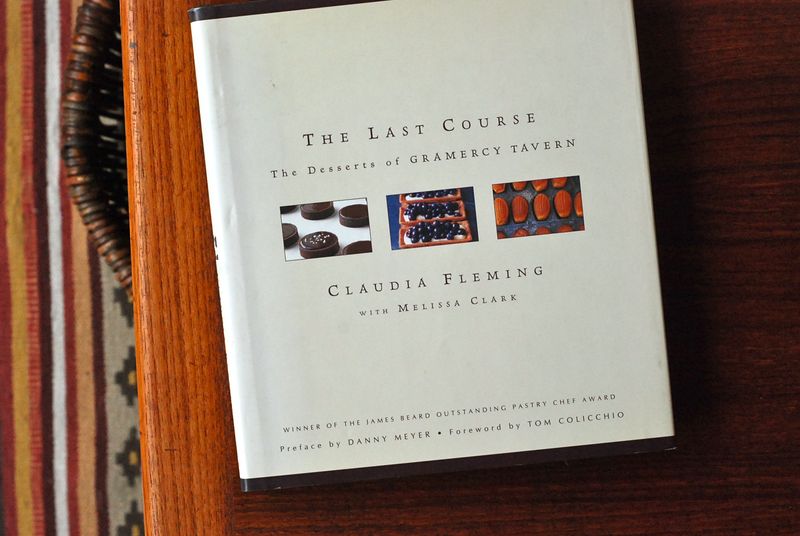
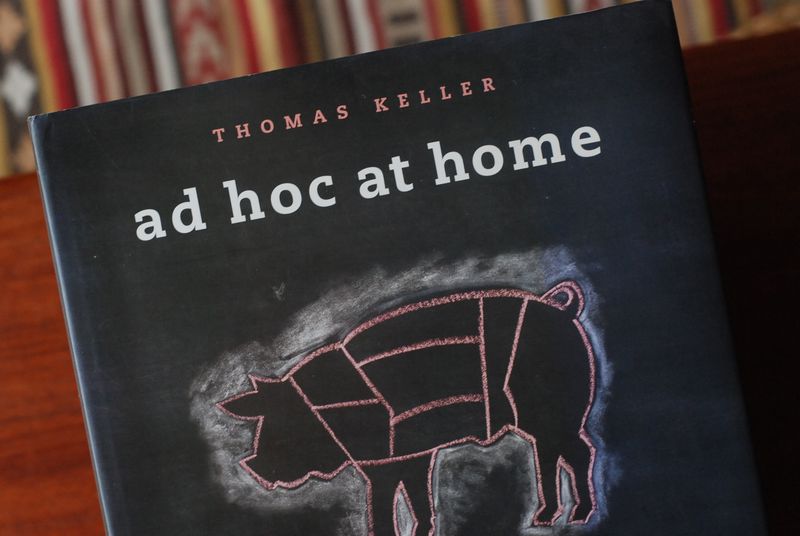
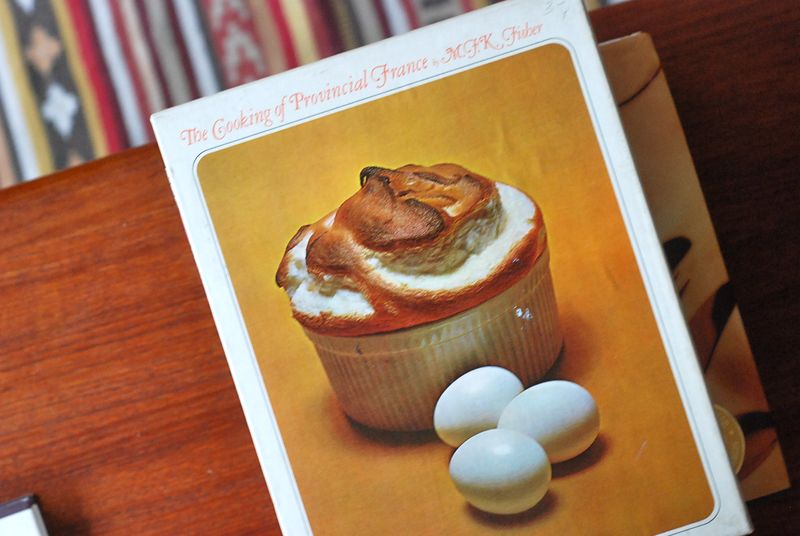
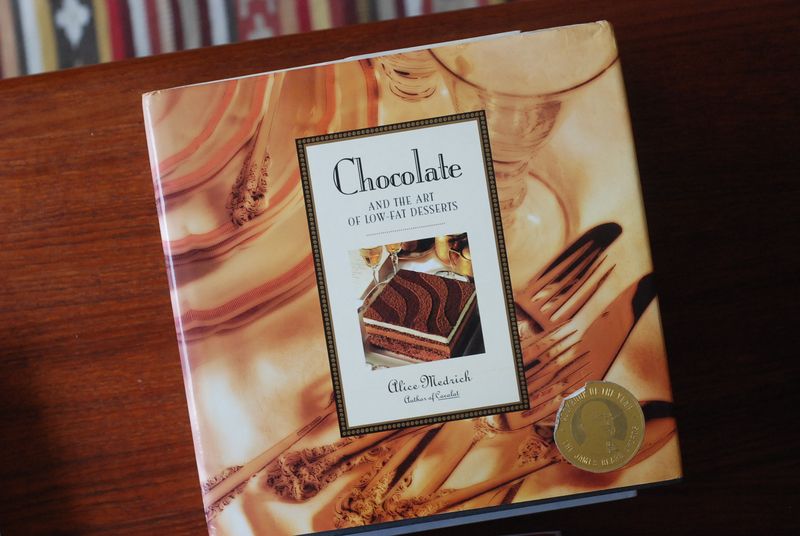
    I've also been thinking about how to help, which is where you come in. I've decided to auction off a good portion (about half!) of my cookbook collection and will be donating all proceeds to the Invisible Child Fund at the Legal Aid Society of New York. There are a lot of great books in the collection, like the much-coveted and out-of-print The Last Course by Claudia Fleming, a signed copy of Thomas Keller's Ad Hoc at Home, M.F.K. Fisher's The Cooking of Provincial France set that she did for Time-Life, and Alice Medrich's cult favorite, also out-of-print, Chocolate and the Art of Lowfat Desserts (one of the first books I scored on eBay way back when because of a food blog).

    DSC_4327

    After much thought, I decided not to use eBay for the auction – I don't want anyone to hesitate to bid because they don't have an account. Instead, I'm going to auction the books off right here. I think it should go relatively smoothly. Here's how it'll work: I'm going to list the books up for auction below, with author name, title, condition of the book, and a bidding price. If you want to bid on a book, just leave a comment or send me an email or a tweet with the amount and I'll update the bidding price. The auction will end on Friday.

    Please help by spreading the word far and wide. While I can't guarantee that the books will arrive in time for Christmas, depending on where you live, I do promise to ship them into the postal system the weekend before Christmas. The books are all in new or almost-new condition, with the exception of the few vintage ones among them. Bonus: Ruth Reichl and Deb Perelman, the authors of Mmmmm: A Feastiary and The Smitten Kitchen Cookbook, respectively, will be matching the winning bid for their books, no matter how high they go. And the winning bidder for Deborah Madison's Vegetable Literacy will received an accompanying limited edition letterpress poster from the publisher. 

    And: If you spend over $50 on any book, you'll also receive a copy of My Berlin Kitchen as a gift.

    Thank you, sweet readers, for reading and for participating.

    DSC_4332

    DSC_4335

    1. Susan Herrmann Loomis's French Farmhouse Cookbook – paperback, like new. $50 (ruth fecych via email)

    2. Barbara Kafka's Roasting: A Simple Art – hardcover, gently used. $60 (Elizabeth Van Pelt)

    3. Deborah Krasner's Good Meat – hardcover, new. $65 (Eleanor)

    4. Alice Medrich's Chocolate and The Art of Low-Fat Desserts – hardcover, gently used. $115 (Thomas Marzahl via email)

    5. Suvir Saran's Indian Home Cooking – hardcover, like new. $150 (Tanya)

    6. Claudia Fleming's The Last Course – hardcover, new. $250 (Theresa Vaskovic. via email)

    7. Sara Forte's The Sprouted Kitchen – hardcover, new. $100 (amanda)

    8. Gourmet's Cookie Cookbook – hardcover, like new. $50 (Deb)

    9. Jamie's 15-Minute Meals – hardcover, new. $50 (Chlo-star.)

    10. Jamie's Great Britain – hardcover, new. $55 (Jennifer)

    11. Lisa Fain's Homesick Texan Cookbook – hardcover, like new. $120 (Sara)

    12. The Nepenthe Cookbook – hardcover, new. $20 (Luann Wierdsma via email)

    13. Alton Brown's Good Eats 1 & 2 – hardcover, new. $100 (Dana)

    14. Food52 Cookbook, Volume II – hardcover, like new. $60 (Mary Nodine via email)

    15. Bruce Weinstein and Mark Scarborough's Ham – hardcover, new. $30 (Edgardo via Twitter)

    16. Clotilde Dusoulier's French Market Cookbook – paperback, like new. $50 (Karey)

    17. Liana Krissoff's Grains for a New Generation – paperback, like new. $80 (Sara)

    18. MFK Fisher's Cooking from Provincial France – hardcover with spiral bound recipe booklet in slipcase, vintage. Good, clean, unused condition. $260 (Brettne Bloom)

    19. Deb Perelman's The Smitten Kitchen Cookbook – hardcover, new. Winning bid will be matched by Deb. $130 (Em)

    20. Thomas Keller's Ad Hoc at Home, dedicated and signed – hardcover, new. $160 (Bec via email)


    ***UPDATE***

    Russ Parsons, Ruth Reichl, Ten Speed Press and Sarah Copeland caught wind of the auction and generously asked to donate the following incredible items. Thank you to them!!

    21. Russ Parsons's How to Pick a Peach, signed – hardcover, new. $70 (Suzy)

    22. Ruth Reichl's Mmmmm: A Feastiary (her very last personal copy!). Winning bid will be matched by Ruth. $525 (John Atchue)

    23. Deborah Madison's Vegetable Literacy, signed – hardcover, new. Winning bid will receive an accompanying limited edition letterpress poster. $250 (Sarah Chamberlain via email)

    24. Sarah Copeland's Feast, signed – hardcover, new. $55 (Katherine)

    25. Sarah Copeland's The Newlywed Cookbook, signed – hardcover, new. $55 (Cayleigh)

  • Squash toast

    A little update on the state of affairs over here: I am sick, felled by the flu. Hugo is in the full throes of cranky, screamy toddlerhood (so soon? help!). It is my birthday, but because of the aforementioned germs I had to cancel every fun thing I had planned for the day. And I am up to my eyeballs in unanswered emails and stacks of work and to-do lists and backlogged posts and every time I think about all that stuff, my stomach does this ugly little flip, it's very disconcerting, and then to make it stop I have to burrow my face into my sick bed and breathe deep and tell myself to stop worrying, which of course does absolutely nothing to stop me from worrying, and anyway, it's all rather unpleasant.

    And yet!

    Despite this pathetic litany of complaints, I am in pretty good spirits. It is December, which is one of my favorite months. I just bought How The Grinch Stole Christmas to give Hugo on Christmas. Our Christmas Eve menu is coming together in my head. (Salt-baked whole fish? Chocolate soufflé? What do you think?) We have a roof over our heads and food in the pantry and I have a mother who drops everything to take care of my kid while I recuperate, even at 6:00 in the morning. Honestly, the only thing I wish I had right now were a few more hours in each day – say, three? I'm not greedy! – to get things done. Who's with me?

    (Which leads me to a quick interlude: Dearest readers – sometimes, when I'm forced to lie in bed and think about thrilling things like organization and staying on top of things and other areas in which I find myself, at times, failing miserably, I wish there was some kind of textbook or curriculum on how to organize your life that could be passed around once you have a child and then go back to work. I'm not talking about having it all or balance or any of that, at least I don't think I am. It's more that I find myself wondering what little tips and secrets there are to running a household, working and parenting and staying marginally sane throughout. Then it occurred to me that I could just ask you wise people, because you've always come through in the clutch for me before. Right? So, tell me, give it to me straight: what is one piece of advice you'd give a frazzled lady such as myself if you could? You know, like, only buy socks in one color so you never have to worry if you lose one in the washing machine! Or…cook all your vegetables on Sunday and then use them up over the week! You know what I mean? Go!)

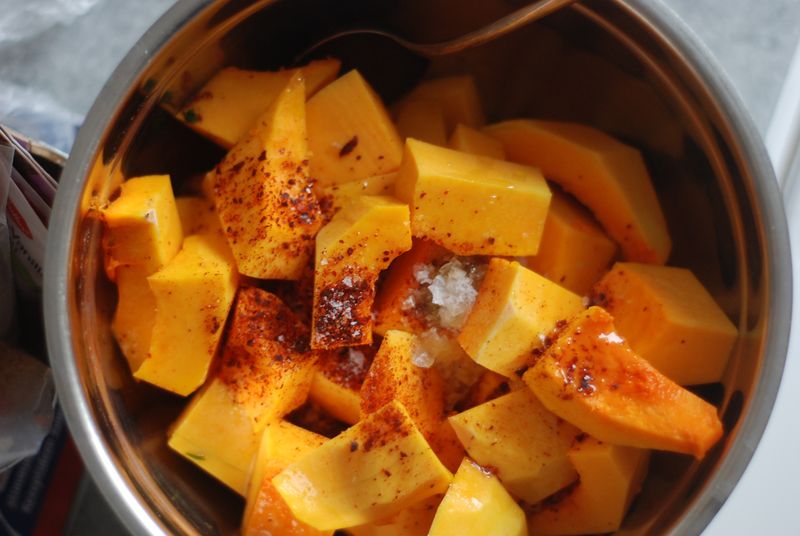
    Raw squash

    In return, I will tell you about this roasted squash business, which I made for the first time a month ago and have cooked every week since then and have decided is my favorite food discovery of 2013, which is no faint praise when you think about all the delicious things I wrote about since the beginning of the year: Orange marmalade, broccoli soup, French chocolate cake, porridge, for Pete's sake, homemade saag and THE BEST ROASTED VEGETABLES EVER, to name just a few.

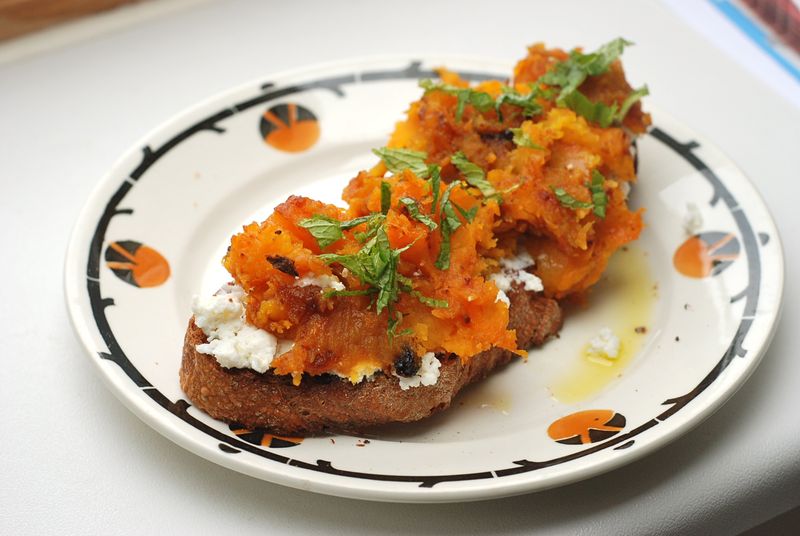
    It comes from Jean-Georges Vongerichten, which should already tip you off somewhat, since that man is a cooking genius and one of the only chefs I know who can successfully translate his insane restaurant kitchen chops into doable home cooking. This particular recipe shows up on ABC Kitchen's menu as Squash Toast and you can see adorable Mr. Vongerichten himself cooking it with Mark Bittman right here (if that video doesn't make you want to get into the kitchen right this instant, then I don't know what to tell you). And the first time I made it, I followed it pretty precisely and had myself a fabulous little lunch – the spicy squash and the sweet-sour onions are fantastic layered with the cooling ricotta, the crunchy bread, and the mint. But it was just me for lunch, which meant that I had a good amount of the roast squash mixed with vinegary onion jam left over. I figured I'd eat the leftovers for lunch the next day, stuck them in the fridge and forgot about them.

    Then, a few days later, my mother was over and we needed lunch, fast. I put water on to boil for pasta, rummaged around in the fridge and found the mashed spicy squash. I thinned it with some starchy pasta water, dressed the boiled pasta with it and topped it with a big mound of grated Parmesan cheese and, lo, it blew our minds. I've made the squash and onions and used it for pasta every week since then. No joke. Everyone who eats it (my mother, my husband, my friends) goes quiet and makes that wide-eyed face, you know which one I'm talking about, as they work their way through their plate. It's magical and delicious and perfect and I love it.

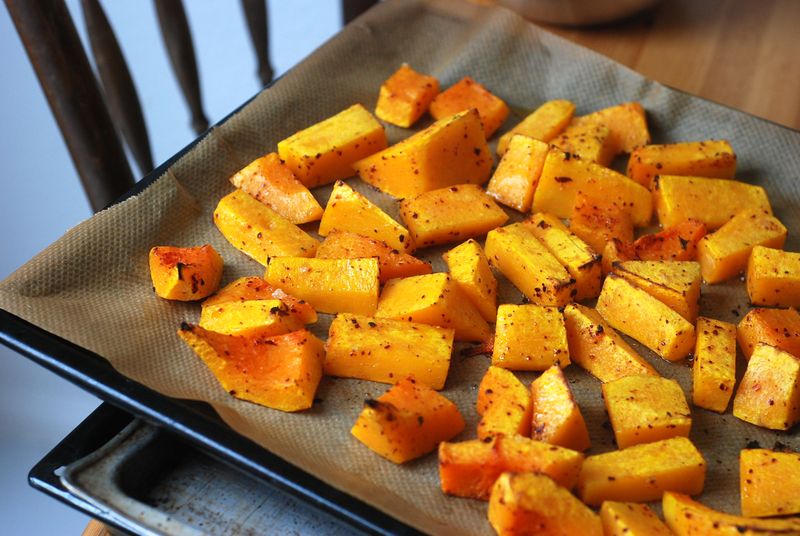
    Roasted squash

    Jean-Georges Vongerichten's Squash Toast
    Adapted from the original recipe
    Note: I usually use less oil than called for here, reducing the amount by a tablespoon here and there.

    1 2 1/2- to 3-pound kabocha or butternut squash, peeled, seeded and cut into pieces 1/8- to 1/4-inch thick
    3/4 cup extra-virgin olive oil
    1/2 teaspoon dried chile flakes, more to taste
    3 teaspoons kosher salt
    1 yellow onion, peeled and thinly sliced
    1/4 cup apple cider vinegar
    1/4 cup maple syrup
    4 slices country bread, 1-inch thick
    1/2 cup ricotta
    Coarse salt
    4 tablespoons chopped mint

    1. Heat the oven to 450. Combine the squash, 1/4 cup olive oil, chile flakes and 2 teaspoons of salt in a bowl and toss well. Transfer the mixture to a parchment-lined baking sheet and cook, stirring once, until tender and slightly colored, about 15 minutes or a little longer. Remove from the oven.

    2. Meanwhile, heat another 1/4 cup olive oil over medium-high heat, add the onions and remaining teaspoon salt and cook, stirring frequently, until the onions are well softened and darkening, about 10-15 minutes. Add the vinegar and syrup, stir and reduce over medium-low heat until syrupy and broken down, 10-15 minutes; the mixture should be jammy.

    3. Combine squash and onions in a bowl and smash with a fork until combined. Taste for seasoning.

    4. Add the remaining oil to a skillet over medium-high heat. Working in batches if necessary, add bread and cook until just golden on both sides, less than 10 minutes total; drain on paper towels. Spread cheese on toasts, then top with the squash-onion mixture. Sprinkle with coarse salt and garnish with mint.

    4a. Alternatively, boil penne or rigatoni in lightly salted water, setting aside 1-2 cups of starchy pasta water towards the end. Toss the cooked pasta with the squash-onion mixture, thinning it with pasta water until you get the desired thickness and top with grated Parmesan cheese. The amount of squash and onions above will make enough "sauce" for 4-6 portions. If you go the pasta route, you can leave off the ricotta and mint.

     
  • Luisa and Jamie
    On November 20, I had the great pleasure of hosting Jamie Oliver at the Apple Store in Berlin for a conversation about Jamie's Food Revolution Day, a worldwide event encouraging individuals to take action against obesity and other diet-related illnesses by bringing healthy food and home cooking back into their communities. It was an incredibly inspiring afternoon and evening for me and I'm brimming with ideas for the next Food Revolution Day, which will be on May 16, 2014.

    For those of you who've already participated in the Food Revolution, tell us a little about it! I'd love to know how you decided to participate and what you organized and did. Will you be participating again next year? I have visions of, among other things, teaching a little "cooking" class to my friend's second grade class or trying to see if there's something that I could organize at Hugo's daycare for the slightly older children. But what I love most about the idea behind Food Revolution is that once you start thinking about all the things you'd like to try and change, you find yourself reaching higher and higher for bigger and bigger things.

    For those of you who haven't yet participated in Food Revolution, like me, could you see yourself organizing something for your community? You can learn more here and by watching our podcast, which is available for download on iTunes – just click here.

    And yes, Jamie truly is as genuinely lovely in real life as he seems on television. He's hugely inspiring, but also just a regular, down-to-earth, nice guy. The real deal.