• DSC_0919
    Sometimes I wonder where it all started. It could have been in Ms. Mercer's fifth grade class, I guess, when I wrote my first story, a bound set of loose leaf pages grandly titled "The Boarding School Murders" and illustrated with a luridly dripping knife, no less. But then I think it must have been earlier than that, when my father taught me how to read on the nubby, cream-colored couch that sits in my living room now, when I learned to escape into the wintry wonderlands of Narnia or the the big woods of Wisconsin, pulled along into those stories by the little girls who bewitched generations of readers before me. Perhaps I was older still, sitting quietly in writing class in college, feeling the strange rush of adrenaline course through my veins when I started writing short stories and found I couldn't stop. Or maybe it was the blog, the daily, weekly discipline of showing up here and writing, opening my heart and finding an audience in a dozen, a hundred, a thousand computers and more, scattered throughout the world.

    Other people knew it before I did, believed in me long before I would ever learn to. I'd resigned myself to being on the other side, didn't really think I'd ever make it happen. Was too scared, if I'm honest. Too anxious I'd fail.

    ***

    Ten years ago this January, I moved to New York. I got myself a little desk outside a big publisher's office, where I answered his phone and took notes in meetings, went out to book parties with other assistants and reveled in bagfuls of free galleys. I walked over the Brooklyn Bridge at sunset, skin tingling, and felt smug pride when I learned to navigate the West Village without a map. Smiled when I started recognizing strangers on the street, when the dry cleaner remembered my name.

    I didn't need much adjusting to New York; it felt almost instantaneous, my acclimation. I had my little room in a darling apartment on the Upper West Side, just across from Zabar's, just a few blocks from Central Park. My roommates and I memorized the lines in "French Kiss" and stayed out late; threw dinner parties with borrowed chairs and fought with our landlady about the heat. I taught them how to cook and they taught me that friends could become family. Turns out that with the right people, all it takes is a little time. That, and a little bit of magic, too.

    I remember when I first fell in love with New York. I was eight, and my father and I were on a visit with my grandparents. There had been an opera at Lincoln Center and a ride in a yellow cab, lunch at an Italian restaurant with their old friends in Midtown and a walk up Fifth Avenue, the city pulsating, alive, around us. It didn't scare me, though; it was thrilling, and so I fell hard and fast. I bought a canvas "I Love New York" tote bag and came home bubbling, proclaiming it, knowing it in my bones. One day, I'm going to move to New York.

    And so, 14 years later, I did.

    ***

    On New Year's Eve last year, at 11:45 pm, I sat in the guest room of my aunt and uncle's apartment in Brussels, wrapped up in a blanket in front of the computer. My family and friends, all felled with the flu, had gone to bed early and I, the lone healthy person, was alone on New Year's Eve. Well, I thought. 2009 wasn't starting very well. It had been a tough fall and I knew the months ahead would be even tougher. I braced myself that night, gave myself a stern talking-to.

    You will get through this. You simply must.

    The thing is, I'm not very good at being stern. I'm too soft, I think, too quick to fold. Now, do you know what I wish I could do? I wish I could go back to that night, slip into that room with the girl sitting in that chair, and wrap her up in a big hug. Trust me, I'd say. Trust me. It won't always feel this way. And she'd know I was right.

    The next few months, though, were just as hard as I knew they'd be. Harder, even. I thought they'd never end. I gritted my teeth and braced myself, but it didn't help. I balled my hands into fists and fought, but lost. I tried to be strong, but it felt like I'd failed.

    And then. Oh then.

    My girlfriends – my sisters – took me with them to Paris. Me with my heart frayed around the edges, so fragile I'd been teetering on the edge of tears every hour, every day. We flew to Paris, and I felt the magic the minute we stepped off the plane. You think I'm speaking in metaphors, maybe, am having just a bit of fun, perhaps. No. There was magic there and it was real. Between the lilacs on the RER and the insistent flap of pigeon wings, Paris shook me awake; gently at first and then harder, with urgency. Open your eyes, I heard. There's no time to waste anymore.

    The answer is right in front of you.

    ***

    Readers, how do I just get it out and tell you? How do I put it in words? I don't know how, am trying so desperately to get it right, to really nail this one, because this is important.

    Something happened in Paris and the weeks thereafter. I don't know if that's where my childhood finally ended or if it was then that I started to realize who I really am and what I really want. Maybe they go hand-in-hand, maybe you can't have one without the other. Either way, something happened, something pushed me to snap out of it, to wake up and take my life into my hands before it was too late.

    In those strange, clear days in late spring, I remember finally realizing with earth-shaking certainty this: You, and only you, determine your own fate. You only get one chance at this life. Do something with your life; open your heart to risk. At some point, enough is enough and you must take the biggest leap you can and live it.

    So I did.

    ***

    Last week, I gave notice at my job. This week, a dream came true. No. This week, my dream came true. The biggest dream of my life, I think, the thing I've been dancing around as long as I can remember, the thing I've always wanted, yet didn't ever believe I could actually do. After writing all summer, after finally getting down to business and trying, after doing what people have been urging me to do for years, I took my heart into my hand, handed a book proposal over to my agent, closed my eyes and leaped.

    48 hours later, the editorial director at Viking Press bought my book.

    ***

    But that wasn't the only leap, you see. Something else I learned this year is that only once or maybe twice in life, when you get the chance for change, real change, you've got to do a whole lot more than just one thing. You've got to look deep inside your own soul and follow where it wants to go. You've got to listen, really listen, in order to hear what the universe is trying to tell you. And move mountains, then, when you finally know what you want. So, my dears, my readers, my silent and not-so-silent supporters, here it is, at last.

    I'm writing a book, yes. But that's not all. I'm leaving New York, too.

    I'm moving back to Berlin and I'm writing a book, about Berlin, about my life, about cooking and home and family and love, about being divided and finding a way back to being whole again, about a city and its recipes, and a girl who's learning how to find her way.

    And somehow, finally, I believe it, too: This is what I was meant to do.
  • DSC_3021

    I remember quite vividly the first time I read Gourmet. I was thirteen years old and visiting my father and his new wife in their house in a suburb of Boston. It was the first time I'd met Susan – my new stepmother – and I was jetlagged and a little overwhelmed. But Susan was nice and my father was happy and the house was cute and there was a cat named Taylor who warmed to me right away, so I found myself relaxing in spite of it all.

    And furthermore, the next morning when I woke up too early and came downstairs, I discovered a stack of magazines with looping script that spelled out Gourmet, with luminous photographs and mouth-watering recipes and photographs of food and stories – well-written, to boot – about the very things I liked to read about. I leafed through the pages slowly in wonder. I felt like the world was opening up, quite literally, in front of me. Whole galaxies of possibility in front of my very eyes! I'll never forget that feeling.

    Before long, I was copying – in longhand – all the recipes that grabbed my imagination. I don't even remember how many loose leaf pages I filled, but for years after that first visit, I would look forward to settling down on my visits to see my dad and Susan with a stack of Gourmets by my side; hours stretching ahead of me in which I could read and fantasize and lose myself in the beauty of that magazine.

    For me, as for many, many others, Gourmet was not just a magazine. It was one of the first things that Susan and I shared, and I can't look at an issue without thinking of her. I had an emotional attachment to it, as well as a professional one. As a cookbook editor, I used Gourmet to find photographers, stylists, and writers, not to mention book ideas. It has been an invaluable source of inspiration.

    Much has been said and written about the folding of Gourmet over the past few weeks. I know some people never warmed to the "new" Gourmet. I know some people subscribed only because of Ruth Reichl. I know some people think the Internet killed Gourmet. And some people think heartless businessmen in suits are to blame. I don't know what did Gourmet inultimately, but what I want to address are readers threatening to cancel their subscriptions to other magazines out of protest or anger because of the folding of Gourmet.

    Please don't. Please remember there are people behind all those other magazines, people who work hard and who are passionate, who have tastes and opinions that matter, who are doing their very best in a very difficult industry, whose work each month inspires millions of cooks and readers and dreamers and artists. If anything, in the wake of Gourmet folding, we should become new subscribers to other food magazines, lending those publications our support and our dollars, letting the writers and editors there know that people are still reading, still paying attention, still hungry, for lack of a better word, for nourishment. Magazines aren't static – they're living, growing, changing things and they need us, like a plant needs water, to keep them vibrant and alive.

    DSC_2982

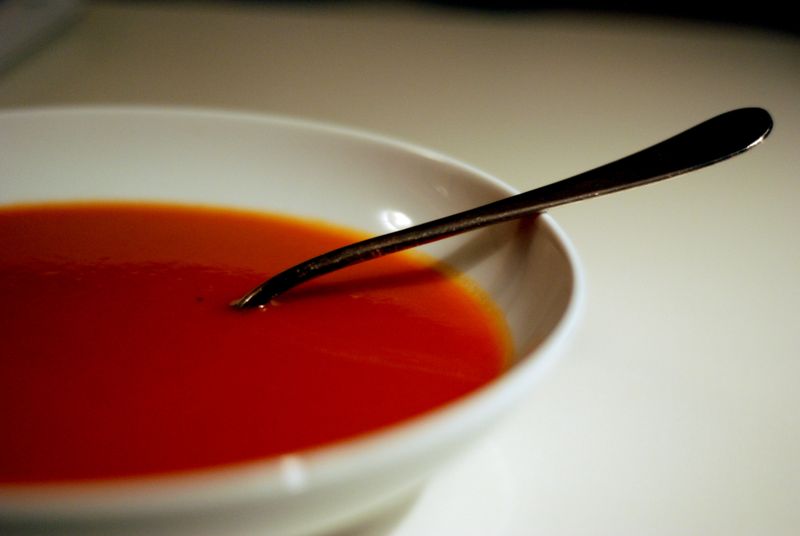
    I found this fantastic soup on Gourmet.com earlier this week. After one of the magazine's editors warned that web-exclusive recipes on the site would eventually disappear when the site got taken down, I spent the better part of an hour getting lost in there, finding delicious things to cook, rereading older pieces by MFK Fisher and Francis Lam, marveling at the amount of work that went into it all.

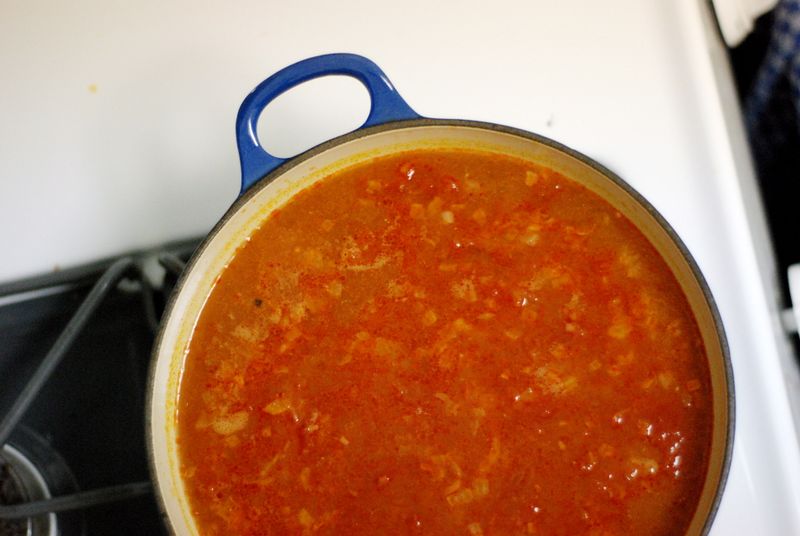
    Tonight, after more than a week out of my kitchen, I chopped up an onion and cooked it in olive oil, then stirred in ground cumin and a few spoons of prepared red curry paste, cooking and stirring the paste gently to release the fragrance. Then I poured in chicken stock, a can of tomatoes and their juice, crumbling brown sugar and some salt. After a brief simmer, a 15-minute window in which I had just enough time to straighten up the apartment, admire a new pair of shoes and read my mail, the soup was ready. I blitzed it into smoothness with an immersion blender, and brightened it up with a good squeeze of lime juice. My apartment smelled incredible.

    Would you understand what I meant if I said this soup tasted like the brightest summer day, simultaneously, impossibly full of languor and excitement? The flavors are strong and bright and layered, despite the humble ingredients, and the fact that you can make the whole thing within half an hour of walking in the door only makes this taste better. The original recipe has you add a cup of water to the brew, but I left it out and the soup was perfect: just hot and spicy enough and not too thick. I find traditional tomato soups, slick with cream, leave much to be desired. This one is my new gold standard: practically shimmering with life.

    Thai-Spiced Tomato Soup
    Serves 4

    1 onion, chopped
    3
    tablespoons vegetable oil
    2
    tablespoons Thai Kitchen red curry paste
    1/4
    teaspoon ground cumin
    2
    (14-oz) cans reduced-sodium chicken broth
    1
    (28-oz) can crushed tomatoes
    1
    tablespoon packed brown sugar
    1/4 teaspoon salt
    Juice of 1/2 lime
    A handful of cilantro leaves (optional)

    1. Cook onion in oil in a 4- to 5-quart heavy pot over medium heat, stirring occasionally, until softened, about 6 minutes. Add curry paste and cumin and cook, stirring, 2 minutes.

    2. Add broth, tomatoes, brown sugar, and salt and simmer 15 minutes.

    3. Purée soup in batches in a blender (use caution when blending hot liquids). Return soup to pot and reheat. You can also leave the soup in the pot and purée using an immersion blender. Stir in the lime juice and serve, garnishing with cilantro, if using.

  • DSC_2606

    Sometimes there's just no escaping a dinner disaster.

    You can try as hard as you can, be armed with this recipe from the always-reliable Ms. Clark, can have lovely corn and vibrant green herbs from the greenmarket, a perfectly plump chicken breast from the gourmet grocery in the West Village, a sack of pearled barley from the now-defunct Balducci's and a luscious can of coconut milk, and things will still Just Not Work Out.

    Hrrmph.

    I mean, how many of you read this and got hungry right then and there? I can't have been alone. But what sounded so promising just ended up being this rather flat, pallid dish that I poked around on my plate for a while, feeling like a truculent third-grader while picking out nibs of corn with the tines of my fork.

    If, and only if, you plan to attempt this yourself, here are my words of wisdom:

    1. Don't fry the cashews with the chicken and then stir them into the stew at the end. This turns them soft and rubbery. And soft and rubbery cashews are Not Pleasant At All. Instead, toast them in a separate pan and strew them over the dish when you plate it. Crunch! Flavor! Delicious.

    2. Melissa's method for cooking the barley just didn't work for me. It needed far more liquid than she said and more time, too. I cooked mine for 50 minutes and it was still too hard and chewy. Hard and chewy barley is not the same as al dente barley, not at all. Take it from me. Also, maybe two whole cups of barley is a little too much barley. I wonder.

    3. How come the photo on the New York Times makes this dish look more like a barley salad than what I ended up with, a creamy barley stew? I don't know. But, in fact, the photo has a point. Maybe you should just cook the barley in salted water until it's properly done and then toss it with cubed, sauteed chicken, sauteed corn, a bunch of herbs and that jalapeño (try two!). Then you'd have a barley-corn-chicken salad that might have a bit of a kick rather than a coconut-barley-risotto type thing that will sit in your stomach like a lead weight and then also take up precious real estate in your fridge for five days before you can bring yourself to face the music and Just Throw It Out. (I'm really going overboard with this capitalization thing, aren't I.)

    DSC_2506

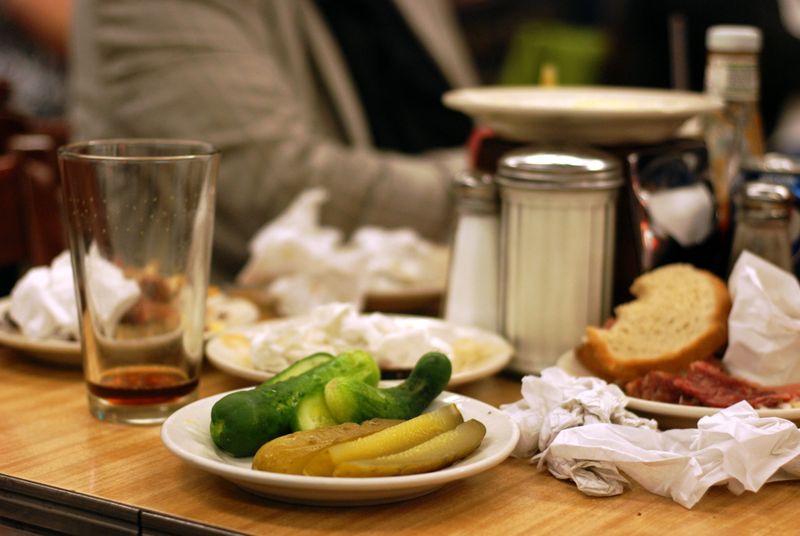
    In other news, totally unrelated, I had my first (and please, God, make it also the last) meal at Katz's Deli (of Sally's infamous orgasm!) on Saturday afternoon. I think I probably aged about 26 days just standing in line, which might be almost as maddening as the (double) line at the Angelika Theater. Not that the corned beef wasn't delicious! It actually really was, as was the sour pickle it came with. But $14.95? For a pile of meat on rye with a freaking pickle alongside it and no table service? Holy highway robbery, Batman.

    Next time I attempt a New York institution, I'm going to aim a little higher, I think. Babbo, anyone?

  • DSC_2104

    I totally respect rules about food. Italians, I think, might be the kings of this habit: No grated cheese on fish pasta! No cappuccinos after breakfast! No cream in pasta carbonara! And sit down when the pasta is ready and eat it right away, for crying out loud, not 10 minutes later after you've finished washing your hands or finishing your milk or both, what's the matter with you anyway? (Oh, Italian children. How you suffer, I know. Console yourself with this: one day, you too can become a tyrant in the kitchen. Being a grown-up is so sweet.)

    So I get it when other people say things like a real bouillabaisse must be made with rascasse. If you don't have rascasse, you don't have bouillabaisse. Or, hmm, that a real Bavarian pretzel cannot be eaten alone, unless you're some kind of sissy. It must always be accompanied by Weißwurst and sweet mustard (and beer, if we're being really exacting). Or, as Pete Wells pointed out the other day, that real chowder can be made only with seafood known to the Pilgrims, quite a lot of it indeed, and potatoes. No discussions, no protestations, no nothing.

    Very, very luckily for all of us, though, Pete seems to be an accomodating kind of food editor and instead of indoctrinating his children with rules about food (like, er, the people in my family), he quite willingly gave in to their tastes and fashioned this soup (he calls it chowder) that is totally, seriously, deeply (all rules aside) delicious. Hey, old-time readers! I'd go so far as to say that this one's lamination-worthy. Boom! How exciting is that?

    DSC_2103

    And it turns out that it's pretty fun cooking, too. At least for those of us who like to futz around in the kitchen (this one is worth the futz!). You make this neat little shrimp stock, first, using shrimp shells and corncobs and basil stems. Doesn't that sound rather old-fashioned and glamorous? While I made it, I kept wishing I was in peeptoe heels and pearls, smoking a cigarette and shouting into the other room at my dinner companion getting drunk on a gimlet, instead of listening to the radio and padding around the kitchen in a pair of cuffed khakis and Chucks. In fact, that shrimp stock might be the best part about this soup.

    After that, you cook together garlic, onions, carrots and fennel, which just seems like such an ingenious addition since it infuses the soup with the faintest (barely, barely perceptible!) hint of aniseed (sort of like Pernod in the afore-mentioned bouillabaisse, which is all just very culturally referential and cute).  Then in goes the fancy stock and a bunch of cubed potatoes, half of which you subsequently mash to thicken the soup, a shower of fresh corn (bing! Forget what I said about the shrimp stock! Is this corn the best part of the soup or what?), a handful of canned tomatoes (squeeze them into bits with your hands!), and a bay leaf. Away that concoction simmers while you munch on pickles or crackers or whatever you munch on when you're hungry and dinner still isn't ready.

    Don't forget the hot pepper! Sheesh. I take that back about the corn. The hot pepper might be the best part about this soup.

    DSC_2115

    Then, when the whole thing is cooked and thickened and fragrant and driving you seriously batty with its smell, you turn off the heat and drop in an entire plate of chopped shrimp. The shrimp cook in the residual heat of the soup, leaving them tender and sweet and fantastic. That might be the best about this soup. No, seriously. Except for the crowning glory of sliced basil on top. Right? Sliced basil is the best.

    I loved this chowder, thick and savory and sweet and fragrant with summer. As far as I'm concerned, traditional chowder can take a hike. I'd rather eat this stuff any day of the week. Don't people say that rules were made to be broken?  I'm going to leave the hand-wringing to the New Englanders.

    Thank goodness, too, because I left out the bacon. *Ducks* Oh, and next time? I'd only use half the shrimp. *Ducks again*

    Delicious!

    Red Shrimp Chowder with Corn
    Serves 4 to 6

    4 cups fish stock, clam broth or water
    2 pounds shrimp, shelled, chopped into pieces roughly 1/2-inch thick, shells reserved (1 pound would be plenty, too)
    4 ears corn, shucked, kernels cut off, cobs and kernels reserved
    2 basil sprigs, leaves cut into fine ribbons, stems reserved
    2 tablespoons butter
    1/4 pound bacon, cut into 1/2-inch pieces (I left this out)
    1 large onion, cut into 1/2-inch dice
    2 to 4 cloves garlic, peeled and roughly chopped
    1 celery stalk, cut into 1/4-inch dice (I left this out, too)
    Half a fennel bulb, cut into 1/4-inch dice
    2 carrots, peeled and cut into 1/4-inch dice
    Salt
    1 pound potatoes, peeled and cut into 1/2-inch chunks
    1 bay leaf
    Red pepper flakes, to taste
    1 28-ounce can whole tomatoes, chopped, juice reserved
    Freshly ground black pepper

    1. In a medium pot, bring the fish stock, clam broth or water to a boil with the shrimp shells, corncobs and basil stems and simmer for about 20 minutes.

    2. In a large pot set over medium heat, melt the butter and fry the bacon in it. When the bacon is crisp, fish it out with a slotted spoon and set it aside. Fry the onion, garlic, celery, fennel and carrots in the hot fat until softened, about 10 minutes. Season with salt.

    3. Strain the shrimp-flavored broth into the pot. Add the corn kernels, potatoes, bay leaf and a pinch of red pepper flakes. Bring to a boil, cover the pot, reduce the heat to low and simmer for 10 minutes.

    4. Using the back of a wooden spoon, crush a third to a half of the potato chunks against the side of the pot. Stir in the chopped tomatoes and juice, return to a boil and simmer for 10 minutes more.

    5. Add the shrimp, stir well, taste and adjust the seasoning, adding salt, black pepper and more red pepper flakes to taste. (The shrimp will cook from the heat of the soup.) Ladle into bowls and sprinkle with the basil ribbons and some bacon.

  • DSC_2019

    You know what's disappointing? Clipping a recipe Nine Whole Years Ago (9!), saving it meticulously for Just The Right Occasion, finally getting to That Blessed Moment, and realizing that the recipe is A Total Dud. D. U. D.

    Oh! There was so much potential. First of all, the recipe came from Molly O'Neill, back when she had a column in the New York Times Sunday Magazine. Illustrious provenance, for sure. Second of all, it involved whole fish, Greek yogurt, red lentils, and marjoram, roasted in the oven. I know! Does that sound good, or what? Third of all, I'd been saving it for nine years. That's practically a third of my life! That number alone should have guaranteed deliciousness, I think.

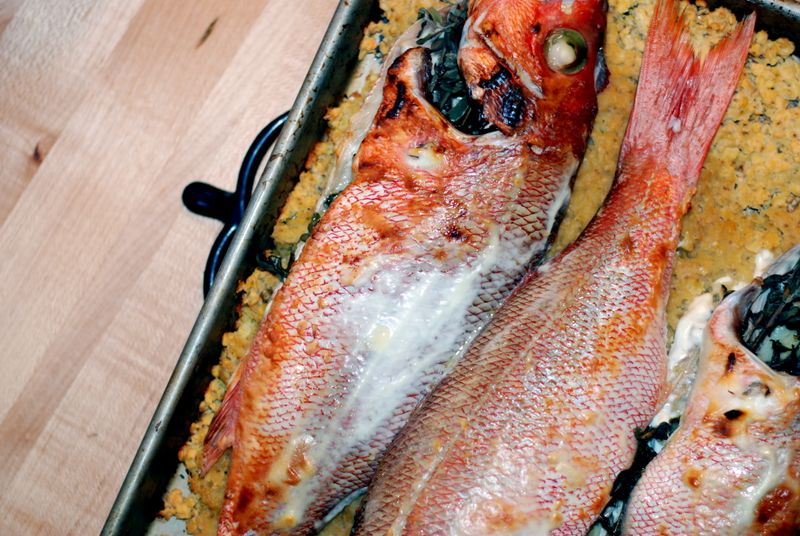
    But instead, after smearing yogurt all over a bunch of fish (red snapper because there was no striped bass to be found), stuffing them with marjoram and garlic, salting and peppering them well, arranging them on a (perplexing) bed of cooked red lentils, and roasting those suckers until they were crispy and browned, all they ended up tasting like was…nothing.

    Now if you know anything about red lentils, you'll know that once they're cooked, they look nothing like their cute, coral selves from the package. They turn into a pallid yellow mush that one of my friends kind enough to share the meal last night actually likened to baby poop. (Oops! I swore to myself last night I wouldn't reference that on this website. I think I might have had too much to drink last night, too.) Now, of course, they can taste rather nice, provided they've been cooked with something, like minced onions and tomatoes and curry powder, or, I dunno, a few sweet potatoes and ginger. But just boiled? Boiled red lentils? Taste like nothing. Roasted in the oven at 500 degrees Fahrenheit? Nothing, crisped.

    DSC_2024
    Then there's the matter of the Greek yogurt. What on earth did smearing it on and in the fish do? I still don't know. The fish sure didn't taste like the yogurt. In fact, once the fish were done, you could barely even see the yogurt anymore. It's like it evaporated into thin air! Or into very hot oven air. As for the eight whole garlic cloves and twelve sprigs of marjoram? I don't know if you'll believe me, but you must: I couldn't taste any of it. And I don't have a cold, either. The fish tasted like…red snapper. Roasted in the oven. Plain. As in, PLAIN. So it was edible, I guess, but oh, so disappointing.

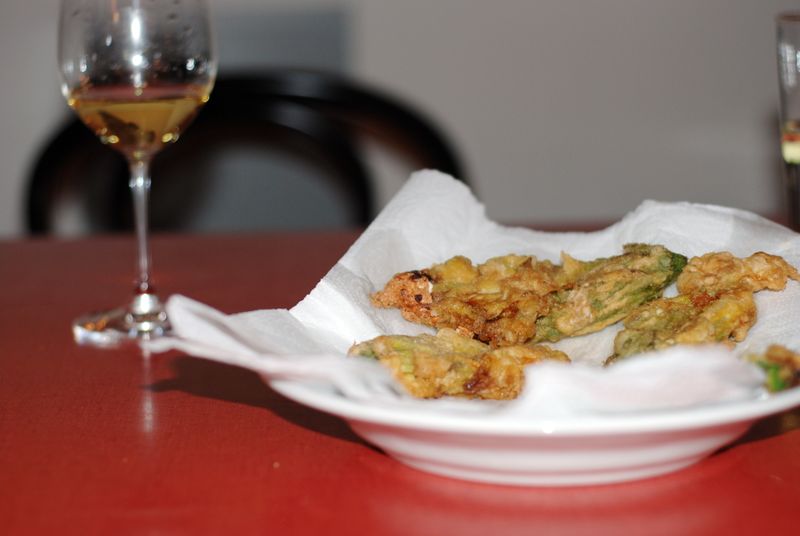
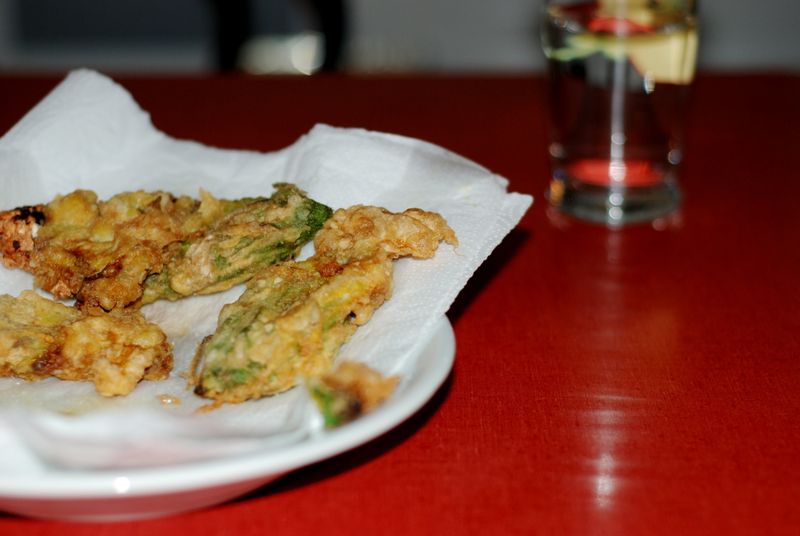
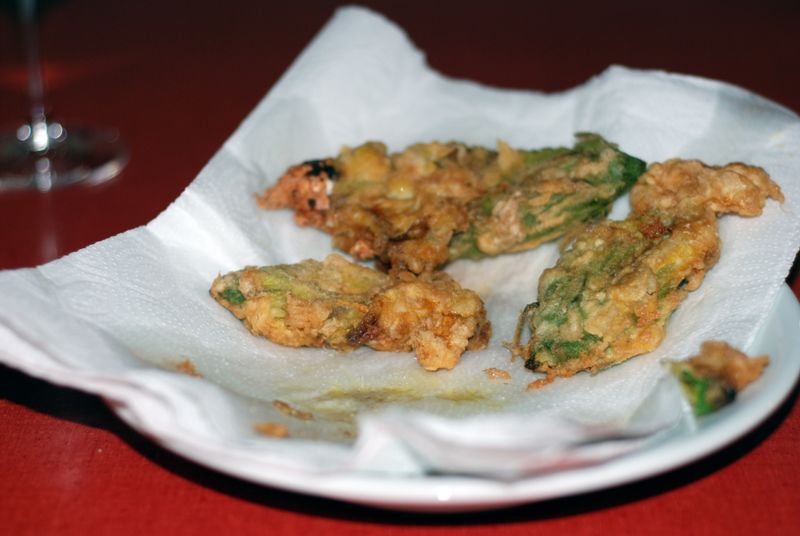
    Very luckily for all of us at dinner last night, my friend Betsy had the eminently sensible idea of overruling me at the market a few days earlier (I said they'd be too much work. Readers, I am a fool!) and buying a big package of zucchini flowers, which she stuffed with mozzarella and a dab or two of olive paste and fried into crispy, crunchy, golden deliciousness. With a cool glass of Sancerre, they made for a far better dinner.

    DSC_2022

    Okay, so a quick recipe for those of you who have yet to fry your own zucchini blossoms:

    Buy a bunch of fresh zucchini blossoms from an organic farmer so you don't have to worry too much about washing off chemicals. They should not be wilted or browned, but rather look like they were just picked, all vibrant with color. Buy a nice, firm mozzarella. This is not the time for bufala, which is too wet and milky. If you want to be totally traditional, buy some salted anchovies. If not, get a bit of olive paste, also known as tapenade. Oh, and you'll need some nice flaky salt, a few eggs, a plate of flour, and a couple of inches of frying oil (you can use olive oil, but not extra-virgin, or just regular vegetable oil).

    Pour the oil into a saute pan with sides, like this one, to the height of one or two inches. Check the blossoms to make sure they're clean and brush off any dirt you might see. Cut the mozzarella into little batons. Rinse the anchovies and cut them in half, if you're using them. Beat 2 eggs in a shallow dish, and pour flour into another dish. Working with one blossom at a time, gently open the blossom end and push in a baton of mozzarella. Then slide in half an anchovy, or a small spoonful of olive paste. Twist the top of the blossom shut. Repeat with the remaining blossoms. Turn the heat on under the pan and while the oil heats up, dip each blossom in the egg to coat, making sure the top of the blossom remains twisted shut, and then dip it in the flour to coat. Repeat with as many blossoms as you'd like to prepare (as an appetizer, consider two or three per person).

    When the oil is hot but not smoking (you can gently drop something into the oil to test if it's hot enough – if it is, it'll start fizzing and frying), gently slip the battered blossoms into the oil. Don't crowd the pan (the 10-incher we used last night fit five blossoms at a time). Fry for three to four minutes on each side, turning only once with tongs. While the blossoms fry, line a few plates with some layered paper towels. When the blossoms are golden brown on both sides, remove them to the paper towels. Sprinkle them with flaky salt and eat them immediately. Well, wait a minute so you don't burn the roof of your mouth, but not more than that. (Oh, and make sure you have a glass of nice, cold white wine nearby.) I think you'll find they're difficult to stop eating and not nearly as much work as you think they are.

    DSC_2020
    There! I've already forgotten about that silly fish and those silly, silly lentils. My work here is done. Have a lovely evening, folks!

    Oh, wait, one more thing. If you often find yourself wondering (which I'm sure you do, right?) what on earth I eat on those days when I'm not slaving away in the kitchen or munching on fried zucchini blossoms, head on over to Gourmet.com (!), where I talk with the lovely Sari Lehrer about rancid butter, Canadian yogurt, the glory that is Mexican salsa verde, and the cheapest meal in New York City.

  • DSC_1914

    I've been brainstorming.

    A home is not a home until bread is baked in it.

    Or, maybe:

    Bread baking makes a home?

    Let's see, how about this:

    A loaf in the oven, a home complete.

    That last one isn't so bad, but still, I don't know. I'm not going to become famous for my phrases anytime soon. But I really do think that it's true, for me at least, that the first time you are motivated to bake bread in your new apartment, the first time the warm smell of yeast and rising dough perfumes your rooms, is the first time you can really settle in and sigh with contentment about being home.

    Every once in a while, I find you simply need to force yourself to stay home for a few days, unplugged and quiet. Read in bed in your nightgown past lunchtime, organize your books alphabetically (or by spine color!), stare out the window at the cloud patterns for a bit, and if you're lucky enough to be somewhere rainy, listen to the droplets falling on windows and the sound car tires make when they slide past on wet, asphalted streets.

    Those are the days for bread-baking, for easing yourself slowly into the start of the autumn chill.

    DSC_1871

    So, I'll be honest: I've been a little bored by the newspaper recipes lately. More than lately, actually. All summer, I think. I've been clipping dutifully and hoarding as usual, but I haven't found anything in months that actually makes me impatient to go to the grocery store and get cooking. Instead, this weekend I started nosing around in my other recipe clippings and emerged feeling inspired. Imagine: a sweet butter-and-milk-enriched yeast bread from Ethiopia, of all places, spiced with cloves, cinnamon, and ginger and an entire tablespoon of ground coriander. Doesn't that sound like something you'd want to make right away, no question about it?

    Let me tell you that you should. It's simply lovely.

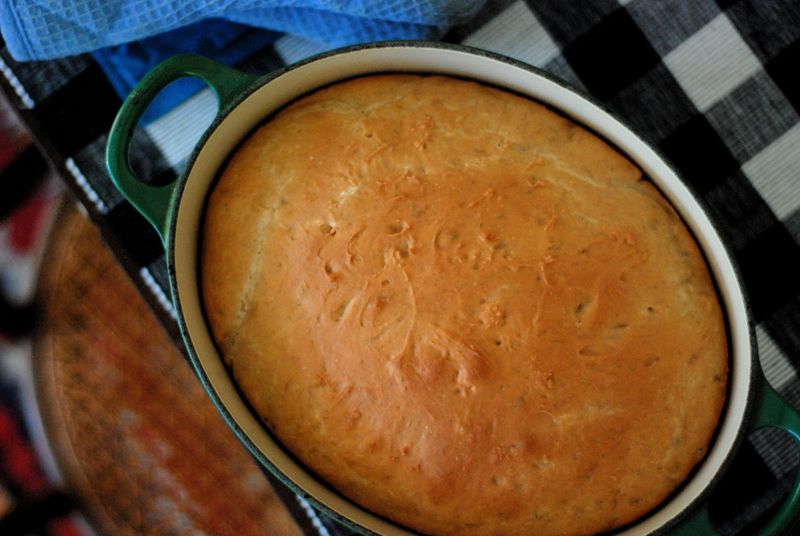
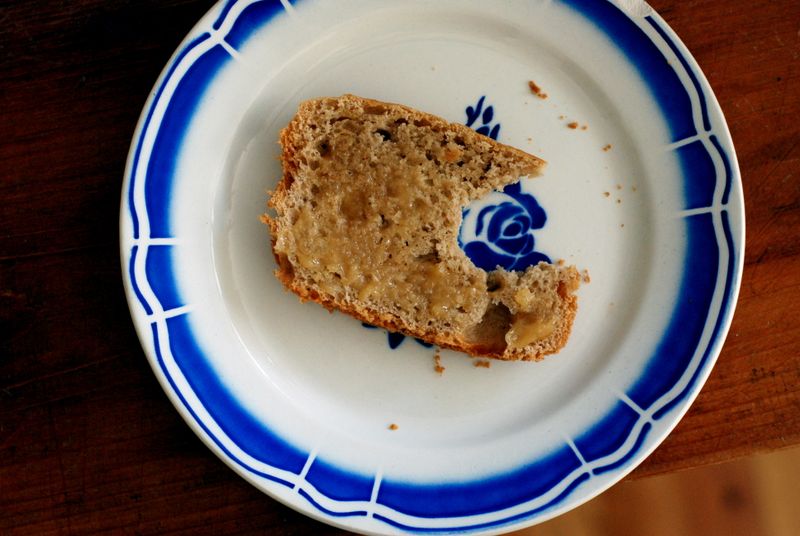
    Your house will smell like Christmas, first of all. Also, you'll get to feel all exotic and interesting: you're baking Ethiopian bread! Best of all, the bread keeps well, so you will have homemade bread for breakfast for a whole week at least (it toasts nicely, too). Gene Opton says that Ethiopians usually just eat this bread spread with butter and honey, but I found it most delicious eaten only with unsalted butter. The bread is sweet enough from all the honey in the dough, and the spices need a little bit of cooling balance, which is just what a nice thin layer of butter provides.

    DSC_1918

    I always find September both comforting and sort of terrifying. On one hand, it's the loveliest month of the year. Still sunny and warm, but with just enough nip in the air to make for cool nights and perfect sleeping weather. Limbs still tanned from the summer, but you can pull out your thin sweaters and look forward to warm shoes again. On the other hand, it's just a few warp-speed weekends until Thanksgiving and then Christmas. When you get to September, the end of the year suddenly looms. Did you get everything done that you wanted to this year? Is it turning out the way you hoped? Do you have your ducks in a row for the months still ahead that will zip past so fast you might just get whiplash?

    Don't worry. Take a deep breath and breathe. And remember this: when you bake bread, everything slows down. Life feels more manageable again. And coming up with phrases about bread-baking to accompany you into posterity seems the most important thing you can do.

    Ethiopian Honey-Spice Bread
    Makes 1 loaf

    1 tablespoon active dry yeast
    1/4 cup warm water
    1 teaspoon sugar or honey
    1/8 teaspoon ground ginger
    1 large egg
    1/2 cup mild honey
    1 tablespoon ground coriander
    1/2 teaspoon ground cinnamon
    1/4 teaspoon ground cloves
    1 1/2 teaspoons salt
    1 cup whole milk, warmed
    4 tablespoons (1/2 stick) unsalted butter, melted and cooled
    4 1/2 cups unbleached all-purpose flour

    1. Combine the yeast, water, sugar or honey, and ginger in a small ceramic bowl and set in a warm, draft-free place until it bubbles vigorously.

    2. Combine the egg, honey, spices and salt in a large mixing bowl or the bowl of a heavy-duty mixer. Add the milk and butter. Mix in 1 cup of the flour.

    3. Add the yeast mixture and beat until all the ingredients are well blended. Add more flour, 1/2 cup at a time, using only enough to make a soft dough. Use your hands, if needed, to work in the last bit of flour.

    4. Turn out onto a lightly floured surface and knead the bread by folding it end to end, pressing down and pushing forward several times with the heel of your hand. (The dough will be sticky. Use a dough scraper to clear the board and turn the mass of dough. Avoid adding more flour.)

    5. In about 5 minutes the dough will become smoother and more elastic. Shape into a rough ball and place in a large oiled bowl, cover with a tea towel, and let rise until doubled in bulk.

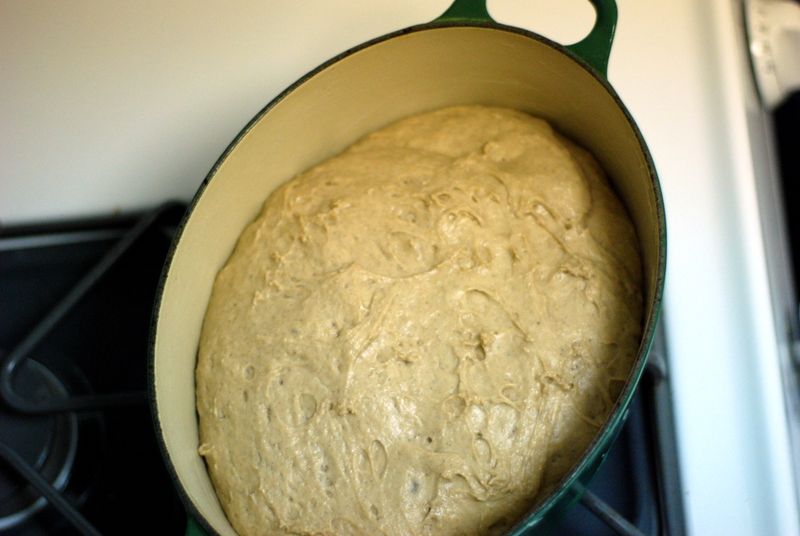
    6. Heavily butter a 3-quart round baking dish that is 3 inches deep, such as a casserole or an enameled Dutch oven. Punch down the dough with a single blow of your fist. Knead the dough for a few minutes, shape into a rough ball, and place in the prepared pan. (Press the dough down so that the bottom of the pan is covered completely.) Cover and let rise again until the dough has doubled and reaches the top of the pan.

    7. At least 20 minutes before baking, preheat the oven to 300 degrees F.

    8. Bake for 60 minutes, or until the bread is nicely rounded on top and a light golden brown. Leave in the pan for 5 minutes, then remove and transfer to a rack to cool completely before slicing.

  • DSC_1456

    The story of my summer vacation:

    One girl, one grill, several pounds of costoluto tomatoes and a tableful of happy eaters, contentedly rubbing crusty grilled bread with cloves of garlic, papery shreds falling away hither and thither, then squashing the herbed, bubbling tomatoes into the crumb, with a drizzle of olive oil on top for good measure. One of my friends visiting from England had a notebook by the ready at each meal: "How do you make this (jam crostata)?" "And this (fresh tomato sauce)?" "And that (bandiera, the Italian version of ratatouille)?" But for this treat, there is no recipe. Just good ingredients and some hot coals. We could have eaten the blistered tomatoes every day.

    DSC_1459

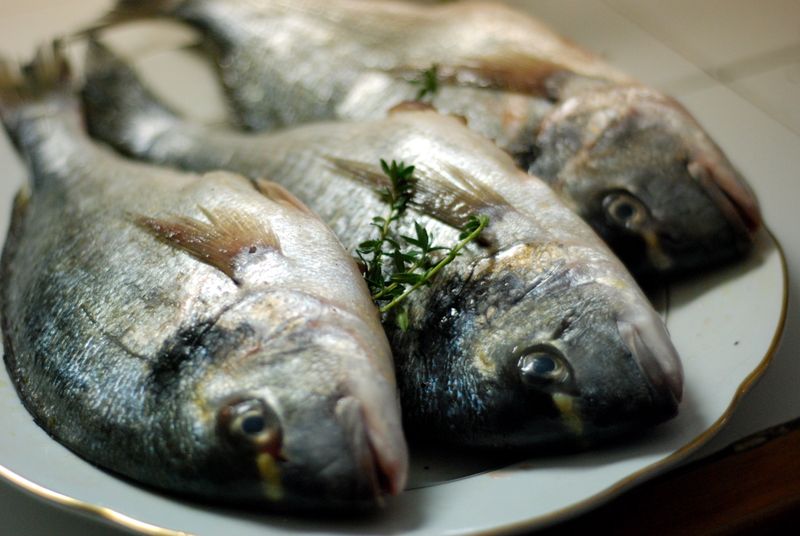
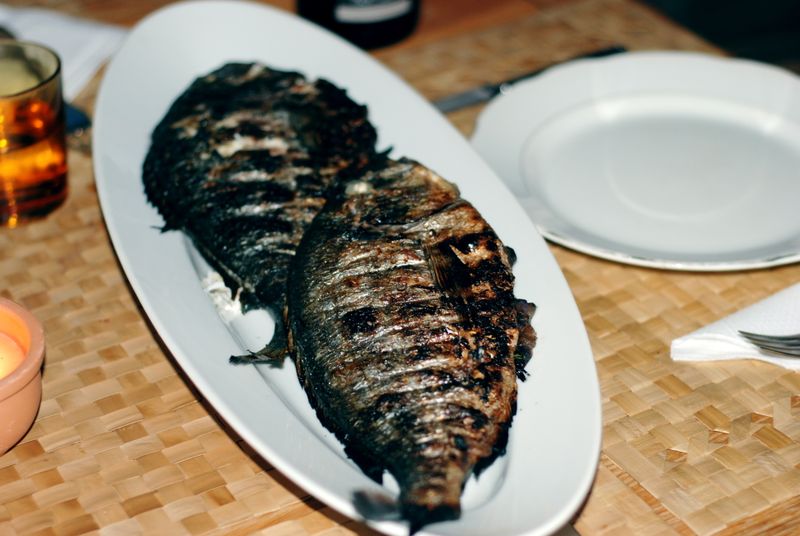
    In return for our recipes, they gave us their expertise with fire. Ian, my Scottish friend, manned the grill ably while he was there, taming the flames just so, dousing with beer when the coals required it, keeping us flush with wine and good humor. We bought plump orata at the market in Urbino on Saturday morning, from a fishmonger uncommonly happy to see us, I thought, until I realized hours later that I'd forgotten to ask her to clean the fish. That's why she was so happy, I thought. An easy sale.

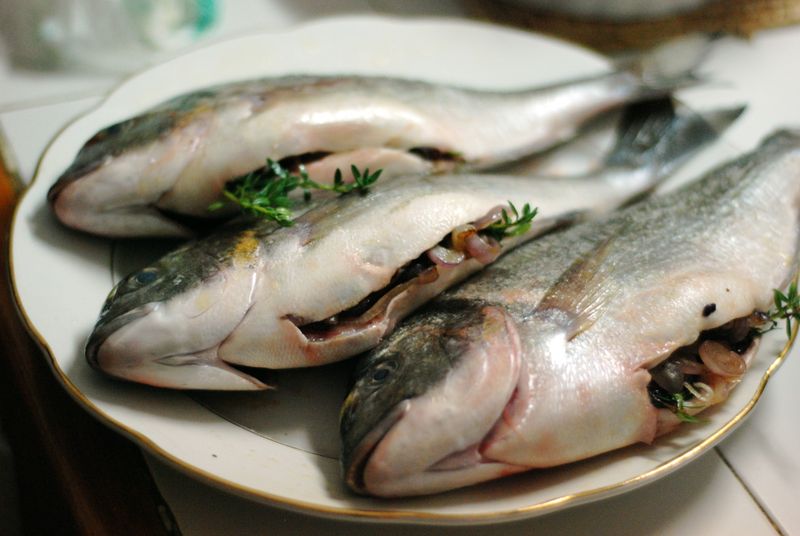
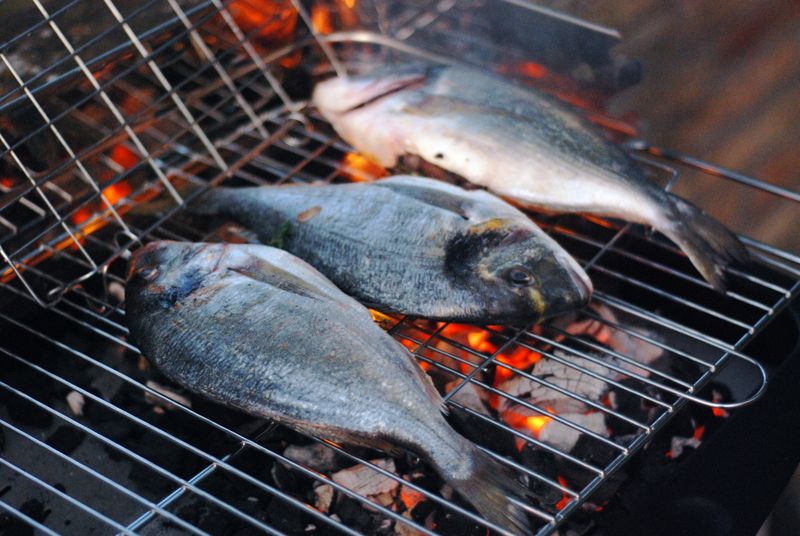
    Florence Fabricant, always uncannily on my recipe wavelength, provided the recipe: grilled onions and fresh thyme stuffed into a gutted, oiled fish, which was then grilled until flaky over hot coals. We grilled in the semi-dark, sun long gone, citronella candles providing light and scent and protection against marauding mosquitos, drunk on us. The fish was delicious, the herby onions even more so, the lemon dressing on top a must. We prepared more fish than we thought necessary and ate almost all of it, with just one little fillet remaining. It went to the cats.

    DSC_1464

    I was going to post a whole lot of photos again, as I do each time I travel, but there was something about this trip that nagged at me, something about the unhappiness and hopelessness in the people I spoke to about the political situation in Italy that left me feeling a little sad and angry, too. Italy has so much physical beauty, and you could surely stare at images of its old stone houses and rolling hills until your hair went gray. But the truth is that there is a lot of ugliness hidden behind that picturesque scenery. A lot of ignorance and racism and shortsightedness and intolerance. That country is slipping rather tragically, in so many different ways, and it is a shame, or worse, that not more people in Italy and outside of it are aware of what is actually happening there, what is being lost.

    DSC_1487

    I came back to Queens today, grateful for the throngs of people around me in the streets, in the stores, the languages around me building another veritable tower of Babel; faces smiling, frowning, simply being – black, white, Hispanic, Chinese, Korean, Bukharian, South Indian, Polish, Pakistani, Bangladeshi, Orthodox Jewish, and little half-It-with-a-German-American-soul-me.

    I know no place is perfect. But this American experiment, this incredible city, just fills me up with pride. Some days it practically brings tears to my eyes.

    (Of course I took pictures, though. I practically slept with the camera under my pillow. Photos here.)

    Grilled Orata and Onions
    Serves 4

    4 tablespoons extra virgin olive oil, more for grill
    2 whole orata or porgies, 2 pounds each, cleaned
    Salt and freshly ground black pepper
    2 medium-large onions, in slices 1/2-inch thick
    6 sprigs fresh thyme
    Juice of 1 lemon

    1. Heat grill to very hot. Oil the grates. While grill heats, use 1 1/2 tablespoons oil to rub fish inside and out. Season generously with salt and pepper inside and out.

    2. Using a grill pan, sear onion slices until lightly charred on grill, or cook them in a dry skillet on top of stove. Stuff fish cavities with onions and thyme. Grill both fish close to source of heat, turning once, until skin is nicely charred and fish are cooked through, 8 to 10 minutes a side, depending on heat of grill. While fish are grilling, mix lemon juice with remaining oil.

    3. Transfer both fish to large platter or board. Remove onions and thyme and set aside. Fillet fish by first cutting along the top and bottom edges and just below the head. Lift off top fillet and place on serving dish. Remove skeleton, head and tail. Transfer bottom fillet to platter. Repeat with second fish and arrange on platter. Scatter onions and thyme over fillets and drizzle with lemon oil. Serve.

  • DSC_1355

    It's like I've got my third hand back! Or my spleen!

    Just kidding, little camera. I've missed you, so much.

    So long, iPhone photos! It was nice to know you!

  • Photo(4)

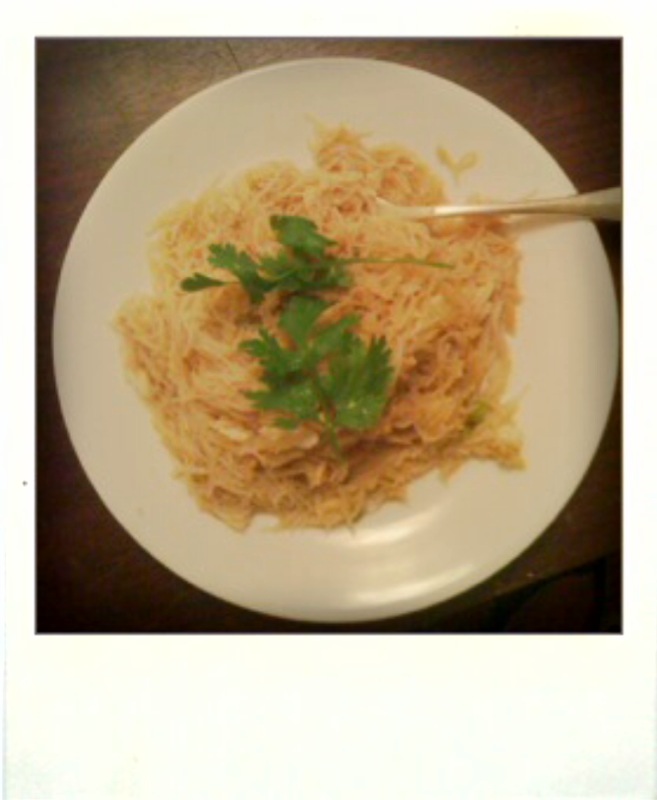
    Oh, how far have I come. Do you see that little green sprig, so innocent, so gentle, lying up there sweetly on that pile of noodles? Just a few years ago, I would have rather chewed on a stick than put a bit of cilantro into my meal, and certainly not for a reason as frivolous as garnish. Feh. But today, bring on the cilantro in all its weird glory! I want to strew with it! I might even chew on it, for a bit.

    This is what I like to call progress.

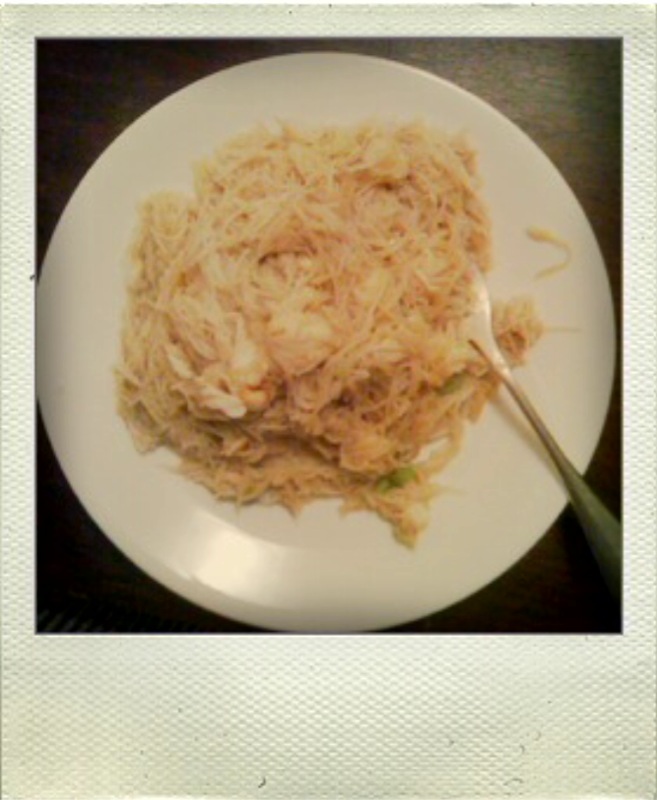
    (See wan plate below for comparison: definitely in need of a little sprucing, wouldn't you say?)

    Photo(3)

    Luckily, the dish itself is quite tasty even without the cilantro and, man, is it fast. I do believe this counts as one of the speediest meals I've ever made that involved turning on a stove (and that does not include scrambled eggs, thankyouverymuch).

    A brief aside on the nitty gritty: First of all, I couldn't find glass noodles. I bought Thai rice noodles instead, because it's all I could find that was even close, even though this is a dish from a Vietnamese chef. Don't do what I did: the rice noodles really aren't right here because of their texture, even though I thought the dish still quite delicious. You need that sort of chewy, pliant wonderfulness of a glass noodle here. Second of all, I bought canned crab instead of fresh. It was way cheaper and wild-caught, which is more than I could say for the frozen stuff available at the fish store in Forest Hills. (Which, maddeningly, closes by 6:30 every night, without fail. And refuses to label where the fish comes from. And doesn't give a hoot about all of this stuff either. Out-of-work, ethically-minded, entrepreneurial fishmongers of New York: come to Queens, would you? We need you.) Ultimately, between all the flavorings and the ratio of noodle to sauce to crab, I couldn't tell that the crab was canned (it tasted pretty good, is what I'm trying to say).

    The recipe comes from an old column called The Chef that used to run in the New York Times and that I adored. One of the section's writers, like Mark Bittman or Amanda Hesser, would go and spend some time with a chef (like Charles Phan of the Slanted Door in San Francisco, or Gabrielle Hamilton of New York City's Prune) and just shoot the breeze for a while, watching them cook, hearing them tell stories. That would get distilled into a little piece or several little pieces about the chef, his or her work and the restaurant they ran, with a few, truly choice recipes alongside (miraculously perfect for the home cook). That column is long-gone, sadly, and I never understood why. Does anyone reading this know Pete Wells? Tell him to bring back that column! It was such a gem.

    I found these noodles to be compulsively edible. They slip down easily and are pretty light to boot. Plus the combination of oyster sauce, soy sauce, fish sauce and sesame oil is irresistible: salty, nuanced, toasty, just so good. This is fast food at its best, and if you buy canned crab, even if it's wild-caught, it's cheap food, too.

    Glass Noodles with Crab
    Serves 2 very hungry people or 3 to 4 regular eaters

    2 packages (2 ounces each) thin glass (mung bean thread) noodles
    2 tablespoons neutral oil, like corn or canola
    1 tablespoon minced garlic
    1/4 cup trimmed and minced scallions
    1 cup crab meat, free of shell
    1 1/2 tablespoons fish sauce
    1 tablespoon soy sauce
    2 tablespoons oyster sauce
    1 tablespoon sesame oil
    Fresh cilantro for garnish

    1. Cover noodles in warm water for about 10 minutes. Drain.

    2. Put oil in a wok or large skillet, and turn heat to high. A minute later, add garlic and half the scallions and, almost immediately, the noodles and crab. Toss, and stir to mix the ingredients.

    3. Add the sauces, taste, and adjust seasoning as necessary. Toss with sesame oil and remaining scallions. Garnish, and serve.

  • This weekend marked this blog's 4-year birthday, which just tickles me to no end. Four years! Holy cats. Happy birthday, little blog. You complete me.

    I, of course, didn't realize it until this morning, so there was no birthday cake or candles or anything of the sort. I had a visitor in from out of town this weekend and was too busy showing off this beautiful city to raise a cupcake to the blog. Besides, it was way too hot for cupcakes. (Though we did have an entirely unexpected, truly delicious and completely random buffet lunch at Indus Express on 48th Street for the grand total of $9.95 each – not including the celebratory Taj Mahal beer! So I guess that kind of counts.)

    Instead of letting the blog blow out candles to itself this year, I'm going to list a few sites I've discovered over the past year which have made me rather hungry indeed:

    Slow Like Honey

    Bread Baby

    Not Without Salt

    The Catskill Kiwi

    Rachel Eats

    Bread & Honey

    Here's to you guys!

    And then I'm going to tell you something thrilling. I'm leaving for Italy in a few days, for my annual trip, and this year, for the first time ever, there will be a grill at the house. I don't know what exactly it will look like (though I'm gunning for something rather crude and rustic, like a steel grate over a pile of coals piled into a hole dug in the ground. Wouldn't that be scenic? My mother, I think, might currently be in the process of a dramatic eyeroll, as we speak!), but I'm getting awfully excited about cooking with it. You see, I've pretty much mastered the stovetop, and the oven, and even the broiler, too. Now, after too many meals at other people's houses where the tables sat groaning under the weight of grilled tomatoes, salsiccie, bruschetta and whole ears of corn, I've decided we don't have to live like this anymore: we, too, can grill! And grill we will.

    I'm bringing two recipes with me from the New York Times (one for a whole fish grilled in and on fresh fennel, and a recipe from Paula Wolfert for something called Roman steak), but seeing as I am a neophyte and it's my blog birthday, won't you guys inspire me with some of your grilling recipes, tips, secrets? I – and my co-eaters in Italy – thank you in advance.