• DSC_8967

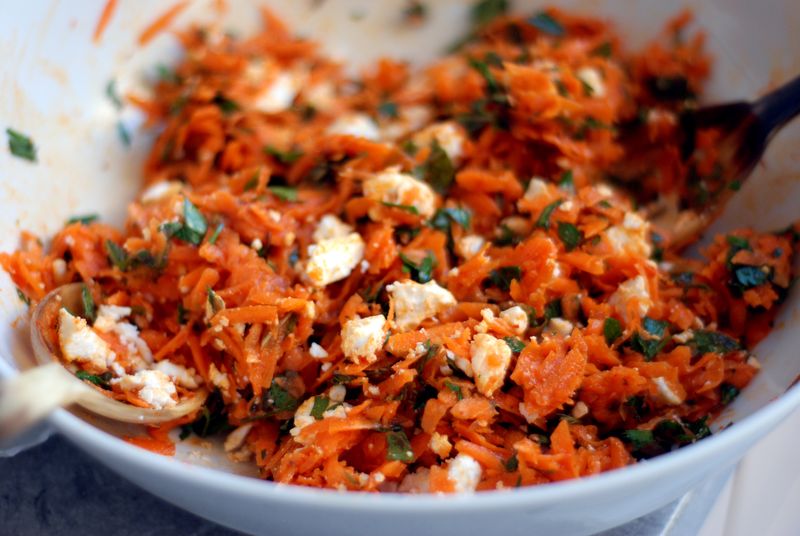
    1. Have you made this
    salad
    yet? You must, you must, you must. It, quite literally, might
    be the best thing since sliced bread. I made it for a dinner party on
    Friday night, along with a plethora of other delicious things, and this
    salad was the one thing at the meal that made everyone stop speaking and
    start pointing at their plates, mouths full, in wonder and greed. It is
    delicious. Hot and spicy, crunchy and cool, complex in texture
    and flavor. Wondrous. Deb got the recipe from Sasa who got
    the recipe from her mother who got it from a cooking magazine in New
    Zealand – all of which simply serves to reinforce the fact that the
    internet is the best thing to happen to cooking since the gods gave us
    fire.

    DSC_8805

    2. I didn't realize until a few months after moving in that I, once
    again, had chosen an apartment with an unencumbered view of the sky,
    which means that we've been hard at work documenting all the glorious
    sunsets that come our way. And lately, the sky has been so generous.

    DSC_9051

    3. The good people of
    Berlin are getting happier, whenever the sunshine intermittently cracks
    through the ever-present clouds, sometimes thin and menacing, sometimes
    plump and cottony, flitting across the sky. In general, Berlin is coming alive, as it always does once spring
    descends. The parks and meridians and sidewalks are bursting with
    overgrown grasses, blossoming trees, blowsy dandelions. The air is sweet
    and fragrant – just last night, I walked up Schlossstrasse taking
    great, deep gulps of air, scented with lilacs and chestnut blossoms and
    earth still damp from an earlier, brief hail storm. It feels like magic, it really does, when you're in the gloaming in
    Berlin and the greenery around you moves and beckons in the wind and you
    feel like there could be fairy sprites hiding in the bushes, peering
    out with glittering eyes as you pass by.

    DSC_5987

    4. Finally, you've all been very patient with my coy attempts at, uh, implying the presence of, er, romance in this space. I guess I've been a little shy. Remember
    back in the fall
    when I said that sometimes, when you're given the
    chance to do
    something that might change your life totally and completely, you have
    to take that step, make that leap, take that chance? I wasn't only
    talking about leaving my job, writing a book and moving to Berlin. I was also
    talking about a love story, the defining one of my life. One that helped
    me move mountains, or continents, if you will. Our story is a
    big one, one I'll tell you about some day, but in the meantime I figured it's time to make it official, time to bring him into the fold here, the man at my table, my heart.

  • DSC_8657

    Paximathakia Portokaliou! Paximathakia Portokaliou! I've been shrieking that in my head for the past week or so, imagining myself as a Greek maiden hawking cookies by the seashore, sun beating down on my brow, cookies crumbling in their little basket. Paximathakia Portokaliou! I mean, did you ever hear a sweeter cookie name? Biscotti, snooze. Cookies, yawn. Paximathakia Portokaliou! Cookies with a name like that must have character.

    And character they have, especially when you consider that the dough for them is kneaded by hand on a counter, like for bread dough. The process of making these cookies was such a delight. I might have mentioned I no longer have any electrical appliances in my kitchen anymore (well, besides a toaster but that joined my household once I got to Berlin). My food processor and my hand beaters and my immersion blender – I left them all behind in New York. So making cookies by the creaming method or the food processor is a thing of the past, at least until I buckle and buy a set of German beaters.

    DSC_8650

    The other day, I had friends coming over for tea and discovered I had only three crumbling cookies in a limp little plastic wrapper to offer. Paximathakia Portokaliou! (is it okay if I just make the exclamation mark part of the cookie name? I think it fits) would require everything I had in the house already and seemed like the perfect tea sweet.

    You dissolve baking soda in orange juice, then mix into that froth some cinnamon (just barely a hint of it), olive oil, lemon peel and juice and some toasted sesame seeds. I'd actually just been given a sack of lemons from a friend's backyard – in Greece – and the olive oil I used was from my mother's olive harvest last year and that, I would say, already made me feel like I was living some kind of agricultural utopian dream. If only I'd ground the flour myself!

    DSC_8653

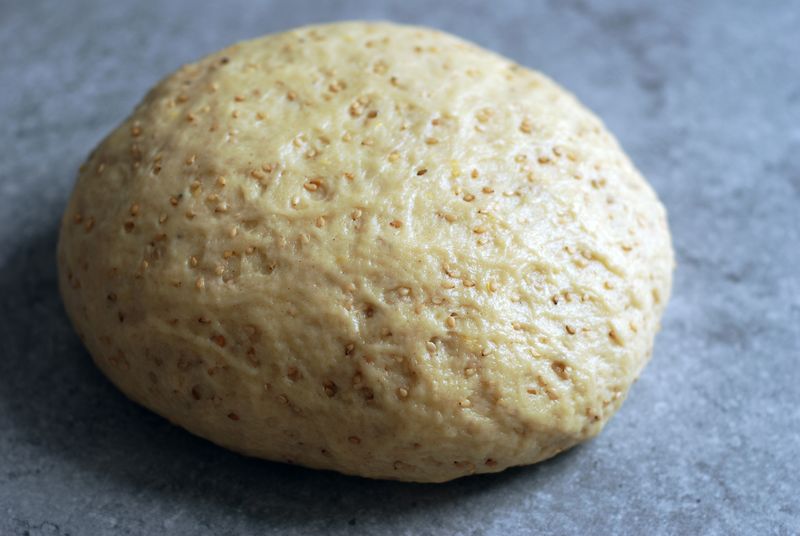
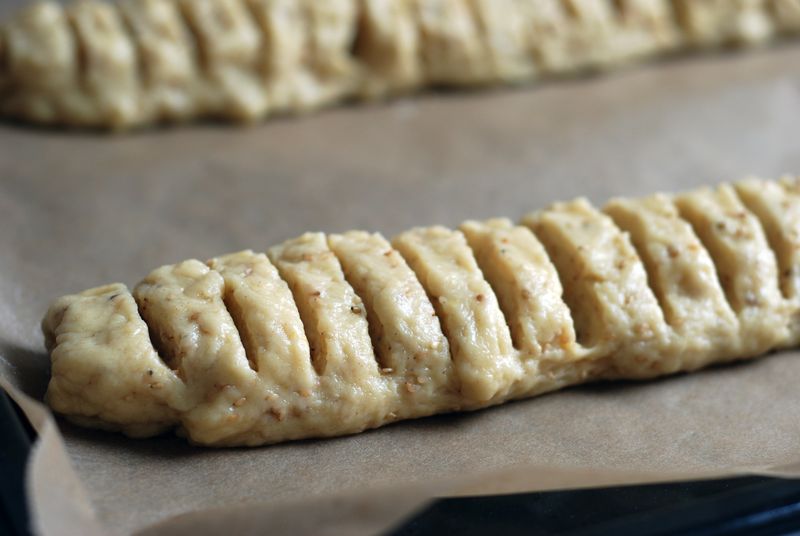
    Into the wet mixture went flour, sugar and baking powder. The dough was turned out onto the counter and within minutes, not the ten required by the original recipe, had come together into a smooth, elastic ball of dough, fragrant with citrus and spice and faintly nubby to the touch from the sesame seeds.

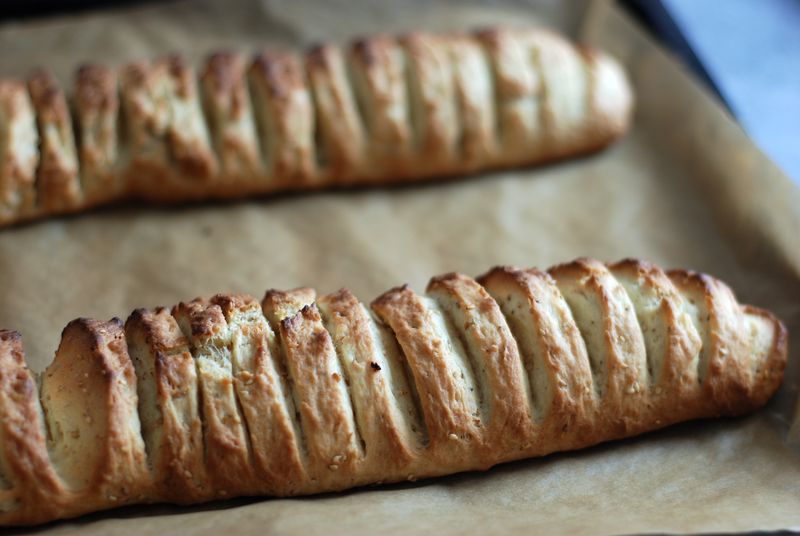
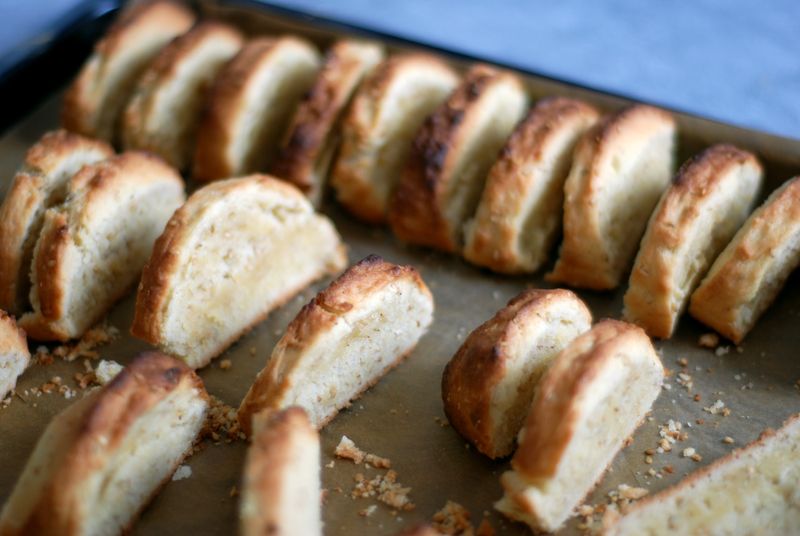
    The rest of the process is pretty simple, too. Logs are formed and sliced. Logs are par-baked then cooled. Cookies are sliced and dried out in a warm oven until crispy. Their fragrance is wonderful, as you can imagine, and eating them is lovely, too. They crunch in just the right places and are barely sweet at all. In fact, even better than at tea time, says my mother, the cookies go just right with coffee for breakfast. Did you know Italians eat cookies for breakfast? They really know how to live, huh.

    DSC_8661

    You'll have to take her word for it, dear readers, because after I made that batch of Paximathakia Portokaliou, I ate half of one to tell you about them, and then – uh – watched them all disappear. Quite literally. Poof! Paximathakia Portokaliou!, despite your imposing name, you were gone before I knew you.

    Paximathakia Portokaliou
    Makes about 4 to 5 dozen

    1/4 teaspoon baking soda
    1/3 cup plus 2 tablespoons pulp-free orange juice
    1/2 cup plus 2 tablespoons olive oil
    1 1/2 tablespoons fresh lemon juice
    1 1/2 tablespoons grated lemon peel
    1/4 cup lukewarm water
    1/4 teaspoon ground cinnamon
    1/4 cup toasted sesame seeds
    3 1/2 cups (14.88 ounces) flour
    1/3 cup sugar
    1 3/4 teaspoon baking powder

    1. Heat the oven to 400 degrees. Line a cookie sheet with parchment paper.

    2. In the bowl of a stand mixer, or in a large mixing bowl, dissolve the baking soda in the orange juice.

    3. To the orange juice, add the olive oil, lemon juice, lemon peel, water, cinnamon and sesame seeds. Beat with the whisk attachment or using a hand mixer at medium speed until thoroughly combined, 3 to 5 minutes.

    4. In another bowl, whisk together the flour, sugar and baking powder.

    5. Add the dry ingredients to the liquid in the mixing bowl slowly, using a dough hook or a wooden spoon. Then knead with your hands in the bowl until the dough holds together. Turn out the dough onto a floured surface and knead until the dough is smooth and soft, about 5 minutes, adding more flour as needed.

    6. Divide the dough in half and knead again until it is dense and holds together lightly. Form each half into a loaf about 14 inches in length and one-half to three-fourths inch high and place on the cookie sheet. Using a floured knife, partially cut the dough into one-half inch slices (slice almost to the bottom but not all the way through each slice). Repeat with the remaining half of dough, forming a second log and leaving a few inches between each as the loaves will expand as they bake.

    7. Bake the loaves until the bottom of each loaf is golden and the tops are just starting to brown, about 15 minutes. Remove the cookie sheet from the oven and lower the oven temperature to 200 degrees. When the dough is cool enough to handle, cut the slices all the way through. Place them upright on the cookie sheet, leaving a little space between each cookie. Return to the oven and bake until very dry, about 1 1/2 to 2 hours.

    8. Cool completely before storing in airtight containers or in the freezer.

  • DSC_8826

    Things improbably gone missing in the move:

    1. One tiny All-Clad skillet bought in a super-deal at Broadway Panhandler when it was still over in Soho and that was my trusty seed-toasting, meal-for-one-making, butter-melting companion for many years. This feels only barely replaceable. I'm pretty bereft. How on earth did my little soufflé dishes, my tea cups and espresso spoons, my ceramic trivets and my antique canisters all make it over, but this little darling didn't?

    2. An entire set of ivory-handled flatware. Well, forks and knives. To be fair, not as essential as it sounds since I'd had the good fortune of being given my grandmother's silver a few years ago. But still, where could it be? An entire set? When I can't sleep at night, I think about it. Is it still in some old apartment that I didn't comb over obsessively enough? Is it in a shipping container on the high seas? Is it off living the life of Riley in grass skirts on a tropical island with an endless supply of fresh coconuts?

    3. A jar of ground coriander. Huh? A half-roll of Saran-Wrap made it over (don't ask). A nearly empty jar of dried summer savory from Penzey's made it over, too. (Seriously, don't ask). But this, a brand-new jar, fragrant and much, much needed, didn't?

    A skillet, flatware, ground coriander. Is this some kind of message from the other side? Am I supposed to be understanding something about what's gone missing? 

    I know. That's a lot of questions for a Wednesday morning.

    DSC_8815

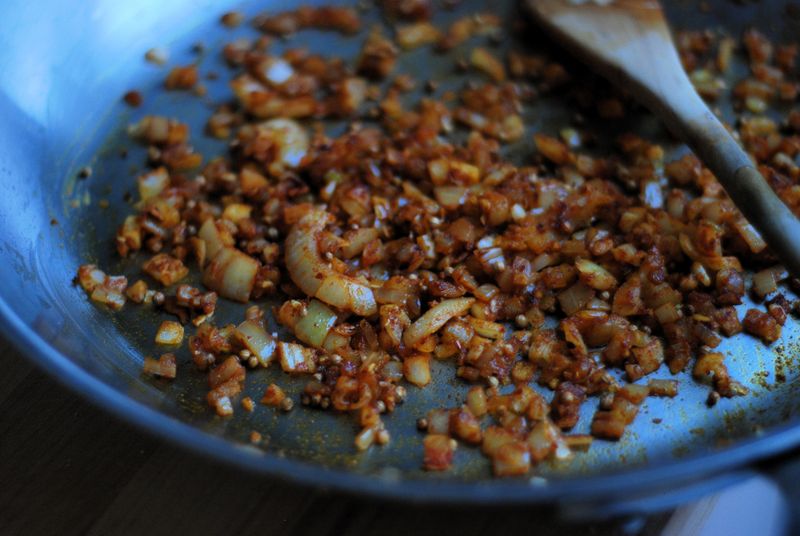
    I discovered the loss of the ground coriander and the baby skillet in the midst of making dinner the other night, which, as you probably know, is not the best time to realize you don't have something that you were pretty darn sure you had. So sure you didn't even check. Still, Julie Sahni's recipe for green beans in a simply spiced coconut sauce had needled its way into my head and was sitting there, setting off fireworks, until I got to cooking and it didn't really matter, until dinner was done – whole coriander subbed in for ground, a little pot used for toasting almonds instead of my skillet – and gone.

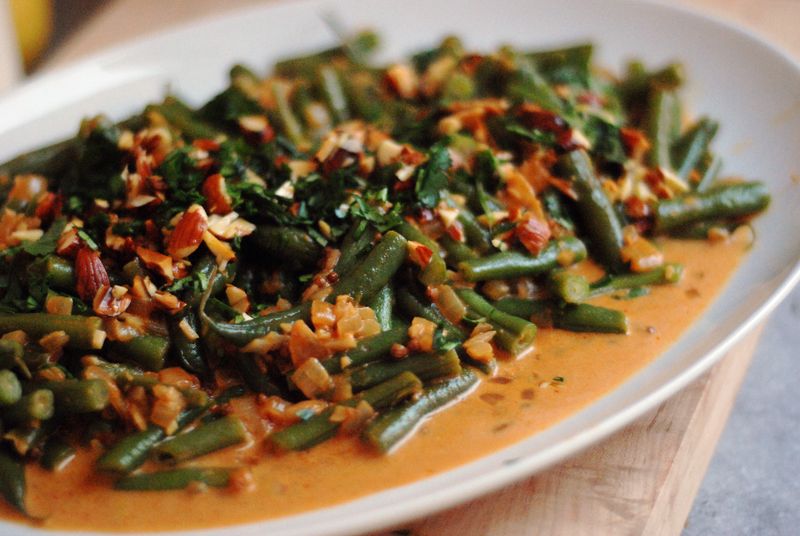
    Yes, done and gone. That's about how fast it was to both cook the meal and eat it. For those of you still afraid to cook Indian food because of the time you think it takes, and the complicated list of ingredients, I've found your recipe. This dish took less than 15 minutes to cook, and only a few minutes more to prep. And the ingredients are all easy to source, especially if you live in a country that sells more than just basil in the herb section of the grocery store (ahem, Germany).

    We gobbled up the whole dish in an unseemly amount of time, white rice soaking up the delicious sauce. "Delicious!" was exclaimed. "So good!" was declared. Plates, dear readers, might even have been licked. The only Indian food I've had since coming to Berlin in December were takeout meals in London and New York, go figure. So I suppose eating politely and demurely was going to be off the table anyhow.

    And even better than the speed and ease with which this was cooked, was the fact that the green beans can be replaced with cauliflower or eggplant, among other vegetables, and the idea of soft, yielding eggplant stewed away in this creamy, velvety sauce is enough to make me forget about any skillet, ground spice or flatware I ever possessed and dream only about the future.

    Bihari Green Beans Masala
    Serves 2 as a main course with rice

    2 tablespoons vegetable oil or light olive oil
    2 tablespoons sliced almonds
    1/2 cup finely chopped onion
    3 large cloves garlic, finely chopped
    1 teaspoon ground cumin
    1 teaspoon ground coriander
    1 teaspoon sweet paprika
    1/2 teaspoon red chili pepper flakes
    3/4 teaspoon kosher salt
    3/4 cup coconut milk
    3/4 pound green beans, trimmed and cut into 1-inch pieces
    1 teaspoon lime juice
    2 tablespoons chopped cilantro

    1. Heat the oil in a 3-quart sauté pan over medium heat. Add almonds and cook, stirring, until light golden. Remove from heat and transfer almonds to a plate or bowl; set aside for garnish.

    2. Add onion, garlic, cumin, coriander, paprika, chili pepper flakes and salt to the unwashed sauté pan, and return to medium heat. Sauté until the onion is tender and begins to fry, about 4 minutes.

    3. Add coconut milk and green beans. Mix well and bring to a boil. Reduce heat to medium-low and cook, covered, until the beans are tender, about 6 minutes.

    4. Sprinkle beans with lime juice, and toss lightly. Transfer to a warmed serving dish and garnish with almonds and cilantro. Serve with plain cooked rice or roti flatbread.

  • DSC_8363

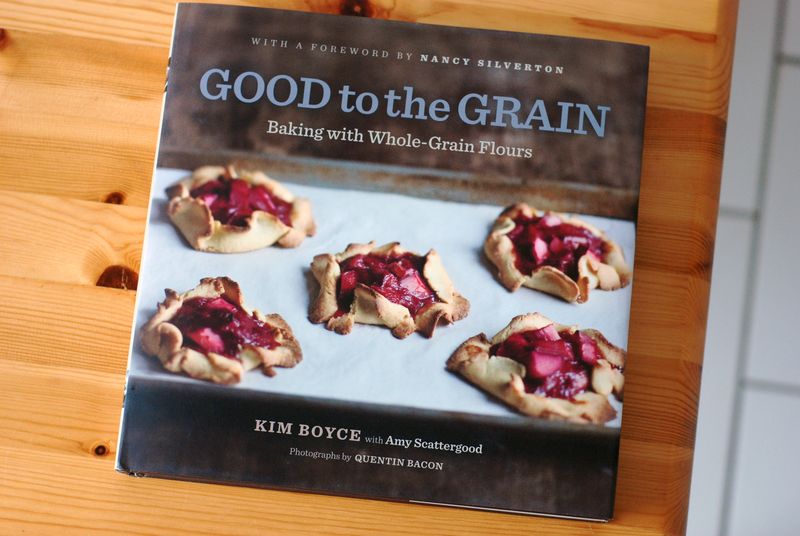
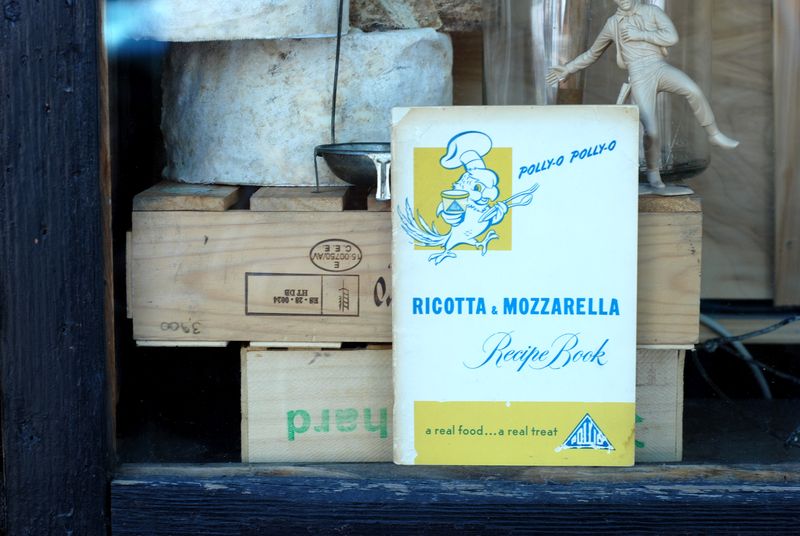
    Here's a little story for you. One day, years ago, I read an article in the Los Angeles Times about a pastry chef named Kim Boyce who was learning how to bake muffins with whole-grain flours so she could feed her two little girls snacks that were delicious and healthy at once. Sounds sort of familiar, doesn't it? Except the recipes included were anything but familiar. Kamut muffins made with Cotswold cheese, or oat flour muffins studded with apples, these muffins sounded…spectacular. I made a batch of whole-wheat muffins with yielding pockets of roasted sweet potatoes and mooned over the whole batch.

    A few years later, sitting at my desk at the company where I edited cookbooks, an agent sent me a proposal for a book. Written by Kim Boyce. But instead of a book of muffins, I found a proposal for a book stuffed with dozens and dozens and dozens of recipes, for cakes, breads, pie doughs, and more, all made with different kinds of whole-grain flours, all bound together by Kim's brilliant philosophy: that whole-grain flours shouldn't just be eaten for their nutritional value, but rather for the subtle and delicious flavors each one had, especially when combined intelligently with flavorings like ripe apricots, dark chocolate, damp Muscovado sugar, rhubarb-hibiscus compote or fresh herbs.

    Like I said. Brilliant. It took me one read through Kim's proposal to know that I had to publish her book. And also bake every single thing she mentioned.

    So yes, this isn't an impartial post. This post is about as biased as you're going to get. But trust me when I tell you this book is a marvel. I don't know how to pick which recipe is worth the price of the book, because each one is.

    DSC_8364
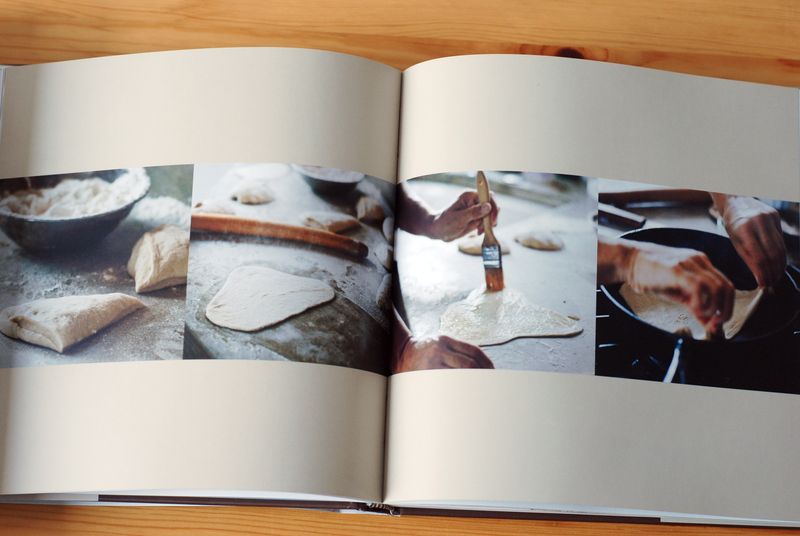
    Chewy, pliant flatbreads made with amaranth flour, sprinkled with herbs and griddled on a cast-iron pan? We ate them coming off the stove, fingers hot and oily. They were gone in minutes.

    DSC_8378

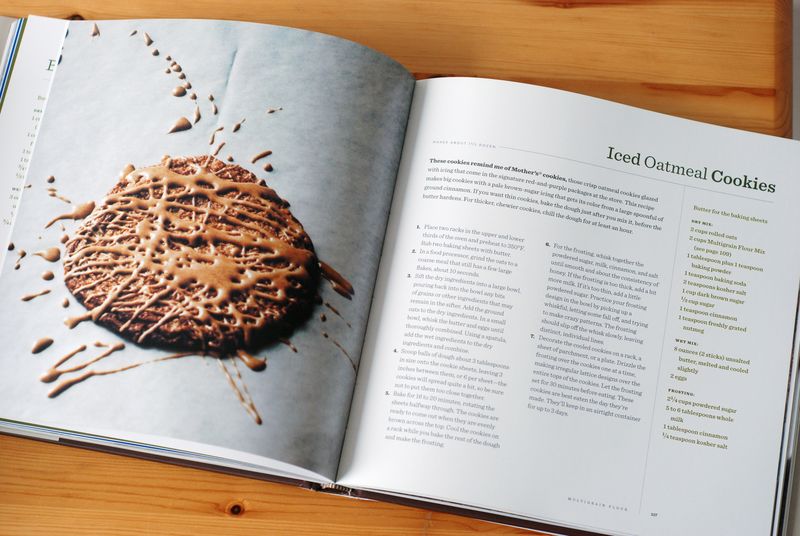
    Oatmeal cookies, palm-sized and iced with Jackson Pollockian drizzles, made with a mix of flours like barley, oat, millet and rye. Just as chewy and perfect as the ones you get at the convenience store. Except, you know, better.

    DSC_8381
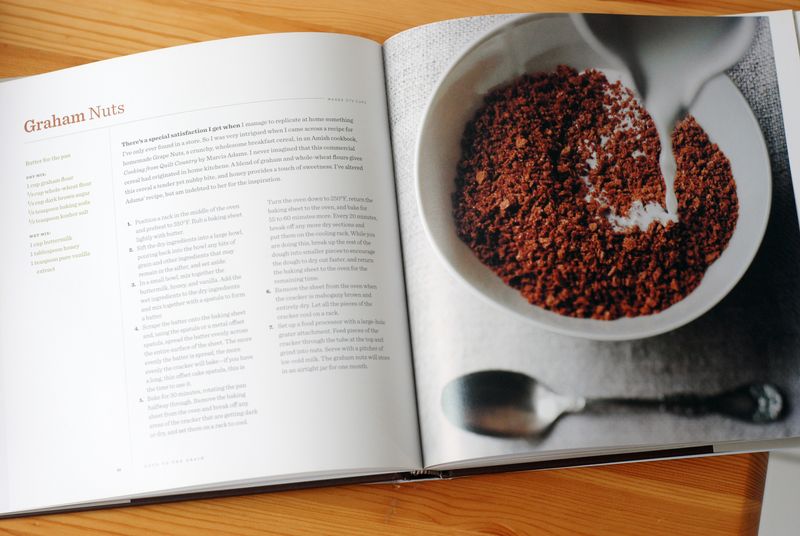
    From graham crackers made with teff flour to chocolate babka made with Kamut flour to flaky rye pie dough to homemade cereal uncannily resembling Grape-Nuts, made with graham flour and buttermilk, everything in this book is wonderful. Delicious. Interesting. A classic. Things I'll be making and baking until I'm old and gray, I know it.

    The point is not that you're remaking classic recipes as healthy alternatives, but rather that Kim's desserts are stand-alone gems in their own right. You'll find yourself craving her whole-wheat chocolate chip cookies because they taste better, full-flavored and rich, than others you've made before, not because they're made with whole-wheat flour. You're also learning that whole-grain flours have subtle flavors to be teased out.

    Did you know that corn flour shines when paired with bright, fruity notes? Or that oat flour has a milky flavor best paired with chocolate or butter? Amaranth is grassy and meant to be mixed with musky sugars like Muscovado. Buckwheat is faintly bitter and needs fall fruits to show off its complex character. Kim put an enormous amount of work into this book – every page is filled with information. I learned so much working on this book and cooking from it.

    DSC_8414
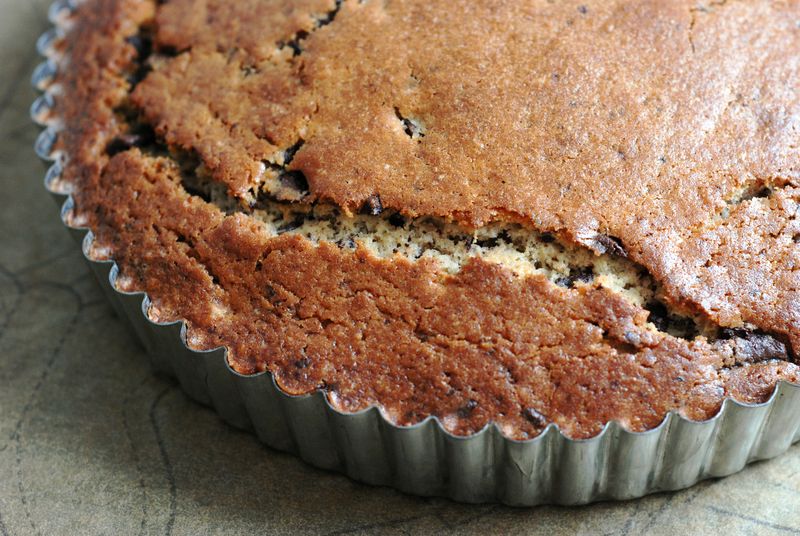
    My most recent discovery from its pages is this humble-sounding Olive Oil Cake. Ho-hum, you might say. Haven't we been here before? It's probably citrus-flavored, you think, and a little boring. Okay, so listen to this. First of all, it uses a combination of spelt flour and all-purpose flour. Just so that the cake has a little character, a sturdy little crumb, appealingly speckled. Then, you add chopped dark chocolate and minced fresh rosemary.

    I know. I did not think I would ever be a fan of rosemary in cake. I like it on my potatoes just fine, but in my desserts? Nah, no thanks.

    Silly me. If anyone was going to make the combination not only seem right, but essential, it'd be Kim. I don't know how she figured this out, but the fruity olive oil, the dark funk of the chocolate and the herbal, aggressive rosemary combine in the heat of the oven to produce the most astonishing thing: a simple tea cake that tastes complex and deep and delicious, with a flavor that is very, very difficult to put your figure on. It tastes so bewitchingly good, you will find yourself thinking about the cake the day after you make it, and the day after that as well, trying to find excuses to bake another round of it. Pretty wonderful.

    Do you ever pick up a book and just sort of feel like you were meant to be holding it, that if you could be kindred spirits with an object, that book would be it? That's how I feel about Good to the Grain. I clutch it to my chest periodically, find myself poring over the pages, the rich colors and photos, getting hungry with each passing page. Yes, if books could be kindred spirits, this one would be mine. Its author already is.

    Olive Oil Cake
    Serves 8

    Kim's note: You don't need to use a specialty olive oil for this cake. But if you have one with a lot of flavor, the cake will be that much better.

    Olive oil for the pan
    3/4 cup spelt flour
    1 1/2 cups all-purpose flour
    3/4 cup sugar
    1 1/2 teaspoons baking powder
    3/4 teaspoon kosher salt
    3 eggs
    1 cup olive oil
    3/4 cup whole milk
    1 1/2 tablespoons fresh rosemary, finely chopped
    5 ounces bittersweet chocolate (70% cacao), chopped into 1/2-inch pieces

    1. Preheat the oven to 350 degrees F. (175 degrees C.). Rub a 9 1/2-inch fluted tart pan with olive oil.

    2. Sift the dry ingredients into a large bowl, pouring any bits of grain or other ingredients left in the sifter back into the bowl. Set aside.

    3. In another large bowl, whisk the eggs thoroughly. Add the olive oil, milk and rosemary and whisk again. Using a spatula, fold the wet ingredients into the dry, gently mixing just until combined. Stir in the chocolate. Pour the batter into the pan, spreading it evenly and smoothing the top.

    4. Bake for about 40 minutes, or until the top is domed, golden brown, and a skewer inserted into the center comes out clean. The cake can be eaten warm or cool from the pan, or cooled, wrapped tightly in plastic, and kept for 2 days.

  • DSC_8304

    I came back from New York with a burning urge to read. I haven't read much past my weekly New Yorker since moving to Berlin and without realizing it, had started to feel a little bereft. This bookworm needs her friends! Her crisp hardcovers and soft-edged paperbacks with dogeared pages. Right now I'm elbow-deep in Kim Severson's Spoon Fed and enjoying it immensely. It's the kind of book I'd like to plow through in one fell swoop and the only reason I haven't done that yet is I'm trying to make it last.

    Like many recent books about food culture in America, there is a bit in the book about Marion Cunningham, she of the yeasted waffles, James Beard's bosom buddy, reviser extraordinaire of The Fannie Farmer Cookbook. Reading about Marion always makes me want to hustle into the kitchen in two seconds flat and get busy making spoon bread and one-bowl chocolate cakes.

    You know what is so cozy? Lying in bed (in my bedroom under the eaves of the roof), listening to a gentle rain, reading about Marion Cunningham, then getting up, padding down the hallway to the living room where I can pull out Fannie Farmer from the bookcase, get back into bed, and curl up with two good books at once. Really, it's the only way to spend a rainy morning.
    DSC_8275

    Anyway, along with the big, fat, white spears of asparagus from the regions near Berlin currently flooding the farmer's markets and bewitching me in all their odd, white, mandrake-root-like beauty, rosy rhubarb is the other thing I can't seem to get enough of. Every time I pass a pile of those red stalks, my body is sort of propelled over to them and I find myself buying a kilo or two, even if I've already got plenty at home as it is. I can't resist the rhubarb. Can you?

    My latest clutch of stalks had been hanging out on my kitchen counter for the past day or two while I dithered back and forth on how to cook them. Roasted with white wine and vanilla bean? Chunked and marmaladed with grapefruit peel or ginger? Turned into a sort of crisp-crumble with spelt flour streusel? (More on that spelt flour business soon.) But then I found myself in bed with Marion Cunningham and Fannie Farmer, reading about rhubarb Betty, and that's when all other plans shot straight out the window.

    In the pantheon of homey American desserts, I've known crumbles, grunt, slumps and pandowdies. I've done crisps and buckles, too. But the Betty always remained just out of sight. I never knew quite what to expect from a Betty. It was too abstract, the name made even less sense than the other ones, and besides, I was too busy mastering baked dumplings and crumble toppings to really pay attention.

    But. Oh, but.

    I should have known that something as humble-sounding as a fruit Betty would win my heart.
    DSC_8286

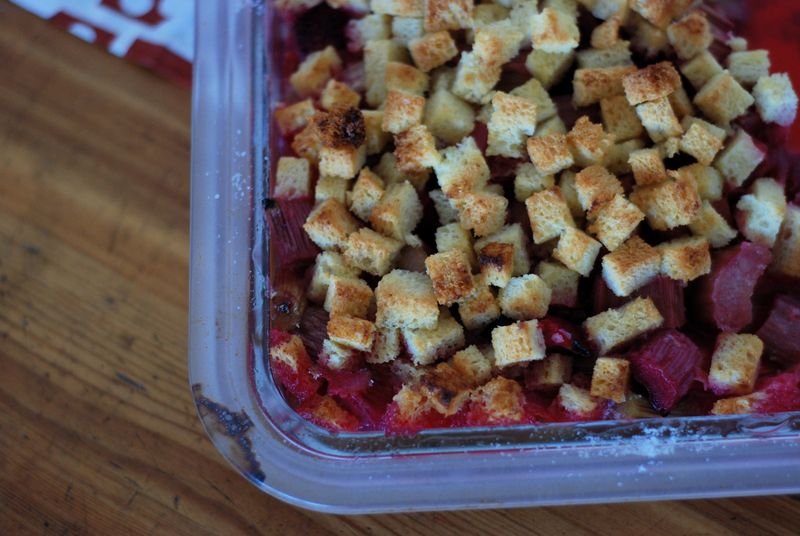
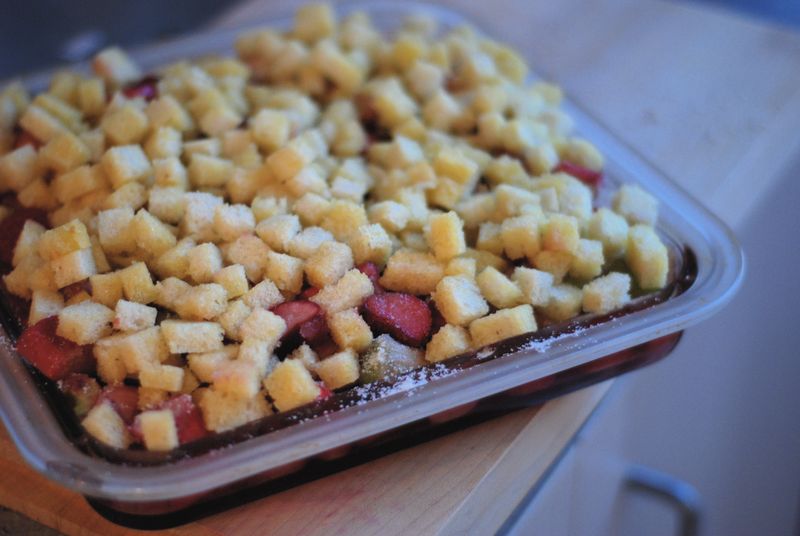
    Betties are, to be precise, the most austere of those homey desserts. The plainest, the strictest, if you will. Simply fruit and sugar topped with butter-soaked bread cubes. That's it. No batter, no streusel, no dumplings. Like deconstructed summer puddings. But more Puritan and with a bit more crunch.

    Now, a Betty won't appeal to everyone. What I find so wonderful about its stripped-down, bare-naked self won't necessarily be your cup of tea. Perhaps you need a yielding cake or a spice-scented topping to make you happy. But if you, like me, are always on the hunt for fruit desserts that can be whipped up in the flash of an eye, don't sit like a lead brick in your belly and can do double-time as breakfast the next day, provided you have some plain yogurt lying around just waiting to be dolloped, then consider yourself in business.

    Marion's original recipe has you stew a couple pounds of rhubarb with sugar and water on the stove before baking it with homemade breadcrumbs. When it's done, you serve it alongside sliced strawberries and whipped cream. Sounds wonderful, doesn't it? Indeed. The thing is, I'm a little tired of the strawberry-rhubarb combination. In fact, I think we should give it a rest for a bit, along with goat cheese and beet salads. Yes? Doesn't that sound like a good idea?
    DSC_8306

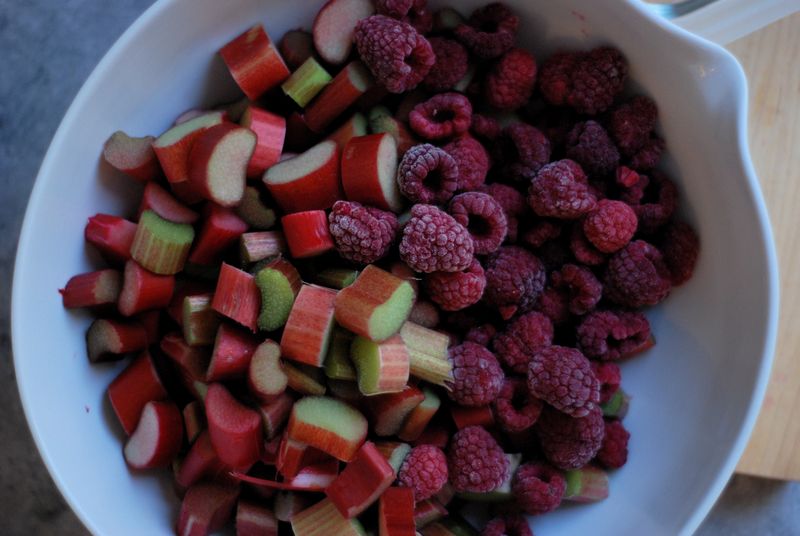
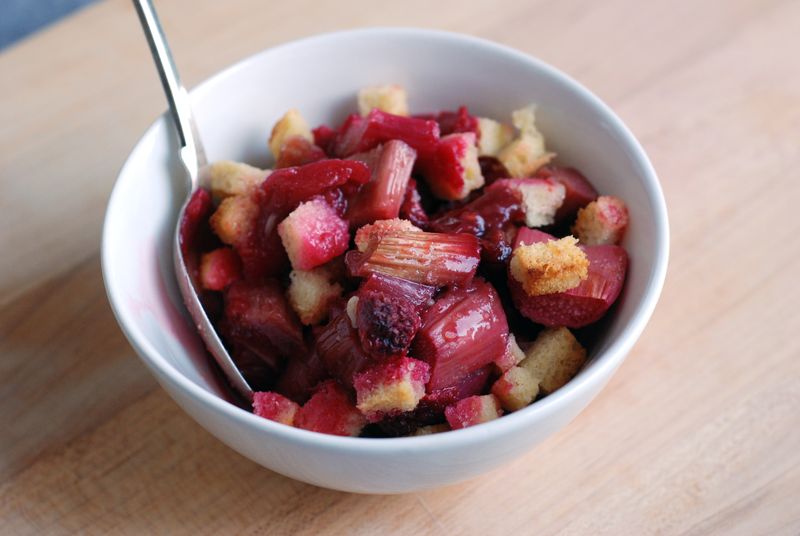
    So I bought a box of frozen raspberries instead. And while I was at it, decided not to stew the rhubarb since that would make it fall apart and go a little pallid. I tossed the rhubarb with the raspberries and sugar (not as much as Marion first called for), then baked it in the oven for a few minutes while I prepared the bread.

    Oh right, and instead of making breadcrumbs, I cubed several slices of plain white bread, then tossed those cubes with melted butter. Less butter than originally called for! I'm such a rebel, on all fronts. Look at me, having my way with this recipe! (I miss my food processor.)

    I pulled the fruit from the oven after five minutes or so, topped the fruit with the cubed bread and put it back in the oven to brown and crisp and bubble.

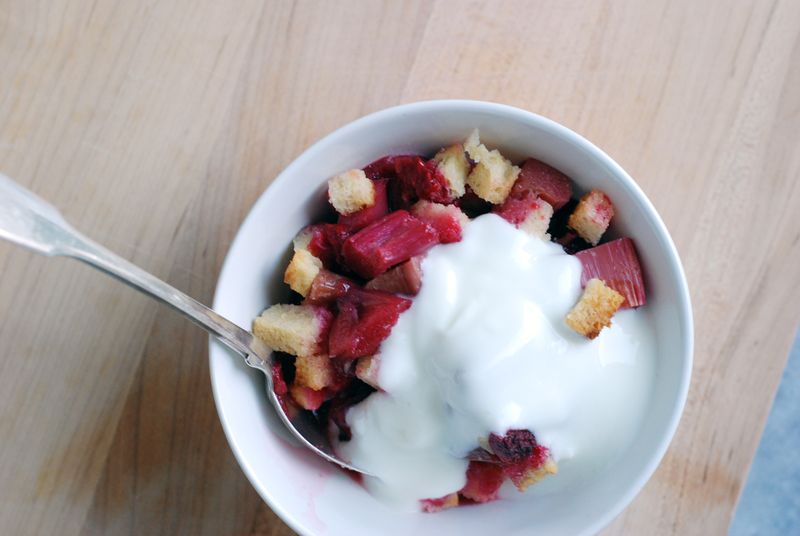
    Baking the fruit instead of stewing it allows it to keep its shape and its lustrous color. The raspberries looked like fat jewels among the chunks of rhubarb. The bread cubes, toasted and crunchy and rich, were textural marvels against the silky fruit. There was a good amount of syrupy juice at the bottom of the pan, which you'll want to spoon over each serving, soaking the bread crumbs a little, mixing in with whatever cream or yogurt you decide to dollop on top.

    It's rather crucial, that final dairy dollop. Without it to smooth out the rough edges of the fruit, a Betty could be a little harsh, a little unrefined. But with the sweetness of cream or the sour slap of yogurt, the Betty turns into a delightful little dish, bound to cause polite giggles over the name to turn into rather greedy demands for second helpings and more.
    DSC_8312

    This week, I keep thinking about inspiration and how crucial it is for our well-being. Inspiration keeps us moving forward and energized, connected with the world around us. I'd been feeling a little lonely and lost before I went to New York. I'd look at my recipes and my books each day and couldn't seem to wrap my head around them. Then I'd stare at the blank page in my computer, trying to write a blog post or a chapter, and it was like my head was filled with cotton wool, or worse, nothing.

    Today, as I eat my leftover Betty for breakfast, and feel like I'm bubbling over with ideas and plans for the next few months, I have to thank Marion Cunningham for the inspiration for the recipe, Kim Severson for reminding me to look at that Fannie Farmer cookbook again, and my friend and agent Brettne for nudging me to read a little more. One thing leads to another and another and before you know it, you're writing an ode to Betties and feeling like everything is possible again. Life is pretty wonderful that way.

    Rhubarb-Raspberry Betty
    Serves 6

    1.5 pounds trimmed rhubarb stalks, in 1-inch pieces
    1/2 pound frozen or fresh raspberries
    1/8 cup water
    1 cup sugar
    2 cups cubed white bread (5 to 6 slices)
    5 tablespoons butter, melted
    For serving, plain yogurt, sour cream, or cream, whipped or to pour

    1. Preheat the oven to 350 degrees F. (175 degrees C.). Toss the rhubarb and raspberries with the sugar. Pile into an 8-inch square baking dish. Bake in the hot oven for 5 minutes.

    2. While the fruit is baking, toss the cubed bread with the melted butter. Remove the dish from the oven, evenly scatter the buttered bread cubes over the fruit and place back in the oven for 30 minutes.

    3. Let the betty cool for 5 to 10 minutes before serving with a dollop of plain yogurt or sour cream or a jug of pouring cream or even whipped cream.

  • DSC_7772

    I got off the airplane at JFK last week and the first thing I noticed was that warm, breezy air wafting around me, tinged slightly with the scent of jet fuel, but warm and welcoming all the same. Hello, New York.

    DSC_7780

    This old view, from a highway in Queens, used to make me gape every time I came around the bend. Well, it still does. Doesn't matter that I don't live there anymore. New York rising up from the ground like a mirage, steel and glass shimmering in the afternoon sun, it's enough to make you cry. Or laugh. In all of its improbable, breathtaking beauty.

    DSC_7788

    From the cold, hard edges of buildings.

    DSC_7793

    To the soft, pink petals of the blossoming trees.

    DSC_7797

    New York is for cheese-makers.

    DSC_7799

    New York is for dreamers.

    DSC_7807

    New York is for patriots and for visitors.

    DSC_7809

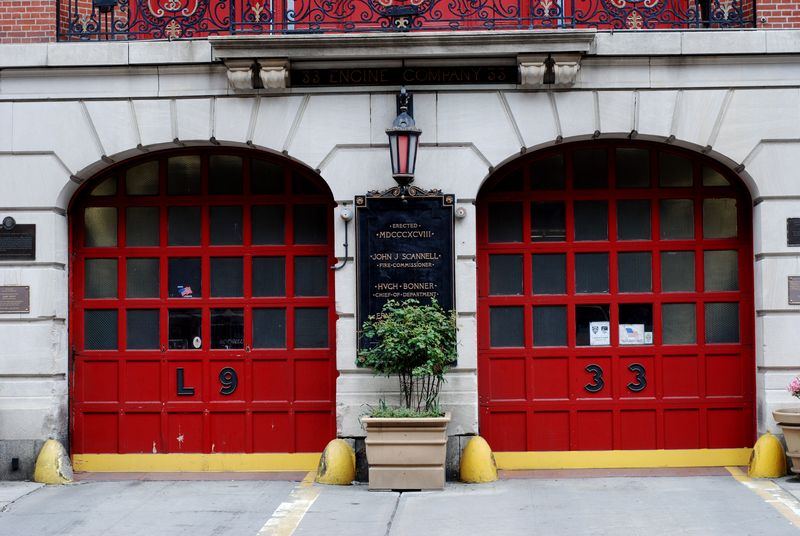
    New York has lots of hidden messages in its nooks and crannies and crevices, waiting to make you smile.

    DSC_7836

    The breadth of its sky is unparalleled. It feels different than anywhere else: huge and unlimited.

    DSC_7842

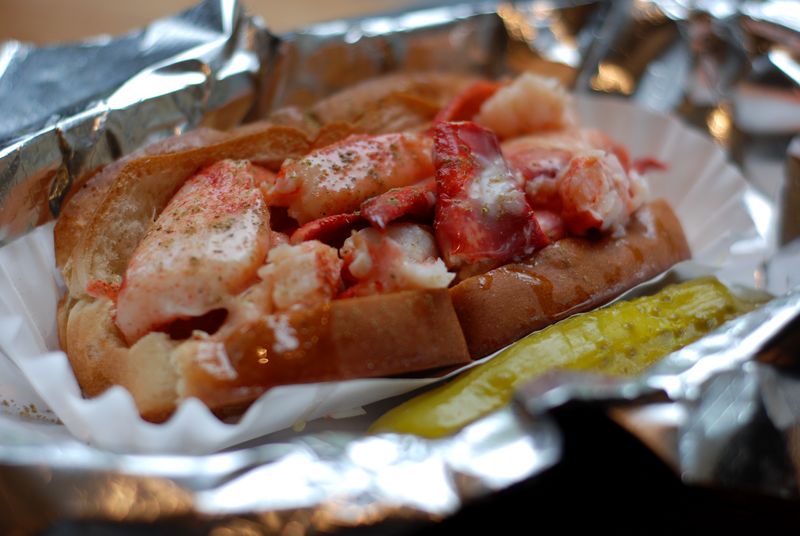
    I didn't pay much attention to food this week; I was distracted by all the people, the streets, the smells, and, of course, my friends. Still, this lobster roll stood out: pure, unadulterated deliciousness. Better than anything I'd ever eaten in Maine. Isn't that just like New York? Always doing it a little bit better?

    DSC_7847

    The first few days back in New York were hard. I had tears in my eyes on every street corner. Felt like I was in a glass box watching my old city, my old life, pass me by. I saw everything I'd given up right in front me, literally close enough to touch. The energy and exhilaration of just being in New York; well, I'd missed both. So much.

    DSC_8150

    Yet, as the days passed, and the rawness subsided, I started to feel more peaceful. Look at this city! I thought. I was so lucky. I am so lucky. I got to live here. This was my home. And in a way, it still is.

    DSC_8106

    I think, later, when this year has passed and I can look back with some measure of perspective and distance, this trip will stand out as something important. Not just a quick vacation to see friends, but some kind of turning point, a moment in time in which everything started to fall into place.

    DSC_7953

    It was also immeasurably inspiring. I don't know yet how to write about this without dissolving into a puddle, but my friends in New York, well, they really inspire me. They make me proud to know them. Kind, funny, interesting, smart: they made me want to do better, write more, laugh louder. I wish I could have told them all in person just how much they mean to me, but this blog will have to do.
    The world. Is what they mean to me.

    DSC_8125

    So, taking leave was hard. Of course it was. I buried my head into my book on the way to the airport and refused to look out the window. I didn't want to see those train tracks passing by, the gleam of yellow cabs, the sheen and shine of the city as my train pulled away, pulled me away.

    But, the thing is, I got to come back to this. A pink sky, an apartment to fill with memories, the smell of lilacs and earth in the street, rain drops on the roof last night. Leaving New York is never easy, as REM once sang. But coming home to Berlin just is.

    DSC_8202

  • DSC_7759
    I have always been a little ambivalent about meat. Oh, don't get me wrong: I like it well and good. Broiling a nice juicy steak until it spatters and hisses and crusts up in all the right places is wonderful. Roasting a chicken and seeing the skin crisp up in the oven while the meat goes tender beneath is lovely, too. And most of the ills in the world can be cured with a few savory pork-stuffed dumplings, dripping broth and juice. But I don't need meat every day, or even every other day. And since moving to Berlin, my goodness, it seems all I do is eat it.

    At first I blamed the winter. All that relentless ice and snow required spitting hot sausages and bacon-studded fried potatoes. Didn't it? Then we went skiing in Austria and were served meat every single night for dinner. And sometimes lunch, too. Every single day! I felt like it was 1962 all over again. And since it's nice to be back in a country where eating liverwurst isn't considered suspect or only for the aged and infirm, I made it a regular part of dinner (and sometimes breakfast), too.

    Sometime a few weeks ago I'd had enough. I'd eaten more meat in the last three months than I probably had combined in the entire past year. Enough! I missed my meatless dinners, my all-green meals, my refrigerator full of leaves.

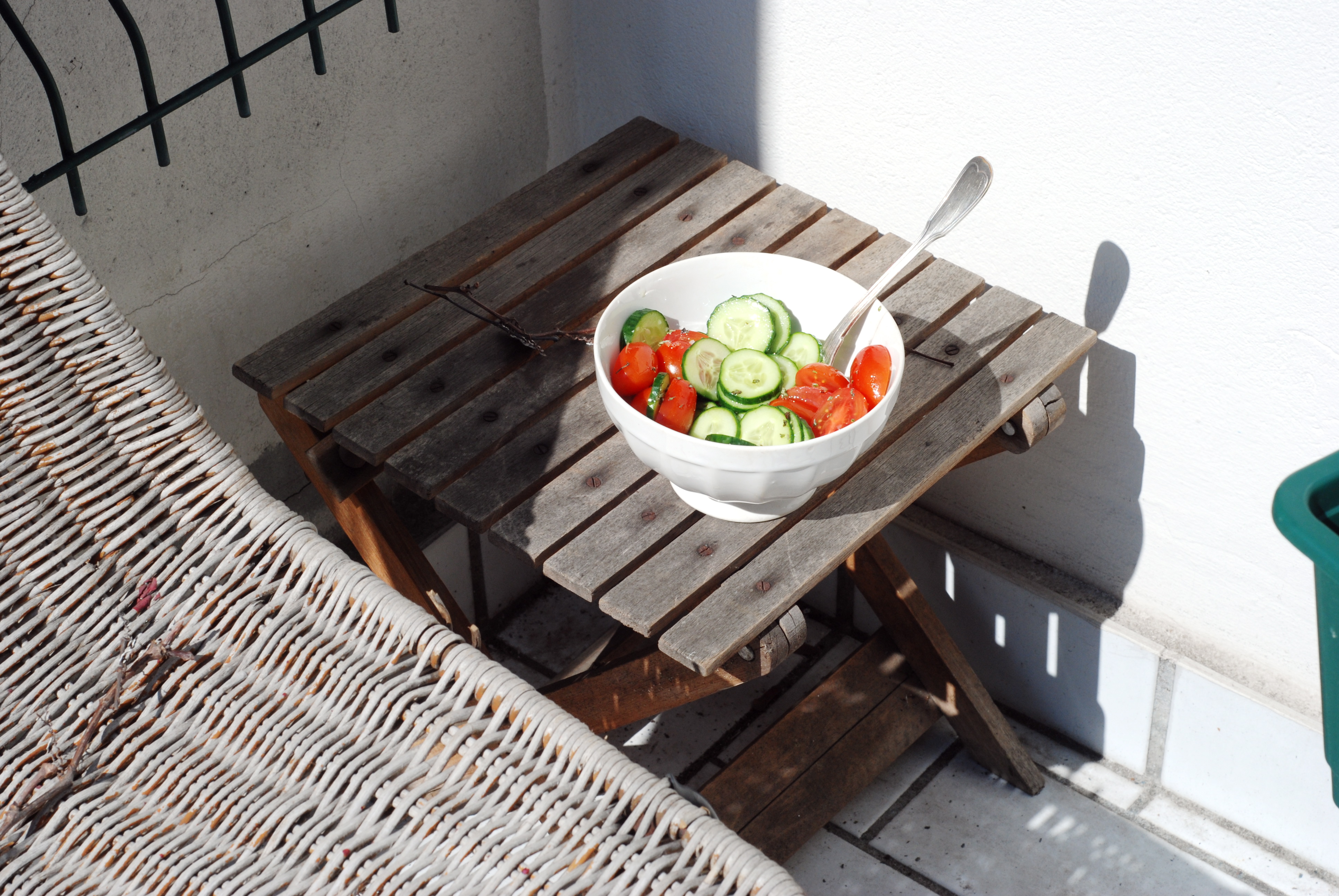
    Since then, I've made a lot of spicy cabbage, several tomato-cucumber salads (eaten on the balcony!), and had more than a few cheese toasts instead of liverwurst ones. (The Sainsbury's cheddar, tragically, is all gone now. Good thing I've just booked another flight to London. For the conference! Of course. Not for the cheese. No, not at all.)

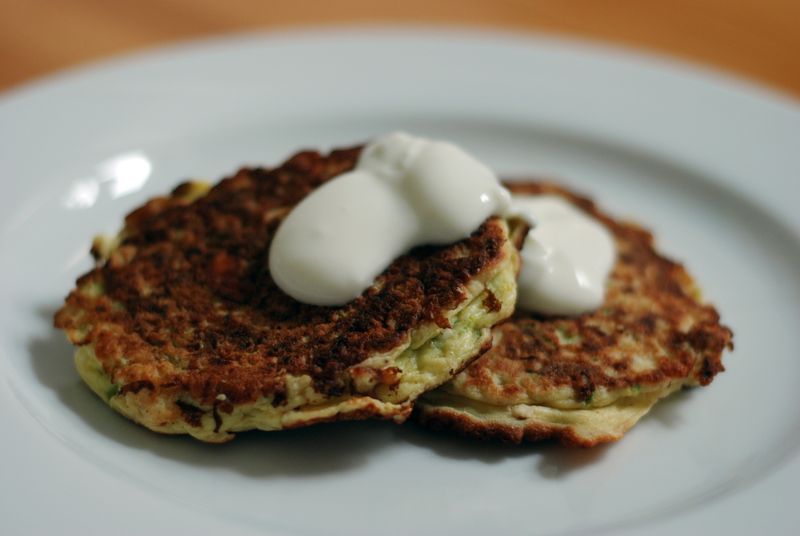
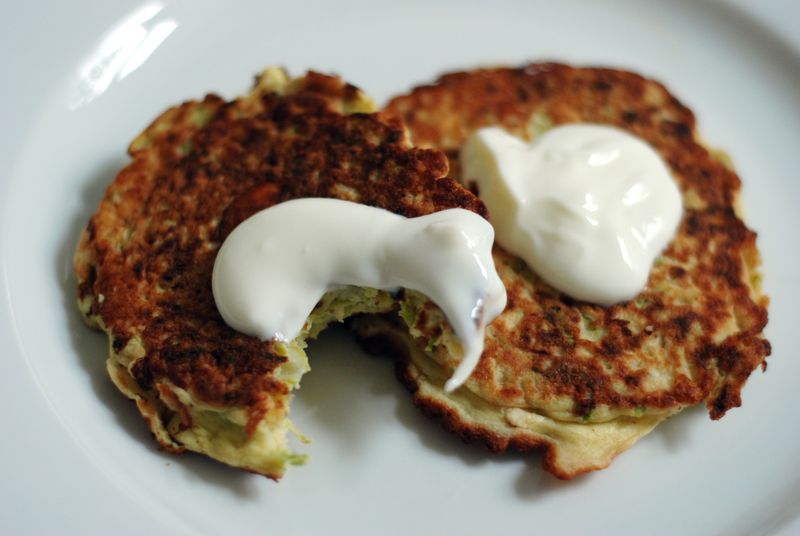
    And I've been saying a little prayer every night to the gods that be at the New York Times dining section that they make Elaine Louie's Temporary Vegetarian column a little less Temporary and a little more Permanent. Seriously, that column? Is a gem. Remember the Chana Punjabi? Her cabbage strudel haunts my dreams. And these Turkish zucchini pancakes, dolloped with garlicky yogurt, were nothing short of stellar. Right now, her column is the best part about that dining section for me and I hope it becomes a permanent part of the Wednesday lineup.

    DSC_7760

    But back to those pancakes. Hoo boy.

    I once had zucchini pancakes, 10 years ago at a friend's one-room apartment in Paris. She was, to be polite, not a gifted cook and all I could remember was the pile of slightly blackened vegetable shreds lying on my plate, glistening with still-raw egg and oil. Oooh, not pleasant in the very least. "A for effort", though, as the 7-foot tall Massachusetts State Trooper folded into the passenger seat of my dad's sedan told me when I passed my driving test at 19.

    So I had this recipe bookmarked for a year before I got around to trying it. What I didn't want were oily pancakes, or heavy ones. I wanted something light and fluffy and delicious and green, and, oh, did I get what I wanted. Readers, don't wait this long before trying these things. They are too good to be ignored.

    I made a few changes to the recipe: First of all, dill remains the final frontier in my food world. It is the one and only thing I really, really don't like. I got over cilantro, so maybe I will one day get over dill, but I'm not holding my breath. It tastes like dirty fridge to me and that's all I can say about that. But mint and zucchini are such a lovely pair, such a springy pair of lovebirds that I substituted the one for the other with spectacular results. Also, I totally forgot to add the baking powder. It just slipped my mind. And the pancakes were fine! So I guess it's not entirely essential?

    Other than that, the recipe was a charm. You quickly shred three zucchini (I used those very pale green ones, which are called marrows in England, held firmly against a big cheese grater) and squeeze the ever-loving life out of them once the shreds have been salted for a bit. You mix this limp green mess with eggs and crumbled feta and sliced scallions and the mint. Then you fry good-sized (3-4 tablespoons worth) mounds of the batter in vegetable oil until browned and crisping.

    Piping hot, they were savory and sweet, full of yielding pockets of salty-soft feta and bright with mint and scallions, while the cool yogurt sauce balanced each mouthful. Very, very good.

    But. Eaten cold from the fridge the next day? They were even better, if that's possible. The flavors were richer yet lighter, too; the pancake firmer and easier to eat. Totally transcendent, really. I had only two pancakes leftover and I actually caught myself wishing we'd eaten less at dinner the night before. I love discovering things that taste even better the next day: It makes my inner Martha Stewart emerge and I find myself planning elaborate buffet luncheons featuring entire tables covered with food cooked the previous day.

    These pancakes? They'd be front and center. And no one would miss the meat.

    Zucchini Pancakes
    Makes 12 pancakes

    For the pancakes
    3 medium zucchini, shredded
    Salt and freshly ground black pepper
    3 large eggs, beaten
    1/2 cup all-purpose flour
    1 tablespoon extra virgin olive oil
    1 cup crumbled feta cheese
    3 scallions, thinly sliced
    1-2 tablespoons finely shredded fresh mint
    1 teaspoon baking powder (I forgot to add this! And they were fine)
    4 to 6 tablespoons vegetable oil, more as needed

    For the yogurt sauce
    2/3 cup plain yogurt
    2 cloves garlic, finely chopped
    1/2 teaspoon salt

    1. Preheat oven to 250 degrees. Place zucchini in a colander over a bowl, and mix with 1/2 teaspoon salt. Allow to drain for five minutes. Transfer to a cloth kitchen towel, and squeeze hard to extract as much moisture as possible. Squeeze a second time; volume will shrink to about half the original.

    2. In a large mixing bowl, combine zucchini and eggs. Using a fork, mix well. Add flour, 1/2 teaspoon salt, olive oil, feta, scallions, mint and 1/2 teaspoon black pepper. Mix well, add baking powder, if using, and mix again.

    3. Place a cast iron skillet or other heavy skillet over medium heat. Add 2 tablespoons vegetable oil and heat until shimmering. Place heaping tablespoons of zucchini batter in pan several inches apart, allowing room to spread. Flatten them with a spatula if necessary; pancakes should be about 3/8 inch thick and about 3 inches in diameter. Fry until golden on one side, then turn and fry again until golden on other side. Repeat once or twice, frying about 5 to 6 minutes total, so pancakes get quite crisp. Transfer to a plate lined with paper towels, and keep warm in oven. Continue frying remaining batter, adding more oil to pan as needed. Serve hot.

    4. For yogurt sauce: In a small bowl, combine yogurt, garlic and salt. Mix well, and serve on the side or on pancakes.

  • DSC_7410

    I hear New York, this weekend, emerged from the cold grip of winter to sudden spring. Isn't it grand, all over again? Here in Berlin, we've been there for a little while now (well, for the most part) and I'm so happy about it I periodically raise a fist clutching seven or eight stalks of glowing pink rhubarb to the heavens in gratitude and howl with glee.

    Hellooo, spring! You are a stone fox.

    DSC_7405

    Well, no, of course I'm not actually howling at the heavens and doing victory dances with rhubarb. (I haven't entirely lost my mind with spring fever. Yet.) But I have been zipping around the city with a bag of rhubarb, trying to decide what to do with my first stalks of 2010. A flat sheet cake studded with pink chunks of rhubarb? A stewy pot fragrant with wine and citrus? I even contemplated juicing the rhubarb and making my own rhubarb spritzers with cold sparkling water.

    Last summer, I spent an afternoon at an outdoor café (is your computer's sound on?) near Zoo Station drinking rhubarb spritzers: impossibly refreshing, palest pink, the prettiest drink I've ever had beading lustrously in the sun. I think it was about then that I decided to move back to Berlin. How could I not, with rhubarb spritzers winking seductively at me? I ask you.

    DSC_7417

    Then up popped a recipe in the New York Times for something as bewitching-sounding as "Country Rhubarb Cake" and I ask you, yet again, how could I not make that first? I don't know if it's my spring-addled imagination or what, but I think I can practically see you all nodding back at me. A rhubarb cake! From the country! A country cake! An Irish rhubarb country cake! Irish rhubarb! Cake! Done.

    Who needs rhubarb spritzers?

    DSC_7425

    I practically fell over myself getting to the stove. Well, actually, it took me five days from the time of reading the recipe to the countertop, but in my defense I will say I had some very important things to do, including a bike ride, the first of 2010, a Sunday brunch, an Easter lunch, and the viewing of one of the weirdest vampire movies I've ever seen.

    Plus, all the stores were closed.

    DSC_7421

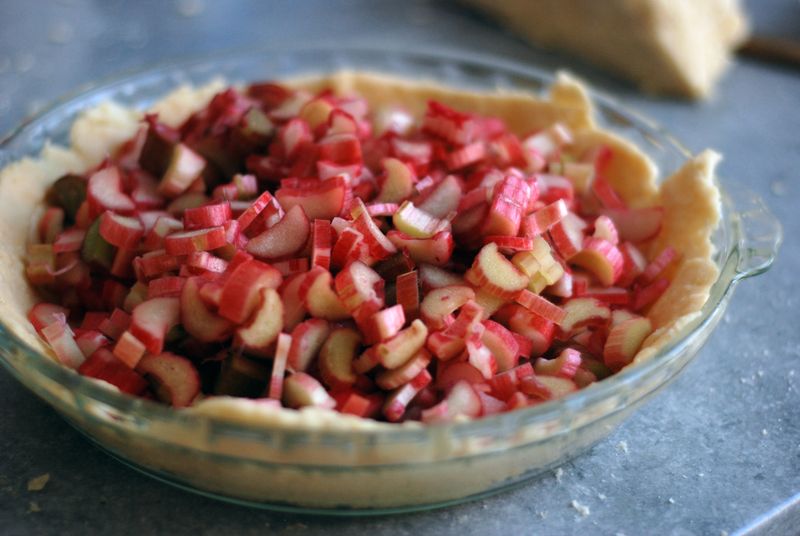
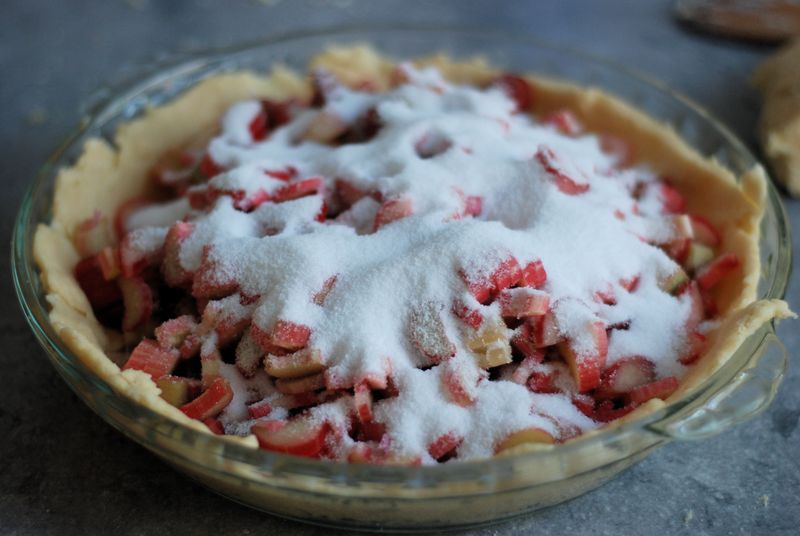
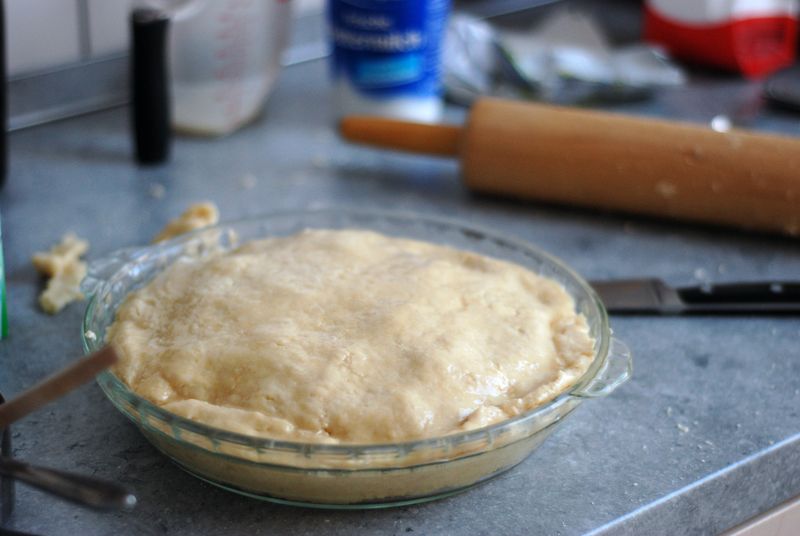
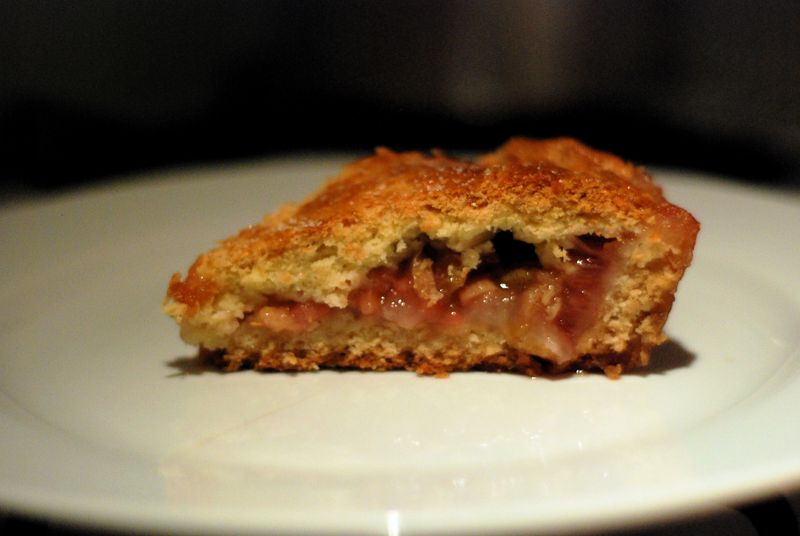
    Anyway, what this country cake is, basically, is a pie. A double-crusted fruit pie, except the pie dough is a little cakey. But the premise is the same: you make a crust, you try not to touch it too much, you divide it in half, roll each half out and line a pie plate with it (I used a 9-inch instead of a 10-inch, by the way, and it was fine). Then you put in a pile of thinly sliced rhubarb and cover that with what seems like an obscene amount of sugar.

    I just had to physically restrain myself from using the caps key on the obscene. Because, people, whoa. The sugar.

    But that's rhubarb! I told myself. It always takes way more sugar than you think. Remember?

    Hrmph.

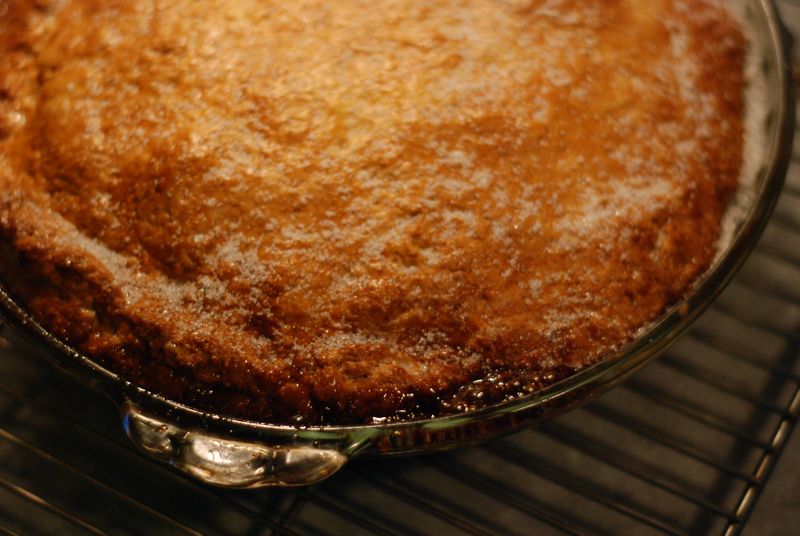
    The cake dough or pie crust or whatever you want to call it is kind of lovely: raw, it's nicely pliable and smells incredibly fresh and rich. It bakes up sort of like an enriched biscuit, almost; like a scone. Burnished and golden and wonderfully fragrant. All the doors and window frames in the apartment were painted a few weeks ago and the paint smell has been impossible to get out. The scent of country rhubarb cake baking in the oven was the best air freshener yet. It chased that paint stench right out the window and waved a Swiss-dot apron sweetly after it, too.

    I love that buttery-sweet cake smell mingling with the sharp smell of sour rhubarb syrup bubbling up to the edges of the pan, sugar caramelizing darkly.

    DSC_7433

    But there were a few things in the recipe that frustrated me.

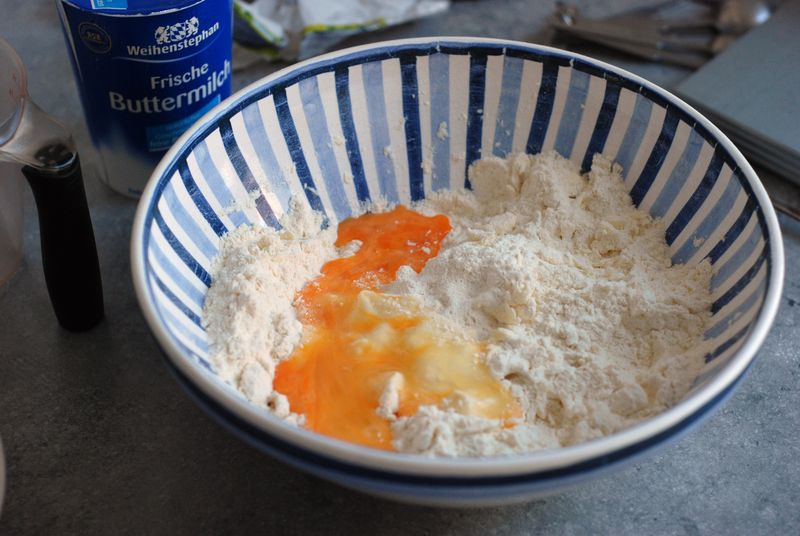
    First of all, there is no way that the small amount of buttermilk and one egg in all that flour would ever turn into a dough with a wooden spoon. I had to turn that shaggy mess out onto the counter and knead it – quickly – for it to come together.

    Second of all, why on earth are you supposed to simply dump all the filling sugar on top of the rhubarb? Why don't you mix the sliced rhubarb and sugar together in a separate bowl, then pour the evenly sugared fruit into the lined tin? This bugged me.

    Third of all, the recipe has you pinch together the top and bottom crust, so that the rhubarb juice won't spill out and ruin your oven, but then it tells you to bake the cake until the rhubarb is soft and juicy. Um, are you meant to ascertain this using x-ray vision?

    Fourth of all, WHAT is the deal with sprinkling sugar on the browned and beautiful crust? Why? What is it good for? The cake is already edging towards this side of too sweet, then you have to go and mar the pretty burnished surface of the cake with a random sprinkling of granulated sugar? Dear readers, skip this step, I beg of you.

    DSC_7435

    I don't have electric beaters yet, so we skipped the whipped cream, but I think it'd be lovely dolloped softly next to a wedge of the cake. The rhubarb was jammy and sweet (next time I'd use a little less sugar – try a 3/4 cup perhaps – and add a few scrapes of lemon peel or something, because I like my rhubarb with a little more sass) and the crust was rustic and pleasingly peasant-like. This really does taste like a cake you'd make in the country, easy and comforting, full of the things you'd get from your neighbor down the road. Just the thing to herald spring, in fact. Despite all those things that bugged me.

    And a little more appropriate, shall we say, than howling at the moon, even in gratitude.

    Country Rhubarb Cake
    Serves 8

    3 cups all-purpose flour, more for work surface
    1/4 teaspoon salt
    1 to 1 and 1/4 cup granulated sugar
    1/2 teaspoon baking soda
    1 stick (4 ounces) butter, cut into pieces, at cool room temperature
    2 eggs
    1/2 cup buttermilk
    1 1/2 pounds (about 8 stalks) rhubarb, thinly sliced
    Softly whipped cream, for serving

    1. Heat oven to 350 degrees. In a bowl, sift flour, salt, 3 tablespoons sugar and the baking soda together. With fingers, rub in butter until mixture is sandy. Beat 1 egg and add to flour mixture. Add buttermilk and blend, then turn out onto a floured surface and knead briefly until the dough comes together. It will be quite stiff and sticky. Divide in two. Roll out each piece to fit a 9-inch round baking dish. Line bottom of pan with one round, pinching together any tears.


    2. Cover dough with rhubarb and sprinkle rhubarb evenly with the remaining sugar. Place second pastry round on top and pinch edges together. Pinch together any holes. Beat remaining egg with 1 teaspoon water and brush it on dough.

    3. Place a baking sheet in oven to catch drips, and place baking dish on it. Bake until crust is golden, about 1 hour. If the crust browns too soon, cover the cake with a piece of aluminum foil and continue baking. Serve warm, with whipped cream on each serving.

  • FBconnect10_SideBar_B(2)

    So where are you going to be the first weekend in June? I'll be in London at the Food Blogger Connect conference, where I've been invited to speak on a panel about blogging and book writing. Won't you come and say hello? I'd love that.

    I wanted to also draw your attention to an interview I did some time ago with Sarah Amandolare of Writers and Cooks. She asked some very good questions, ones that really made me think. If you'd like to read my answers (none of which involve my favorite foods or what I'd like to eat before I die), click here.

    ***

    These last few months have been quite a whirlwind. They've been challenging and wonderful at once. As spring descends upon Berlin, I feel almost as though I've woken up from a strange sleep: fitful, not entirely rested, but with some perspective on the last few months.

    Today, I delivered three chapters to my editor. The rest follows next February. Let me tell you something: writing a book is humbling. In terms of work, I do believe it's the hardest thing I've ever done. Some days are good, some days are awful. Some days, not much at all happens. And some days, it all comes tumbling out. Whenever the work threatens to overwhelm me, I tell myself: this is just one year, just one book, and you're just one person. Breathe.

    Then I eat a cookie.

    ***

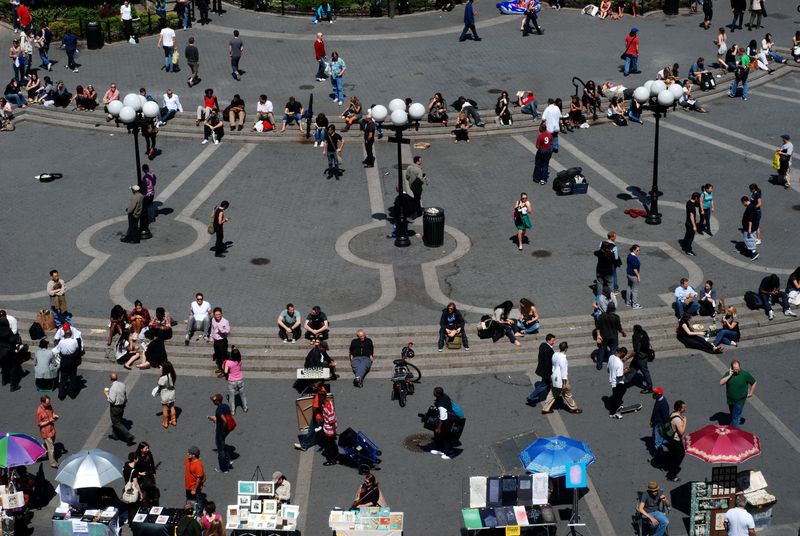
    In a few weeks, I'm going back to New York for a week. Besides spending time with my friends, the thing I'm looking forward to most is just to walk down 7th Avenue or 5th, for that matter, or the West Side Highway or 18th Street or through Union Square. Just to walk those messy streets and smell New York City air and see all the lovely people around and hear the pushy cabs and the street vendors and some dude Noo Yawking away on his cell phone. I can't wait to take the subway and eat a drippy, spicy banh mi and buy a whole bunch of trashy magazines and hear all the clanging, dissonant, fabulous noise that is the greatest city on earth and simply be in all that wild New York City energy.

    Cannot wait.

  • DSC_7028

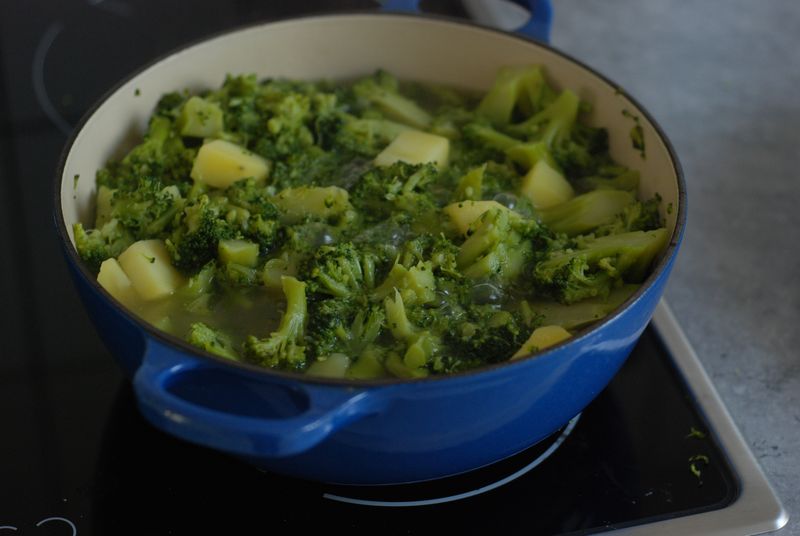
    The boxes are unpacked, the cookbooks are once again in their shelves, a few paintings grace the walls and there are fresh towels in the bathroom. My name isn't yet on the doorbell, but I've got a basil plant thriving in the warm light that comes through the window from the balcony. I don't have a phone line yet, but my living room looks almost lived in. And though I haven't yet got a table and chairs in the kitchen, I made lunch there the other day, the first real thing I've cooked since moving in, and the smell of browning onions and boiled broccoli was the best sign of being home.

    DSC_7032

    Sadly, the lovely apartment I ended up in doesn't have a gas stove. A lot of apartments in Berlin don't have them anymore, out of what seems to be a combination of modernity and fear. (Of gas leaks, explosions.) So instead of flames at the hearth, hissing away as I boil water or fry an onion, I now have a sleek, black induction stove, which looks super cool, but is eerily silent and, I find, a little strange. I'm getting used to it. I don't know if it's my imagination or not, but water boils awfully fast on it, which is rather nice. Perhaps I've got a physicist or two in my audience who can tell me if I'm making this up or not? In any case, it's easy to clean. Which is good, too. Like I said, I'm getting used to it.

    DSC_7036

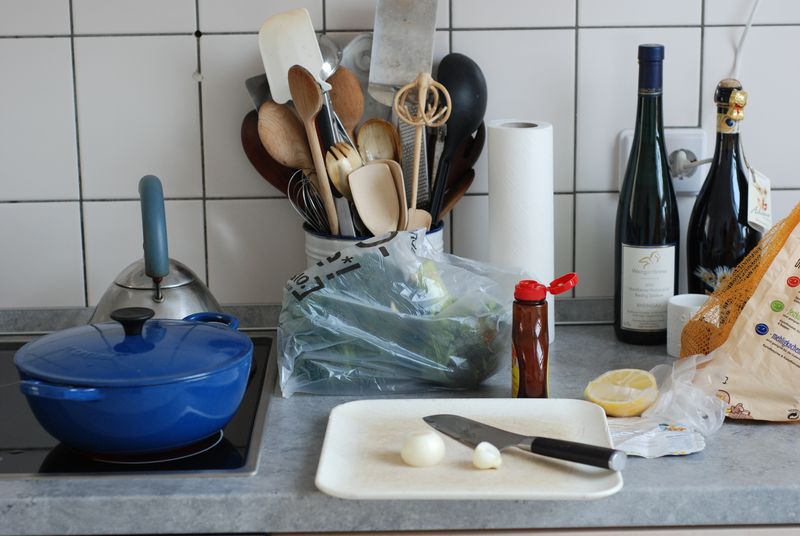
    The kitchen is lovely. Flooded with light and with a gorgeous view, I feel really peaceful when I'm in there. Sometimes I can hear traffic a few streets away, and sometimes I hear little birds chirping in the eaves outside my window. All my old friends are gathered together: my blue soup pot, my knives from college and New York, my grandmother's spatula, a tea kettle given to me by an old boyfriend over a decade ago. I've got Rancho Gordo beans in the cupboard and two kinds of brown sugars in the fridge (thank you, Nikolas!). I've got parchment paper in the cupboards and my trusty lipped cutting board at the ready.

    DSC_7041

    I can already tell, good things are going to come from here.

    DSC_7079

    And last week, a few days before I left for London, where I spent the weekend with my friends, strolling through Borough Market, marveling at stylish London girls, buying killer cheddar and Cadbury's speckled chocolate eggs at Sainsbury's and drinking, yes, quite a lot of tea, I made soup in the new apartment. My very first proper meal cooked there, if you don't count the spaghetti with tomato sauce I made for a couple friends who came over to help me put up shelves and do a bit of drilling a few weeks earlier.

    DSC_7066

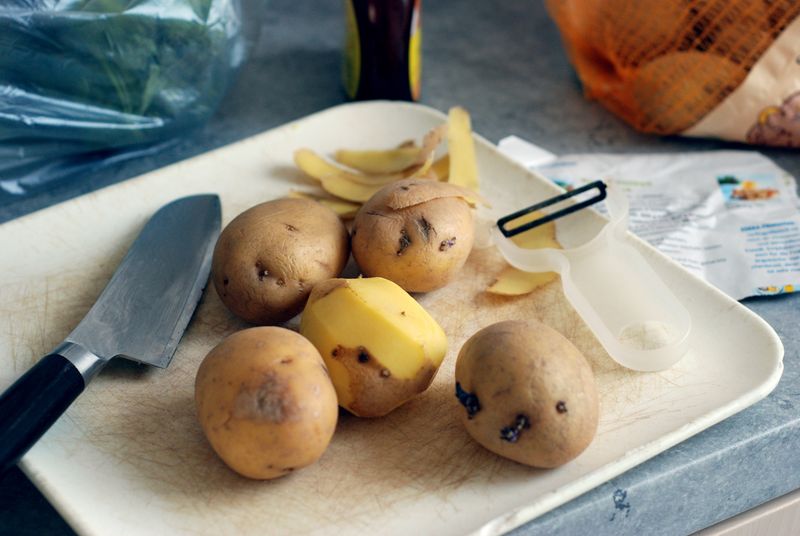
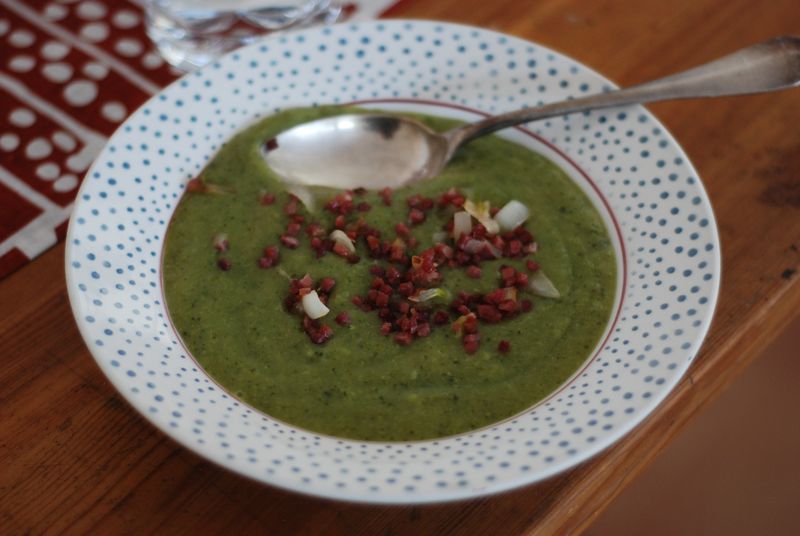
    I found the soup recipe in a free magazine from a grocery store chain here that my mother picked up for me, which sounds rather unpromising, I know, but trust me. It's just broccoli and potatoes boiled in chicken stock, then puréed and topped with fried onions and Speck and little slivers of mint leaves. It's simple and easy and awfully filling, plus it looks just darling, especially when spooned into lovely antique plates bought at a flea market in Paris ten years ago and then forgotten about in a basement until now.

    Oh, right, and it tastes good, too.

    DSC_7072

    The last week has been warm and sunny here. The trees sport fat buds, crocuses are peeking up from the moist ground, I hear birds chirping before the sun goes up and the air is fairly bursting with anticipation for spring. We're not quite there, yet, as today's cold wind reminds me. And the markets are still only selling asparagus and peas from far away countries like Greece and Spain. But today I saw local rhubarb for the first time, so pink the stalks almost glowed. And I have plans for tomato plants on my balcony, and little gherkins so I can make my own cornichons later this year.

    It's going to be a good spring.

    Broccoli Soup with Speck
    Serves 3 to 4

    1 medium yellow onion, minced
    6 slices Speck or pancetta or unsmoked bacon, finely diced
    1 lb (450 g) floury potatoes, cubed
    6 cups (1.5 liters) chicken broth
    1 lb (450 g) broccoli, roughly chopped
    Salt and pepper
    2 tablespoons thinly sliced fresh mint

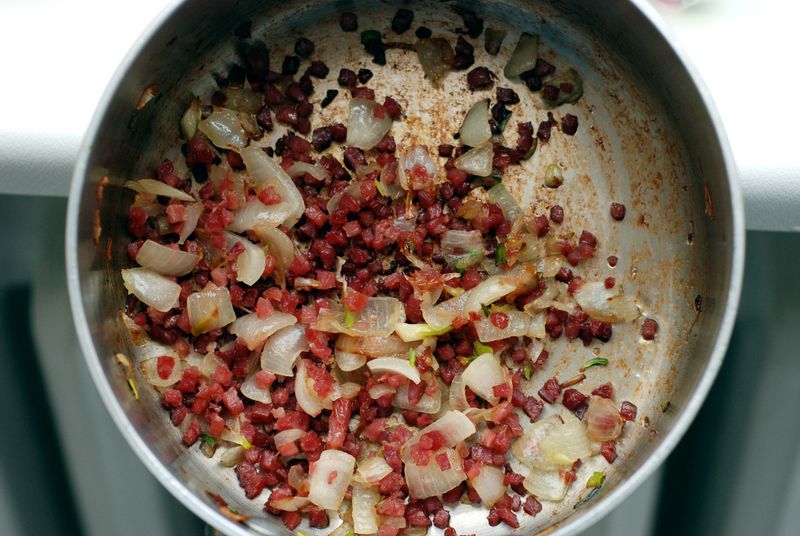
    1. In a small pan, cook the onion and Speck together over low heat until the onion is translucent and fragrant, about 7 minutes. Set aside.

    2. In a covered soup pot, bring the broth to a boil. Add the cubed potatoes, lower the heat and simmer for 10 minutes. Add the chopped broccoli, mix well and cook for another 10 minutes. Remove from heat and, using an immersion blender, purée until smooth. Add salt and pepper to taste.

    3. Ladle the soup into plates and sprinkle a spoonful or two of the bacon-onion mixture over each serving. Top with the sliced mint and serve.