•  

    P1030044_1

    Run, don't walk, to your local fishmonger today and buy two pounds of mussels, stat. Because I seem to be on some kind of a roll again here, and we have to take advantage of moments like this, of recipes proffered from newspapers that turn out to be recipes you will love and treasure and make over and over again. With this one, I know I will. It's labeled a soup, but I'd venture to say this is really more a stewy bowl of broth-moistened bread with all sorts of delicious things sloshing around in there. The recipe comes from Daniel Young's new book, The Bistros, Brasseries and Wine Bars of Paris that was reviewed in the LA Times. Although Young's subject is as old as the hills, this recipe alone is worth the price of the book.

    I have the good fortune of having the world's best fishmonger working just a few blocks from my office. He's French and knows his metier in the way only a Frenchman can, which, I'm sure I don't need to tell you, is a relief after having stood in front of one too many other fish counters with fishmongers who don't know the difference between halibut and cod. In the 2-pound sack of mussels he gave me, there was only one mussel that didn't open in the cooking process… I'd say that's pretty great quality. And the flavor? Sweet, tender, delicious. Plus, I just get a kick out of him in general: "yes-euh, no problem-euh".

    But we were talking about the recipe here: it's easy as pie. You dump your cleaned mussels in a heavy pot (I used my cast-iron one) with a cup of water and a cup of wine and bring it all to a boil to steam open the mussels for a few minutes. You drain off the mussels and save that milky, fragrant liquor. Then you saute a panful of chopped garlic, add the mussel juice and simmer it together before adding in a slurry of beaten egg yolk and vinegar. You layer toasted baguette slices, shucked mussels, and a bit of grated cheese in a bowl before pouring over the frothy broth that softens the bread and melts the cheese and bathes the mussels with gorgeous flavors.

    To gild the lily, you could dust piment d'Espelette on top, or do as I did and not. I'd say the recipe makes four dainty servings – it's not a lumberjack's meal. But it's so satisfying that you won't need much more than a sharply dressed salad to follow it for a very successful dinner. I'd rather have this than moules frites any day of the week.

    Garlic Soup with Mussels
    Serves 4

    2 pounds mussels, scrubbed and debearded
    1 cup dry white wine
    3 tablespoons olive oil
    6 garlic cloves, minced
    1 baguette, cut into 12 (half-inch) slices
    1 egg yolk
    1 tablespoon red wine vinegar
    1 cup (4 ounces) grated Gruyere
    1 to 2 teaspoons piment d'Espelette or chili powder – optional

    1. Place the mussels, wine and 1 cup of cold water in a large saucepan over moderately high heat. Cover and cook until the shells open, 4 to 6 minutes. Strain the mussels into a colander, collecting the juices in a bowl placed below.

    2. Heat the olive oil in a saucepan over low heat, add the garlic, and cook, stirring constantly, until pale gold, 3 to 4 minutes. Do not let brown.

    3. Add the mussel juice to the garlic, raise the heat to medium and bring to a boil. Cover, lower the heat to very low, and simmer for 10 minutes.

    4. Meanwhile, remove the mussels from the shells. Lightly toast the bread.

    5. Remove the soup from the heat. Combine the egg yolk, vinegar and a couple tablespoons of the soup in a mixing bowl and beat vigorously with a whisk until the mixture gets foamy. Slowly pour the mixture back into the remaining soup, continuing to beat with a whisk.

    6. To serve, place a few baguette slices, 3 to 4 tablespoons of grated cheese and some mussels on the bottom of 4 wide soup bowls, cover with soup and dust with piment d'Espelette.

  • Crostini

    It's been a while since I've made a Russ Parsons recipe. Because if all I ever did was write about slam-dunk recipes, you'd all be snoring your way through this blog. Or maybe that'd just be me? Either way, Russ knows his recipes. Whether he's having you puree boiled greens with cooked rice to make a delicate soup, or steam potatoes to serve under an aromatic and earthy hash of mushrooms, Russ brings you Seriously Good Food. So it was no surprise to me that his latest recipe was yet another smash hit.

    In last week's LA Times, Russ wrote about burrata – an Apulian knot of mozzarella filled with rags of molten cheese and cream. In Italy, it's difficult to find burrata outside of the small region that produces it (I have some family in a town in that region and have had the most distinct pleasure of eating burrata there. It's quite the gustatory experience, and totally decadent, especially for someone raised by people with more ascetic, Lutheran sensibilities. Have you ever heard of anyone eating cream-filled cheese in northern Europe?), but of course California being California, Russ tracked down an Italian immigrant running a healthy business producing burrata in Los Angeles.

    And that is great news for all of us. Because if Russ hadn't tracked down the burrata maker, he wouldn't have printed a recipe for toasted bread with sauteed radicchio topped with a dollop of cream and cheese, and we'd all be the poorer for it. I had friends coming over for dinner on Friday, and figured I'd start our dinner with a tray of these crostini passed around. After all, a weekend that started with these crostini could be a very good weekend, indeed (and it was. Dinner with friends! A Spike Lee Joint! Brooklyn Real Estate Hunting! A Blogger Meet-up!). In New York, it's not too difficult to find burrata – it gets flown in from Italy and is sold at Garden of Eden, Zabar's and Buon Italia, to name a few stores.

    The radicchio marmalade was a cinch: nothing more than a hot panful of sliced radicchio cooked down with garlic cloves, oil, salt and balsamic vinegar. While that cooked, I sliced baguette rounds and toasted them. Each round got a spoonful of radicchio and a gently torn-apart piece of burrata, taking care to include both outer layer and filling. I forgot both the oil drizzling and pepper cracking on top, and still my guests and I couldn't stop eating the crostini. Crunchy bread with silky, pungent radicchio, capped with softly unctuous cheese that was fresh and barely sour: this bruschetta was delicious beyond words. And though it was utterly original and different, it tasted just like Italy.

    Since I halved the recipe, I had leftover burrata to contend with. It was pretty easy getting rid of it. Some got eaten cold from the fridge with a fork the next day, after I'd spent seven hard hours baking bread with the big league and needed something – anything – to keep me alive. The rest of it I chopped up fine and dumped into a bowl of hot pasta with barely cooked tomatoes in basil oil for lunch today – the residual heat from the pasta and sauce melted the burrata, which in turn coated the spaghetti strands with creamy, wonderful flavor. Not a bad way to start the week off, either.

    Bruschetta with Burrata and Radicchio Marmalade

    Serves 8

    1 pound radicchio, preferably di Treviso
    4 tablespoons olive oil, divided
    5 whole garlic cloves, peeled
    1/2 teaspoon salt
    1 tablespoon balsamic vinegar
    1 baguette
    1/2 pound burrata
    Freshly ground black pepper

    1. Trim ends, then cut each head of radicchio into lengthwise quarters and then into cross-wise ribbons about 1/4-inch wide. Combine the radicchio in a cold skillet with 3 tablespoons of olive oil, garlic, salt and balsamic vinegar. Cover and cook over medium-low heat, stirring occasionally, until the radicchio has softened, about 10 minutes.

    2. Reduce the heat to low and cook until the radicchio is quite soft and the bitterness has cooked out, about 5 minutes more. Season to taste with salt and perhaps just a little more balsamic vinegar. Remove from heat and set aside. Remove the garlic before serving.

    3. Slice the baguette into half-inch slices and toast until lightly browned on both sides.

    4. Spoon a heaping tablespoon of radicchio marmalade onto each slice of bread and top with a similarly sized spoonful of burrata (try to get both the filling and the wrapping in each spoonful). Sprinkle each with a light grinding of black pepper and a drizzle of the remaining olive oil and serve.

  • If Ben's not around to keep me to the protein, starch and veg division of the dinner plate, I often fall back into the kind of eating I did when I lived alone in France. With no roommates or parents or boyfriends around, a plate of vegetables and a hunk of crusty bread was all I needed to keep me going. If I tried to make that for dinner now, Ben would look at me and laugh and then ask quizzically why I hated him. I must say that I'm grateful to him for helping me eat more protein before I shriveled up into an amino-acid deficient sissy and dropped dead.

    Ben's been in Los Angeles all week, spending time with a few action-sports enthusiasts, and probably eating a lot of very good Mexican food. I, on the other hand, have been having a love affair with string beans. It all started when I bought a pound and a half of them to use in a recipe that originally called for Romano beans, which were nowhere to be found. (It's probably for the best: my father has been preparing Romano beans in the same way for as long as the world has turned – with a chopped onion and canned tomatoes – and if I had to prepare them any differently, he might disown me.) Seeing as the wee French beans that I bought were, in some cases, a third or fourth of the size of a Romano bean, a pound and a half of them was A Lot Of Beans.

    At home, I snapped off the ends and boiled them until tender before sauteeing them for a few minutes in a hot pan with a few spoons of olive oil and diced pancetta. Then I sprinkled some smoked Spanish paprika over the beans and added a spoonful of sherry vinegar to meld all the flavors together before turning off the heat, piling a bunch of beans on my plate and settling down for dinner. The beans were good – snappy and fresh – but the combination of smoked paprika and diced pancetta seemed strange: why didn't I just dice up some smoked ham instead? It seemed like the recipe was fussier than it needed to be.

    I ate one plateful, and then put the rest of the hulking amount of beans away to return to them the next day at lunch. And WOW, what a difference a night makes. The beans had softened somewhat and allowed the oils and flavors to penetrate them more. The pancetta had mellowed considerably, and the vinegar had transformed itself into an easy background note. I couldn't stop eating them. I must have eaten 3/4 of a pound of green beans for lunch yesterday. I don't feel like a total glutton, because besides a heel of bread that's all I ate, but still. Three quarters of a pound! Of anything! I'm pretty impressed with myself.

    And the recipe. It's really quite easy and I love using my Spanish paprika – it makes me feel vaguely exotic and enterprising. If Ben were around to hold me to a more balanced diet, I'd make these alongside a simple roast chicken and a gratin of potatoes – or served with a nice broiled pork chop. And I'd be sure to prepare them the night before eating them (try not to refrigerate them, or at least let them really return to room temperature before eating them. The cold of the fridge lessens the taste otherwise). Today, I'll be having the remaining ones for lunch, ending my illicit affair just in time. Come home already, Ben! My muscle tissues miss you.

    Sauteed Green Beans, Caceres style
    Makes 4 servings

    Kosher sea salt
    1 1/2 pounds Romano green beans, or French beans, stem ends snapped off
    2 tablespoons olive oil
    1 ounce pancetta, cut into 1/4-inch cubes
    1/4 teaspoon sweet paprika, preferably Spanish smoked
    1 teaspoon Sherry vinegar

    1. Bring a large pot of salted water to a boil. Add the beans and return to a boil, then cook at a high simmer for 7 to 10 minutes until done to taste. Drain and pat dry.

    2. Heat the oil over medium-high heat in a large skillet. Add the pancetta and saute 2 minutes, then add the beans and saute another 2 minutes. Lower the heat, stir in the paprika and the vinegar and cook 1 more minute before serving.

  • Muffins

    You're going to think I'm looney tunes – I know. I just posted on maple pecan muffins yesterday, and here I go again? But, trust me, dear reader. Would I be boring you with yet another treatise on breakfast goods if the recipe were anything less than stellar? Absolutely not.

    It all started last night when I read Molly's suggestion (thank you!) for a bake-off between the muffins I made yesterday, and Nigella Lawson's version from her book, Feast. Having just had a miserable experience with one of Nigella's baking recipes, I thought it might be a double challenge. Since I had all the required ingredients at home already, and I could always use a soothing hour in the kitchen to keep me sane, and my coworkers scarfed down every last muffin yesterday so I that had an actual excuse to bring more muffins into the world, I set out this morning to bake my breakfast (again).

    The recipe differs in some place from Shulman's – it has a bit more flour, a goodly amount of wheatgerm, four whole teaspoons of baking powder, and far more pecans. I remembered the oil this time around, and used only one egg (as directed). When the batter came together, it seemed oddly stiff (I didn't overbeat – never fear). I spooned it into the little paper shells, then sprinkled gorgeously aromatic chopped nuts and sugar over each muffin top. The muffins baked for only twenty minutes, until the topping had browned and smelled irresistibly good.

    I broke open a muffin after it had cooled, and found a perfect crumb. It was light and tender, but had a substantialness to it from the wheat germ and nuts. It had the barest sweetness from the maple syrup, and the topping gave it a welcome crunch. The presence of so many more pecans gave it that otherworldly flavor that matched so well with the subtle taste of the maple syrup. As much as I liked the muffins from yesterday, these muffins are far superior. In fact, I'd say they'll be my go-to maple pecan muffins forevermore. I'll do my best to hang on to them until Ben comes back from LA, but I can't make any promises.

    Maple Pecan Muffins
    Makes 12

    1 cup pecans, roughly chopped
    2 cups all-purpose flour
    4 teaspoons baking powder
    1/2 cup wheat germ
    1 pinch of salt
    1/2 cup milk
    1 egg
    1/2 cup maple syrup
    1/2 cup vegetable oil
    1 teaspoon vanilla extract
    1 tablespoon dark brown sugar

    1. Preheat the oven to 400 degrees. Fill a 12-cup muffin tray with paper liners. Reserve 1/4th of the chopped pecans.

    2. Mix together the remaining pecans with flour, salt, wheat germ and baking powder. In another bowl, whisk together milk, egg, maple syrup, oil and vanilla.

    3. Pour the liquids into the dry mixture. Gently fold to mix. The batter can have some lumps. Do not overmix because these muffins can get tough. Spoon batter into muffin cups.

    4. Chop the remaining nuts finely and mix with the brown sugar. Sprinkle a little of this mixture on top of each muffin.

    5. Bake for about 20 minutes until tester comes clean. The nut topping turns golden, but the muffins will be somewhat pale. Remove muffins to a cooling rack.

  • P1030011

    Or, How To Screw Up a Muffin While Being a Scatterbrain and Still Have It Taste Good.

    Last Thanksgiving, I apparently had a death wish and made three pies for our Thanksgiving gathering. It was enough to make my head explode, what with all the delicate pastry and oven usage orchestration and innacurate cooking times and so on. When two out of three of the pies turned out to be absolute revelations, I counted my lucky stars. The third pie, however, was a soapy, insipid disaster. I promptly threw out the recipe and never looked back. What I had forgotten was that I still had other pecan recipes waiting for me from the same article Martha Rose Shulman wrote while on a stint in Paris.

    When I stumbled across her pecan muffin recipe, I scowled a bit and thought about throwing it out, untested. But something about the list of ingredients made me stop and think. I liked the addition of whole wheat flour, a dollop of yogurt, and using nothing but maple syrup to sweeten the muffins. Yesterday morning, making my way back into the city from Williamsburg (Ben's new home), I stopped for the first time at Trader Joe's to gather up my ingredients. (So, now that I get to gripe along with everyone else, I don't think TJ's will ever replace Whole Foods – the selection is so much smaller and not as aggressively priced as I would have thought. But still, I got some cheap butter and a bag of pecans for a dollar less, and though they have nothing to do with anything, a tub of freeze-dried strawberries that might be the best thing since sliced bread).

    And then, Monday happened. I absent-mindedly ate my lone yogurt for a snack, forgetting it was supposed to enrich my muffins later that day. I forgot that among my stash for 10 different flours, I actually didn't have a whole wheat pastry flour sack (only whole wheat or pastry, gah). Best of all, while stirring together the ingredients for the muffins (using a little extra milk to make up for the lacking yogurt), I totally and utterly forgot to add the quarter cup of oil called for. Blissfully ignorant of my mistake, I sat down on the couch while the most wonderful smell filled the air. It smelled like breakfast baking in the oven. Like a medley of French toast and pancakes and waffles all combined into one glorious dish.

    When the muffins were browned and firm, I took them out and popped them onto a cooling rack. After they'd cooled off somewhat, I broke one open. It had that barely rubbery feeling of a low-fat baked good, but smelled so irresistibly fantastic that it couldn't be all that bad. And in fact, it wasn't. It was delicious. Maple and pecans really do go together very well, and the barely sweet muffin with the nutty chunks was soothing and wholesome and tasted like I was eating a pancake drizzled with maple syrup. I can't imagine how much better they'd be if made correctly (maybe someone will tell me), but even my screwed-up version is a definite keeper.

    Maple Pecan Muffins
    Makes 12 muffins (so Shulman says – I only got 9)

    1/2 cup whole-wheat pastry flour (you can also leave this out and add another half cup of AP flour)
    1 cup unbleached all-purpose flour
    2 teaspoons baking powder
    1/2 teaspoon baking soda
    1/4 teaspoon salt
    2 eggs
    1/4 cup oil
    1 teaspoon vanilla extract
    1/4 cup low-fat yogurt
    1/2 cup low-fat or regular milk
    1/2 cup maple syrup
    1/2 cup coarsely chopped pecans

    1. Heat the oven to 375 degrees. Grease 1 (12-cup) or 2 (6-cup) muffin tins.

    2. Sift together the flours, baking powder, baking soda and salt.

    3. In another bowl, beat together the eggs, oil, vanillla, yogurt, milk and maple syrup. Quickly combine the dry and wet ingredients, and fold in the pecans. Spoon the batter into the muffin cups, filling them 2/3 way full.

    4. Bake the muffins until brown and firm, 20 to 25 minutes. Remove them from the oven and allow the muffins to cool in the tins for 5 or 10 minutes before removing them and cooling them on a rack.

  • Salad

    I won't blame you if you're asking yourselves whether I'm really serious with this potato salad post. After all, isn't potato salad usually just a bland dollop of something whitish on your plate – highly perishable, flatly greasy and innocuous, nothing special, really? Yes – potato salad, with cold pasta salad trailing it closely, has in my mind always been Food To Be Avoided Like The Plague. But when Kurt Gutenbrunner – of Wallse and Cafe Sabarsky fame, not to mention Thor and Blaue Gans) wrote a piece in the New York Times about his favorite potato salad with nary a smidge of mayonnaise, I started paying attention.

    I had clipped all four recipes printed with the article – Fennel and Blood Orange, Wilted Red Cabbage, Celery Root and Apple, and the aforementioned Potato and Cucumber. The other salads looked luscious in their own right, but a bit more wintery than what I was craving. The soft breeze at the end of my workday heralded warmer weather and the need for lighter fare – and the potato salad sounded just right. With no fingerlings to be found at my local store (and it being an off-market day), I bought a sack of Yukon Gold potatoes and left out the dill (for a long time, dill was my cilantro and I'm still not really over it).

    What I loved about the recipe were the small, easy touches that really made a difference. A pinch of caraway seeds in the potato water to flavor them subtly, briefly boiling chopped onion in chicken stock to take the harsh edge off, a spoonful of yogurt or cream to add the barest touch of body, salting and draining cucumbers to have their springy flavor pop. I'm not usually one to worship at a chef's altar, but in this case the privilege of having Kurt's knowledge of how to coax out the best possible flavor in a totally pedestrian dish was invaluable.

    Further proving Ben to be a sweetheart and a darling, he came over for dinner bearing two soft-shell crabs (unbidden!) on ice. We floured and fried them up in a pan of browned butter and ate them with a generous squeeze of lemon juice, alongside the vinegar-brightened potato salad that had crunch from the onions, the cucumbers and the mustard seed. The stock poured over the warm potatoes gave it a welcome creamy texture. Along with the crispy, saline crabs, it was a pretty spectacular Tuesday night dinner. I'll never look at potato salad the same way again.

    Potato and Cucumber Salad
    Serves 4 to 6

    1 English cucumber, sliced paper thin
    Salt
    2 pounds Austrian crescent or other fingerling potatoes
    Pinch caraway seeds
    Freshly ground black pepper
    1/2 cup chicken stock
    1/4 cup chopped onion
    1 tablespoon Dijon mustard
    1/4 cup cider vinegar
    2 tablespoons extra virgin olive oil
    1 tablespoon canola or sunflower seed oil (I left this out)
    2 tablespoons sour cream, crème fraîche or plain yogurt, optional (I just used one spoonful)

    1. Put cucumber slices in bowl, toss with 2 teaspoons salt, and set aside.

    2. Put potatoes in saucepan, cover with water, add generous pinch salt and caraway, bring to a boil, and cook until potatoes are just tender. Drain, peel, and slice into a bowl while still warm. Season with salt and pepper.

    3. In a saucepan, bring stock and onion to a simmer. Add to potatoes, and toss gently until silky and lightly thickened. Fold in mustard, vinegar and oils.

    4. Drain cucumbers well, squeezing out excess liquid. (Liquid can be used in soups or sauces.) Fold cucumbers into potato salad. Add more salt, pepper and vinegar if needed. Add sour cream, crème fraîche or yogurt if wanted. Serve as first course or side dish.

  • Endives

    Gratins usually make me think of rich, bubbling casseroles, replete with cream and cheese, providing warmth and sustenance during hard winter months. They do a good job of disguising pallid root vegetables at a time when you simply can't see another potato, turnip or rutabaga. But I often find them difficult to cook just for myself or when Ben joins me. The dish invariably ends up being too heavy for one small eater (with questionable leftover-eating habits) and her companion (who does a valiant job of eating, for sure, but I don't him to die of a coronary at 30). So unless I'm cooking for a group, I steer clear of gratins.

    And yet! Yesterday I stumbled across a recipe for an endive gratin that Kay Rentschler wrote about in the New York Times two years ago. It accompanied an article on bitter greens (is there a better green than a bitter one? I think not). I noticed straight away that it included no cheese and just a few spoonfuls of cream. So basically it'd be oven-roasted endive with a cream glaze and chunks of salty ham. I certainly could get behind that. And although spring is out in full force here, there's still a tiny nip in the air which meant last night that this transitional dish could be just right for dinner. And it was.

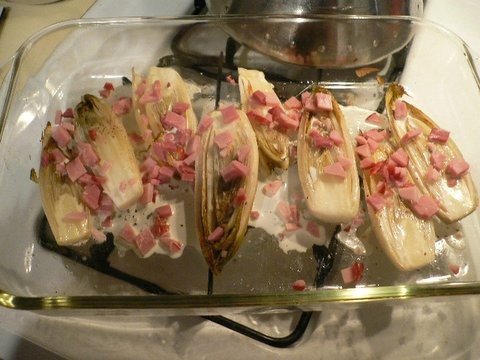
    The recipe called for two large endives, but my store only sold slim, little ones, so I bought four. I didn't have the green garlic called for, so I used a regular garlic clove. My mistake was not to use fresh bread crumbs – because the dried ones browned much faster. They were still delicious – tasting of beurre noisette and savory garlic (the apartment smells of them this morning), and with an alluring crunch. I halved the endives, rubbed them with oil, salt and pepper and let them roast until brown on one side. Turning them around, I spooned in the cream (which looks deceptively little) and threw in the chunks of ham.

    6a00d8341c660253ef00e54f687f2e8834-800wi

    The dish went back into the oven until the cream evaporated. I scattered the buttered, garlicky bread crumbs around each endive and let it all roast together for a few more minutes before serving. It was a revelation. The oven heat mellowed the bitterness of the endives and the cream added sweetness and body. The pieces of ham flavored the dish with a hint of smoke and a welcome salty bite. The bread crumbs added a crunchy textural layer and a nutty flavor. I ate one spear, then another and a third, and I still couldn't stop picking at the pan. The dish was perfect for spring: it had the savory flavors of winter, but they were scaled back and lightened, and the silky roasted endive really had a chance to shine. I only have two halves left, and I can't wait for lunch today.

    Belgian Endive Gratin with Black Forest Ham and Green Garlic
    Makes 4 servings as a side

    2 tablespoons butter
    4 tablespoons coarse fresh bread crumbs
    4 tablespoons minced green garlic or 1 teaspoon minced regular garlic
    2 large heads Belgian endive, cut in two
    2 tablespoons extra virgin olive oil
    3/8 teaspoon salt
    1/2 teaspoon freshly ground black pepper
    3 tablespoons heavy cream
    2 ounces Black Forest ham, cut into  1/4-inch cubes (1/4 cup)
    2 teaspoons lemon juice

    1. Heat oven to 450. Melt butter in a small skillet until foamy. Add bread crumbs and sauté until golden, about 5 minutes. Stir in garlic and sauté until fragrant, 10 seconds. Remove from heat and set aside.

    2. Rub endive with olive oil, sprinkle with salt and pepper and place cut-side down in a shallow baking dish. Roast until spears are golden brown on bottom, 5 to 7 minutes. Turn endive with tongs, add cream and ham, return to oven, and bake until cream has reduced to a glaze, 4 to 5 minutes more.

    3. Sprinkle bread crumbs over endive, turning spears to coat. Return to oven for 2 to 3 minutes. Sprinkle with lemon juice. Serve.

  • Birthday

    No matter how rhapsodic I wax about my city, there are times when it's imperative to just get out. The apartment walls feel like they're inching closer every day, the city's patina looks more like filth than age-old wisdom, and my ability to deal with a full workload, dates with friends and Ben, and the semblance of an inner life flies completely out the window. As luck would have it, an escape lies just up the Hudson River. From time to time, when life in the big city overwhelms us, or when someone's birthday needs celebrating, we pack up our bags, zip to Grand Central and ride up along the river to Beacon, where Ben's mother lives.

    From the back bedroom that we claimed this weekend, I could lie awake at night and hear the distant whistle of the train, raising some ancient wanderlust, and in the morning faint chirping readied me for the day. Leisurely meals around the dining table, rousing games of Uno!, and a sunny walk down Main Street where I alternately kept my eyes peeled for Pete Seeger and dreamt of renting out one of the many storefronts to open a bakery or restaurant, were some of the best parts of the weekend. But best of all was celebrating Ben's birthday with his family (though one crucial Spaniard was missing).

    Nigella Lawson's article on easy baking in the New York Times several months ago proffered up a recipe for a cocoa-flavored banana cake covered with chocolate icing, fusing two of Ben's favorite things – bananas and chocolate. With high hopes after other Nigella successes in my kitchen, I figured I'd found the perfect cake for Ben, and so I packed up my springform, a bloc of Valrhona and a clutch of browning bananas before our ride upstate. It must have been Murphy's Law that on such an occasion, I was totally disappointed by the results.

    The cake's crumb was dry in some spots and leaden with wet bananas in others (looking more like fruitcake than birthday cake). The cocoa flavor was masked by the large amount of mashed bananas and the rustic texture of the cake clashed entirely with the elegant and fruity icing (of which there was far too much – I poured the smooth and glossy leftovers into a pitcher to eat over ice cream). I kicked myself for not making Molly's well-tested and spectacular banana cake instead. Ben and the others, being both darlings and sweethearts, ate their slices gamely (even taking seconds, with vanilla ice cream valiantly gussying up each plate) and Ben's mother asked for the recipe, so it wasn't an unmitigated disaster. But I'd never make it again.

    I don't agree with Nigella that anyone can be proficient as a baker – and perhaps that's where the problem lies. Nigella created the recipes in that article for novice bakers – and I think she did them a disservice. Baking is more difficult than making a stew – it does require more effort, a lighter touch, a bit of reverence in the kitchen. Why should novices settle for instant gratification rather than delicious results (and though she calls this cake sophisticated, I beg to differ)? Becoming a good baker takes practice, failure, and run-ins with bad recipes. One newspaper article that promises spectacular results with a dollop of sour cream and a devil-may-care attitude isn't going to do the trick.

    Chocolate Banana Cake
    Yield: 10 to 12 servings

    For the cake:
    3/4 cup (1 1/2 sticks) butter
    1 tablespoon olive oil
    1 3/4 cups flour
    2 1/2 teaspoons baking powder
    1/2 teaspoon baking soda
    1/4 cup best-quality cocoa
    1 cup sugar
    2/3 cup sour cream
    1 1/2 cups mashed banana (about 4 very ripe bananas)
    1 tablespoon vanilla extract
    3 large eggs
    Pinch of salt

    For the icing:
    1/2 cup heavy cream
    4 ounces semisweet chocolate, finely chopped
    2 tablespoons light corn syrup

    1. For cake: heat oven to 325 degrees. Oil or spray a 9-inch springform cake pan and set aside. In a large saucepan over low heat, melt butter with olive oil. Remove pan from heat.

    2. Add flour, baking powder, baking soda, cocoa and sugar. Mix well. Add sour cream and mashed banana, and whisk to combine. In a small bowl or pitcher, whisk together vanilla extract, eggs and salt. Add to saucepan and whisk until smooth. Pour into cake pan.

    3. Bake until a cake tester inserted into center comes out clean, about 45 minutes. Allow cake to cool on a rack for about 15 minutes, then remove springform and allow cake to cool completely before icing.

    4. For icing: In a medium saucepan, combine cream, chocolate and corn syrup. Place over low heat, stirring gently with a spatula to avoid creating air bubbles, until mixture is very smooth. Place cake on a stand or a plate and spread icing over it with spatula.

  • Meatballs_1

    In my arcane filing system, I have some recipes that manage to wiggle their way out of their plastic slipcovers and into my bag, destined for a week or two or three of being schlepped around town, between my apartment and my office and the grocery store, offering up their services loyally, yet never really being exactly what I feel like eating that day, though I possibly could be interested in them the next. Sometimes I even go so far as to write down a shopping list only to have it be pushed aside at the store in favor of a different dinner. Earlier this week, though, I'd had enough with my dilly-dallying. I buckled down for meatballs.

    Running an errand in SoHo meant I'd be buying my groceries at Dean & Deluca, which in turn meant that when I asked for ground pork at the meat counter, I saw a hand reach into the display and pluck out a plump, boneless pork chop to grind up right then and there. Something about freshly ground meat is just so much more appealing than the shrink-wrapped, pre-ground stuff that offers ominously little information as to its provenance. The added benefit of being at Dean & Deluca (besides the mind-boggling array of sparkling bottles and jars filled with all sorts of goodies and treats, and despite the jacked-up prices) is their cookbook department, located conveniently in the back of the store. My recipe by Joyce Goldstein came from an LA Times piece on international meatballs, but at the store I was able to look up her original recipe in the book it was published in.

    There was nothing specifically useful about this, but it somehow gave the recipe more context. The book explained that this particular preparation leaves the meatballs soft instead of "crunchy" because you simmer the raw balls directly in the sauce instead of panfrying them first (lightening them, too, something I'm always happy about). What made me laugh was the LA Times' note that the meatballs should be served with mashed potatoes, unless it was a meal for children, in which case they should be served with spaghetti. Who knew that spaghetti and meatballs are considered kid's food, yet mashed potatoes aren't? That's probably a discussion for another time.

    I never ate meatballs with spaghetti as a kid (we just ate them plain), so I don't necessarily associate them with comfort food, but I liked the idea of a plate of lightly sauced noodles dotted with small polpettine (or, as the Sardinians apparently call them, bombas). Nigella Lawson had a recipe for tiny meatballs in the NY Times a while ago that looked similarly good, but I can't seem to find it – it must have disappeared somewhere among my 4,000 other clippings (sigh).

    How were they? Good (I particularly liked the size and lightness of the meatballs), but one thing I would absolutely recommend is that you not eat them right away. They improved hugely with an overnight sit in the fridge, becoming more deeply flavored and savory. The next night, I made a simple tomato sauce (just canned tomatoes, a garlic clove, salt, and a drizzle of basil oil cooked together until reduced slightly) to warm the meatballs up in. We grated generous amounts of Parmigiano on top, and had ourselves a delicious little Sardinian-American dinner.

    Sardinian Meatballs
    Serves 4 to 6

    1 pound ground pork
    1/4 cup dried bread crumbs or 1/2 cup fresh bread crumbs
    2 eggs
    6 tablespoons grated pecorino cheese
    2 cloves garlic, minced
    1/4 cup chopped flat-leaf parsley
    1/2 teaspoon salt
    1/8 teaspoon freshly ground black pepper
    2 to 3 tablespoons olive oil
    1 yellow onion, chopped
    1 3/4 cups canned tomatoes, seeded and chopped
    1/2 cup water

    1. In a bowl, combine the pork, bread crumbs, eggs, cheese, garlic, parsley, salt and pepper and mixed together until smooth. Form the mixture into balls about 1 inch in diameter.

    2. In a saute pan, heat the olive oil over medium heat. Add the onion and saute until softened, about 8 minutes. Add the tomatoes and water, mix well, and then add the meatballs.

    3. Bring the sauce to a gentle boil, reduce the heat to low and simmer, covered, until the meatballs are cooked through and tender, about 45 minutes. Season with salt and pepper. Serve with mashed potatoes or spaghetti.

  • Pletzlach

    My roommates are generous girls. Not only do they not seem to mind my near-constant presence in the kitchen, but on days like today, when I transform the apartment into a near-facsimile (at least, olfactorily speaking) of a Jewish bakehouse, there’s nary a peep of protest to be heard. I am grateful, to say the least. While I realize that baking leavened bread on Passover is about as blasphemous as it gets (well, okay, I exaggerate, I know), I just couldn’t help myself. I wanted to bake something and pletzlach it would be.

    Pletzlach are flattened rolls of bread strewn with poppy seeds and chopped onion and kosher salt. The recipe came from a lovely article about a Polish Holocaust survivor in the New York Times two years ago who made them for Hannukah. Pletzlach is the plural for one pletzel, which sounds adorable to my ears (a pretzel? a pletzel!). The dough is simple and barely sweetened, and provides a gentle background for the more straightforward topping. I thought about eating my pletzlach with a cup of lentil soup for lunch, but settled for a simple salad instead. You know spring is springing when the tomatoes in your store-bought salad actually taste like something found in nature. It’s enough to make me sprout wings with joy.

    The instructions for the pletzlach left a bit to be desired (was I supposed to make a well in the flour and let the yeast and water dissolve for half an hour without stirring in the flour? or was I supposed to stir it all together into an awkwardly stiff and shaggy dough?), but for someone not afraid of yeast doughs it wasn’t too difficult to figure out. I slapped the dough around a bit until it came together as I thought it should. I let mine proof overnight because I’d started on the dough too late last night, but it’s a quick dough to make and could easily be done straight after work in time for dinner, too.

    When the dough was fully risen (and punched down, kneaded, and risen again), I divided it into equal balls and flattened each slightly before topping them with the raw onion mixture. Using the rolling pin and a careful hand, I rolled out each ball, squashing the onions and poppyseeds into the surface of the rolls. Plopped on an ungreased sheet, pricked and sprinkled with salt, the pletzlach baked in the oven until golden brown and fragrant. I don’t like savory breakfasts, but it was all I could do to not eat one as a snack this morning.

    I was hoping for a slightly chewier bread – something more akin to a bagel or pizza crust. This dough was crisper, more snappy. But the flavor was homey and delicious – savory onions, barely sweet bread, and black poppyseeds providing crunch and sparkle. It was an Old World treat that made me think of my Jewish grandmother, long gone now. She would have never baked these pletzlach, but she would have eaten them with relish.