• P1070204

    Who doesn't love a good bulgur salad? Tossed with diced tomatoes and minced parsley, it shows up as tabbouleh on your summer tables, gets stuffed into pita with falafel, and is an all-around Middle Eastern workhorse. But did you know that an equally delicious winter version exists? One that holds its ground against hummus and baba ghannoush at a Levant-themed spread, and can just as easily transform itself into an exotic supper side dish? Without further ado, let me present it to you.

    Courtesy of the eminent Claudia Roden (she of Arabesque and The Book of Jewish Food), this salad is the perfect example of a dish whose sum is greater than its parts. You see, the bulk of the salad is just made up of soaked bulgur, chopped parsley and toasted nuts (I used pecans instead of walnuts, because their fragrance totally bewitches me. Plus, walnuts make my mouth feel funny). But then you mix it with a kitchen-sink dressing that catapults this humble dish into the stratosphere.

    Pomegranate molasses (use restraint! Or you'll regret it), olive oil, four different spices, tomato paste, lemon juice: the dressing is a symphony of flavors that bloom and develop with every dressing of the salad. It's a slow process as the bulgur soaks up each dose of dressing like a sponge. But it's worth waiting for. Because in the end you find yourself with an ochre-tinged pile of fluffy bulgur that is exotically perfumed, toasty and spicy and fragrant with a medley of flavors that make it very, very difficult to stop eating.

    And all of this is done without turning on the stove. Well, you have to use the oven to toast the nuts, but that's barely even considered cooking, right?

    Bulgur Salad with Pomegranate Dressing and Toasted Nuts
    Makes 8 to 10 servings

    2 3/4 cups bulgur, preferable coarse-ground
    Salt
    3/4 cup olive oil
    6 tablespoons pomegranate molasses (I used only 3)
    Juice of 2 lemons
    6 tablespoons tomato paste
    2 teaspoons ground cumin
    2 teaspoons ground coriander
    1 teaspoon ground allspice
    1/2 teaspoon cayenne, or more to taste
    Pepper
    2 cups walnuts or pecans, coarsely chopped and toasted
    1/4 cup pine nuts, lightly toasted
    1 bunch flat-leaf parsley, finely chopped

    1. Put bulgur in a large bowl and cover with cold, lightly salted water. Let soak until tender, from 30 minutes to 2 hours, depending on coarseness of bulgur. Drain in a sieve, firmly pressing out excess water, and transfer to a serving bowl.

    2. Whisk olive oil with pomegranate molasses, lemon juice, tomato paste and spices. Add salt and pepper and taste; mixture should be pleasingly tangy. Add more pomegranate molasses and lemon juice as needed.

    3. Pour half the dressing over bulgur and mix well. Set aside to absorb for 10 minutes. Taste for salt, adding more if needed. Add half the remaining dressing, all the nuts and parsley, and mix well. Before serving, taste again and add more dressing as needed.

  • Tart_1

    I have to say that when I first saw this recipe in the paper, my eyes sort of glazed over and I just kept going. I don't really know why – after all, I like vegetables and tarts and goat cheese – but perhaps I judged too quickly that the combination of all three would be fussy and twee and not really my kind of thing. I figured it was one less thing I'd have to try, moved on and promptly forgot all about it.

    And then, a few months later, Hannah announced she was closing up her food blog to continue elsewhere and told me that if I hadn't already made the tart, I should get to it. Right quick. Well, she didn't actually say Right Quick, but it was implied. So, I made my way through the Internets, googling left and right to find the archived recipe. And, like it was meant to be, I found it. Just waiting for me to come by and snatch it up.

    Oh, I'm so glad I did. Thank you, Hannah, for pointing me in the right direction. And thank you, Florence, for coming up with this in the first place. Because, dear readers, I'm pleased to say that we've got another winner here, another one for the laminated files, the Hall of Fame. Yes, it's that good.

    First of all, it's just so pretty. But then, it's also just so easy. Well, for a tart. And most importantly? It's fantastically delicious. Crisp, buttery pastry encasing a sweet and mellow filling of sauteed vegetables, topped with tangy, crumbled goat cheese – I mean, it really is as good as it sounds.

    Better even.

    The hardest thing about this was contemplating the frozen puff pastry. I'd never used any before (ridiculous, I know) and found myself a bit intimidated by the prospect of pate feuilletee in my very own house. But really, all there is to it is a bit of unfolding and rolling. That's it! Well, and some trimming. A monkey could do it. A monkey with knife skills.

    You saute leeks and mushrooms and sliced fennel (for all you fennel haters, I swear to you that the anise flavor is imperceptible. Just a faint background note! Bringing all the livelier flavors to the fore! It's delicious. Trust me) before halving the defrosted puff pastry and rolling each piece out into a long rectangle (I halved in the wrong direction which proves that my recipe-reading skills are for naught, or that a monkey could do this better than me). You have to trim the edges and then form a little border and glaze it with an egg wash, which sounds irritating, but is finished quite quickly and the benefit is that your tart puffs up in all the right places and just looks so professionally appealing.

    The pastry gets baked empty the first time, is filled with a goat-cheese-and-egg mixture for the second baking and then receives the topping of sauteed vegetables and goat cheese for the third pass in the oven under the broiler for a final, burnished touch. I set out still-warm squares of this for my guests and they were gone – gone! – in minutes.

    I'm beginning to think that Florence Fabricant might just have the best recipes at the New York Times.

    Leek, Mushroom and Goat Cheese Tart
    Yields 10 to 12 servings

    1 small bulb fennel
    2 medium leeks, white and light green parts only, halved lengthwise and rinsed carefully
    16 medium cremini or white mushrooms (about 1 pound)
    1 tablespoon plus 1 teaspoon olive oil
    Salt and pepper
    1 4-ounce package puff pastry (like Dufour), defrosted according to package directions
    3 eggs
    8 ounces goat cheese

    1. Heat oven to 400 degrees. Trim fennel of green top and root end, reserving fronds and quarter bulb from top to bottom. Using a mandoline or very sharp knife, cut fennel and leeks into paper-thin slices. Clean and slice mushrooms.

    2. Heat 1 tablespoon oil in a skillet over medium heat; add fennel and leeks and saute until just tender but not brown, about 6 minutes. Transfer to a bowl and set aside. Heat remaining teaspoon oil in skillet over medium-high heat; add mushrooms and saute until they release all their liquid and most of it boils away, about 5 minutes. Combine fennel mixture with mushrooms and saute together briefly; season with salt and pepper. Remove from heat.

    3. Unfold puff pastry onto lightly floured surface or Silpat; cut in half lengthwise to form two long rectangles. Gently roll out each rectangle to approximately 5 by 14 inches and place on cookie sheet (or cut into two circles, if desired). Trim edges by 1/4 inch strips all around; set strips aside. Break one egg into a small bowl; beat slightly. Brush edges of pastry with some egg. Use trimmed strips to make a raised border on each. (Or, fold pastry edges over to form a rim.) Brush entire surface with remaining beaten egg. Prick interior of pastry all over with a fork. Bake unti pale gold, about 10 minutes. If pastry has puffed up inside edge, press it down gently. Set aside.

    4. Meanwhile, combine remaining eggs with 6 ounces of goat cheese and blend until smooth. Spread onto pastry. Return to oven and bake just until set, about 4 minutes. Remove from oven and spread with mushroom-leek mixture. Crumble remaining cheese on top. Just before serving, broil tarts for a few minutes, until cheese softens and starts to brown. Garnish with fennel fronds.

  • Hummus

    I may never buy hummus again. And after reading this, you may join me. Because once I (and thereby you) figured out how easy, cheap, and ridiculously delicious homemade hummus is, I decided to turn my back on the prefabricated stuff and am never looking back. That's it! I'm done.

    This summer, the LA Times ran a story about the best hummus in Los Angeles just weeks after a similar story ran in the New York Times. But what made the LA Times article stand out was its inclusion of Paula Wolfert's recipe for the homemade stuff at the end. Wolfert, one of the goddesses of Middle Eastern cooking, is another kitchen heroine of mine, but it took me a while to actually make her recipe. It's seriously high-yield, producing 4 whole cups worth of hummus. Even if it would prove to be the best version in the world, how would I ever polish off that much?

    Well, it turns out that a birthday party is a pretty good place to answer this question, as you'll have at least 20 people avidly digging in to the hummus plate and yet you'll find, after they've all gone home and you are dejectedly cleaning up and thinking that this year's birthday was even better than the last, that you still have some left over. Which, actually, is just fine as these kinds of leftovers are the good kind and after all, how better to end a birthday week than with a smear of hummus on a second loaf of the No-Knead bread? Which, by the way, I baked in my 4-quart oval Le Creuset, thereby discovering that it's the perfect size and shape for this loaf.

    You soak a bunch of dried chickpeas overnight (I bought a bag of roasted, dried chickpeas at BuonItalia, just because they looked…nuttier than the regular ones, but who knows if that made a difference), then simmer them in salted water until they're soft. In the meantime, you make a paste out of salt and garlic, then whizz that in a food processor along with sesame seed paste and what seems like an inordinate amount of lemon juice. Trust the recipe, though! Wolfert says the mixture should look "contracted", which meant nothing to me, but I stopped when it looked like this and that turned out to be fine.

    Then you add the drained chickpeas and process the mixture until an improbably creamy mass starts to form. Depending on how loose you like your hummus, you can add cooking liquid and lemon juice. It keeps in the fridge for a few days, though you'll have to add some more water and lemon juice to loosen it up a bit (and let it come to room temperature, because the flavors totally bloom then). I sprinkled mine with paprika and drizzled it with one of the delicious oils in my Alejandro & Martin sampler.

    A more appetizing plate of hummus I never did see. And the taste! Fresh and creamy, with a nutty flavor and grassy notes from the oil. The hummus had heft, but was also airy from all the processing. I'm telling you – after you make it, you'll never want storebought hummus again. I'm so glad I tried this recipe. It's like a birthday present from Paula herself. Thanks, Paula!

    Hummus
    Makes 4 cups

    1 1/2 cups dried chickpeas, soaked overnight
    1 teaspoon kosher salt, divided
    3 garlic cloves, peeled
    3/4 cup sesame seed paste
    1/2 cup fresh lemon juice, and more to taste
    Cayenne or hot Hungarian paprika
    2 tablespoons chopped parsley
    2 teaspoons olive oil

    1. Rinse the soaked chickpeas well and drain them before putting them in a saucepan and covering them with plenty of fresh water. Bring to a boil; skim, add one-half teaspoon salt, cover and cook over medium heat, about 1 1/2 hours, until the chickpeas are very soft (you might need to add more water).

    2. Meanwhile, crush the garlic and one-half teaspoon salt in a mortar until pureed. Transfer the puree to the work bowl of a food processor, add the sesame seed paste and lemon juice and process until white and contracted. Add one-half cup water and process until completely smooth.

    3. Drain the chickpeas, reserving their cooking liquid. Add the chickpeas to the sesame paste mixture and process until well-blended. For a smoother texture, press the mixture through the fine blade of a food mill. Thin to desired consistency with reserved chickpea liquid. Adjust the seasoning with salt and lemon juice. The hummus can be kept in an airtight container in the fridge for up to a week.) Serve, sprinkled with paprika and parsley and drizzled with oil.

  • P1070176

    I know that this is probably the fiftieth post you've read about cookies – it's just that time of year – so I'll keep it brief, I promise. It's just that these biscotti are so good and so worth being added to your Christmas baking list that I can't help telling you about them. Being a purist, I have to start off by saying that this recipe, without butter or oil or any other shortening, is how real biscotti are made (of course, the ginger and pecans are New World additions, but the technique, people, that's what matters). But I have to also add that if you've never baked with turbinado sugar before (like me), then you're in for a revelation. So that's another reason to try this out.

    Well, and then there's of course the taste, the heat of the ginger, the fragrance of the toasted pecans, the pleasing crunch of the large-grained sugar. These cookies are pretty great things, hard and snappy and with so much character, which is what I have come to appreciate during a season in which I am faced with endless amounts of soft and flaccid cookies. And as Florence Fabricant indicates, these biscotti go well with rye whiskey. So, if you're at your wit's end about buying a present for that one friend you never know what to buy for, or you have to show up somewhere bearing gifts in hand once again, then buy a nice bottle of rye, bake up a batch of these (eating the end pieces, of course, because those are the cook's treat), and expect to be thanked warmly.

    That's it! I told you! Short and sweet and to the point!

    Oh wait, one more thing. The part where you're supposed to pat out the dough, cover it with the nuts and ginger, then roll it up and cut it in half and form into a log and all that business? It's not the most logical way to proceed. I did it all on my Silpat, which was a lifesaver and what I'd recommend for you, otherwise you'll still be picking dough off your countertops four days later. But really, why don't you just stir the nuts and ginger into the dough after it's rested for half an hour? And then turn that dough into two logs? Try it that way – I think it might be easier.

    Okay, and now I'm done. Happy Baking!

    Ginger-Pecan Biscotti
    Yields 30 biscotti

    1¼ cup all-purpose flour, more for dusting
    ½ cup turbinado, Demerara or granulated brown sugar
    ½ teaspoon salt
    ¼ teaspoon baking powder
    ¼ teaspoon baking soda
    2 large eggs, beaten
    1 teaspoon vanilla extract
    1/3 cup finely chopped crystallized ginger
    1/3 cup chopped pecans

    1. In a large mixing bowl, whisk together the flour, sugar, salt, baking powder and baking soda. Remove 1½ tablespoons of the egg to a small dish and reserve. Add vanilla to the rest. Make a well in center of dry ingredients, add egg-vanilla mixture and, using your hands or a large rubber spatula, work flour into eggs. It will be crumbly at first but will soon form into a soft dough. Allow to rest 10 minutes.

    2. Heat oven to 350 degrees. Line a baking sheet with parchment. On a lightly floured surface, flatten dough into an 8-inch square. Spread ginger and pecans on it, lightly pressing them in. Tightly roll up dough and cut it in two. Press and roll each piece into a log about 9 inches long. Place logs on baking sheet, brush with reserved egg and bake about 20 minutes, until firm to the touch and lightly browned.

    3. Remove from oven and let cool 10 minutes. Use a sharp, thin knife to cut logs at an angle into ½-inch-thick slices. Stand slices an inch apart on baking sheet and return to oven 15 to 20 minutes, until crisp. Cool completely before serving.

  • Ribs

    So, after finishing Michael Pollan's The Omnivore's Dilemma and feeling much like what I imagine our parents felt like after reading Rachel Carson's Silent Spring in 1962, I vowed to myself never to buy industrial beef again. Oh sure, I'd already given up on supermarket eggs and chicken a long time ago, but now I've added meat to the list. Or rather, from now on I'll only be shopping for chicken, meat and eggs at the Greenmarket.

    A lofty, unrealistic goal? Yeah, quite possibly. Who knows how sustainable these kinds of ideals are? And yet, I just don't know how to continue to justify buying meat and eggs from a place that doesn't care how those animals were raised or slaughtered and, more importantly, doesn't care about the effects that food has upon me, my family, my friends, and my fellow citizens. If you don't know what I'm going on about, seriously, buy yourself a copy of Pollan's book. It's so endlessly fascinating, rich with information and stories, and hugely important in its message. It's irreverent and funny, heartbreaking and infuriating to boot.

    The point of the book is not just to talk about how we eat and why, but also about how we buy, how we're talked to and looked down upon by the industries that purport to nourish us, and how we can change the way we see our kitchen, the dinner table, grocery store and the people we rely upon to feed us. Forgive me if I'm proselytizing, but I'm feeling transformed.

    The point of all this? To tell you that after finishing the book (and realizing I had friends coming over for dinner a few days later), I thought I should put my money where my mouth was. So I went to the greenmarket and bought what felt like the world's most expensive oxtail from John Gigliardi's Grass-Fed Beef. The recipe I wanted to make came from a piece in the New York Times last year about cooking with animal bones and called for five to six pounds of oxtail. If I had bought that amount from Gigliardi, it would have cost me $37. So, I asked for a little under four pounds, and figured I'd fudge the recipe a bit. The meat still cost $25.

    Which makes me wonder – do grass-fed beef producers have to charge such high prices to actually make a profit? Or is it my mistake to think that oxtail, historically among the cheapest cuts, hasn't increased in price due to its "reverse snob appeal"? You tell me.

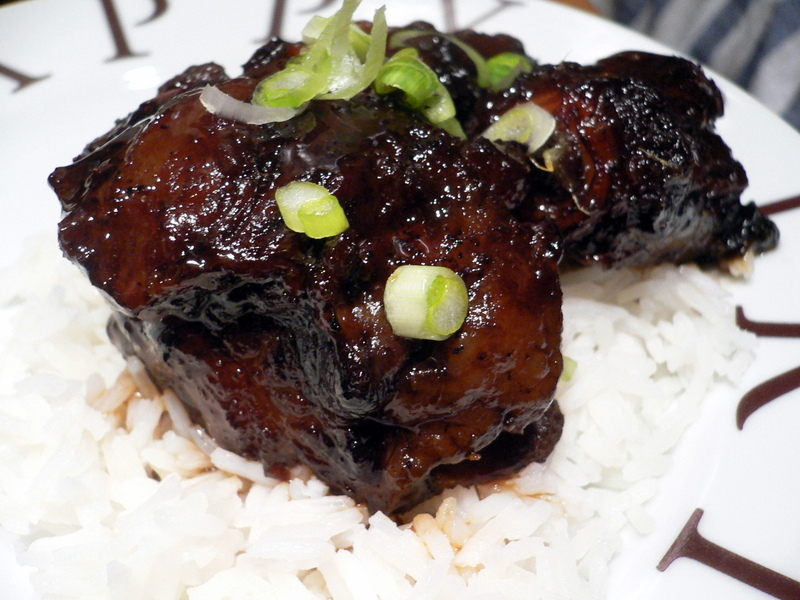
    After a day of defrosting in my refrigerator, the oxtail were ready to go. First I browned them in batches, which always takes longer than I expect. When each piece was crusty and well-browned, I removed them to a plate, poured off the fat and poured in the Shaoxing wine to deglaze the pot. Then I added soy sauce and the aromatics and brought the mixture to a boil. The oxtail went back into the pot, as did some pieces of orange peel, and the whole thing went, covered, into the oven for three hours.

    It takes a large amount of discipline not to eat dinner right at the moment that the kitchen timer buzzes, because your house will smell of all kinds of good things – browned and braising meat, savory sauces, fragrant fruity and spicy flavors. Good luck with your willpower. I removed the quivering oxtail to a baking pan and strain the dark sauce into a pan, before covering both and stashing them in the fridge. The next day, I warn you, you might be slightly disgusted at the task of scraping off the quarter-inch thick layer of fat on the sauce, but the heavenly smell will motivate you to keep going.

    I liquefied the jellied sauce over a low flame, poured it over the chilled oxtail and put the baking dish back in the oven for another hour. In this time, the sauce thickened and the oxtail edges crisped while the interior meat became meltingly soft. We ate our oxtail stew over plain white rice, which soaked up the deliciously aromatic sauce. I didn't actually halve the sauce ingredients despite the fact that I used less meat – and it seemed to work out just fine. And the amount for four people was more than enough – I even had leftovers the next day.

    This is humble food, but the exotic flavors give it a sheen of sophistication (not to mention a sense of accomplishment that the sauce tasted as good as something I've had in a Chinese restaurant – a good one!). Was the grass-fed beef so much better than the industrial kind? To be honest, it's kind of beside the point. This beef tasted delicious, cooked up perfectly and made me feel good on a couple different levels. So what if it cost more? I don't eat meat all that often anyway. Who knows, maybe this idea of eating as sustainably as possible isn't something I can afford in the long run, but I'm going to try. And maybe, just maybe, we're around the corner from a food revolution in this country and soon everyone will feel like I do. Wouldn't that be nice?

    Aromatic Chinese Oxtail Stew
    Serves 6

    5 to 6 pounds oxtails, cut into pieces, fat trimmed
    Kosher salt and ground black pepper
    2 to 4 tablespoons vegetable oil
    ½ cup Shaoxing rice wine or dry sherry
    1/3 cup dark or regular soy sauce
    1½ tablespoons brown sugar
    1 star anise, broken into pieces
    3 scallions, trimmed and cut into 2-inch lengths, plus 2 scallions, thinly sliced on the diagonal, for garnish
    6 slices fresh ginger
    2 garlic cloves, peeled
    1 orange, 4 large strips of zest removed with a vegetable peeler and reserved
    Cooked rice, for serving

    1. Heat oven to 300 degrees. Season oxtails with salt and pepper. Heat 2 tablespoons oil in a large ovenproof pot with a tight-fitting lid. Working in batches if necessary to avoid crowding, brown oxtail all over, removing each piece when done. Add oil as needed.

    2. When done browning, pour off extra fat from bottom of empty pot and set pot over high heat. Add wine and bring to a boil, scraping up browned bits. In a bowl, mix soy sauce and sugar with 2 cups water and pour into pot. Add star anise, 2-inch pieces of scallions, ginger and garlic and bring to a boil. Turn off heat. Return oxtails to pot and add orange zest. Cover and transfer to oven. Cook 1½ hours.

    3. Turn over pieces of oxtail, cover again and cook 1½ hours more, or until oxtail is very tender. Transfer oxtail pieces to a baking dish. Strain sauce into a separate saucepan; discard contents of strainer. Cover oxtails and sauce and refrigerate overnight.

    4. The next day, heat oven to 300 degrees; remove oxtails and sauce from refrigerator. Lift off any fat on surface of sauce and discard. Gently warm sauce until liquid, then pour over oxtails. Cover with foil or a lid and bake 30 minutes.

    5. Uncover, stir and raise oven temperature to 400 degrees. Cook, uncovered, 15 minutes. Stir again and cook another 15 minutes, until hot and glazed thickly with sauce. Meanwhile, squeeze ¼ cup juice from orange. Remove oxtails from oven, stir in orange juice, and serve in bowls over rice. Sprinkle each serving with thin scallion slices.

  • Balls_1

    Hark! The holiday party angels sing. So, how many parties have you been to so far this month? Or better yet, how many are still to come? Are you sick of showing up with your stand-by bottle of wine? Or a potted poinsettia? Well, dear readers, never fear. I've got a fantastic little recipe for you that, wrapped up in Martha Stewart-ish glassine paper and tied with a pretty bow, is a perfect holiday gift.

    The recipe comes from Anne Willan – a kitchen hero of mine and a contributor to the LA Times. Not only is the recipe easy to follow, but it has the added appeal of surviving doubling and even tripling its quantities if you need high-yield baked goods for gifts this time of year. Luckily for all of us, the outcome tastes pretty fabulous, too. And doesn't slaving over a hot oven virtually guarantee you lots and lots of holiday points from your grateful hosts? Although the slaving part here is totally fabricated – it'll take you all of 20 minutes.

    The food processor renders the flour, ground mustard, salt, pepper, grated Parmigiano and melted butter into fragrant, couscous-like crumbs. You roll the crumbs into small balls and let them chill before popping them in a hot oven, where the pungent flavor of the cheese morphs into something deeper and more nuanced. The mustard and ground pepper add an irresistible kick to the crumbly balls. And what comes out of the oven is a sophisticated, savory snack that is quite difficult to stop eating.

    What I like the most about these holiday hors d'oeuvres is how they so easily morph from high-end to low-brow, depending on what you decide to serve them with. An elegant coupe of Champagne and you've got yourself a swish little Christmas soiree. A mug of mulled wine and – presto! – you're at a cozy weekend Advent afternoon. A tall, frosty beer and you're just hanging back taking a breather from all this insanity.

    My tip to you is to shape these balls even smaller than indicated – a half inch across would probably be great (and also, my baking time was longer than indicated, by about ten minutes). They tend to the dry side and since you really do need to pop them whole into your mouth, a slightly smaller ball is all the better for being washed down with your beverage. Maybe that should be your gift to yourself this year. A break. A drink. And a handful of these toasty, crumbly, peppery balls. Then let the holiday madness wash over you!

    Anne Willan's Parmesan Balls
    Makes 26 balls

    1 1/4 cups flour, plus up to 3 tablespoons more, if necessary
    1 cup loosely packed grated Parmesan cheese
    1/2 teaspoon salt
    1/2 teaspoon freshly ground white pepper
    1/2 teaspoon dry mustard
    1/2 cup melted butter

    1. In the bowl of a food processor, mix the flour, Parmesan, salt, pepper and dry mustard. Add the butter and work it in using the pulse button so the mixture forms crumbs. Press a few crumbs together with your fingers. If it's sticky, add 2 to 3 tablespoons more flour.

    2. Butter a baking sheet. Turn the crumbs into a bowl, press them into balls 1 inch in diameter and place them on the baking sheet. Chill in the refrigerator for 30 minutes>

    3. Heat the oven to 350 degrees. Bake the cheese balls until lightly browned, 26 to 28 minutes. They keep well in an airtight container, or they can be frozen.

  • Menuforhopelogo

    As the holidays approach, so does the annual Menu For Hope raffle, started by the lovely Pim three years ago. Last year, a whopping $17,000 were raised for Unicef. This year, the money will be going to the UN’s World Food Programme. Let’s try to surpass that amount! With the fantastic prizes up for grabs, I’m hoping it won’t be too difficult.

    From a gleaming red KitchenAid mixer to dinner for two at L’Atelier de Joel Robuchon in London to coffee with Thomas Keller (or maybe a tea with Harold McGee?), there is sure to be something for everyone out there. And at $10 a ticket, how can you not participate?

    Here’s how to do it. Go to First Giving where you can make a donation (or several), and note what it is you’d like to win (a full list of prizes is here). If the company you work for has a corporate matching program, there’s a box you can check so that we can collect those additional funds, too. The winners and their prizes will be announced on January 15.

    And what will I be offering up as a prize this year? Well, myself. Not that way! Dirty birdy. If you’ve always dreamed (or, let’s face it, even if you haven’t) of joining me in my kitchen while I cook and curse my way through a newspaper recipe, this is your chance! I’m offering up my services as a sous-chef (co-chef?) and dining companion. You get to choose a recipe, from the New York or Los Angeles Times, of course, and we’ll cook it and eat together. Our culinary adventures will be, of course, photographed and documented on this site and you’ll be the envy of all your blog-reading friends. Or maybe of absolutely no one. But we’ll have fun! I promise.

    If you’d like to specify the particular prize of moi, then make sure you type in the code UE06 when placing your donation. That’s "my" code and will let Pim and the administrators know how to bookmark your donation. But there are so many wonderful prizes to be had that you might have some trouble deciding which ones to go for. How about all of them! Go! Donate! What are you waiting for?

  • P1070118

    Ah, the humble matzo ball. Few can say they do not hold affection for the fluffy bubble floating in its golden pool of fatty broth, even if they didn't have a Jewish grandmother shaping the balls by hand and dropping them gently into a steaming pot of chicken soup at least once a year. I actually had a Jewish grandmother, but I can't remember her ever making these (what I do remember her cooking were odd condensed-tomato-soup-and-noodle casseroles, pretty fantastic briskets, and the best stewed pears in all of human history). So much for that.

    Matzo balls are like comfort in a bowl: almost creamy and agreeably bland against the salty chicken soup. In America, they're universally touted as being The Emblem of Jewish Food. But since my own taste memory doesn't lead me down any particular recipe road, I found Joan Nathan's article on Jewish dumplings all the more interesting.

    Gundi are dumplings from the Jewish community in Iran and are simple, simple, simple to make. The hardest part will probably be finding chickpea flour (I got mine at Buon Italia, New Yorkers). You pulse some onions in a food processor and then a piece of chicken breast before mixing the mince with an array of Middle Eastern spices and letting the cold, clammy mixture sit for several hours. Chicken soup is brought to a boil, the mixture is formed into little balls and they are simmered for 40 minutes.

    While they cook, gundi expand and lighten, going from soggy little balls to puffy yet substantial dumplings. Do not make my mistake and use Better Than Bouillon as your chicken soup. It's fine if used in small amounts for making a sauce or deglazing a pan. But in this case, where chicken soup really has a starring role, make your own. Otherwise you won't really be able to taste anything besides SALT, SALT and more SALT. Also, as the start to a holiday dinner, these would be tasty and interesting (who doesn't like talking about the Jewish Diaspora? Well, you might not, but your Uncle Hi will be impressed for sure). As The Only Thing For Dinner on a ho-hum Tuesday night? A little gundi overkill.

    But anyway. We sprinkled chopped parsley and mint over the soup, slurped up the exotic dumplings and a lot of cooling water, and felt a little closer to our (sort of) Jewish brethren very, very far away.

    Chickpea and Chicken Dumplings (Gundi)
    Makes 8 servings

    4 medium onions, peeled and quartered
    ½ pound skinless, boneless chicken breast
    8 ounces (about 2¼ cups) chickpea flour
    1 tablespoon olive oil
    1 teaspoon salt
    1 teaspoon freshly ground black pepper, or to taste
    ¼ teaspoon turmeric
    ½ teaspoon cardamom, or to taste
    ½ teaspoon cumin
    4 quarts chicken soup
    Handful each of finely chopped basil, parsley, mint and cilantro

    1. Using a food processor with a steel blade, pulse onions until finely chopped. Transfer to a bowl and set aside. Pulse chicken until it has the consistency of ground meat.

    2. Combine onions and chickpea flour in a bowl and mix well with hands. Add chicken, oil, salt, pepper, turmeric, cardamom and cumin. Mix well, adding a bit of water if needed, to make a dough about the consistency of meatballs. Refrigerate until well-chilled, about 3 hours.

    3. Dip hands in cold water and divide mixture into 16 portions. Shape into balls about 2 inches in diameter. Bring soup to boil. Gently add dumplings one at a time and simmer, covered, for 40 minutes. Meanwhile, in a small bowl, toss together basil, parsley, mint and cilantro.

    4. Ladle soup and dumplings into serving bowls, and sprinkle with mixed herbs.

  • P1070112

    If I ever have a restaurant, or a homey little cafe, or a bed and breakfast out in the wild, these will be my pancakes. Not only because cranberry and cornmeal are a combination made in heaven and should be served at every breakfast, every day, but because these pancakes are all the things bad pancakes are not.

    They are not too sweet, and the chopped cranberries enliven each bite with a sour tang that is softened by a slick of maple syrup. They are not too heavy, the ridiculous amount of baking powder ensures a fluffy crumb (how fluffy? this fluffy!). They are soft and yielding, yet the cornmeal threads through each one with an agreeable crunch and gives these cakes some body and character. Adapted from the Breakfast Goddess herself, I think this recipe is probably worth the price of the book (incidentally? this is my favorite shower gift, along with a seasoned cast-iron pan).

    I have to say that when I first saw this recipe, in Sunday's New York Times Magazine, I was a bit turned off. For these gorgeous pancakes were apparently supposed to be drenched in not only a pumpkin-pie spiced (eek) apple compote, but with a cream-cheese caramel sauce to boot. I sort of had to refrain from snorting at the idea. Luckily for all of us, both of those sauces can be left by the wayside. Why would you want to muffle this sparkling example of a pancake with a barrage of spices and gloppy sauces?

    Would Johnny Apple really have endorsed that?

    So keep your condiments to a minimum, maple syrup or, if it must be, confectioner's sugar, and make sure you put these on your weekend to-do list. If you're like me and simply couldn't wait until the weekend, get up a little earlier tomorrow. You and your co-breakfasters will be so happy you did. And don't anyone go opening a bed and breakfast featuring these pancakes before I do. Or, if you do, let me know so I can plan my next long weekend.

    Cornmeal-Cranberry Pancakes
    Makes about 24 4-inch pancakes

    10 tablespoons butter, cut into chunks, plus more for greasing pan
    2 cups milk
    4 large eggs
    2 cups flour
    ½ cup yellow cornmeal
    2 tablespoons sugar
    2 tablespoons plus 2 teaspoons baking powder
    1 ½ teaspoons salt
    1 ¼ cups chopped fresh cranberries
    Maple syrup

    1. In a saucepan over medium-low heat, heat the butter and milk until the butter melts. Set aside until lukewarm, about 15 minutes. Beat the eggs in a medium bowl. Slowly stir in ½ cup of the warm milk mixture (it cannot be hot, or it will cook the eggs). Pour in the remaining milk mixture and stir to combine.

    2. In a large bowl, whisk together the flour, cornmeal, sugar, baking powder and salt. Pour the egg mixture into the flour mixture a little at a time, stirring slowly, just until the dry ingredients are well moistened. The batter should be lumpy and will start to bubble.

    3. Heat a griddle or skillet over medium-high heat until a few drops of water sprinkled on it sizzle. Lightly grease the pan with butter, then add 3 to 4 tablespoons batter to make a 4-inch pancake. As soon as the batter sets, sprinkle the top with cranberries. Cook until bubbles break on the surface. Flip and cook for another 30 seconds, or until the bottom is lightly browned. Repeat, buttering the pan and adjusting the heat as needed. Serve with maple syrup.

  •  

    P1070095

    Hello? Yes? I'm still here. I can't seem to tear myself away from my blog. Or my kitchen. It's just, well, as Deb points out, old habits die hard. Even if those habits aren't very old at all. In fact, only 30 days old.

    But it's Friday, and since I promise to stay away from the computer all weekend, let me just get this one little item in. After all, it's about chocolate pudding! Silky chocolate pudding. It's so good that before leaving for work this morning, Monosyllabic Morning Ben told me we had a date to eat more of it tonight together.

    The recipe comes from John Scharffenberger's new book, The Essence of Chocolate, which is elegant and beautiful and offers lots of interesting recipes. But I found myself bookmarking only the homiest of recipes, this pudding and the Chocolate-Marbled Gingerbread (the combination of chocolate and gingerbread being, in my opinion, the best December flavor there is). I got to work on the pudding last night and realized, as I was stirring the milk into the cornstarch, that I've never made pudding from scratch before. Well, to be fair, I've never made it from a packet either. Mousse, yes. Panna cotta, too. But pudding? This would be my first time.

    And what a time it was. Since I didn't have vanilla extract, I used half a vanilla bean, scraped clean, and mixed it in at the beginning with the milk, sugar and cornstarch. It took exactly 20 minutes for this mixture to thicken as promised. I only had two ounces of Scharffenberger 70% chocolate and supplemented the rest with an equally dark Italian chocolate bought for me by my mother because of its name. After stirring in the chopped chocolate, the mixture transformed into this glossy, voluptuous, vanilla-specked puddle of pudding.

    It took quite a bit of willpower not to eat the pudding warm, for dinner, and I think Ben would have been okay with that. But we dutifully ate our turbot (too fishy) and our salad while the pudding chilled. And then. Pure deliciousness. It was silky, yes, almost velvety. Blooming with chocolate flavor and an absolute delight to eat. It's like love and comfort in spoonable form. The pudding was a just reward for all the hard work, and thankfully, I've got a hot date tonight for more.

    And that's it! That's all you'll get from me! For at least, um, … two days.

    Silky Chocolate Pudding
    Serves 4 to 6

    1/4 cup cornstarch
    1/2 cup sugar
    1/8 teaspoon salt
    3 cups whole milk
    6 ounces 62% semisweet chocolate, coarsely chopped
    1 teaspoon pure vanilla extract

    1. Combine the cornstarch, sugar and salt in the top of a double boiler. Slowly whisk in the milk, scraping the bottom and sides with a heatproof spatula to incorporate the dry ingredients. Place over gently simmering water and stir occasionally, scraping the bottom and sides. Use a whisk as necessary should lumps begin to form. After 15 to 20 minutes, when the mixture begins to thicken and coats the back of the spoon, add the chocolate. Continue stirring for about 2 to 4 minutes, or until the pudding is smoooth and thickened. Remove from the heat and stir in the vanilla.

    2. Strain through a fine-mesh strainer into a serving bowl or into a large measuring cup with a spout and pour into individual serving dishes.

    3. If you like pudding skin, pull plastic wrap over the top of the serving dish(es) before refrigerating. If you dislike pudding skin, place plastic wrap on top of the pudding and smooth it gently against the surface before refrigerating. Refrigerate for at least 30 minutes and up to 3 days.