• Dsc_1892

    Sweet, sweet readers, how did I ever get so lucky? Oh my. I wish I could stand in front of you in person right now and give you each a big, sobby, grateful hug. Thank you for your comments and emails: believe me when I tell you that I truly felt love surround me as I read them all. I’m speechless at your empathy and generosity. I’ve got tears in my eyes just thinking about it.

    And for the first time in weeks, this morning when I woke up so early that it was still dark out, I felt my stomach growl instead of sink with the realization of another day ahead of me. That’s hopeful, isn’t it? A few of you suggested a change in my daily routine, so instead of gulping down a bowl of cereal while standing in the hallway, I got up and made blueberry pancakes instead. (The daily swim will have to wait until next week when we *finally finally finally* go visit my mother in Italy.)

    The pancakes weren’t all that great (from the Fannie Farmer cookbook and a perfectly fine basic pancake recipe until someone came along wanting to use up random flours from her pantry, subbing Italian 00 flour and whole wheat flour for the regular all-purpose flour called for, cheeky monkey) and the blueberries all clumped together in a soggy little puddle on the underside of the pancakes, but they were warm and sweet and rather comforting nevertheless, and I ate them out on the balcony while the rest of my neighborhood still slept. Steam curled off my cup of tea and the herbs on the table moved intermittently in the early morning wind and I suddenly felt some peace.

    Dsc_1889

    Sadness is a bitch, isn’t it? I was particularly moved by how many
    of you chimed in with your own admissions of struggling with it.
    Community, for lack of a better word, is an amazing thing and it does
    make a burden, any burden, easier to bear when you realize that
    you aren’t entirely alone. Thank you, friends. I’d like to make you all
    blueberry pancakes and have you over to breakfast on my balcony with me.

  • Dsc_1316

    What to say, how to say it? I don't really know how to broach it. It feels awkward and out-of-place. But since it's also residing in me like a 900-pound gorilla, I don't know how to write around it anymore. I'm having a hard summer, folks. I keep waiting to get up one morning and feel like I've emerged from a strange, dark cocoon, but instead I keep waking up on the verge of tears.

    Depression is exhausting and maddening, the way it niggles at everything good in your life and turns the rest into an unmanageable calamity. It worms its way inside you and takes up residence like some kind of tropical parasite, keeping you up at night while it seems that the rest of the world sleeps blissfully. Other people's happiness is both a comfort and a finger in the ribs.

    It's hard to write through this fog. It's hard to stay focused, to give thanks for all the good things (and I know there are many good things), to simply keep putting one foot in front of the other sometimes. And it's not easy finding an appetite or a sense of adventure when it comes to food.

    Dsc_1307

    But I made pickles the other day. It seemed easy enough, rounds of zucchini peeling off my sharp knife as I stood in the kitchen, the counter holding steady against my leaning hip; a sturdy comfort. All I had to do was slice zucchini and an onion, soak them in cold water and salt, then submerge them in a nose-wrinkling mixture of sugar and vinegar and mustard seed.

    I packed the pickles into jars and let them marinate in the fridge, for one night, then one week, and a fortnight. As the days passed, the pickles developed more flavor. I liked them best right away, crunchy and barely sweet, the fresh brine making me break out in a gentle sweat. But Fran ate them a good two weeks after I first made them and wrote, "The pickled zucchini are AMAZING. I want, I need the recipe. Addictions are made of that concoction of vinegar, mustard, garlic."

    Indeed.

    I don't know how to shake off what's wrong. I keep muddling forward in the hopes that the sadness will just melt away eventually. Bear with me as I figure things out, would you?

    Zucchini Pickles
    Makes 3 cups

    1 pound zucchini
    1 small yellow onion
    2 tablespoons kosher salt
    2 cups cider vinegar
    1 cup sugar
    1 1/2 teaspoons dry mustard
    1 1/2 teaspoons crushed yellow and/or brown mustard seeds
    Scant 1 teaspoon ground turmeric

    1. Wash and trim the zucchini, then slice them one-sixteenth-inch thick; a mandoline works best, but a good sharp knife is fine, too. Slice the onion very thin as well. Combine the zucchini and onions in a large but shallow nonreactive bowl, add the salt and toss to distribute. Add a few ice cubes and cold water to cover, then stir to dissolve the salt.

    2. After about 1 hour, taste and feel a piece of zucchini – it should be slightly softened. Drain and pat dry.

    3. Combine the vinegar, sugar, dry mustard, mustard seeds and turmeric in a small saucepan and simmer for 3 minutes. Set aside until just warm to the touch. (If the brine is too hot, it will cook the vegetables and make the pickles soft instead of crisp.)

    4. Return the zucchini to a dry bowl and pour over the cooled brine. Stir to distribute the spices. Transfer the pickle to jars, preferably ones that have "shoulders" to hold the zucchini and onions beneath the surface of the brine. Seal tightly and refrigerate for at least a day before serving to allow the flavors to mellow and permeate the zucchini, turning them a brilliant chartreuse color.

  • Dsc_1801

    In the last week, I have eaten harissa with

    boiled potatoes
    stewed beans
    scrambled eggs and a 3-minute egg
    pasta (I know, I know)
    and
    sardines on toast.

    Yes, it's true. Apparently, harissa is something that goes well with everything.

    I had no idea. I really didn't. Would you know that harissa used to be something I looked at sideways, with suspicion? I would like to smack that former self of mine. How many couscous meals did I have in Paris that were simply begging to be adorned with that reddish manna? How many merguez sausages did I eat, blithely, stupidly unaware of how good they could have really been? Silly me, walking around Paris like I thought I knew what was what, eating baguettes and falling in love and living in a tiny garrett when what I really should have been doing was eating harissa.

    Dsc_1794_2

    Clearly I have some catching up to do.

    I used Amy's recipe to start, but then I saw Mary's post on the same subject and decided to do a little fusing of the two. Far less garlic than Amy calls for, and cumin instead of caraway – though less because of flavor than circumstance: I don't have a spice grinder. I also lessened the amounts of spices somewhat. This harissa is hot, yes, but not too too much, and incredibly floral. Something about the alchemy between the peppers and the spices and the oil creates this wonderfully lush pepper paste that begs to be stirred into and spread onto almost everything it comes across.

    One thing I have to say before you go and make this yourselves? Please buy a pair of plastic gloves. I didn't have any, and ended up deseeding the peppers with plastic bags on my hands. I looked like some kind of self-mutilating basket case. Plus, looks aside, it made deseeding – already not the best part of any day – a real pain.

    Tomato-pepper harissa

    Makes 1 cup

    4 ounces dried chiles (I used New Mexico chiles, but you could also use guajillo chiles or an equal mixture of both)
    1 clove garlic, peeled
    1 teaspoon kosher salt
    1/2 teaspoon ground cumin
    1 teaspoon ground coriander
    3 sun-dried tomatoes, dry-packed
    1 large red bell pepper
    2 tablespoons best-quality olive oil, plus extra for storage

    1. Roast the red pepper in the oven until blistered and collapsing on all sides. Set aside to cool on baking sheet. Place the chiles in a large bowl and cover with boiling water. Let rest until softened, about 30 minutes. Drain, then remove the seeds and stems from the chiles. Wear latex or rubber gloves when you do this to avoid irritating your skin.

    2. Place the seeded and stemmed chiles into the bowl of a food processor with the garlic and pulse a couple of times. Add the salt, cumin and coriander. Process until smooth, pouring the olive oil into the feeding tube on top as you blend.

    3. In a small bowl, cover the sun-dried tomatoes with boiling water and allow to soften, about 15 minutes. Drain. Remove the skin of the roasted pepper, and the veins and the seeds. Do not rinse under water.

    4. Add the tomatoes and one-half of the roasted red pepper (reserve the rest for another use) to the chile mixture, adding a few tablespoons of water if needed to achieve the right consistency. The harissa should have the texture of thick paste. Cover with a thin layer of olive oil and refrigerate until needed.

  • Dsc_1304

    I have this thing about fruit. If it's fresh – and good, you know, the kind that simply glows with flavor, zings on your tongue – then all I can do is eat it fresh and raw, out of hand. Cooking it feels like I'm spoiling the whole point. Jams, pies, compotes – they're more for middling fruit or the frozen stuff, fruit that could use a little sugar and warmth to coax out its juicy flavors. But if you've got that one perfect, bursting peach or that handful of raspberries simply alive with the flavor of summer, I say eat as is and throw away your recipes. Life's too short.

    But then the New York Times goes and publishes an article about an adorably-named dish called "flummery" and it's all I can do to keep myself from racing to the store, because, well, flummery! I am powerless in the presence of English puddings. Flummery and fool, syllabub and spotted dick, trifle and treacle – I don't know what it is about those goofy names, but Jane Grigson and Laurie Colwin always work me up into a state when they write about those suet crusts and dried fruits and ginger-studded whatsits. If anything can get me to ignore my self-imposed rule of not cooking any wondrous summer fruit, I suppose the English (Welsh!) can. Besides, could you say no to a softly set fruit pudding served with cream?

    What happened next will probably have several people related to me by blood or (common) law in impolite giggles.

    I went to the store to buy a quart of blackberries to make said flummery and proceeded to spend HALF AN HOUR trying to figure out how many pints make a quart. Dry pints. Dry quart. Wait, do I even mean pints? I mean those little clam shell plastic things that raspberries and blackberries are sold in these days when you're at the grocery store and not at the farmer's market where you should be and where the farmers would not only know the answer to your questions, they would roll their eyes – well-deservedly – at you to boot, guaranteeing that your shame would mean you'd never forget the thing about pints and quarts again. I suppose it will come as no surprise that no one in the store could help me. But who am I to get indignant?

    Dsc_1305

    I bought four of those little plastic shell containers full of blackberries with crossed fingers, hoping that the internet would help me. It didn't. Either there's paltry information out there about how, exactly, to calculate the weight of a dry quart or I am a bigger idiot than I ever thought. (It's quite possible. I have, let's say, issues with some of the more precise details of mathematics.) In the end, I measured out a little more than four cups of blackberries, popped the rest in my mouth as a soothing mental analgesic, and decided to stop worrying.

    First of all, blackberries are delicious, people. I never buy them, but goodness, I should do so more often. And hot blackberries, stewed into submission with sugar and then gently gelled with cornstarch? Are a floral, fragrant, gorgeously purple dream. A few comments: I didn't strain the berries as directed to in the original recipe – I like my fruit desserts chunky (remind me to tell you about rote Gruetze one day). Also, I found the flummery far too sweet. (If it turns out that I was wrong about my quart measurements, then I take that back). I'd advise you to use less sugar – try 1/2 cup or 2/3, if you've got a sweet tooth. Remember that you might be serving this with heavy cream, which has its own sweetness and is usually served with berries that don't have even the merest sprinkling of sugar on them.

    I ate the flummery one night with cream and found the whole thing sort of powerful and overbearing – too heavy, too sweet. The next night, though, I pulled the flummery straight from the cold fridge and ate it with plain Liberte. And that's when the angels sang. It was wonderful. Something had definitely happened to those berries over the night, and the acidity of the yogurt was the perfect foil. We gobbled up the rest like a bunch of 19th century English urchins and practically banged our spoons on the table for more.

    Blackberry Flummery
    Serves 6 to 8

    1 quart fresh blackberries
    1/2 to 3/4 cup sugar, depending on your sweet tooth
    2 tablespoons cornstarch
    3 tablespoons cold water
    Juice of half a lemon
    Heavy cream or plain yogurt, for serving

    1. Combine the berries, sugar and ½ cup hot water in a saucepan. Cook over low heat, stirring, until the mixture is liquid. Bring to a boil.

    3. Meanwhile, blend the cornstarch with the cold water or milk. Stir this into the boiling berries. Add the lemon juice. Simmer for 1 minute. Serve with heavy cream.

  • Dsc_0940

    Ben’s sister gave birth to a lovely little Spanish-American monkey of a boy two days ago, at least as far as we could tell from the blissed-out sound of her voice and the blurry images of an adorable wee baby face on the webcam. We’re counting the days (hours! minutes!) until we get to snuggle little Francisco (nickname: Kiko! Are you dying from the cuteness? I think I might be already dead.) and in the meantime I’m trying to come up with ways to be useful.

    What I mean is, what shall we bring them to eat?

    So far, I’ve decided on a pot of jam, a jar of homemade zucchini pickles, and a batch of meat ragu for their freezer. But then I started to get sidetracked (I’ve never made a tuna fish casserole! It scares me. And how well does bean soup freeze? And while we’re asking questions, do chocolate chip cookies aide breastfeeding?) so I thought I’d put the question to you all.

    Tell me, dear readers who were once the wide-eyed and sleepy  parents of a newborn: what shall we bring this new family to keep them (mostly) out of the kitchen and fed while they spend these first weeks doing nothing else but changing diapers and contemplating the beauty of their little boy?

    This proud almost-aunt thanks you.

    *   *   *

    Oh right, I knew there was something I was forgetting, the redesign! Yes, I finally got around to cleaning things up around here. I hope you like it. I’m still settling in, feeling my way around. But I think it’s a good change and I hope you agree.

  • Dsc_1287

    It takes a particular breed of nut to roast peppers when it's 93 degrees out and humidity hangs in the air like the fug in the monkey house at the zoo. Am I such a nut? Apparently, dear reader, I am.

    Here's the thing. I wanted to get rid of some walnuts that have been cluttering my pantry for far too long. Because, oof, I hate food clutter. I have a quarter cup of Arborio rice just sitting in the cupboard – it's been there for months – but I simply haven't been in the mood for risotto (who is, in the summer?) and haven't yet gotten around to insalata di riso (oh, but I should, if only for your sakes' – you must be told about insalata di riso) and so the rice sits there, irritating me to no end, staring at me every time I open the door like it's taunting me or something.

    Anyway, the walnuts. I found a recipe in my file that combines walnuts and my new love, Aleppo pepper (I just like repeating Aleppo, Aleppo over and over in my head, it's quite addictive), and bread crumbs and red peppers  into a Middle Eastern condiment (huh, yeah, more on that in about a minute) which works well as a dip or a sandwich spread or simply as something you dip the end of your roast lamb kebab into as you eat. Just the ticket, I thought. Along with some cold cucumber spears, warmed pita bread, and perhaps a salad, I suddenly couldn't imagine a better summer dinner.

    But about 15 minutes into roasting the peppers, I questioned my sanity. Who turns the oven on in weather like this? Come on now. I couldn't back out, though: we were hungry and there wasn't much else to eat in the house, and those darn walnuts were sitting on the counter looking so pleasingly doomed, so I gritted my teeth, mopped my brow and waited it out.

    I'm glad I did. The muhammara, as the concoction is called, is like an Arab version of romesco – rusty-red, full of warmth from the pepper and spice and body from the nuts. We dipped our cucumbers into it, spread it on chewy pita, Ben might have even taken his fork to the stuff, though I'm not entirely sure (what I do know is he said, "oh my God, this is good" about five times), when suddenly it was gone. Gone. We ate an entire batch of this stuff for dinner. A condiment! For dinner. Am I the only one slightly shocked, appalled, impressed by this?

    I read, the day after this astonishing display of gluttony, that Donna Deane – she of the apricot tart, the curried chicken salad, this muhammara (and countless other recipes that I haven't made my way through yet) – had been let go from the LA Times. I know I won't be the only one to miss her recipes.

    Muhammara
    Makes 2 1/3 cups

    3 large red bell peppers
    1 clove garlic, crushed
    1 teaspoon cumin seeds, crushed
    1 tablespoon lemon juice
    2 teaspoons pomegranate molasses
    1 1/2 cups toasted walnuts
    1/3 cup bread crumbs
    1 teaspoon salt
    1/2 teaspoon Aleppo pepper, or to taste
    3 tablespoons olive oil, divided

    1. Roast the red peppers on a rack over the burner on a gas stove or on a grill until blackened and blistered all over, about 10 minutes. Once they are roasted remove them from the rack to a paper bag and let stand until they are cool enough to handle.

    2. Remove all the charred skin from the peppers, and remove the stems and seeds.

    3. Combine roasted peppers, garlic, crushed cumin seeds, lemon juice and pomegranate molasses in a food processor and process until almost smooth. Add the walnuts and bread crumbs and process until chunky smooth.

    4. Add the salt, Aleppo pepper and olive oil and process just until combined. Cover and refrigerate until ready to serve. It can be refrigerated for up to three days.

  • Dsc_0566

    Drowning in greens! Send help!

    Beet greens, collard greens, turnip greens, Swiss chard, they’re overflowing from my fridge like some kind of sturdy green tidal wave. A long weekend in Maine and a few nights out on the town has allowed the wholesale takeover of my crisper drawers and imbued me with an increasing sense of desperate futility every time I open the fridge.

    (I couldn’t even depend on Ben to tackle part of the problem: on his own last night, he made pasta with tomato sauce. When I asked him if he’d had any of the vegetables, he looked up and said, "a carrot?" Clearly I have failed in my channeling of the sense of urgency.)

    The other vegetables are disappearing with ease. Kohlrabi? Gone. Beets? Pickled, oh yes, and gone. Cabbage? Spicily sauteed and gone. Little white turnips? Sob, gone. (I loved those.) But the greens, dear me, the greens.

    I’ve decided I’ve got to be methodical. I can’t see the green pile as some kind of towering inferno. I have to tackle it leaf by leaf, drawing deep breaths. (And every once in a while, I have to be okay with throwing some of the greens in the trash. Only the wilted, browning ones! They aren’t doing anyone any good, sitting there balefully, making me feel like a jerk.) And I have to get help from the professionals.

    Dsc_0582

    After all, who better than Alice Waters to help with getting rid of some perfectly good week-old Swiss chard?

    I don’t own The Art of Simple Food, but so far every recipe I’ve tried from it has been a bit of a knock-out. In a quiet, unassuming way, mind you. No fireworks necessarily. But I like food like that. It allows you to have a conversation while you eat, being a good hostess to the people gathered around your table, or a good dinner partner to the person sitting across from you every night. Food like that fills your belly and uses up the stuff in your kitchen, like greens gone wild and old bread and the last dregs of milk and a dusty onion, and tastes good – really good, like something your mother might have taught you to make if she was a resourceful cook with impeccable taste who grew up on a farm in France.

    This gratin, while it does dirty more dishes than when I normally make chard (bang it in a pot to steam, drain it a little bit later and douse liberally with lemon juice and olive oil), is a lovely way to use up chard, stems and all. Rich and creamy without being heavy, the gratin has melting soft chard at the bottom and crispy, crunchy breadcrumbs at the top. It’s the European peasant version of creamed spinach: fresher, leaner, cheaper.

    If you’re drowning in greens like me, for God’s sake, double the amounts below and take the leftovers, if there are any, to work. And be grateful. In six months time, it’ll be frozen Brussels sprouts all over again.

    Chard Gratin
    4 servings

    1 1/2 bunches of chard
    1 cup fresh breadcrumbs
    2 teaspoons melted butter
    2 tablespoons butter
    1 onion, diced
    Salt
    2 teaspoons flour
    1/2 cup milk
    A few strokes of freshly grated nutmeg

    1. Wash and stem the chard. Save
    half the stems and slice them thin. Bring 2 quarts of salted water to a
    boil and cooked the sliced stems for 2 minutes. Add the chard leaves
    and cook until tender, about 3 minutes. Drain and cool. Gently squeeze
    out the excess liquid from the stems and leaves and coarsely chop them.

    2. Toss together the breadcrumbs and the melted butter. Toast on a baking sheet in a 350-degree oven, stirring now and then, until lightly brown, about 10 minutes.

    3. Melt 1 1/2 tablespoons of butter over medium heat in a heavy-bottomed pan and add the diced onion. Cook over medium heat until translucent, about 5 minutes. Stir in the chard and season with salt. Cook for 3 minutes. Sprinkle with the flour and stir well. Then add the milk and nutmeg and cook for 5 minutes, stirring occasionally. Add more milk if the mixture gets
    too thick. The chard should be moist but not floating in liquid. Taste
    and add salt if needed.

    4. Butter a small baking dish. Spread the chard mixture evenly in the dish and dot with the remaining butter, cut into bits. Sprinkle the breadcrumbs evenly over the top. Bake in a 350-degree oven until the gratin is golden and bubbling, 20 to 30 minutes.

  • Dsc_0661

    With apologies to William Carlos Williams:

    This is just to say
    that I am not immune
    to kitchen disasters

    Lest you thought otherwise
    witness this bread
    made with such naive delight

    It is terrible
    so hard
    and so flat

    Dsc_0662

    (This rose just fine during the first proofing stage, and it seemed to be doing fine towards the beginning of the second one, but then – in the oven – nothing. Oh, I wanted to cry. It smelled good while it was in the oven, but once taken it out it just had the strange, sour, unpleasant smell of a failed bread. But you try and reread More Home Cooking innocently one quiet afternoon and get out without being propelled into the kitchen and compelled to make something from it, I dare you.)

    Oat Bread
    Makes 2 loaves

    1 cup oatmeal
    1 cup wheat germ
    6 cups white flour
    1 tablespoon of salt (I used a little bit less)
    1/2 teaspoon of yeast

    1. Put the oatmeal in a blender and grind until fine. Put the oatmeal, wheat germ, flour, salt, and yeast into a large bowl. Add 2 to 3 cups of tepid water, enough to make up the dough. Knead it, roll it in flour and put it back in the bowl. Cover with a tea towel and let it rest.

    2. The next morning, knock down the bread. Divide it in half and put each half into a buttered bread tin. Cover the tins with a tea towel and let rise all day.

    3. When you come home, heat the oven to 400 degrees, paint the tops of the loaves with milk, and bake for 40 minutes, turning once. Let cool on a rack until cool enough to handle, then turn out of the tins and let cool entirely.

  • P1110839

    We were up in Beacon this weekend with a group of friends, staying at Ben’s mother’s house. It was rainy, rainy and warm, on Saturday, and then sunny on Sunday. While the rest of the group slept on Sunday morning, I showered and quietly padded out of the house to walk down to the Beacon Farmer’s Market. To get there, you have to walk to the train station, and go through its dank underground passage that smells distinctly of old urine and wet concrete. But when you emerge on the other side, you see the sparkling blue of the  Hudson River, and a small collection of shaded stands. Happy dogs and small children and a few other early risers walk amongst the offerings.

    I could see boats bobbing up and down in the dock, and the handsome legs of a person who’d climbed to the roof of Pete Seeger’s boathouse on an old wooden ladder. A pierced, kerchiefed woman was selling mushrooms: frilly maitake the color of slate, obscene-looking King Trumpets, and a tufty fungus called, appropriately, Lion’s Mane from which she’d pinched off small pieces for customers to sample. It looked like spun sugar and tasted like the earth. She also had quart containers of chanterelles, at $50 a pound. She apologized for the price. To me, those mushrooms will always be called Pfifferlinge, their German name. I know there will be people who see that name and roll their eyes and think it’s proof, yet again, of German’s reputation as a difficult, homely language, but to me Pfifferling is a beautiful, whimsical word and so perfectly suited to a little golden mushroom that tastes of nuts and loam. I didn’t buy any.

    Further along, a stout man selling creamed honey and maple sugar and beef jerky and pickled vegetables and yogurt made by two German men in Vermont told me about his 3 million honey bees, how they’re strong and safe and unaffected by colony collapse disorder. He’s strict about who he lets on his property (hardly anyone) and near his bees (no one) and hasn’t had a single sick bee or disappearing one, for that matter. His honey was the only thing he sold not affected by the rising gas and oil prices.

    Dsc_0639

    A blonde woman and her young daughter manned a stand piled high with fruit: sweet and sour cherries, raspberries and blueberries, and then – far more intriguingly – gooseberries and red currants. When I was little, I spent a day every week visiting the elderly father of a family friend in the outskirts of East Berlin. We’d brave the mile-long border traffic and the grave stares of East German border police and drive to the village of Brieselang, where he lived in a small, cool house that smelled appealingly musty. His backyard was a sylvan paradise for a city child, with a table for outdoor meals and a little shed that made a wonderful spot for hide and seek. There were fat and juicy snails to play with, and sometimes a darting rabbit to run after. Towards the back of the garden, thick brambles grew wildly, and it was back there that we picked berries, fat gooseberries and sour currants that we’d sugar and eat with cream once we’d driven back to West Berlin at the end of the day. In America, they’re tough to find and expensive when you do. I bought a container of red currants for the exorbitant price of $5.00, but sometimes you simply have to pay a certain price for a memory. Not often, but every once in a while.

    At another stand groaning with breads – strange ones studded with fruits and gilded with cheese, and more austere baguettes and whole grain loaves – I bought a floury ciabatta as long as my arm, and plucked a bialy flecked with pinkish onions and small poppy seeds from a basket for breakfast. I read The Bialy Eaters earlier this year and found myself strangely unmoved by Mimi Sheraton’s professions of love for what had always seemed to me  to simply be a dusty, stale-ish bread that was infinitely less desirable than a plump, shiny bagel. But as I strolled back to the house chewing on that bialy, away from the river breeze and the mushrooms and the honey farmer, with red currants in a bag dangling from my wrist, and flour powdering my shirt from the ciabatta pinned under my arm, I suddenly understood its appeal. Agreeably chewy and faintly blistered in spots, the onions providing just the right amount of subtle flavor to the plain, straightforward crumb, I felt there could be no better breakfast. Who knew that the best bialys can be found in Beacon?

    We drove back to the city in the afternoon, when the sun started throwing long fingers of light across the highway. We ate our ciabatta on the balcony, using it to soak up the remains of a tomato salad, and to float in bowls of zucchini soup. We spooned up the red currants, sugared and doused with cream. I thought of home, that one and this one and the others, and felt anchored, present in this world, for the first time in months.

  • Dsc_0588

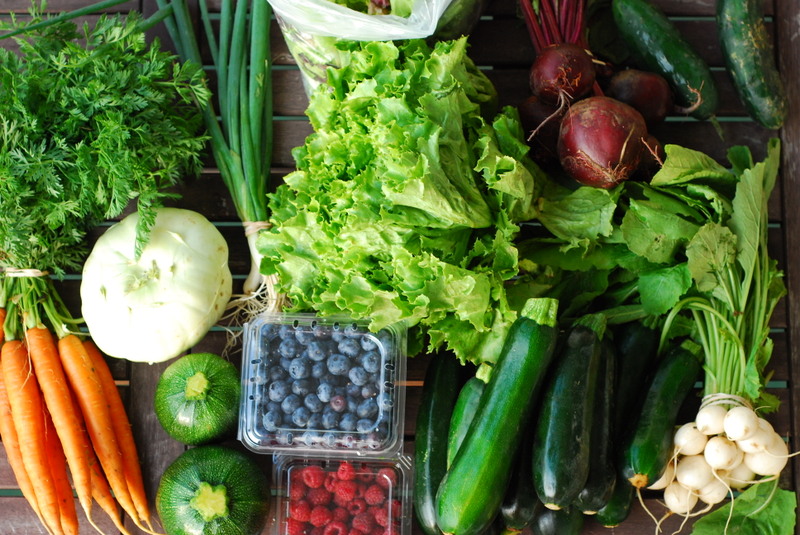
    Let me indulge in some gentle proselytizing today, yes? I’ve just come home laden with plastic bags and I’m feeling chatty. Have a look at the collection of fruits and vegetables that I picked up today from my CSA drop-off point at a church here in Queens.

    We’ve got a bundle of sweet carrots, a huge kohlrabi, some scallions, a bag of tender baby lettuces, a bunch of beets and their lovely greens, two cucumbers, the smallest, whitest turnips I ever did see, a gaggle of dark-green zucchini, a box of raspberries, a box of blueberries, a hardy head of lettuce, and two rond de Nice zucchini. (Oh, and a bunch of wispy dill, but I left that in the swap box, since my neighbors aren’t here to take it.)

    Now. Do you know how much this whole assortment cost? Go on, guess. I’ll wait. Ready?

    $24.00.

    Ben and I and our friends upstairs share our CSA box, so usually we divvy everything up fair and square (they get the fruit because they pay extra), and Ben and I find ourselves with more vegetables than we can usually finish for less than $10 a week.

    Try and buy that same amount of food at Whole Foods or Garden of Eden or your local grocery store and you’ll be spending, what, twice, three times that amount? I should do a little price comparison. Next time.

    CSA’s are not only a way to eat fresh, local produce for more than 6 months a year and support a family farm instead of a huge, industrial farm (organic or not), but they’re also very affordable, which is pretty important any day, but particularly in a time when people are finding the price of everything – gas, milk, bread, everything – going up. Plus, membership forces you to grow beyond your habits – you’ll find yourself eating vegetables you’d never even known about before.

    Most CSA memberships are closed for the season, but if you’re at all interested in joining one, early next year is a great time for signing up – sometimes early birds even get a little discount on the fee.

    Now, back to my vegetables:

    I’m going to turn the carrots into soup, along with a fennel leftover from last week. I’ll leave it chunky and serve it at room temperature. Maybe a little sour cream on top. I never do that, so it’ll be a nice change.

    The kohrabi I’ll just peel and slice into thin discs to crunch on, raw. Some people cook kohlrabi, but I simply can’t – it’s too good just as it is. Cold from the fridge, preferably. Who needs radishes?

    The berries, Gemma and Seb’s, I’m going to either freeze and bag or turn into a pot of jam for them. It depends on how busy the rest of the week is.

    I’m going to try to eat the beets raw this time. I always cook them, but I read this week that you lose all the antioxidant power of the beets when they’re cooked. So I’ll shred them, maybe with a carrot or two, and dress them with a tangy vinaigrette. As for the greens, I’m a little sick of the standard garlic-and-olive-oil-saute. Any ideas, dear readers?

    The regular zucchini are so lovely that I’ll eat a few of them sauteed with olive oil and garlic (uhh…) and the rest I’ll turn into a soup, with mint and basil from the balcony.

    My farmer says to just eat those little white turnips raw, which sounds like fun. I never buy turnips, never eat them, not out of any antipathy, just because I’m never quite sure where to start with them. So this feels easy and good. Although I could also be convinced to pickle them. I’m in a pickling mood. I’ll add the greens to whatever I end up doing with the beet greens.

    And the round zucchini, well, there are too few to turn into petits farcis, so I might just do a little breadcrumb stuffing – homemade breadcrumbs mixed with a large amount of minced parsley, chopped capers, some grated Parmigiano, salt, and olive oil, then mounded into the hollowed-out zucchini and roasted in the oven.

    What’s left? Oh, right, the scallions. I’ll admit, I’m stumped. I sometimes throw these into a grain salad of sorts, but I never really enjoy them, mostly because I don’t like any member of the allium family raw. So, another question for you, then, do any of you cook your scallions? Tell me how.