• FBconnect10_SideBar_B(2)

    So where are you going to be the first weekend in June? I'll be in London at the Food Blogger Connect conference, where I've been invited to speak on a panel about blogging and book writing. Won't you come and say hello? I'd love that.

    I wanted to also draw your attention to an interview I did some time ago with Sarah Amandolare of Writers and Cooks. She asked some very good questions, ones that really made me think. If you'd like to read my answers (none of which involve my favorite foods or what I'd like to eat before I die), click here.

    ***

    These last few months have been quite a whirlwind. They've been challenging and wonderful at once. As spring descends upon Berlin, I feel almost as though I've woken up from a strange sleep: fitful, not entirely rested, but with some perspective on the last few months.

    Today, I delivered three chapters to my editor. The rest follows next February. Let me tell you something: writing a book is humbling. In terms of work, I do believe it's the hardest thing I've ever done. Some days are good, some days are awful. Some days, not much at all happens. And some days, it all comes tumbling out. Whenever the work threatens to overwhelm me, I tell myself: this is just one year, just one book, and you're just one person. Breathe.

    Then I eat a cookie.

    ***

    In a few weeks, I'm going back to New York for a week. Besides spending time with my friends, the thing I'm looking forward to most is just to walk down 7th Avenue or 5th, for that matter, or the West Side Highway or 18th Street or through Union Square. Just to walk those messy streets and smell New York City air and see all the lovely people around and hear the pushy cabs and the street vendors and some dude Noo Yawking away on his cell phone. I can't wait to take the subway and eat a drippy, spicy banh mi and buy a whole bunch of trashy magazines and hear all the clanging, dissonant, fabulous noise that is the greatest city on earth and simply be in all that wild New York City energy.

    Cannot wait.

  • DSC_7028

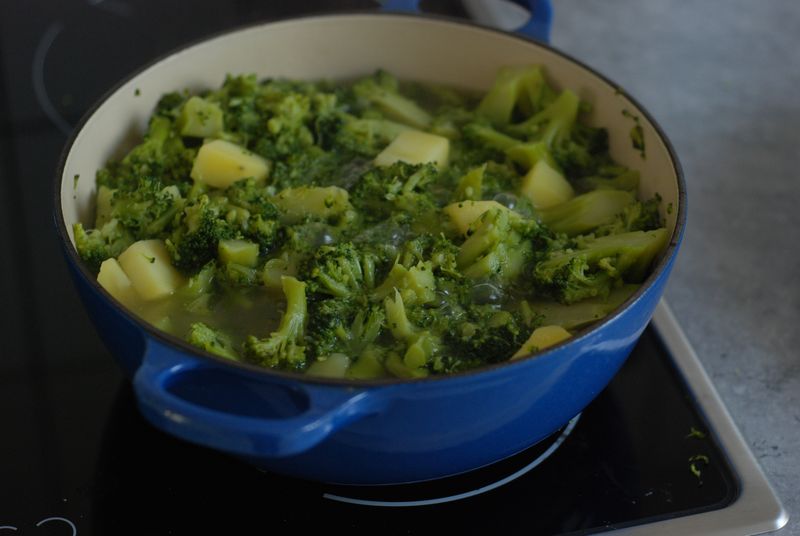
    The boxes are unpacked, the cookbooks are once again in their shelves, a few paintings grace the walls and there are fresh towels in the bathroom. My name isn't yet on the doorbell, but I've got a basil plant thriving in the warm light that comes through the window from the balcony. I don't have a phone line yet, but my living room looks almost lived in. And though I haven't yet got a table and chairs in the kitchen, I made lunch there the other day, the first real thing I've cooked since moving in, and the smell of browning onions and boiled broccoli was the best sign of being home.

    DSC_7032

    Sadly, the lovely apartment I ended up in doesn't have a gas stove. A lot of apartments in Berlin don't have them anymore, out of what seems to be a combination of modernity and fear. (Of gas leaks, explosions.) So instead of flames at the hearth, hissing away as I boil water or fry an onion, I now have a sleek, black induction stove, which looks super cool, but is eerily silent and, I find, a little strange. I'm getting used to it. I don't know if it's my imagination or not, but water boils awfully fast on it, which is rather nice. Perhaps I've got a physicist or two in my audience who can tell me if I'm making this up or not? In any case, it's easy to clean. Which is good, too. Like I said, I'm getting used to it.

    DSC_7036

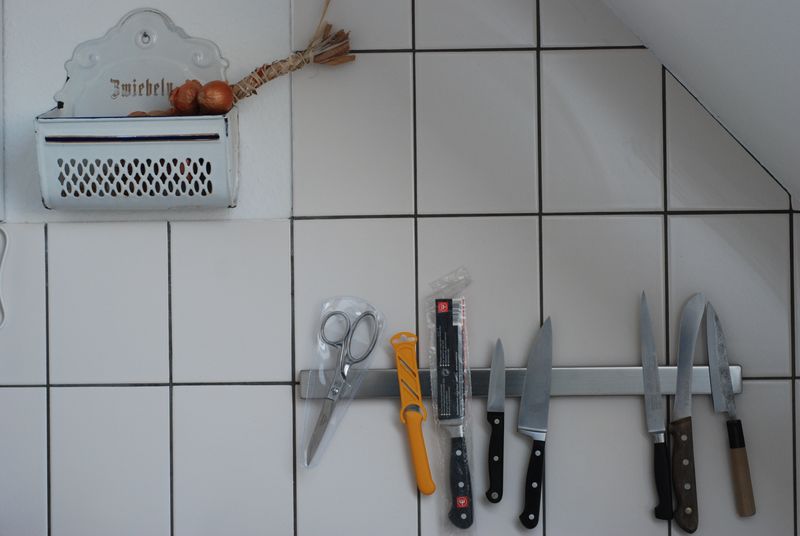
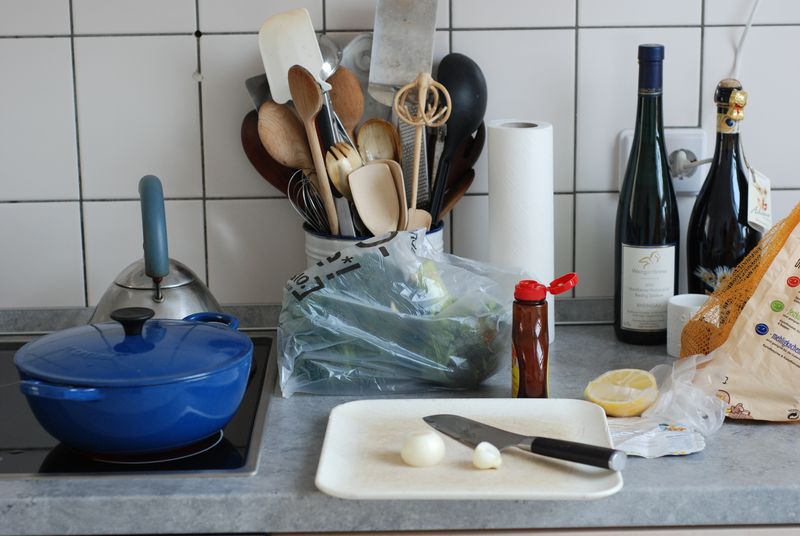
    The kitchen is lovely. Flooded with light and with a gorgeous view, I feel really peaceful when I'm in there. Sometimes I can hear traffic a few streets away, and sometimes I hear little birds chirping in the eaves outside my window. All my old friends are gathered together: my blue soup pot, my knives from college and New York, my grandmother's spatula, a tea kettle given to me by an old boyfriend over a decade ago. I've got Rancho Gordo beans in the cupboard and two kinds of brown sugars in the fridge (thank you, Nikolas!). I've got parchment paper in the cupboards and my trusty lipped cutting board at the ready.

    DSC_7041

    I can already tell, good things are going to come from here.

    DSC_7079

    And last week, a few days before I left for London, where I spent the weekend with my friends, strolling through Borough Market, marveling at stylish London girls, buying killer cheddar and Cadbury's speckled chocolate eggs at Sainsbury's and drinking, yes, quite a lot of tea, I made soup in the new apartment. My very first proper meal cooked there, if you don't count the spaghetti with tomato sauce I made for a couple friends who came over to help me put up shelves and do a bit of drilling a few weeks earlier.

    DSC_7066

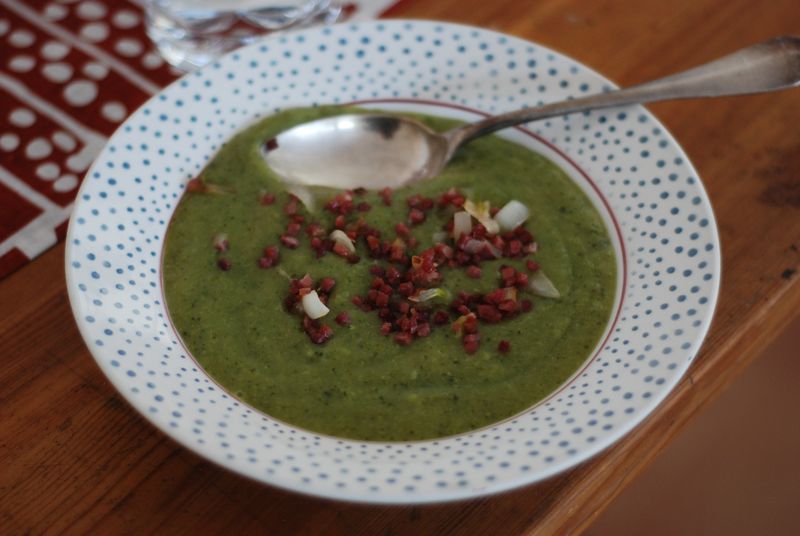
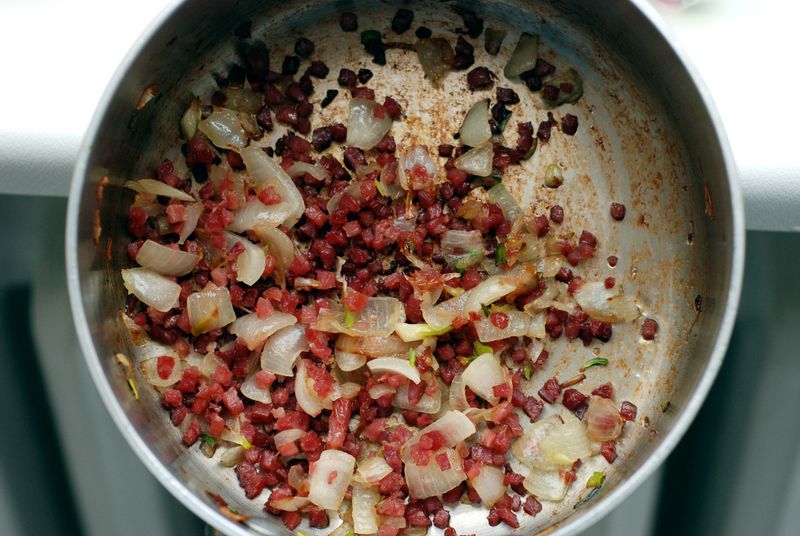
    I found the soup recipe in a free magazine from a grocery store chain here that my mother picked up for me, which sounds rather unpromising, I know, but trust me. It's just broccoli and potatoes boiled in chicken stock, then puréed and topped with fried onions and Speck and little slivers of mint leaves. It's simple and easy and awfully filling, plus it looks just darling, especially when spooned into lovely antique plates bought at a flea market in Paris ten years ago and then forgotten about in a basement until now.

    Oh, right, and it tastes good, too.

    DSC_7072

    The last week has been warm and sunny here. The trees sport fat buds, crocuses are peeking up from the moist ground, I hear birds chirping before the sun goes up and the air is fairly bursting with anticipation for spring. We're not quite there, yet, as today's cold wind reminds me. And the markets are still only selling asparagus and peas from far away countries like Greece and Spain. But today I saw local rhubarb for the first time, so pink the stalks almost glowed. And I have plans for tomato plants on my balcony, and little gherkins so I can make my own cornichons later this year.

    It's going to be a good spring.

    Broccoli Soup with Speck
    Serves 3 to 4

    1 medium yellow onion, minced
    6 slices Speck or pancetta or unsmoked bacon, finely diced
    1 lb (450 g) floury potatoes, cubed
    6 cups (1.5 liters) chicken broth
    1 lb (450 g) broccoli, roughly chopped
    Salt and pepper
    2 tablespoons thinly sliced fresh mint

    1. In a small pan, cook the onion and Speck together over low heat until the onion is translucent and fragrant, about 7 minutes. Set aside.

    2. In a covered soup pot, bring the broth to a boil. Add the cubed potatoes, lower the heat and simmer for 10 minutes. Add the chopped broccoli, mix well and cook for another 10 minutes. Remove from heat and, using an immersion blender, purée until smooth. Add salt and pepper to taste.

    3. Ladle the soup into plates and sprinkle a spoonful or two of the bacon-onion mixture over each serving. Top with the sliced mint and serve.

  • Gelierzucker

    Skiing was so much fun, it really was. But one afternoon, our energy levels pooped out entirely (the infamous third day!) and so a few friends and I decided to go souvenir shopping at the local grocery store in the next town over from our little village. Ooh! We found some serious gems. Here's what I bought:

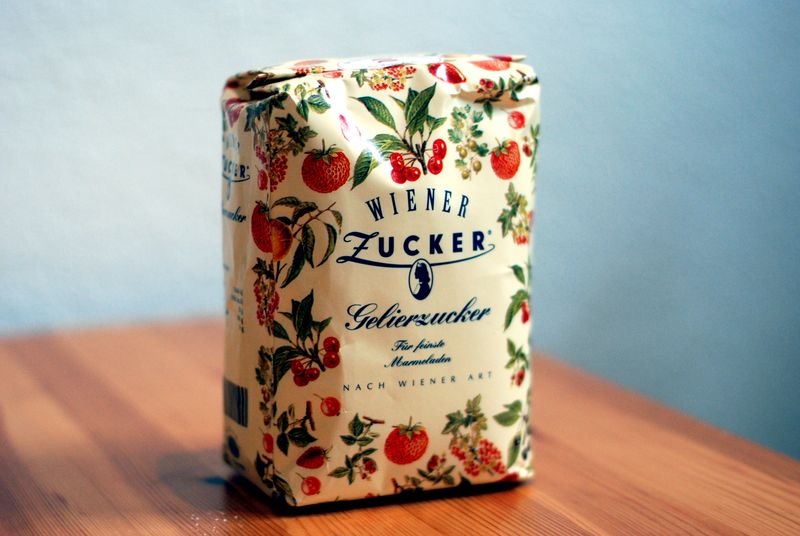
    Gelierzucker is what Germans and Austrians use to make jams and jellies. It's sugar mixed with powdered pectin. Have you ever seen more beautiful packaging? I don't believe I have. It is the only reason I bought this sugar and if I could have, I would have bought a case. Wiener Zucker seems to be Austria's Domino and they make all kinds of different sugars, including powdered sugar that comes in an equally enchantingly designed box. (Austrians call powdered sugar Staubzucker, which means "dust sugar". This, for some reason, pleases me to no end.)

    Poekelsalz

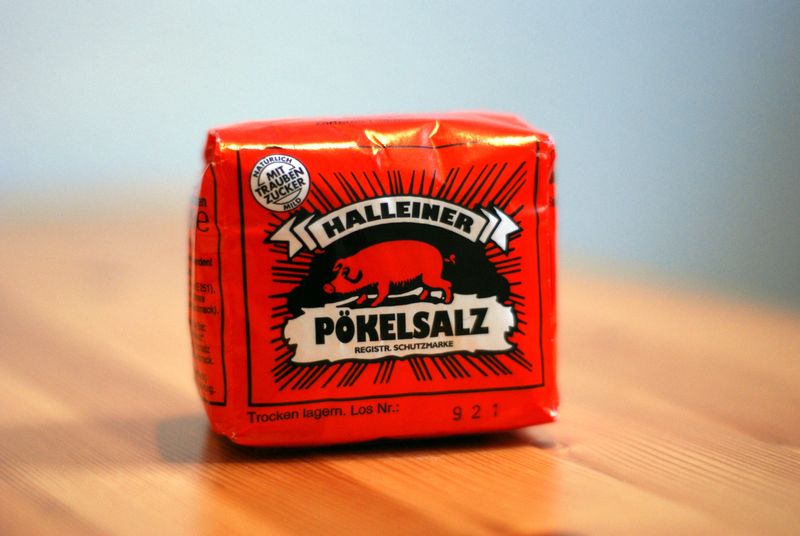
    Another purchase just for the package. This, my friends, is pickling salt. Enough for 50 kilos of meat once mixed with a couple kilos of table salt. Apparently, it's best used when "butchering at home". Why yes, of course I need this in my new kitchen! Who wouldn't? I plan on doing a lot of meat butchering and pickling this year. Seriously, I could not pass this by. Could you have? Look at that little pig! It was too much.

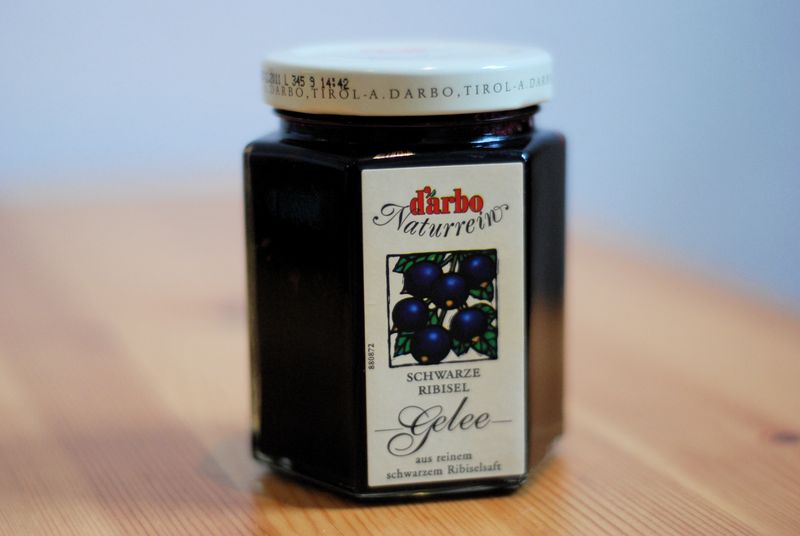
    Ribiselgelee

    The Austrians have all sorts of adorable names for things. Like the aforementioned "dust sugar" or "ice box" for refrigerator or "powidl" for plum jam. They also call black currants schwarze Ribisel (pronounced REE-BEE-sel), which is so perfect, isn't it? Of course they're little Ribisel! That's exactly what they are. Anyway, d'Arbo is an Austrian jam maker that does a lot of business worldwide (you can find their jams in New York and Berlin anyway), but I'd never seen this delicate little jelly anywhere before.

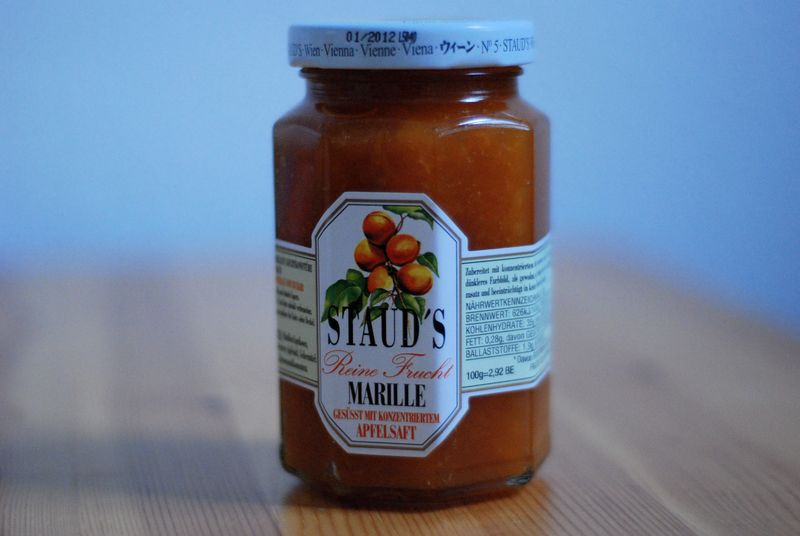
    Staud

    While in the jam aisle, physically restraining myself from reaching out and putting everything I saw in the basket, I made an exception for Staud's apricot jam, made with pure fruit. Austrians call apricots Marillen, which always makes me think of Marilla Cuthbert, who was Anne of Green Gables's caretaker, in case you didn't read that book 14 times (uh, I didn't get out much in the 5th grade) and so I am powerless when it comes to them. Also, Dean & Deluca sell Staud marmalades for totally atrocious prices, which always rather appalled me, so part of why I bought this was because it was cheap. Chee-heap.

    Karntnerspeck

    My shopping companions spent a lot more time than I did eyeing, discussing and marveling over all the cured meats available at the store. Let's just say, if you're into cured pig, especially but not exclusively, there is a lot to get excited about in Austria. I liked the look of this maroon slab of dry-cured bacon (which, literally translated, means "ham bacon", har) out of Carinthia. I'll let you know what I end up using it for. Right now I just like hefting it back and forth.

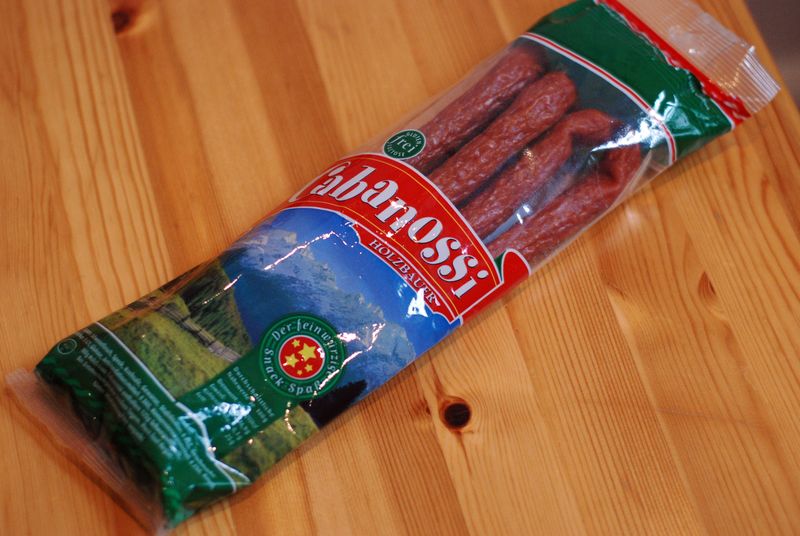
    Cabanossi

    Cabanossi, I have recently learned, are one of Austria's greatest salami products. Thin and chewy and completely addictive, some people I know take them skiing to gnaw on during breaks (I can't seem to even handle chewing gum while on the slopes, but that's another story). They're not that easy to find outside of Austria and certainly impossible to find outside of Central Europe. I wasn't allowed to leave the store without buying a package.

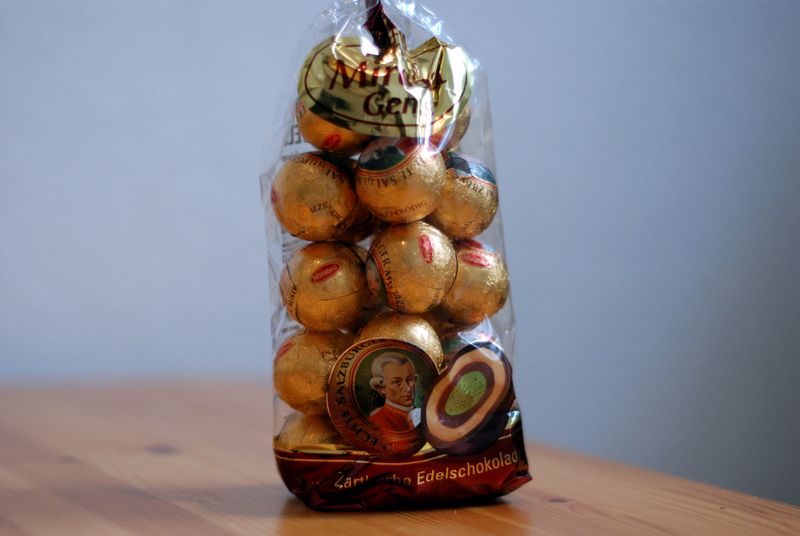
    Mozartkugeln

    Mozartkugel! Do you know about Mozartkugel? A ball of pistachio paste covered with a layer of nougat covered by a layer of marzipan, then covered in dark chocolate. Delicious little things. These are not authentic; no, the real, true, authentic Mozartkugel are only made at a confiserie in Salzburg, where Mozart was from. But unless you go to Salzburg or pay a lot of money to have them shipped, they're out of reach. These industrial ones from Mirabell are pretty and delicious and very easily squashed into a suitcase. Also, affordable. Mozartkugel for everyone!

    Vinegar

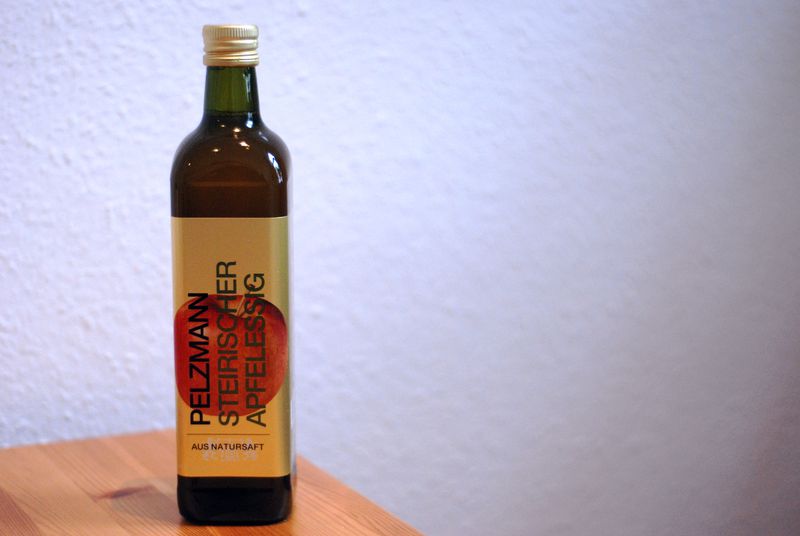
    I mentioned Austria's gorgeous pumpkinseed oil in my last grocery store post. But what Styria, the pumpkinseed capital of Austria, is also famous for is apple cider vinegar. This near-liter bottle cost a whopping €1.99, plus the packaging was so stylish I couldn't resist. I plan on splashing this liberally into potato, cabbage and beet salads.

    Wienersenf

    And now we come to the mustards. Lovely people, the mustards. I could have spent an hour in the mustard aisle and I don't even love mustard as much as I love ketchup. It was insane. Insanely wonderful. All kinds of metal tubes and bottles and flavors and oh my goodness, you would have thought we'd never even seen mustard before the way we carried on in there. I managed to get out of that store with only five (5!) tubes and I tell you, I practiced some serious restraint.

    Above, in exhibit A, we have the classic Wiener Würstel mustard (semi-sweet, whatever that means). If you go to any butcher in Germany and ask for a Wiener Wurst, you will get what looks like a slightly elongated American hot dog (no bun, obvs). (Wien, in case you were wondering, is Vienna in German.) You can eat it on the spot, cold, or go home and heat it up in water. Either way it's iconic and delicious and apparently, this is what you should be dipping it in.

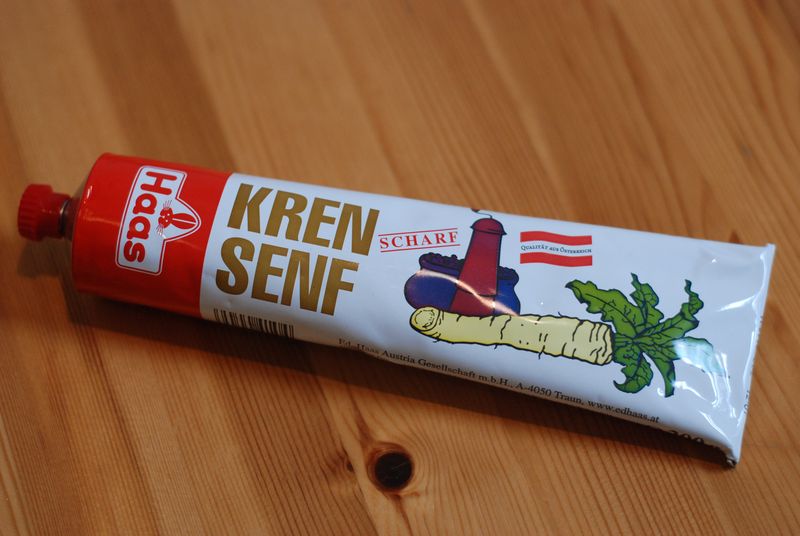
    Krensenf

    Austrians have a thing for fresh horseradish. They call it Kren and dudes, it is HOT. They like shredding it over an open-faced sandwich or grating it onto boiled beef and holy hotness, it should come with a warning. MAY BLOW YOUR FACE OFF or CAN PERMANENTLY RECONFIGURE SINUSES. I do believe it could be hotter than wasabi. This here, exhibit B, is horseradish mustard, labeled "hot". Um, YES. Don't let that goofy horseradish root cartoon drawing fool you.

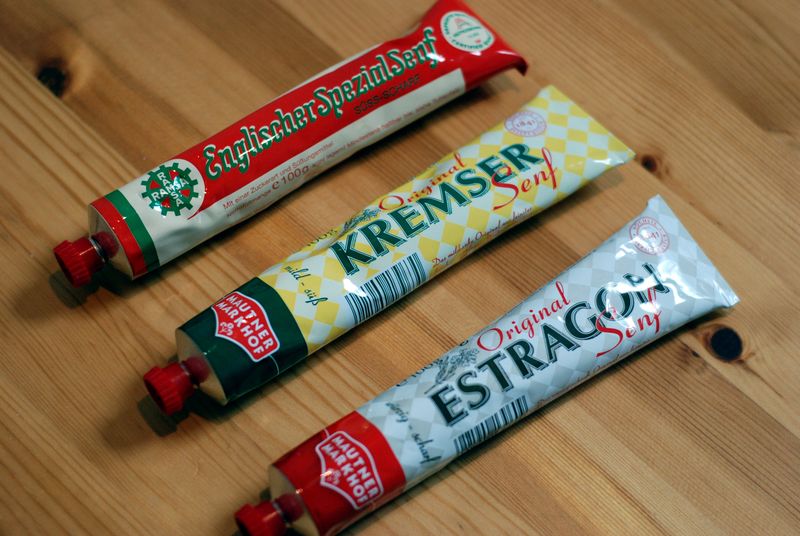
    Threesenf

    Here, Exhibit C, we have the remaining three mustards I bought. Tarragon mustard (savory-hot), at the bottom, a traditional Austrian mustard from Krems in the middle (mild-sweet), and then something called "English Special Mustard" (sweet-hot) at the top. Aren't they darling? The metal tubes are cool and smooth to the touch. The terrible thing is this: I bought these as gifts and now can't bring myself to give them away. How can I live another day not knowing what English Special Mustard tastes like? Or the original sweet mustard from Krems? Or that spicy tarragon mustard?

    Yes, there was that thing about there not being much room left in the suitcase, what with the apple cider vinegar and the sugar and the preserves and the cured meats and the freaking pickling salt, but really, I have learned my lesson: there must always be room for more mustard.

  • DSC_6658

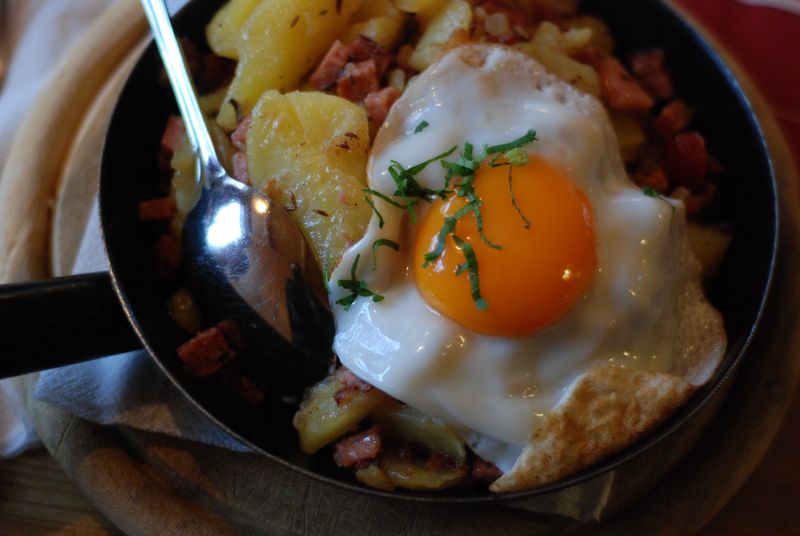
    When in Austria, do not leave without eating at least one serving of Tiroler Gröstl (approximate pronunciation help: GRR-ESH-TL, helps if you go all guttural on the "RRR"). You should receive an individual cast-iron pan filled with crusty fried potatoes, big chunks of bacon and ham, topped with the most perfectly fried egg you ever did see, the yolk still runny, the edges laced just so. If you are physically able to finish this all in one go, you will probably not need to eat again all day or perhaps the next day, too. Sharing it will leave room for dessert.

    DSC_6675

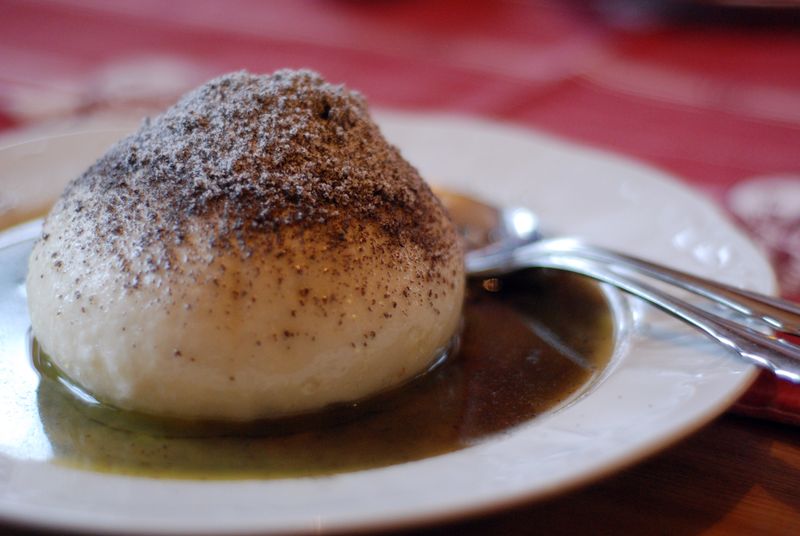
    Dessert, after all, could be as delicious and essential as one puffy, gorgeous Germknödel, which I know, I know, does not sound like much to Anglophone ears ("what do they mean, GERMS?"), but is one of the greatest contributions to world cuisine. (Germ is Austrian for yeast.) What you get is a large, steamed, yeasted dumpling (similar, I suppose, to char siu bao) filled with a generous helping of plum jam (remember?), topped with a small mountain of ground poppyseeds and powdered sugar, swimming in a pool of melted butter and more poppyseeds. I, frankly, could do without all the butter, but the dumpling itself, yielding and chewy, and that plum jam, slightly sour and spiced, is seriously wonderful. You will be happy you left room for it.

    DSC_6678

    The week in the Austrian mountains was wonderful. Concentrating on not breaking a leg or humiliating myself on the slopes was an excellent way to detach from regular life. Oh, and no access to the Internet seemed to help, too. What is it with snow-covered trees and their enchanting ability to seem like a gathering of silent and wise old men?

    DSC_6883

    We stayed in a cozy little guesthouse run by a family that also runs one of the restaurants on the top of the nearby mountain, providing hungry skiers with plenty of fried potatoes and steamed dumplings and other Austrian comforts. There were delicious meals every night (each dinner started with a different soup, made with homemade stock cooked fresh every day, beef bones and turnips a-bobbing), adorable little girls who poked their heads into the dining room and ran off giggling when spotted and the sound of a rushing brook next to the nearby road at night.

    DSC_6713

    I didn't realize until we left how deeply soothed I felt. The mountains and the sky and the crrrsh crrrsh crrrsh of skis slicing through fresh snow reordered how my mind worked.

    Berlinwall

    But coming home was good, too. I saw Berlin, with its cement gray skies and damp earth air, with eyes wide-open. People! Graffiti! Signs! Traffic! Buildings!

    DSC_6638

    Lovely in its unloveliness. Gilded and sooty alike.

    Berlinlot

    You can walk through some parts of Berlin and see a whole new city unfold in front of you. New streets, new bridges, a new identity entirely. And in other parts it looks like nothing has changed in thirty years, like there is still a Wall and melancholy swirling around empty fields underneath that metallic sky.

    Tiergarten

    But you keep moving, because you must, there's more to see just around that corner and there are subways to take and dinner to cook and before you know it, it's snowing again. Great big fat snowflakes, gathering wetly on your sleeve. You pass Tiergarten, seemingly unchanged in a hundred years, and there they are, those wise old trees, bewhiskered with white, standing like sentries in the midst of this strange, interesting city. Silently watching us as we go.

  • Slice

    Alright, poppets, this one has to be quick. In one hour and 35 minutes, I am leaving the house to get on a bus to drive through the night from Berlin all the way down to Austria, where I will be skiing for the next 8 days. Ooh! The last time I did this was in the 8th grade. I remember that drive as a long night filled with classmates taking turns on some lucky kid's brand-new Game Boy and a lot of dirty, well, for 14-year-olds at least, jokes. This time, instead of the Game Boy, we've got an iPod, a couple of books and maybe even a few better jokes than last time up someone's sleeve. Honestly, I just can't wait.

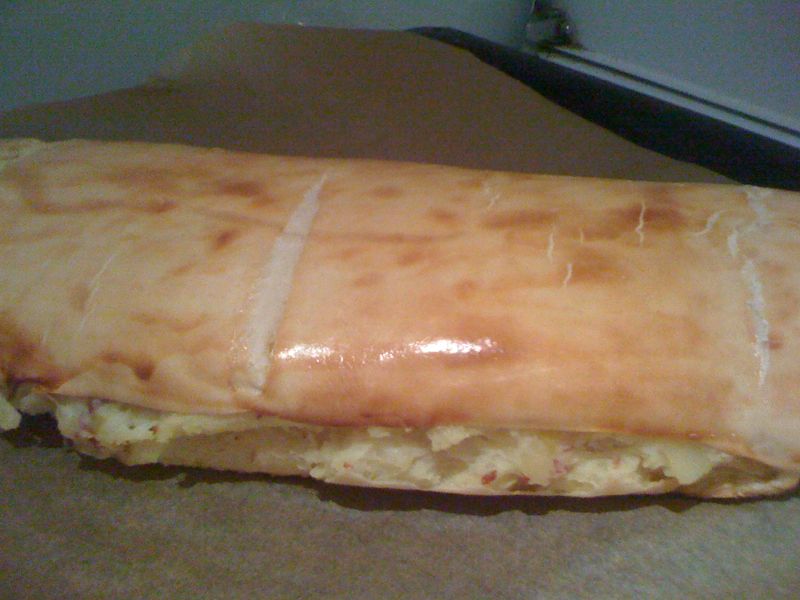
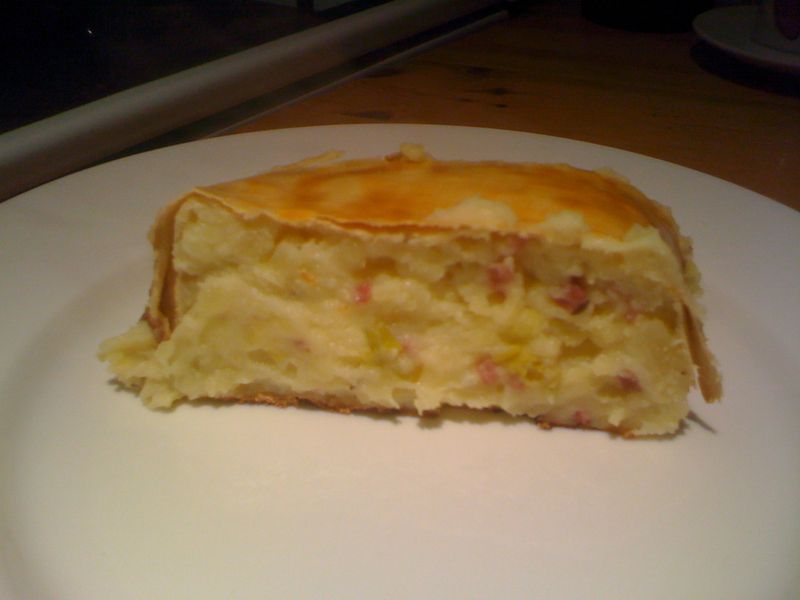
    While I'm gone, eating more ham sandwiches than I care to count, I leave you with a true Austrian gem in the spirit of my vacation, if you will. Potato strudel, which is sort of like the most delicious, most elegant potato knish you'll ever eat, only studded with bacon. It's tasty. And you don't need German strudel dough to do this, you can use plain old phyllo (or filo) instead.

    Let's get started, shall we? My long underwear won't pack itself. Pardon the iPhone photos, I know they are hideous, but the night I made this, my camera battery died and this was all I had.
    Potatoes

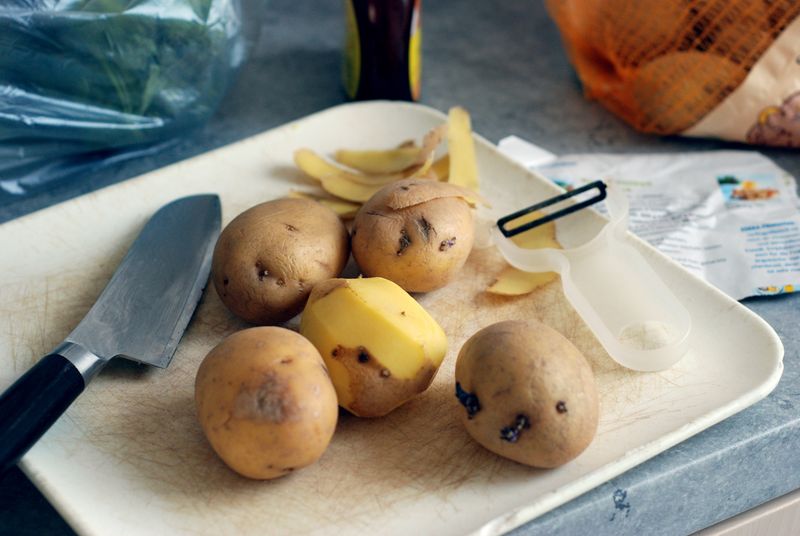
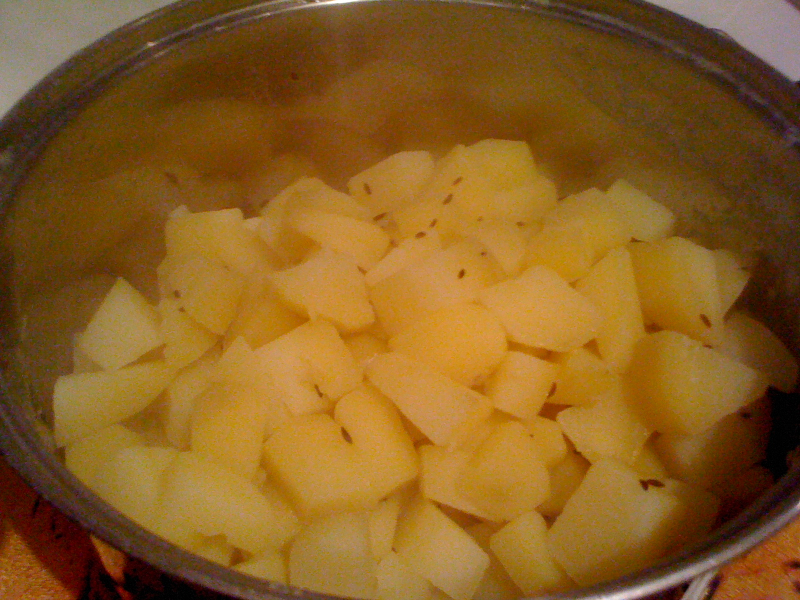
    First you boil a whole mess of peeled, cubed potatoes. They will take far less time or elbow grease to prepare than you think. In the time it takes to boil a pot of salted water, basically, you should be able to take care of those babies. Add some caraway to the cooking water. It imbues the potatoes with wonderful flavor and some even make it into the strudel later. By the way, in case you didn't know, potatoes and caraway? Soulmates, star-crossed lovers, meant to be.

    You mash those potatoes with Quark and a good amount of salt and pepper. In New York, I know, you can find Quark at the farmer's market and at Whole Foods and Fairway. It's a fresh German cheese. You can substitute fromage frais, if that is easier to find. The recipe I used has you thrown in minced mint, too, which sounds lovely. I didn't have any, so I left it out and no one missed a thing. Do as you like.
    Ham

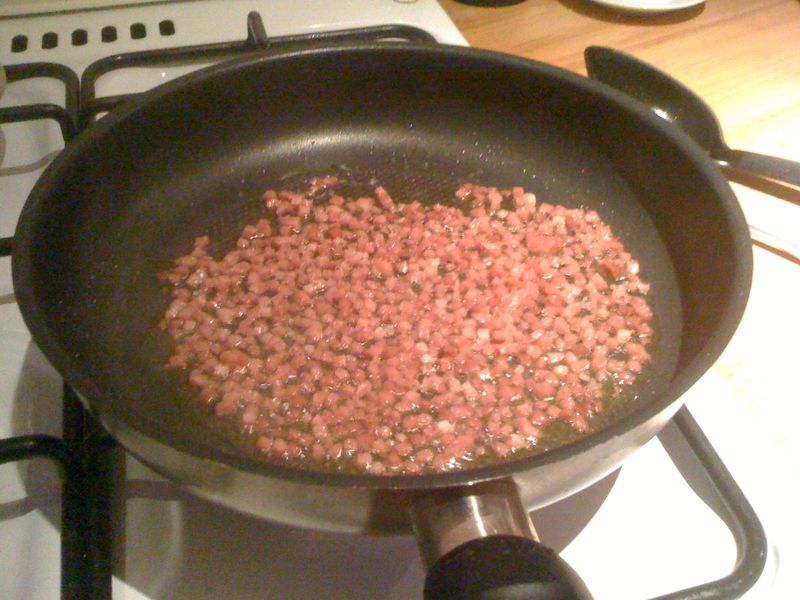
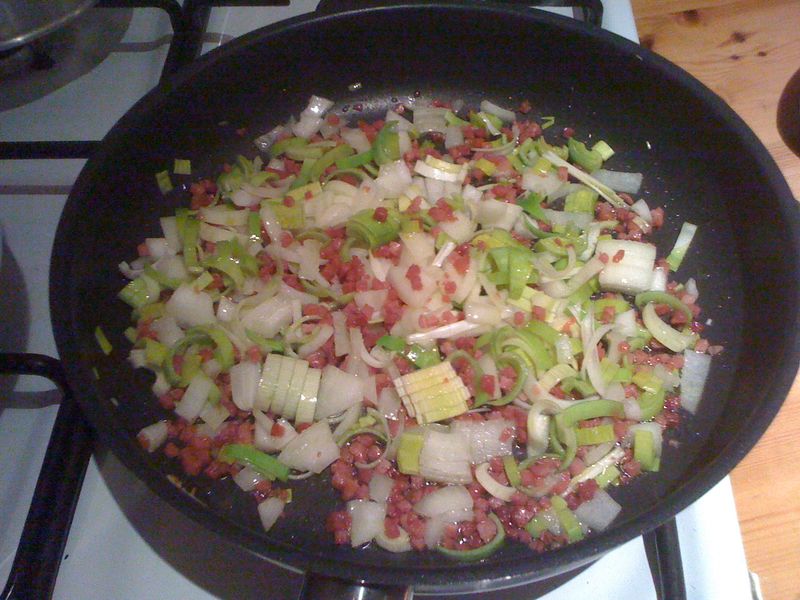
    Next up is the bacon. Here at the grocery store, you can find ready-cubed bits of bacon just as you can in France. When I went grocery shopping, the store was all out of the regular stuff and only had "diet" cubed bacon left. One cold look at the package and I realized it was just regular cubed bacon, with all the fat cut off. Uh. Thank you for doing my work for me? (Incidentally, the brand-name of this bacon was Abraham, I kid you not.) So. Anyway. Bacon. Fry up a bunch of it, cubed, until the fat renders or, if you're using the superlean kind, sauté it in some olive oil. Then add sliced leeks and minced onions and cook until everything is wilted and glossy and fragrant, about 7 to 10 minutes.
    Leeks

    Go back to the mashed potatoes and mix in an egg and then the leek mixture. Ooh, it will be hard not to stick your finger into those potatoes and have a taste! Oh, go on. Have a taste. Lovely. Make sure there is enough salt and pepper and set aside.

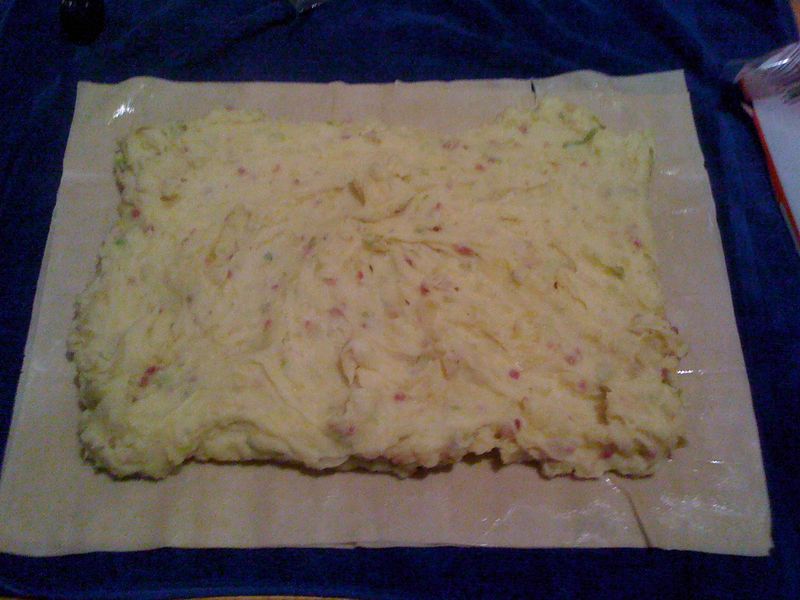
    On a damp towel, spread out the strudel or phyllo dough that you've layered and brushed with butter (don't worry, I've written it all out below). Pile on the mashed potatoes, but don't overdo it. My split strudel is not very Austrian. They are far more restrained, I hear.
    Mashed

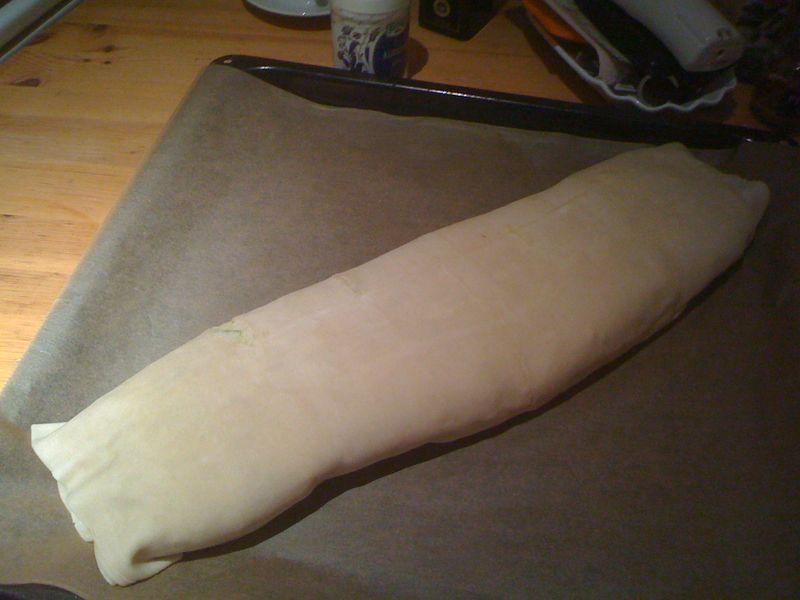
    Using the towel, instead of pulling on that oh-so-delicate baby's bottom strudel dough, gently roll the strudel over itself, making one big long log. Gently glue the ends to the side of the strudel, making a nice neat package.
    Unbaked

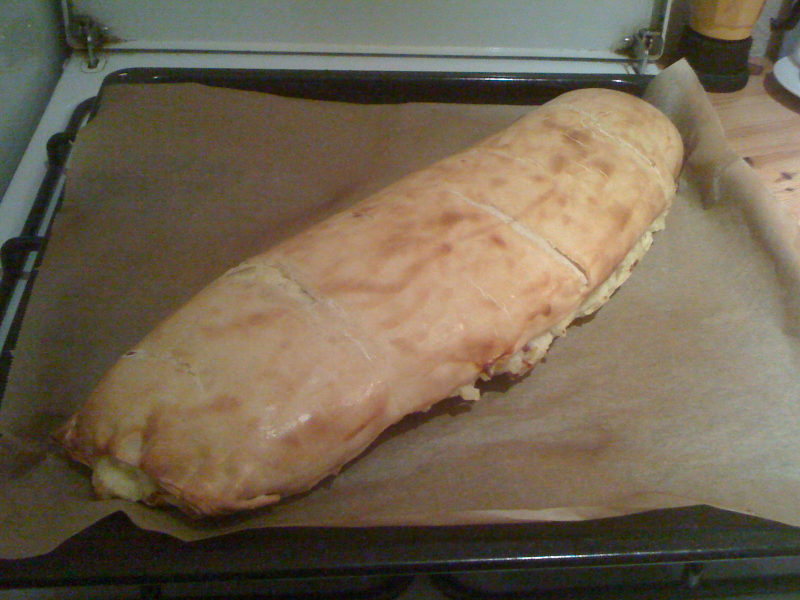
    You brush this thing with egg yolk to make it all shiny and burnished later and bake it in a hot oven until it smells irresistible and is crackling with excitement. We ate great big slices of it next to green salad dressed with pumpkinseed oil. It doesn't keep particularly well, so try to come hungry, will you? Everyone takes two helpings, no discussion.

    The outside casing is thin and crispy and sort of shatters under your fork, while the filling is fluffy and yielding and creamy and wonderful, the Quark and leeks and bacon and caraway combining to glorious effect. This food is fancy and peasant at the same time, easy enough for a weeknight (I swear), yet impressive enough for dinner with your mother-in-law.
    Baked

    See the split? Tsk tsk.

    Split

    Alright, I think that's it. I have to go: less than an hour and still no packed suitcase, eep. Have a lovely week, you all. Enjoy your strudels! Stay warm!

    Austrian Potato Strudel
    Serves 6

    1 lb (500 grams) floury potatoes, like Russet, peeled and cubed
    1 teaspoon caraway seed
    1 cup (250 grams) Quark
    Salt
    Pepper
    2 teaspoons fresh mint, minced (optional)
    3 tablespoons unsalted butter or oil
    3.5 ounces (100 grams) lean bacon, diced
    1 leek, thinly sliced
    1 onion, diced
    1 large egg and 1 egg yolk
    2 sheets of prepared strudel dough or phyllo dough (do not use puff pastry dough)

    1. Preheat your oven to 390 degrees F or 200 degrees C. Bring a large pot of salted water to boil. Throw in the cubed potatoes and the caraway and cook until tender, about 10 or 15 minutes. Drain and put the cubed potatoes back in the pot. Some caraway will have gone out with the water, but some will still be stuck to the potatoes. Mash loosely with a fork. Mix in the Quark until well combined, and salt and pepper to taste. Mix the minced mint into the potatoes. Set aside.

    2. Heat a tablespoon of butter or oil in a skillet and add the bacon. If using regular bacon, you can simply render its fat in the skillet without using any additional fat. Add the leek and onion and sauté, stirring, until glossy and wilted, about 10 minutes. Turn off the heat.

    3. Mix the egg into the potatoes and then the bacon-leek mixture. Combine well.

    4. Unfold one dough sheet on a damp towel. Brush with some of the remaining melted butter. Unfold the second sheet over the first and, again, brush with the rest of the melted butter. Spread the potatoes over the second sheet evenly, leaving room at the edge of the dough. Do not overfill – leftover mashed potatoes are delicious if fried into croquettes the next day.

    5. Using the damp towel to assist you, gently lift one edge of the strudel and begin rolling it over the filling. "Glue" the edges to the side of the roll and arrange the strudel, seam-side down, on a baking sheet fitted with parchment paper. Beat the egg yolk and brush the strudel thoroughly with the egg yolk.

    6. Bake the strudel for 30 minutes, until the strudel pastry is shiny, golden brown and crackling. Remove from the oven, setting the pan on a cooling rack. Slice into thick pieces and serve immediately, with a green salad.

  • Schmalz
    I love going to grocery stores. And I'm willing to bet money a lot of you do, too. No?  There's something so calming about grocery shopping. All those nice parallel lines, the reliable stacks of products, the hum of the refrigerated section, the loamy scent in the produce aisle. I heft sacks of rice in my hand, feel the bumpy rinds of cool lemons, run my index finger along smooth jars of honey. Whenever I'm feeling out of sorts, a stroll through the grocery store sets me right again.

    After a long time out of German grocery stores, I am having such a good time rediscovering what's in them. There are enormous amount of dairy products, lots of whole-grain flours, very cheap, delicious honey and the most beautiful Savoy cabbages you ever did see. There are also more "ethnic" products than there used to be, like Chinese sauces and Yugoslavian pepper pastes; and the produce sections, while piddling in size compared to the grotesquerie of a Whole Foods, now sport lemon grass and cilantro along with the standard offerings of local potatoes, leeks and turnips.

    I don't know about you, but when I travel I love spending an afternoon in a grocery store, looking at local cheese that will never leave the zip code, strange jams, interesting vegetables and more. You can learn a lot about a place from its grocery stores;
    can see the importance of cured meats, say, in one culture, or the lack
    of green vegetables in another. I buy gifts for people back home there, figuring a rosehip jam or an exotic nut oil is so much better than a standard post card. It's something tangible you can eat and feel transported by, something delicious you can't get back home, something special, best of all.

    I thought you might like to see some of my favorite things from my local store here. Next time you're in town, stock up.

    Mus

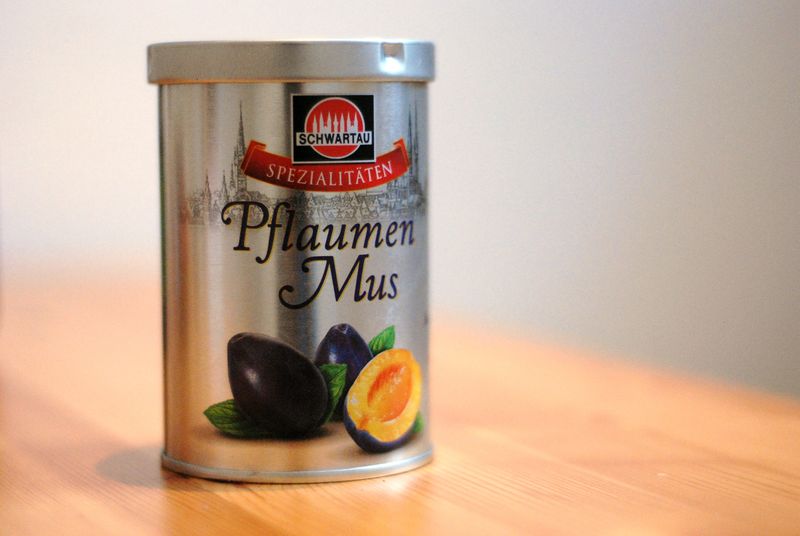
    Pflaumenmus is German plum butter and it is glorious. Dark and sticky and lightly spiced with cinnamon, German bakeries pipe this stuff into doughnuts and citizens put it on toast for breakfast. I've heard it on good authority that it tastes especially delicious spread over fresh cheese on bread. For some reason, Pflaumenmus is almost always sold in tins, which makes for lovely presents.
    Strudel

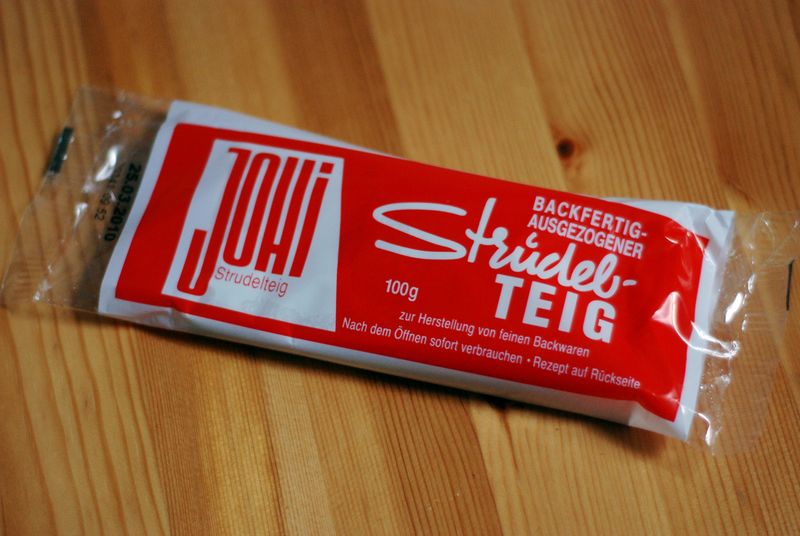
    Strudel. Oh, strudel. Those Austro-Hungarians, man, they had good ideas. Light, delicate dough, so thin you can read newspaper through it, stuffed with spiced apples and brushed with butter, browned in the oven, served with cream… Is your stomach growling yet? I am nowhere near knowing how to make my own strudel dough, so I loved finding this premade dough in the refrigerated section. Plus, isn't the type on the package worth buying it alone? This stuff is from Bavaria, which will probably make me the laughingstock of any Austrians reading the blog, but I've also seen Austrian strudel dough at a fancy department store here and I'm buying that next. Last night, I filled and baked a sheet of this dough with mashed potatoes seasoned with caraway, then mixed with sauteed leeks, onions and ham, and almost two cups of quark. Sliced and served with a salad, oh ho, it was good.
    Tee

    Germans love tea. They love tea. Especially herbal tea. In my grocery store, there are herbal teas available for almost every kind of ailment or situation known to man. From standard offerings like fennel and rosehip to more complicated stuff like "Men's Tea" or "Tea for the Common Cold" or even a tea called "Hot Love" (ahem), you could spend hours in the tea aisle and be convinced to stop believing in modern medicine. My favorite herbal tea at the moment is this stuff called "Arabian Spice Tea". It's flavored with cardamom and plums, among other things, and tastes especially wonderful with a spoonful of honey melted into it. No idea if it does anything good for your health, but it warms my soul and that seems plenty.
    Zwieback

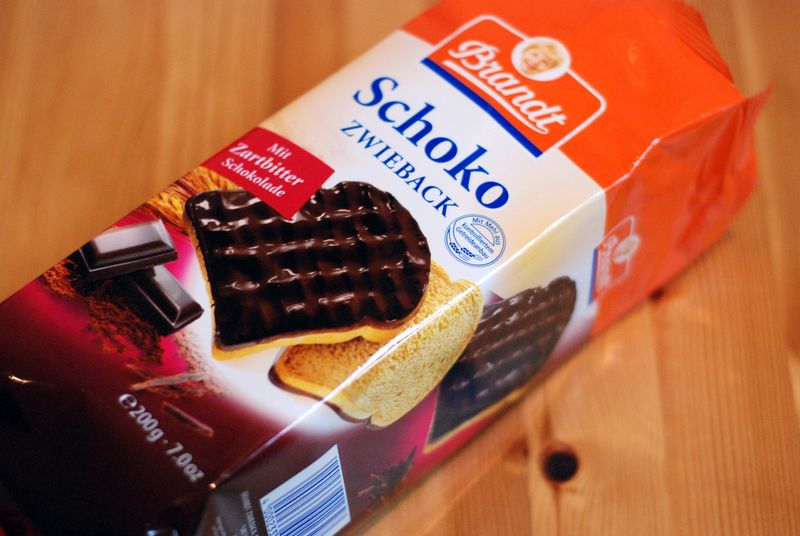
    We all know Zwieback, right? Just little squares of crispy bread, best eaten when afflicted with a stomach flu. Here in Germany, though, the birthplace of the Zwieback, some evil genius has gone and done it: created what is possibly the best teatime snack ever made: the chocolate-covered Zwieback. Covered in bittersweet chocolate, Schoko-Zwieback is addictive. It's crunchy as all get out, barely sweet and so satisfying. I am a little bit obsessed. You will be, too.

    öl

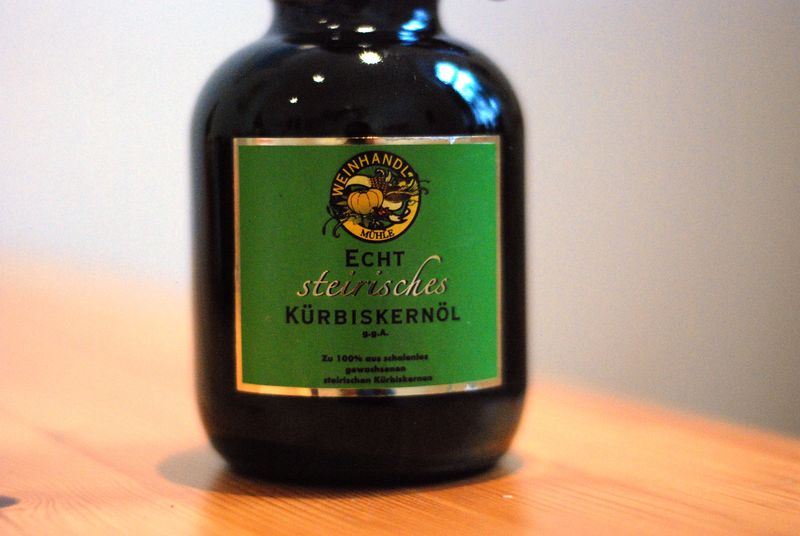
    Another import from Austria is Styrian pumpkinseed oil. Produced exclusively in Styria, a region of Austria, pumpkinseed oil looks like dark green ink and tastes like a pumpkinseed on steroids. I like drizzling it on pureed pumpkin soup or dressing greens for salad with it (best with a delicate white wine vinegar). It's powerful stuff and comes in all kinds of beautiful little jugs and bottles. Way, way better than a miniature replica of the Brandenburg Gate.

    Bauer

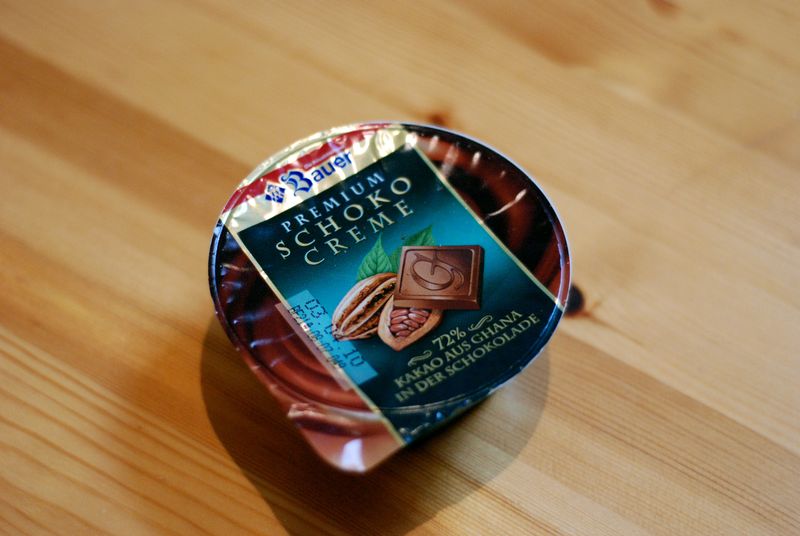
    And finally, the best ready-made dessert you'll ever buy. Bauer, a privately-owned dairy, makes this very simple, very plain chocolate pudding. Made only with milk and no cream and with 72% cacao, it's improbably light and yet packs a serious chocolate punch. It's almost black and silky on the spoon. Best of all: the ingredient label. No preservatives, no strange color numbers. Just milk, sugar, cacao, and starch. Imagine eating a mashed pototo strudel for dinner and then still finding room for dessert? This is the only thing that will fit.

  • Browniebaked

    Darlings, I have an apartment! With real walls, ceilings, windows – windows! – and a balcony looking at rooftops. The balcony is currently filled with snow drifts, but does that matter? Not one little bit. It features largely in my nighttime fantasies in which pure golden sunlight drifts down from the heavens as I sit outside in the morning on that balcony, drinking tea and feeling blessed. Around the corner from the apartment is an Italian wholesale grocery store and a lovely greenmarket on Tuesdays and Fridays (here some summertime photos of said market that might make your eyes hurt what with all the sunshine and the green leaves). Plus the Charlottenburg Palace is in spitting distance. I interpreted these three things as auspicious signs that I should take the apartment. Doesn't that sound sensible? I sign the lease in two days and move next week. Next week!

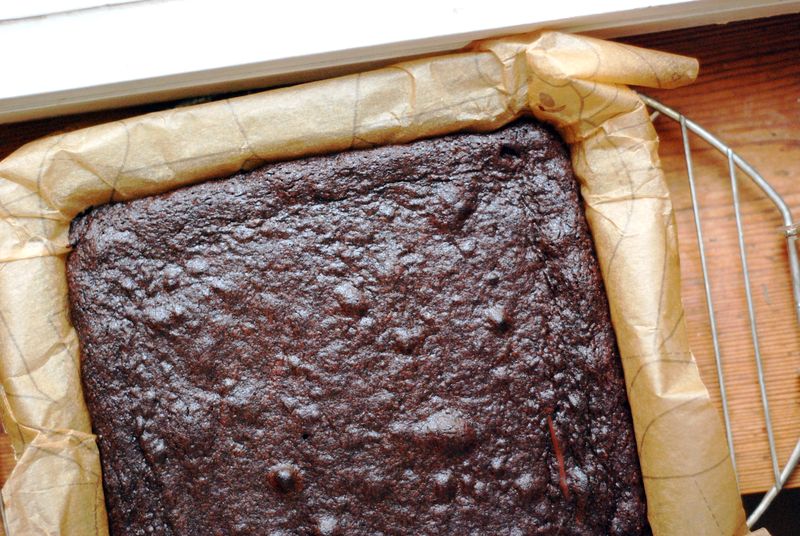
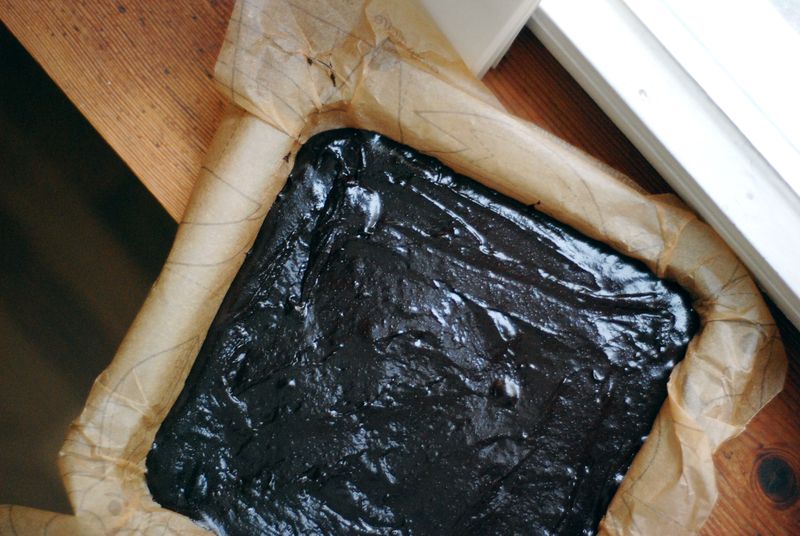
    All in all, these past few days have felt wonderful. An apartment to call my own, the acceptance of my health insurance application (making the black ice all over Berlin's sidewalks feel just a little less treacherous), and the discovery of Alice Medrich's cocoa brownies. Yes, I did just put a brownie recipe on the same level as finding a home. With good reason. These brownies can bridge cultures. They can make people fall in love. They can bewitch you into making them twice in two days. They are powerful, killer brownies.

    Batter

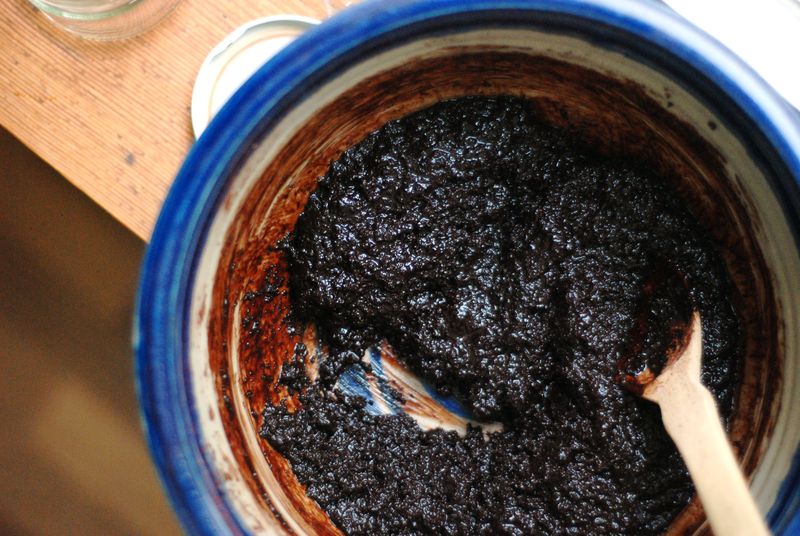
    Furthermore, they are a piece of cake. I mean, all you do is melt butter, sugar, cocoa and salt into a coal-black, grainy sludge in a water bath. Then you beat in vanilla extract, two eggs and a fillip of flour. The batter looks like silk. And that's it. A monkey could make these brownies. A small child could master them.

    The first time I made these, on Friday, I underbaked them. The middle was oozy and gooey and when I brought them to a party, people fell upon them. And can I say, there's something sort of deeply satisfying about seeing one of America's greatest exports, the humble brownie, being so fervently appreciated. Like I said, culture-bridging. I got all warm inside.

    Browniepan1

    The second time I made them, on Saturday, I brought them to a somewhat more intimate gathering. In which, err, I was hoping rather hard to show off my baking prowess. This time, I baked the brownies a little longer. The centers were now all purely fudgy, without any goo, but with the same deep, dark chocolate flavor and that alluring chew. Ooh, they were spectacular. Certain eaters present ate three brownies in one go, making me feel all warm inside, too, but of a distinctly different order.

    Apartment, insurance, brownies. I'd say it was a pretty great week.

    Best Cocoa Brownies
    Makes 16 larger or 25 smaller brownies

    10 tablespoons (141 grams) unsalted butter
    1 1/4 cups (280 grams) sugar
    3/4 cup plus 2 tablespoons (82 grams) unsweetened cocoa powder (natural or Dutch-process)
    1/4 teaspoon salt
    1/2 teaspoon pure vanilla extract
    2 large eggs, cold
    1/2 cup (66 grams) all-purpose flour

    1. Position a rack in the lower third of the oven and preheat the oven to 325°F. Line the bottom and sides of an 8×8-inch square baking pan with parchment paper or foil, leaving an overhang on two opposite sides.

    2. Combine the butter, sugar, cocoa, and salt in a medium heatproof bowl and set the bowl in a wide skillet of barely simmering water. Stir from time to time until the butter is melted and the mixture is smooth and hot enough that you want to remove your finger fairly quickly after dipping it in to test. Remove the bowl from the skillet and set aside briefly until the mixture is only warm, not hot. It looks fairly gritty at this point, but don’t fret — it smooths out once the eggs and flour are added.

    3. Stir in the vanilla with a wooden spoon. Add the eggs one at a time, stirring vigorously after each one. When the batter looks thick, shiny, and well blended, add the flour and stir until you cannot see it any longer, then beat vigorously for 40 strokes with the wooden spoon or a rubber spatula. Spread evenly in the lined pan.

    4. Bake until a toothpick plunged into the center emerges slightly moist with batter, 20 to 25 minutes. Let cool completely on a rack. (Deb suggests putting the cooled pan in the fridge or freezer for a while, which helps if you want clean lines when cutting the brownies.)

    5. Lift up the ends of the parchment or foil liner, and transfer the brownies to a cutting board. Cut into 16 or 25 squares.

    http://feeds.feedburner.com/%7Es/smittenkitchen?i=http://smittenkitchen.com/2010/01/best-cocoa-brownies/

  • Finishedchicken

    This week marks my sixth week of apartment hunting in Berlin. I took a break the week between Christmas and New Year's and again when I was felled with the stomach flu. But besides that, looking for a place to live has become my new job. And, boy, do I hate this new job. Ooh! With vim and vigor. But who wouldn't? No one, that's who. I can practically see you all nodding your heads in agreement when I say that apartment hunting is the pits. Let me tell you, I'd rather be doing the most mind-numbing data entry in a windowless room than trudging up yet another set of stairs. But as I am 32 years old and I cannot live in my mother's apartment, pulling things out of a suitcase every day, for the rest of my life, I persevere. And I muse upon the fact that I've now spent more time looking for an apartment here than I did in all of my almost ten years in New York City. Ain't that a kick in the head?

    Never mind! Instead of complaining, let's talk about nice things, shall we? Like some of the things that make me happy here.

    1. Eating Nutella on fresh, yeasty rolls for breakfast. Who over the age of 10 still eats Nutella for breakfast? Well, me. It is delicious, obviously. And can I tell you something scandalous and wonderful? All of my pants are loose! Turns out eating Nutella on a regular basis is great for your waistline.

    2. Buying tulips for peanuts. The proximity to Holland, I suppose, makes cut flowers incredibly cheap here. I bought a dozen tulips for my mother the other day, the fancy, frilly kind, for less than 5 euros. Peanuts! And just wait until the ranunculus (ranunculii?) start coming into stores. Fresh flowers every day!

    3. Listening to NPR Worldwide on the radio, 104.1 FM to be exact. Hearing Renee Montagne's and Steve Inskeep's familiar voices from my old mornings in Queens during the day in Berlin is strange and lovely at the same time.

    4. One word: soccer. Every week.

    5. Despite missing my friends in New York and my old life and my awesome, awesome city, I feel peace in my heart here. I'm supposed to be here, even with this apartment hunt and the never ending ice and snow and the cold apartments and the gray skies. I'm home. And that feels good.

    Chickenbroth

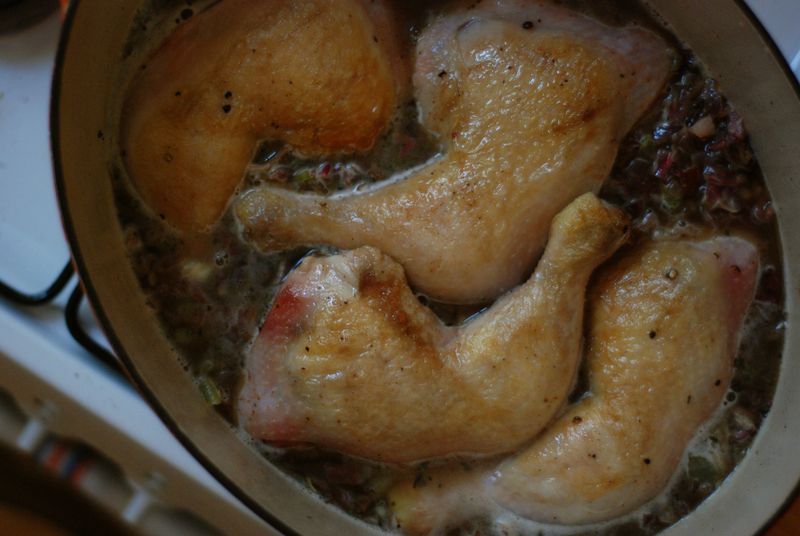
    You know what else is good? Florence Fabricant's prosaically named Chicken Baked with Lentils. (That may have been the worst transition in the history of this blog. Forgive me? My artistic juice is currently on the lam, though fortunately my mojo seems to have returned.) Lentils and radicchio flavored with sage and cumin, chunks of ham and a splash of vinegar are the stars in this easy braise of golden brown chicken legs. So much more sophisticated than the name indicates, no? And yet it's still easy enough to work as a weekend lunch or a weeknight dinner.

    The other day, after a morning of seeing apartments with my mother gamely in tow, now that she's in town for a few weeks, I decided we had to take a break. We needed a hot meal and respite from the icy streets. And I needed to focus on something other than apartments. My obsessive mind needed calming, needed to simply dice onions and boil stock, rather than have another conversation about renovation costs, look at another floor plan, or contemplate another compromise.

    So I set about cutting up celery and onions, thin-slicing radicchio, browning cubes of bacon and chicken legs and trying to find my center, not to sound like a total yahoo. And it totally worked! I found it! Turns out it was in the kitchen all along. What a surprise, I know.

    Platedchicken

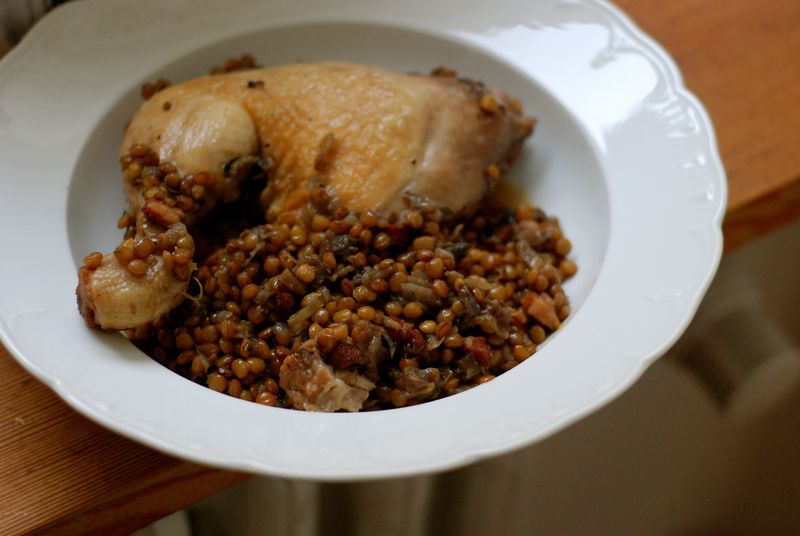
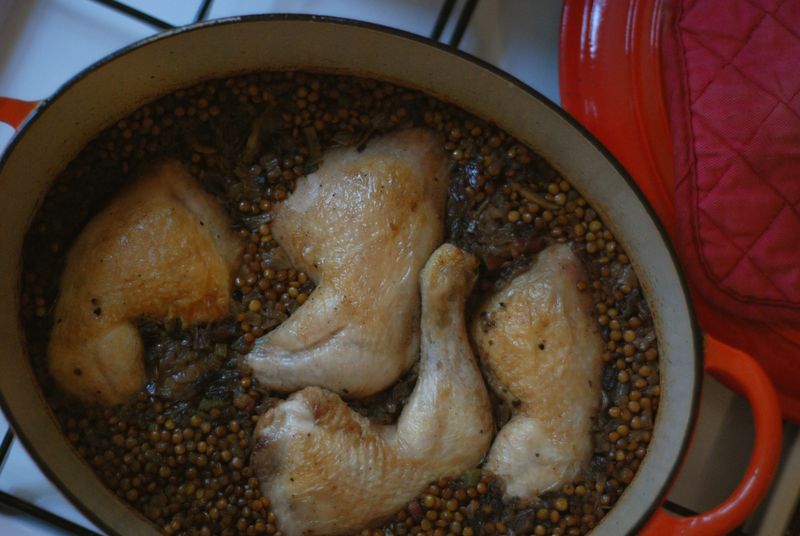
    Basically, you make this deeply flavored base for the dish, using bitter radicchio, mellow bacon, herbal sage, a kick of vinegar, earthy cumin, and onions and celery for good measure. Then you stir in lentils and lay browned chicken legs (or just thighs, whichever) on top, and cook the lot in the oven for an hour, until the liquid is mostly absorbed, the lentils are plump and bursting with flavor, and the chicken is so moist and tender it practically slides off the bone onto your fork in one fell swoop.

    It's not much to look at, I suppose, from the point of view of an aesthete. But as with a lot of peasant food, I think its beauty is special precisely because you have to look twice to see it. Once you do, it's hard to avoid. The gravel-like lentils, shining like little planets in the sky of the plate. The golden tones of the chicken, skin puckered and delicate as a lace shawl. The chunks of bacon, rosy-hued and glowing with flavor.

    Florence says to serve this with mashed potatoes, but it was so hearty we found it didn't even need a side. Just a deep plate, a big fork, an appetite, and a hankering for comfort. Delicious.

    Chicken Baked with Lentils
    Serves 4 to 6

    1 tablespoon extra virgin olive oil
    1/4 pound pancetta or bacon, in one slice, diced
    3 pounds chicken thighs, 6 to 8 pieces, patted dry
    Salt and freshly ground black pepper
    2 cups finely chopped onions
    1/2 cup finely chopped celery, about 1 rib
    4 cloves garlic, sliced
    2 teaspoons ground cumin
    2 cups finely chopped radicchio, about 1/2 head, cored
    1 tablespoon red wine vinegar
    2 tablespoons minced fresh sage
    2 cups lentils
    3 cups chicken stock, more if needed

    1. Heat oil in a 4-quart ovenproof casserole. Add pancetta and cook on medium until golden. Remove. Season chicken with salt and pepper and add, skin side down. Sear until golden on medium-high heat, working in two shifts if necessary. Remove from pan. Heat oven to 300 degrees. Pour off all but 2 tablespoons fat from pan.

    2. Add onions, celery and garlic, cook on medium until soft and translucent. Stir in cumin. Add radicchio, vinegar and sage; sauté briefly. Add lentils, stock and cooked pancetta.

    3. Return chicken to pan, bring to a simmer, cover and place in oven. Cook about an hour, until lentils are tender and most of the liquid has been absorbed, but not all. Lentils should be saucelike but not soupy. Add a little stock if needed. Check seasoning, adding more salt and pepper if needed, then serve.

  • DSC_6001

    You all know my mother is from Rome, right? Una vera romana, she can swagger and gesticulate with the best of them. And she's pretty cute, if it's still alright to say that about a woman of a certain age. She's the lady who taught me how to pan-fry thin little pork chops with slices of raw lemon until crisp and juicy and totally delectable. She's the one whose Parmesan broth with tiny noodles is still the only thing I want to eat when I'm sick. And its her tomato sauce that, simmering on the stove, makes any house my home.

    She is, however, not a cook. By her own admission. My career path mystifies her. She loves to eat, but cooking is not her bag. She masters the simple, but leaves the complicated to restaurants, Sicilian brother-in-laws, her strange daughter, or the hallowed halls of her childhood memories. When I called her the other night to tell her I was making gnocchi alla romana, a classic Roman dish of little semolina pucks baked in the oven and served with tomato sauce, her voice registered only disbelief.

    "You're going to make them? Yourself? From scratch?" She might as well have said, "why on earth would you ever bother?"

    Told you she thinks I'm strange.

    DSC_5947

    The thing is, semolina gnocchi really aren't that hard. You cook semolina with milk and butter until creamy and pulling away from the sides of the pot, sort of like polenta. You mix in some cheese and egg yolks and spread this mass out onto a baking sheet. Later, using a cookie cutter, you stamp out little rounds, tuck them into a baking dish, dust them with more cheese and dot them with butter and stick them in the oven until lightly crisped around the edges and browned. Yes, that's about it.

    Oh, and that tomato sauce is so easy you could practically do it with one hand tied behind your back, whistling. (Though the slices of garlic were a little unsightly.) I didn't have any cookie cutters for the semolina gnocchi, so I tried to improvise with an egg cup. That was sort of a bust. I ended up finishing the job with a sharp knife, cutting little rounds out by hand which was far less fussy than it sounds.

    What's important in this recipe is one small little thing: salt. Oh, ho. Yes. The amount of salt you add can and will be the difference between insipid baby food and something rather delicious. Which is why I found it so annoying that the recipe doesn't stipulate the amount of salt needed. I put in about a teaspoon and, sadly, my gnocchi tended very much towards the insipid. So try at least two teaspoons and taste taste taste as you go. If I made these again, I'd also double the amount of Parmesan used, and I'd put most of it in the semolina batter and only a little bit on top of the gnocchi.

    DSC_5960

    This recipe made an enormous amount of gnocchi, but only a rather modest amount of sauce. The sauce is so nice that it's a shame to have too little of it. So I'd double that, if I were you. Leftovers, if you've got any, are easy enough to get rid of on your spaghetti dinner the next evening. The gnocchi need that acidic, juicy kick of sauce to give them some spine.

    And here's the last thing about semolina gnocchi: you must eat them when they're fresh and when they're hot. I know, I know: Italians and their food rules. But really, listen up. If you've got leftovers, too bad. Do not attempt to eat them the next day. You will regret it. Instead, invite some friends over and impress the pants off of them with dinner. Make them scrape up every last gnocco and be glad you don't have any left to throw out.

    Gnocchi alla Romana
    Makes
    6 servings

    1 quart plus 2 tablespoons whole milk
    1/2 teaspoon grated nutmeg
    2 teaspoons salt, or more to taste
    6 tablespoons unsalted butter
    1 1/2 cups semolina flour
    1 5- to 6-ounce piece Parmigiano-Reggiano, grated
    3 large egg yolks, lightly beaten
    4 tablespoons extra virgin olive oil
    4 cloves garlic, sliced
    2 medium onions, finely chopped
    2 14.5-ounce cans chopped tomatoes
    Freshly ground black pepper

    1. In a 3- to 4-quart saucepan, combine milk, nutmeg, salt and 4 tablespoons butter. Bring just to a boil, lower heat to medium and immediately start adding semolina in a thin stream, whisking constantly. Keep whisking to make a smooth mixture. Reduce heat to very low and cook, stirring, about 15 minutes. Remove from heat. Stir in most of the cheese and the egg yolks.

    2. Use some of the oil to grease a baking sheet. Spread hot batter on baking sheet to a thickness of 1/2 inch. Cover with plastic wrap. Refrigerate until very cold, 4 hours or overnight.

    3. Heat remaining oil in a saucepan, add garlic and onions, cook until soft and add tomatoes. Simmer gently about 10 minutes. Season with salt and pepper and set aside.

    4. Preheat oven to 450 degrees. Use a little remaining butter to grease a shallow baking dish about 9 by 13 inches. Use a 2- to 3-inch round cookie cutter or a glass to cut disks of chilled dough. Keep dipping cutter in cold water to prevent sticking. Lift disks off baking sheet and arrange, slightly overlapping, in baking dish. Scraps can be kneaded briefly and smoothed out to allow for a few additional disks. Sprinkle disks in dish with remaining cheese and dot with remaining butter. Bake about 15 minutes, until lightly browned.

    5. Gently reheat sauce. Serve gnocchi with some sauce alongside each portion.<nyt_update_bottom>

  • DSC_5893

    No.

    No.

    No, no, no, no, no.

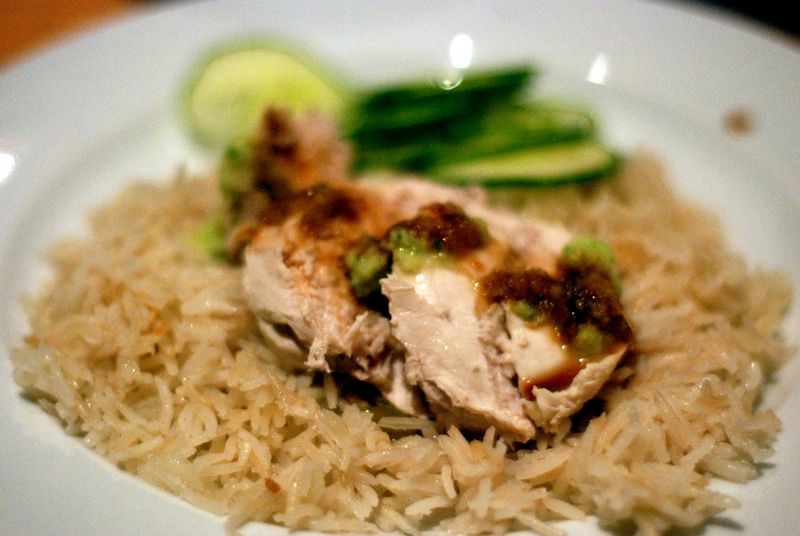
    I most emphatically disagree with this recipe. I wish it wouldn't exist. It vexed me, irritated me, annoyed me to my core. It it were up to me, I'd strike it from existence. In short, I hated it.

    It sort of hurt, hating it. After all, I love Zak Pelaccio's food. If it were up to me, I'd have a standing lunch date at the Fatty Crab every week. Also, I loved the mission of the article accompanying the recipe: how to make the lame old skinless, boneless chicken breast glam again. Loved it! (Also, must try the sauerkraut-stuffed, pan-fried chicken breast recipe now).

    But this recipe was a doozy: my "gently cooked" chicken breasts were hard as rocks. I have poached many a chicken breast in my time and they've always been tender, juicy, a joy. These were rubbery, hideous things. German chicken breasts? Or this recipe? I'm looking at you, recipe.

    DSC_5890

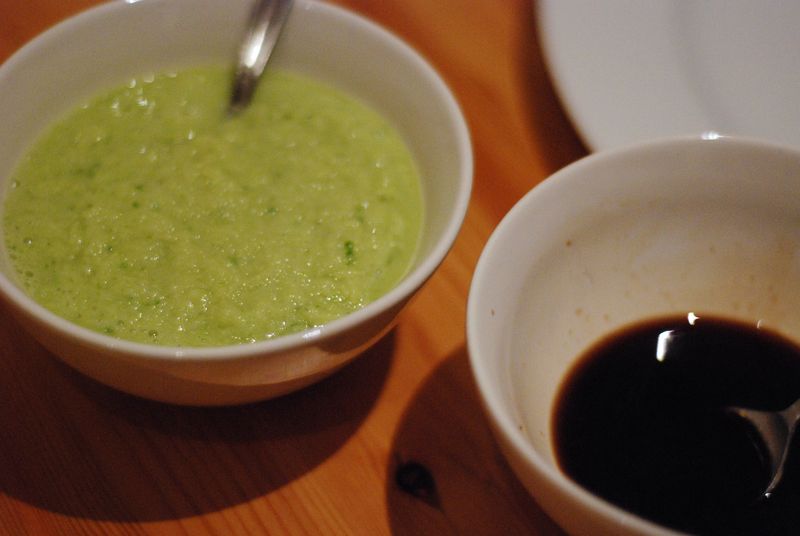
    Second of all, and this, I realize, is partially my failing because I emphatically do not subscribe to the school of Raw Garlic Adoration, but the Garlic-Chili-Ginger Sauce was so heavy on the stuff that it practically hurt. I woke up in the middle of the night after eating, oh, a teaspoon of the sauce, and had to go brush my teeth a second time. In the dark. In the middle of the night.

    One word: UGH. Another word: wouldn't half as many garlic cloves still have worked?

    The sweetened soy sauce was kind of interesting to know about, and the spicy broth was nice: I used it to cook rice the next day and that was totally tasty. But if that's the best thing that this recipe has to offer, I'm leaving it behind me in the dust.

    Onward!

    Oh, and one administrative thing: After many, many requests, I finally got around to putting an RSS feed link on the blog. Want to subscribe to The Wednesday Chef? Look over in the left-hand column, all the way at the bottom. Enjoy. And thanks for your patience!

    Chicken Breasts with Garlic-Chili-Ginger Sauce
    Serves 4

    4 boneless, skinless chicken breast halves, 8 ounces each
    Kosher salt
    Freshly ground black pepper
    1 5-inch-long piece fresh ginger root, peeled
    8 fat garlic cloves
    4 jalapeño peppers
    1 quart chicken broth
    3 tablespoons soy sauce
    2 tablespoons dark brown sugar
    2 teaspoons fish sauce
    2 teaspoons freshly squeezed lime juice, more to taste
    Cooked rice, for serving
    Sesame oil, for drizzling
    1 bunch roughly chopped basil, for serving
    1 bunch roughly chopped cilantro, for serving
    1 bunch thinly sliced scallions, for serving
    1 European cucumber, thinly sliced, for serving

    1. Cut each chicken breast in half crosswise and season with salt and pepper.


    2. Slice about an inch of ginger root into thin rounds and place in a large pot. Coarsely chop remaining ginger and place in a blender. Thinly slice 2 garlic cloves and add to pot. Coarsely slice remaining garlic and add to blender. Thinly slice 2 jalapeño peppers and add them to pot. Halve remaining peppers, discard seeds and coarsely chop flesh; place in blender.

    3. Add chicken broth to pot and bring to a simmer. Let cook for 10 minutes. Add chicken pieces to broth and let liquid come back to a simmer. Immediately turn off heat, cover pot and let sit for 10 minutes. Cut into a piece of chicken to test for doneness. If it is not done, bring broth back to a bare simmer, then turn off heat, cover and let sit for an additional minute or two.

    4. In a small bowl, stir together the soy sauce and brown sugar until sugar mostly dissolves. Set aside. To the mixture in blender add fish sauce and lime juice along with 1/4 cup broth from pot. Puree, if necessary adding a little more broth to help mixture move in blender. Taste and add a pinch of salt and more lime if needed.

    5. When chicken is done, transfer to a cutting board and slice. Remove garlic and pepper from broth and discard, if you like. To serve, heap rice in 4 shallow bowls and top with chicken slices. Spoon several tablespoons broth over chicken and rice, then drizzle with sweet soy sauce and sesame oil. Sprinkle on the herbs, scallions and cucumber. Serve garlic-chili-ginger sauce on the side; have additional sesame oil and sweet soy sauce on table for more drizzling.