• DSC_0814

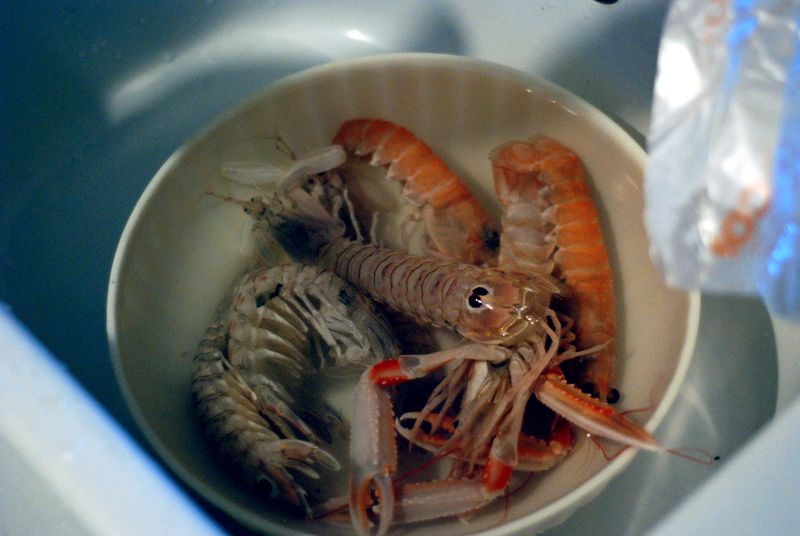
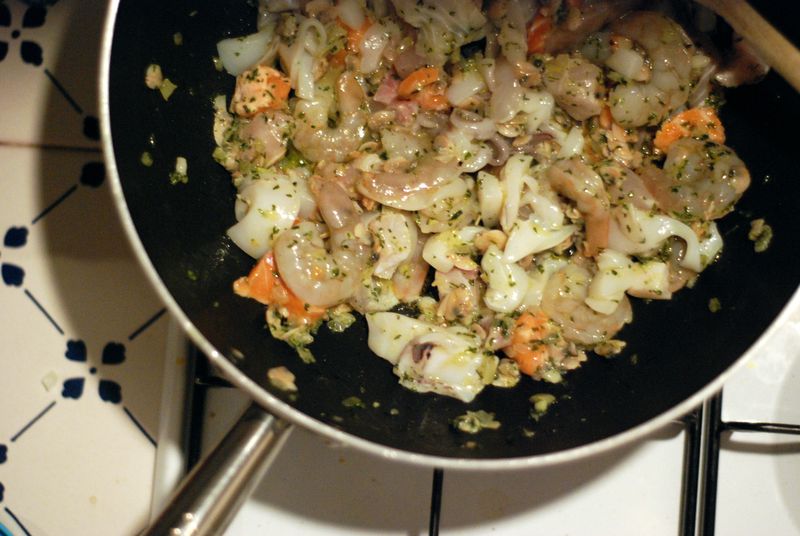
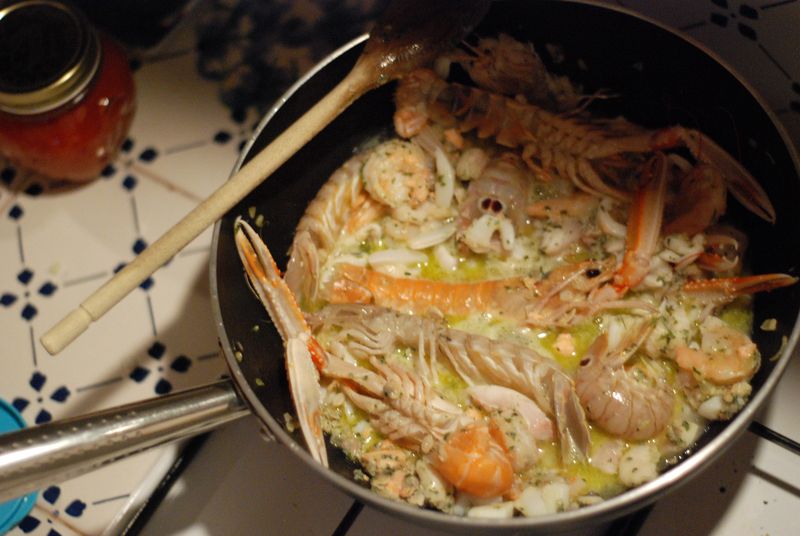
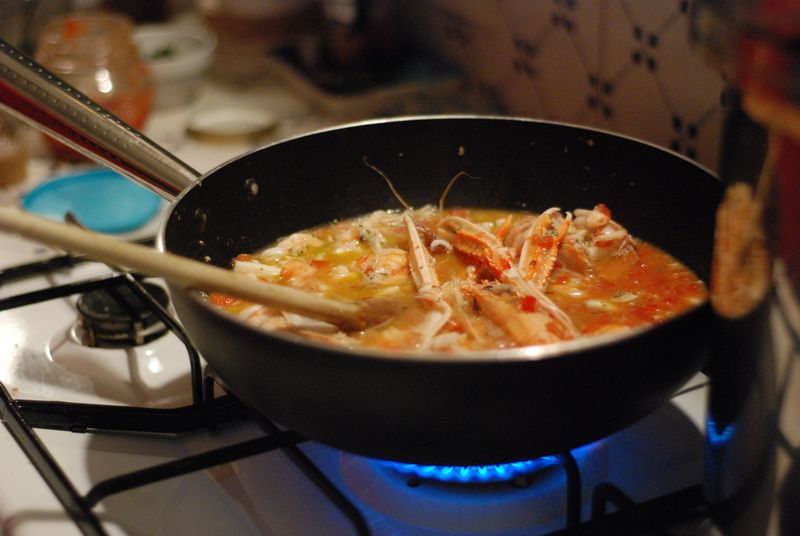
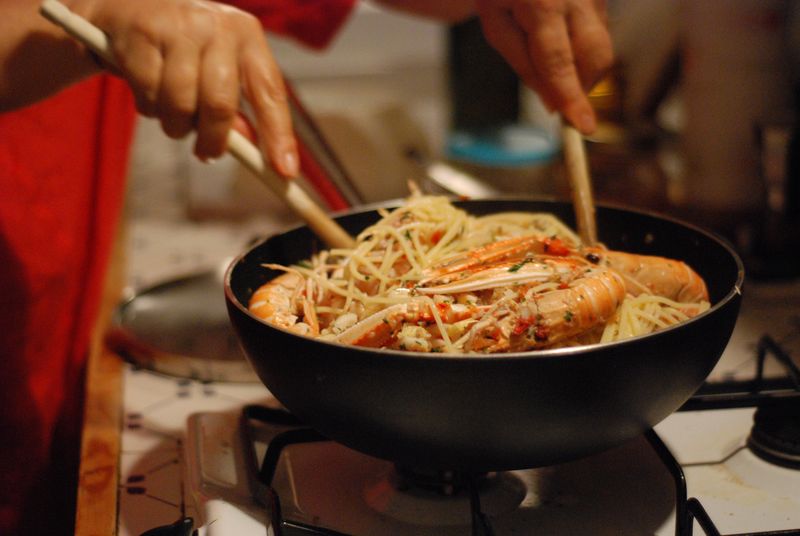
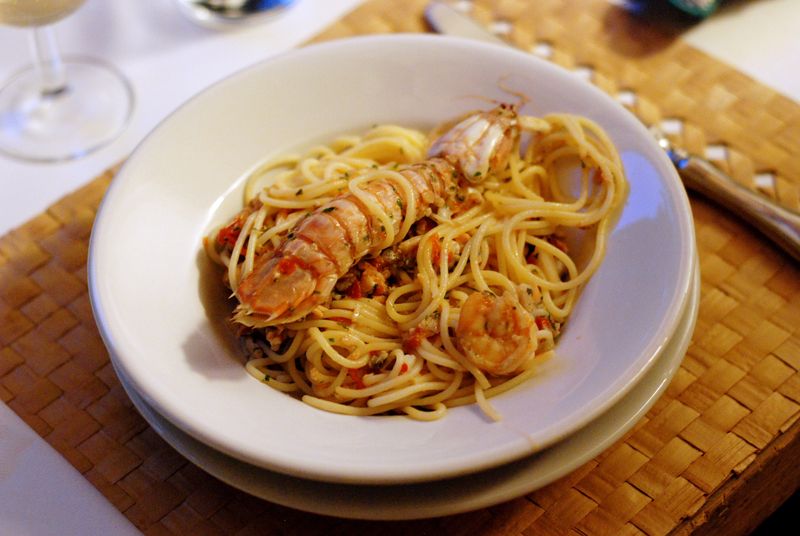
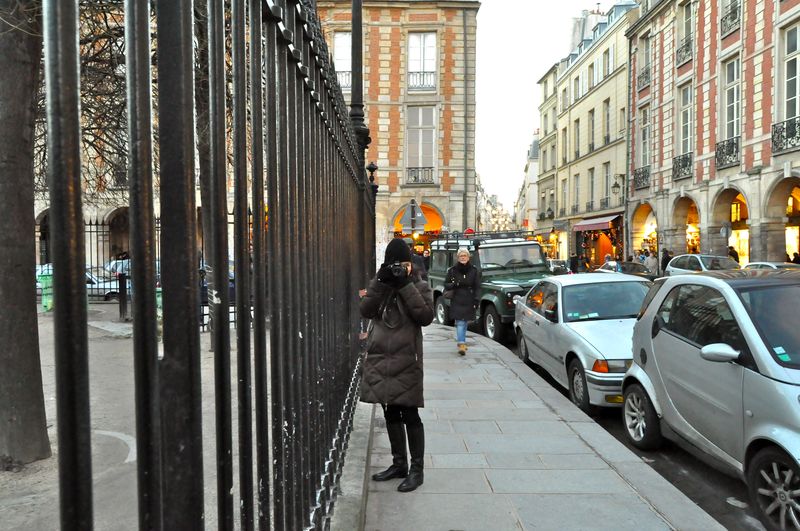
    I'm not big on New Year's Eve. I mean, I'm happy to have an excuse to drink Champagne and it's fun to yell down the countdown to midnight together, but I've never really felt that you need to have a big party to transition from one year to the next or that if you find yourself in pyjamas in front of the television on December 31st, you've somehow failed as a human being. (Which was convenient last week in Paris since that is exactly where I found myself, throat swollen beyond comprehension, medicated with powerful French antibiotics and just barely able to sauté some of the most flavorful pink shrimp with tomatoes and garlic for a celebratory dinner while we watched a French talk show. Huh. Max valiantly drank the entire bottle of Champagne by himself as I looked on sipping a verbena infusion. Double huh. He got the better end of that deal.)

    It is no surprise, then, that my most magical New Year's Eve moment, exactly a year ago, didn't involve a party or a sequined dress, but played out in our car in the moments when 2009 passed into 2010. In Berlin, New Year's is a big deal. Fireworks aren't illegal and the whole city truly explodes at midnight (depending on what neighborhood you're in, this can be rather thrilling and fun, or a total terror trip: Kreuzberg, I'm looking at you). Incidentally, if you like celebration, come to Berlin for New Year's. Seriously. I always think the Berlin tourism board should feature it as one of the reasons to visit this city.

    So we were in our car, driving from one party to another, when we realized or, actually, admitted to each other that instead of being at yet another loud, anonymous party, we both fervently preferred to be at home. Were we brave enough to ditch our plans? We were! And just like that, with a gentle u-turn on snow-covered streets, we slowly drove home. It was 11:50, and then 11:55, and then suddenly, as we found ourself in the narrow, residential streets of leafy Wilmersdorf, it was midnight. The city, so dark and quiet and empty just moments before, exploded in light and sparkle. People flooded the sidewalks, setting up empty Champagne bottles to launch their fireworks, striking matches, preparing the show. As we drove, gliding almost, on the thick ice layer, our car barely made a sound. Street after street, we saw children's beaming faces, staring upward into the black night, fireworks gleaming in their eyes. We saw their parents and other adults dancing on the sidewalks, with the night sky lit up, the colorful explosions reflected in the snow. I sat in the passenger seat, mouth agape, looking out at sweet Berlin transformed into a pink! gold! silver! green! blue! movie set, watching in slow motion as 2009 – as painful and as joyous a year as I've ever known – ended and 2010 – so unknown then! so unfamiliar! – opened its first pages. It was a stunning couple of minutes. And I felt so… lucky to have had those minutes. They were like a gift, like someone drawing open a heavy velvet curtain on the secret machinery of humanity and letting me have a few minutes watching it all unfold. You know? Pretty darn special.

    DSC_0837

    I'm not quite sure how to sum up 2010 in words. I guess, at the root, it was a year full of learning experiences. Learning to live without New York. Learning to be a Berliner again. Learning to work at home full-time. Learning to make new friends. Learning to stay close to my friends far away. Learning to function outside of my comfort zone, learning to be my own boss, in so many more ways than just the one.

    But I also became a tourist in New York, walked along the canals in Venice, picked olives from my mother's trees, felt the sand of the Baltic sea under my feet. I wrote three chapters of my book, then six, then eight. Hated all of them, learned to like some of them. Wrote some more, had more sleepless nights than I can count, wrote more and more and more. I stood at the top of snow-topped mountains in Austria, walked familiar streets in Paris, met my girlfriends for a pedicure in London. Celebrated Christmas in a wood-oven-warmed living room in Bavaria, walked along the swollen Elbe in the dog days of August, picked wild plums where the Wall once stood. I made my own sauerkraut, roasted my first goose, canned my own applesauce. I started a new blog, wrote my first article for a national magazine, learned to call myself a writer. I was confronted, again and again, with the funny fact that life can be glorious and infuriating at the same time. It always is. It always will be.

    And, a few months ago, in this year full of firsts and second chances, we started planning our wedding. This summer, in the shadow of my favorite fig trees, we'll become a family. Though really, as Max said just the other day, we already are one.

    DSC_0842

    So, happy new year to you, dear readers. May 2011 be full of wonderful moments that make you happy to be alive, strength for the difficult times, bravery for the big steps, love to keep you going. I hope you have enough hot sauce to make your lips curl and the promise of drippy fresh peaches in summer to make you smile. Thank you for reading, for being my loyal audience, for your patience through the long silences I left here this year, for inspiring me every day (truly) to be a better writer, better cook, and better observer of all those little things that make life worth living. You continue to be the reason why starting this blog over five (!) years ago remains one of the best decisions of my entire life.

    Thank you!
  • DSC_4965

    It is a lot, I know, to expect you – in this mad December rush – to slow down and candy your own quince. Forgive me, will you? It's just that I believe in you! I know you can do it. I know you can find the time. And furthermore, I know it'll be worth it.
    Besides, candying quince isn't even all that hard. In fact, I think tracking down the quince is the hardest part (well, that and trying to core it, but never mind). You should also candy your own orange peel, if you can't find any at the grocery store (one of the charms of living in Germany: chopped candied orange peel at any old grocery store). But that's even easier than candying quince. Promise. Cross my heart!
    See, what we're making is panforte. Strong bread, if you want to know the literal translation. But what panforte really is is a deep, dark nut-and-fruit confection, warm with spice, the low, sweet chew of dried plums and candied quince, all wrapped up in a cocoa-tinged, citrus-peel-flecked, honeyed batter and baked until almost black.

    It's a lot of work, it's true. But what you get in return will sustain you, I promise. If the Benne Wafers were the instant gratification cookie of the holiday season, this panforte is the long, slow, steady burn.

    DSC_5070

    Panforte is a traditional Italian sweet meat, cut into thin little wedges (you'll need a very sharp, very heavy knife – it's dense) and served after dinner around Christmastime. It's chewy and crunchy, not too sweet and keeps for weeks, if well-wrapped. So the way I see it, it makes for pretty great presents, if you can bear to part with what you've made. All you need is willpower, parchment paper and a bit of butcher's twine for artful wrapping and bows, and you'll have yourself some very grateful friends.

    I love how panforte is both restrained and a little luxe. It's the kind of dessert that makes you feel virtuous, after all that roast goose, and elegant, with nut-studded blackish wedges lying insouciantly on little gold-rimmed plates.

    DSC_5072

    Pardon all the wonky light in these photos, but we've not had much sun in Berlin these past few weeks. In fact, it hasn't done much else but snow lately, giving everything in my kitchen a rather blueish hue. But the heavy gray lid over the city doesn't feel as oppressive as it will in a few months. Right now, it's kind of cozy. We gather indoors with friends, drink tea, crunch through homemade cookies, light candles, and prepare for the holidays. In a few months, the lack of light will feel interminable. Today, it feels just right.

    It's better for baking, anyway, when the sun isn't shining and you have every right to wile away the day in your kitchen.

    DSC_4927

    There's little that's complicated about making panforte. In fact, other than good ingredients, you just need to be able to work quickly at crucial moments and have a little bit of muscle in your upper arms, a little bit of elbow grease.

    Besides the candied quince and orange peel, you need a nice assortment of dried fruit. The original recipe, from the first Tartine cookbook, calls for dates, but says that you can use any type of dried fruit, just as long as the total amount is about 25 ounces. Since I have a burning love for prunes (and think their bright, juicy flavor works particularly well with cocoa and citrus zest), I used equal amounts of dates and prunes, plus a bunch of raisins instead of the original currants (one of the few dried fruits I really just don't dig, with their weird crunchy little selves).

    You also need a whole bunch of toasted nuts – pistachios, hazelnuts and almonds – which bump this firmly into luxury territory, but it's affordable luxury, I think. The kind I can get behind.

    DSC_4931

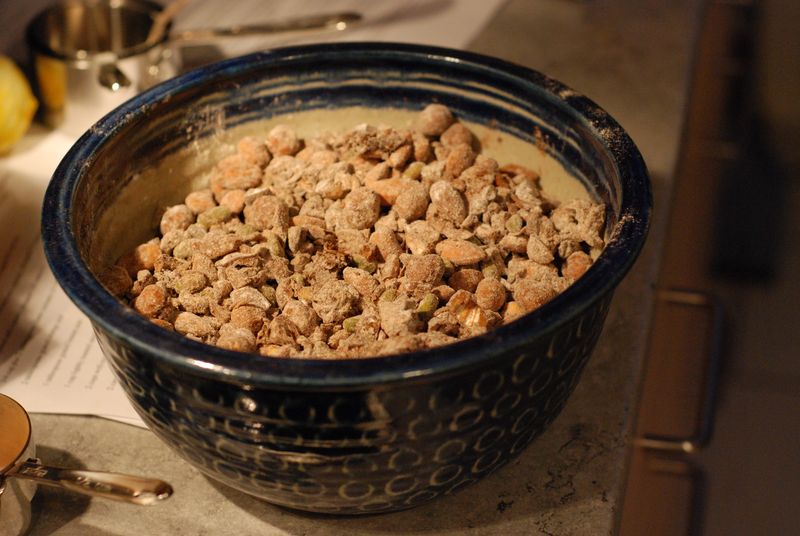
    After you toast the nuts and dice up all the fruit and zest the citrus, you toss this all with flour and cocoa and a whole mess of spices, including ground coriander, black pepper and what seems like an enormous amount of nutmeg.

    To make the syrup that will bind these dusty nuggets together, you melt together sugar and honey until they bubble and froth without boiling over. Here's a good look at how the syrup should look when you're ready to pull it off the stove. And this is where you need to work quickly. The syrup, boiling hot, will hit the nuts and fruit and then, in a heartbeat, turn to what feels like hot tar. Arm yourselves, therefore, either with plastic gloves or a very heavy-duty plastic spatula and move quickly. Mix the syrup into the fruit and nuts well, moistening every last bit and making sure that no powdery streak of flour remains. If you do this well, you can skip your weight-bearing exercises for the day! Up and at 'em, folks.

    DSC_4933

    Then scrape this mixture, fragrant and nubby and far too hot for dipping a finger in and tasting, into a parchment-lined springform pan and bake it in the oven until set. What's difficult at this point is not over-baking the panforte. Since the batter is so dark to begin with, it's hard to tell if it's starting to burn. Trust your nose, your oven thermometer and the kitchen timer.

    DSC_4946

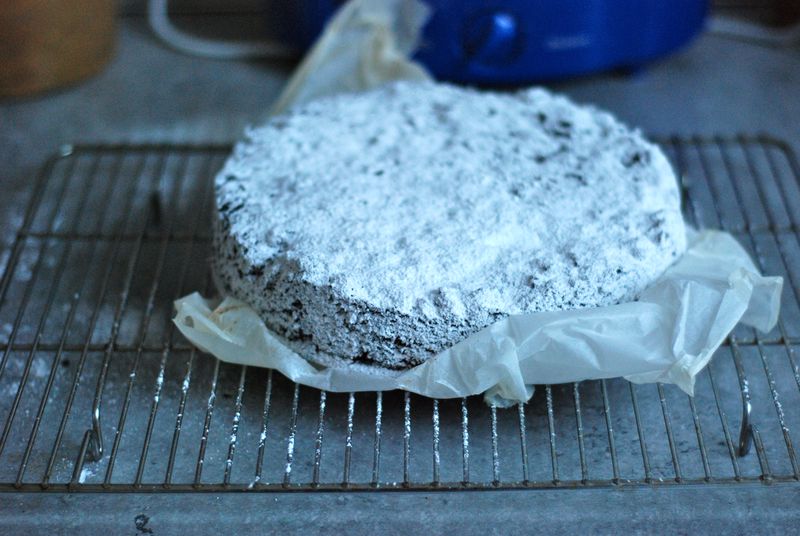
    This brick-like confection will cool and settle and then you can unmold it from its baking pan and cover it with a snow-like dusting of confectioner's sugar before cutting it into wedges and parceling them up. You will find yourself sneaking little tastes here and there, little nibs and nobs of the panforte that get nicked under your knife, trying to track down each individual flavor but becoming overwhelmed by the goodness of the whole. You'll cut a wedge to keep for yourself and then, later, you'll curse yourself for not making it a bigger one. Your mouth will tingle with spice.

    As you can tell, I've fallen hard for this panforte. I'll be making it for many Christmases to come. Do you what to know just how hard I've fallen? So hard that I'm throwing in the towel on the cookie production for the year. Nothing's going to top this baby.

    So, like I said, get to finding that quince! Time's a-wasting.

    Panforte with Candied Quince
    Makes 32 half-inch slices
    Note: You can use any type of dried or candied fruit, in any combination, as a substitute for the fruits in the recipe as long as the total amount is about 4 1/2 cups (25 ounces).

    Candied orange zest
    3 large, unblemished oranges
    1 1/2 cups water
    1 1/2 cups sugar

    1. Remove the zest from the oranges: Run a zester from the top to bottom of the orange, cutting the zest into thin strips (avoid the pith). Repeat with the remaining fruit. Reserve fruit for another use.

    2. In a medium, heavy saucepan, cook the water and sugar over medium heat. Bring to a boil, stirring, until the sugar dissolves. Add the zest, lower the heat to medium-low, and cook at a gentle simmer until the zest strips become tender and semi-translucent, about 30 minutes.

    3. Remove from the heat and pour into a heat-proof container. Cool completely, then store the zest in the cooking syrup in an airtight container in the refrigerator for up to 1 month. You should have about one-half cup (3 ounces) of candied zest.

    Candied quince
    1 1/2 cups water
    1 1/2 cups sugar
    1 large quince

    1. Peel the quince, slice it in half, remove the core and cut the fruit crosswise into one-fourth-inch slices.

    2. In a medium, heavy saucepan, combine the water and sugar over medium heat, stirring with a spoon, until the sugar dissolves. Add the fruit, reduce the heat to medium-low, and cook at a gentle simmer until the fruit is semi-translucent, about 45 minutes.

    3. Remove from the heat and pour into a heat-proof container. Cool, then store the fruit in the cooking syrup in an airtight container in the refrigerator. You'll have about 1 cup (8 ounces) of fruit.

    Panforte
    1 recipe candied quince, strained and coarsely chopped (8 ounces)
    1 recipe candied orange zest, strained and coarsely chopped (3 ounces)
    1 cup dates, pitted and coarsely chopped (5 ounces)
    1 cup prunes, pitted and coarsely chopped (5 ounces)
    3/4 cup plus 2 tablespoons Zante currants (4 ounces)
    2 tablespoons grated orange zest
    1 tablespoon grated lemon zest
    1 cup lightly toasted unsalted pistachios
    2 cups well-toasted hazelnuts
    2 cups well-toasted almonds
    2/3 cup flour
    1/2 cup cocoa powder
    1 tablespoon ground cinnamon
    Freshly grated nutmeg from 1 1/2 nutmegs
    3/4 teaspoon ground coriander
    3/4 teaspoon freshly ground black pepper
    3/4 teaspoon ground cloves
    3/4 cup honey
    1 1/3 cups granulated sugar
    1/4 cup powdered sugar

    1. Heat the oven to 325 degrees. Butter a 10-inch springform pan with 2- or 3-inch sides, line with parchment paper, and butter the parchment, making sure to butter the sides of the pan well.

    2. In a large mixing bowl, combine the candied quince and orange zest, dates, currants, orange and lemon zest, and all of the nuts. Sift together the flour, cocoa powder, cinnamon, nutmeg, coriander, pepper and cloves over the fruits and nuts. Mix well. Set aside.

    3. In a deep, heavy saucepan, combine the honey and granulated sugar over medium-high heat. Stir gently with a wooden spoon from time to time to make sure that no sugar is sticking to the bottom of the pan. Bring to a boil and cook until the mixture registers 250 degrees on a thermometer, about 3 minutes. The mixture will be frothy and boiling rapidly.

    4. Remove from the heat and immediately pour over the fruit-and-flour mixture in the bowl. Stir with a wooden spoon to incorporate the syrup thoroughly with the other ingredients. The mixture may seem dry at first, but it will come together once it is well mixed. (If you have rubber gloves, it is easier to mix with your hands than with a spoon.) Work quickly at this point; the longer the mixture sits, the firmer it becomes.

    5. Transfer the mixture to the prepared springform pan and smooth the top with a rubber spatula dipped in water. Bake until the top is slightly puffed and looks like a brownie, about 1 hour. Cool in the pan on a wire rack for 30 minutes. Run a knife around the edge to loosen and turn out of the pan and cool completely.

    6. With a fine-mesh sieve, sift the powdered sugar over the top, bottom and sides of the panforte. Lightly tap it over the counter to shake off excess sugar. It will keep, well wrapped, in a cool, dry place for up to 2 weeks, or indefinitely in the refrigerator. To serve, slice into quarter- to half-inch slices.

  • DSC_5050

    I keep starting this post and deleting what I've written, because it just doesn't seem adequate. Or particularly verbal. But then I try to come up with something more…grown-up or legible, and fall short. Standards, you know? Sigh.

    Do you want to see what I've deleted so far? Fine, here:

    1. OMG.

    2. Aaaaaah!

    3. Best. Cookies. Ever.

    4. Oh my goodness, you guys!

    See what I mean? I think these cookies have possessed my brain or at least the parts of it that used to know how to write. But seriously, we need to talk about the cookies. Seriously. Pull up a chair!

    DSC_5024

    A few weeks ago, I was sent a copy of the Gourmet Cookie Book. You know, the one that features the "single best [cookie] recipe" from 1941 to 2009, according to the editors at Gourmet (sigh). It's a funny little book, with very stark pictures of the cookies on black, white or red backgrounds, arranged almost architecturally. The most recent hyper-baroque style of Gourmet is nowhere to be found. So it's not the most sensual cookie cookbook ever designed or photographed, but it is…efficient. After all, each recipe gets a photo, which is rather nice. And the starkness of the photography means you get to really get in there and see the texture of a toasty almond or a spray of powdered sugar. Also, the editors did all the heavy lifting in culling out the very best recipes over the years, which, you know, is a big plus.

    The headnotes, if you're into food history, and into Gourmet, which I am on both counts (double sigh), are lovely little reads. You go to the page about Norwegian Butter Cookies, also known as Spritz, and find out they were the favorites of a former food editor's pioneer mother. Or you turn to the Curled Wafer page and find out that there were only four cookie recipes published in Gourmet during all of 1963 – and none of them were American. Or you can go to the recipe for Scotch Oat Crunchies and read that those buttery discs sandwiching jam were cooked up during the war, when the staff at the magazine, along with housewives the nation over, I suppose, tried to come up with ways to make oatmeal palatable. Huh.

    (My quibble with the book is that I wished the recipes had more consistent information about how long the cookies keep and how they should be stored. After all, most of us will be using this book around the holiday season, when shipping and storage times are crucial bits of information when planning what to include in a cookie tin.)

    When I first leafed through the book, I made a list of the cookies that I wanted to make:

    1. Speculaas
    2. Bizcochitos
    3. Glazed Pain D'Epice Cookies
    4. Cottage Cheese Cookies
    5. Basler Brunsli

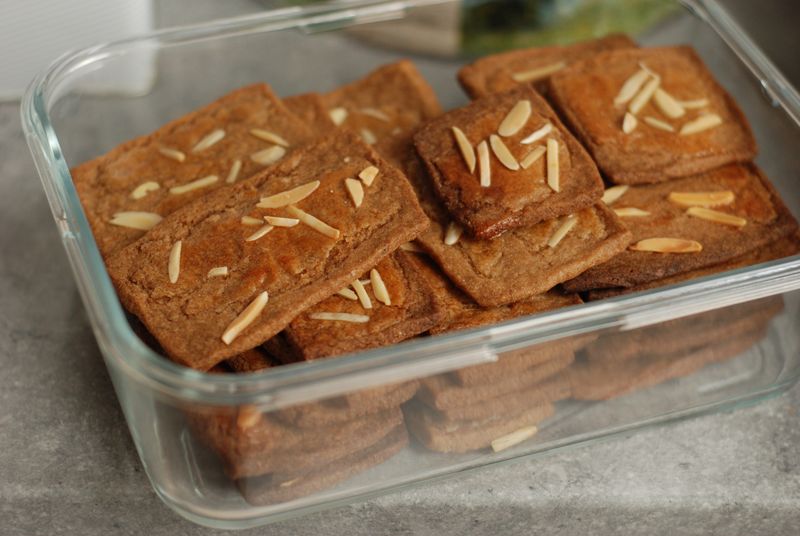
    Now this didn't seem like a very long list. After all, I was expecting to dogear half the book. That's disappointing, I thought. But that's how it goes with cookbooks sometimes. And besides, wasn't I the person saying just the other day that if you find one good recipe in a cookbook, it's worth the price of the book? So I went and made some cookies. First, the Cottage Cheese Cookies, which are tender, cakey little things with agreeably crispy edges and a fine, plain flavor. Max popped one in his mouth and commandeered the entire tray for the rest of the week. Then I made the Speculaas, which were a dream to make – the softest, most aromatic dough just needed to be rolled out into a rectangle and cut into little squares or rectangles before being topped with slivered almonds and baked. The cookies were fabulous. Buttery, crunchy, full of Christmassy flavor, just like those great little Biscoff cookies you get on airplanes, only better. (These would be great crushed into a pie crust, too, by the way.) This time, I was the one who hoarded them.

    DSC_5043

    And then I started re-reading the book. I'd ignored some recipes on the first go-around, but now I couldn't them get out of my head. Like the Gianduia Brownies, which I'm thinking will be a hit at our Bavarian Christmas this year. Or the Walnut Acorn Cookies, just because they combine chopped walnuts and butter and melted chocolate to what looks like splendid effect. Or the Old-Fashioned Christmas Butter Cookies, which sound like such a snooze, but upon reading the headnote ("what you end up with are cookies that are incredibly crisp and so flaky they almost seem to float away") you realize you can't really live much more than a few hours longer without trying them.

    People, I am up to my eyeballs in cookies this year. It's December 2nd and I've already made six, no, seven different ones. By any normal stretch of the imagination, one look at a cookie book should have me shrinking away in horror. And yet, I can't seem to keep away. They keep sucking me in, these Fig Cookies, Jan Hagels, and, oh, the mighty Benne Wafer.

    Or, lo! The Mighty Benne Wafer!

    DSC_5010

    So, now we're back where we started, with me apparently struck dumb or incapable of putting into lyrical type just how good these cookies are.

    SO. GOOD. Is that better? I'm sorry.

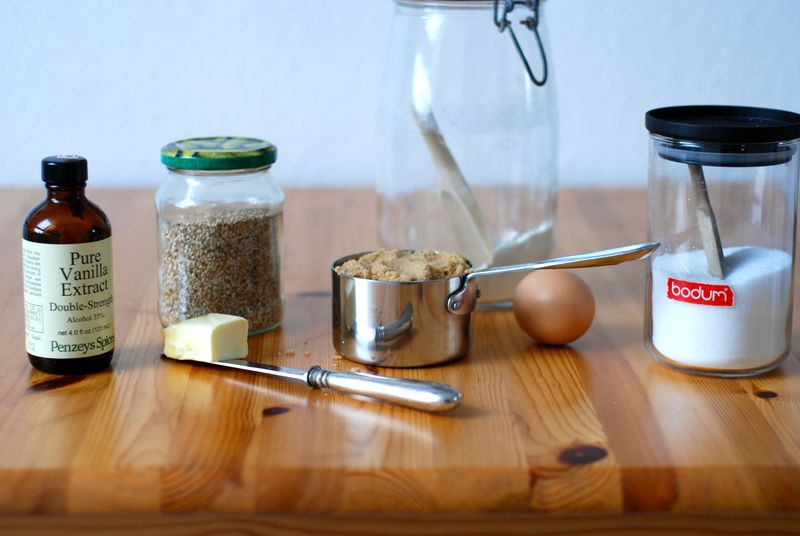
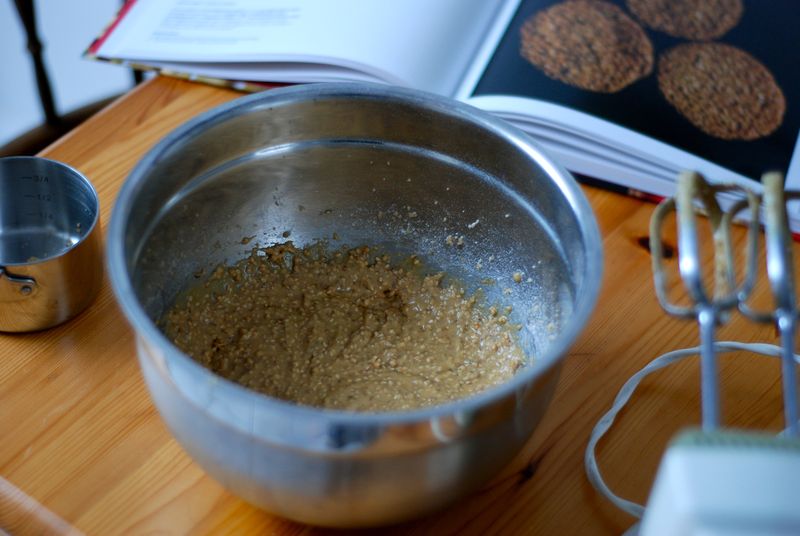
    Let me tell you a little bit about them, maybe that will help. First of all, you need hardly anything to make them. An egg, a pat of butter, two spoons of flour – do you see where this is going? If you're the kind of person who stocks sesame seeds in her house, you can make these cookies…whenever you want! (Every day, you'll want to do them every day, believe me.) You cream some brown sugar and that little nugget of butter together, though creaming is not exactly what happens, since there's so little butter to the amount of sugar. Beat until they're combined and no longer lumpy and the sugar is fluffy and a little lighter than before. Then beat in the egg, some vanilla, the flour and half a cup of sesame seeds. And a little pinch of salt! That is it. What you're left with is what looks like the measliest amount of cookie batter ever. It should be loose and a little drippy, but only barely.

    DSC_5013

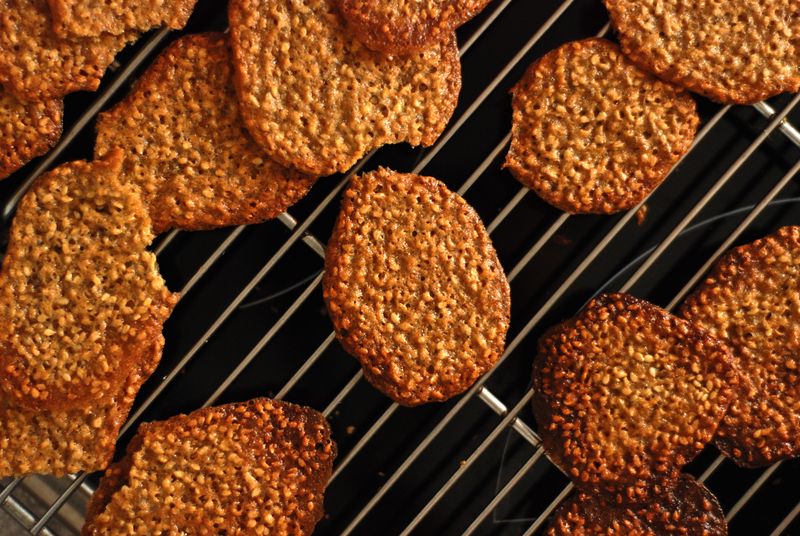
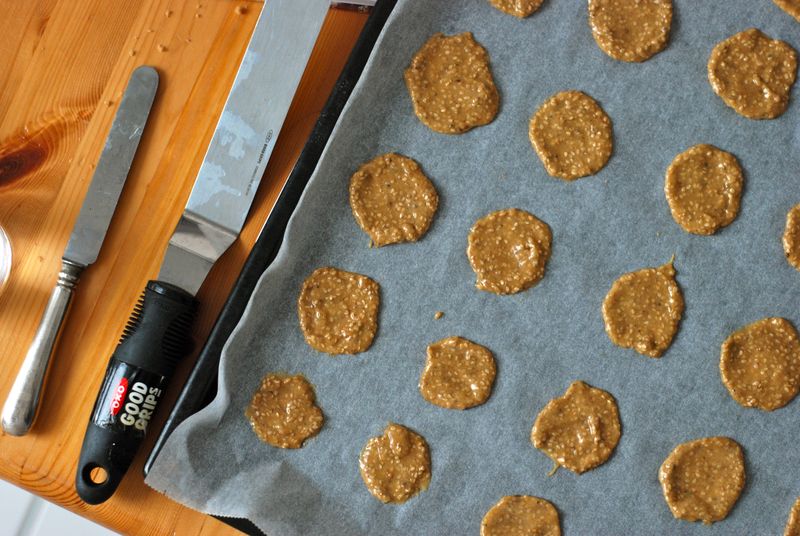
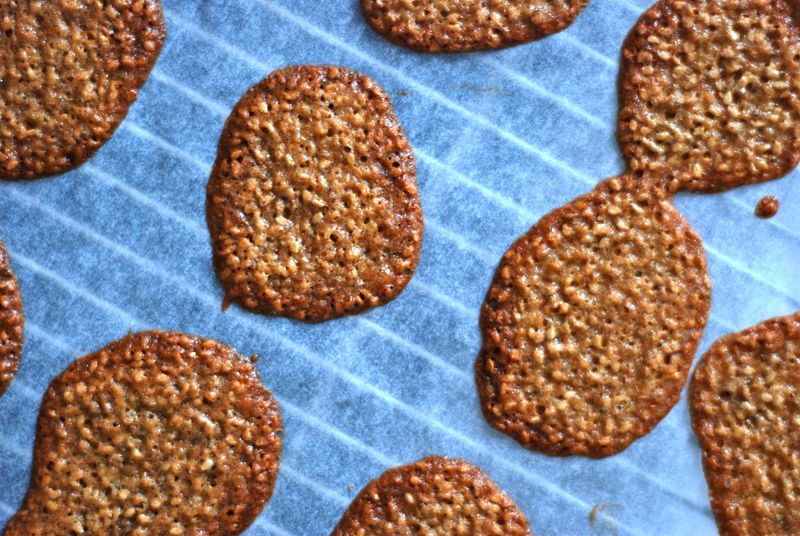
    You drop little rounds of the khaki-colored stuff onto a parchment-lined baking sheet and then, using a knife that you repeatedly dip in ice water, flatten them out a bit. Don't do what I did on the first round and make the dough drops too close – you'll end up with large rectangular Benne Wafers. These go into the oven for six minutes. Six! That's it. Any more and you'll have charred edges, any less and they'll still be a bit too chewy. I like to pull the parchment paper off the sheet pan directly onto the cooling rack. If you have just a little bit of patience, then, you'll be able to gently tug the cookies right off the paper. They set up into these caramelly, crispy wonders – pop one in your mouth and you'll wonder how you ever lived all these years without eating a single Benne Wafer before.

    I was planning on including these in my cookie boxes for friends, but after I brought Max one to try and we stood there looking at each other, chewing dumbly in stupefaction, he begged me not to let them leave the house. "But, but, think of the Christmas spirit!" I protested weakly.

    I think I'm making another batch.

    DSC_5027

    In the end, did I actually manage to tell you just how insanely good these cookies are? They are delicate and taste like caramel. They have this alluring crunch both from their crispy edges and the toasted sesame seeds. You can make them when you have barely anything in the house. And you could eat, I don't know, ten of them in mere seconds. (Even though there are currently fresh drifts of ankle-deep snow on my balcony, right at this very moment, I keep having visions of them stuck into a scoop of ice cream at a summer dinner party, too.) They are so good they've sort of instantly become my favorite cookie. Superlatives can be so annoying, I know. But I just can't help it. The might Benne Wafer is here to stay!

    Benne Wafers
    Makes about 4 dozen
    Note: Some people reported having issues with the texture of their cookies; please remember that the butter you use must not be warm or room temperature, but cool to the touch and still quite firm before you begin to cream it with the sugar. Here's an article on butter in baking for your reading pleasure.)

    1 1/2 tablespoons unsalted butter, cool but not cold
    1 cup light brown sugar
    1 egg
    2 tablespoons all-purpose flour
    1/4 teaspoon salt
    1 teaspoon vanilla extract
    1/2 cup sesame seeds

    1. Preheat the oven to 350°F (175°C).

    2. Cream together the butter and sugar until light and well-combined. Add the egg and beat until combined. Add the flour, salt, vanilla extract and sesame seeds. Mix until all the ingredients are combined.

    3. Drop small spoons of dough onto a parchment-lined baking sheet. Flatten the wafers with a knife dipped in ice water.

    4. Bake for 6 minutes. The cookies should be a golden brown with deeper golden edges. Pull the parchment paper off the sheet pan onto a cooling rack. After about 5 to 8  minutes, gently pull the cooled cookies off the parchment. Reuse the parchment for the next batch.

    5. Cool completely and store in a tin for up to 2 weeks.

  • DSC_4363

    In the past week, I have baked five different batches of cookies, two pies, and one panforte. I am going through bags of sugar like it's going out of style. I buy candied orange peel every time I see it in the store, because I can't seem to keep it in stock in my pantry. And not a day goes by without some sort of nut toasting in a pan. Christmas in Germany (or the Advent time leading up to Christmas, I should specify) is serious business.

    But, oh, it's so lovely. I can sit in my kitchen working on yet another spice cookie thing and hear the four-person brass band playing Christmas music at the Weihnachtsmarkt across the street. We lit our first Advent candle last night and let it burn in its pine wreath almost down to the nub. I have stockpiled a tower of tins for cookie-sharing and gift-giving. The best part is that it's all just so cozy at the same time as it's busy and productive, which is a lovely feeling. I'd dare say it's the nicest thing about this time of year.

    I have also been doing a lot of cooking, but being up to my eyeballs and elbows in molten hot honey or a panful of nuts just this side of toasted at the same time has made documenting my dinner properly a little difficult. So! I'm going to do a little recipe round-up today instead.

    DSC_4357

    I finally got around to trying Judy Rodger's panade with Swiss chard and Gruyère, which is so toasty and silky and delicious that it is very difficult to stop eating. What is it about stale bread and hot liquid? It's amazing to me that something so rough and scratchy around the edges, something as mundane as old bread and hot broth, can be transformed into something so supple and elegant. There's also the alchemy between long-stewed onions, teetering just on the edge of being too sweet, and nutty Gruyère cheese, which undergoes some sort of Cinderella-pumpkin thing in the hot oven. All put together, it's wondrous stuff. I find myself wanting to hide old bits of bread in the bread box so that we have a reason to make this more often.

    DSC_4343

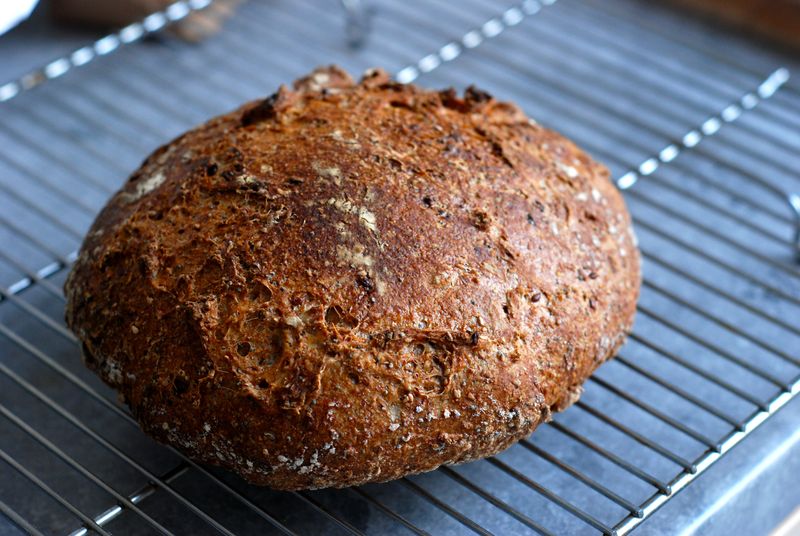
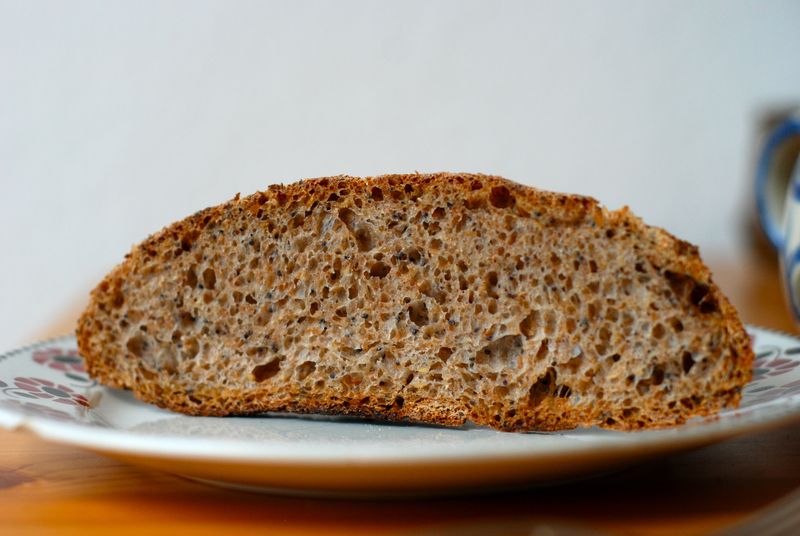
    Speaking of bread, I made some of my own! Inspired by none other than the 100th issue of Goop. This seeded whole-wheat loaf, from Tartine's new bread book, was featured in the newsletter, along with instructions from the owner and resident bread baker at Tartine for making natural leaven for bread simply by using water and flour and the natural yeasts in the air, instead of commercial yeast. For those of us who can't dedicate three days to producing natural leaven, you're given the alternative to make a pre-ferment poolish, which is what I gratefully did, and a weekend later, I had two glorious loaves of whole-wheat bread, full of flavor and delicious seeds and a chewy, holey crumb.

    DSC_4348

    Except, you know what? I live in Germany now, or the Land of Bread as it's alternatively known (well, not really, but it should be), and making my own bread doesn't hold the same allure it once did. Also, these loaves were a lot more work than Jim Lahey's No-Knead Bread. So, my verdict: for those of you living anywhere but in Germany, make this bread! It's so satisfying to watch bakery-style loaves emerge from your oven. And you'll never get tired of the chemical wondershow that is one measly gram of yeast turning a bunch of flour and water into bread. For those of us in Good Bread Land, eh, get thee to a bakery.

    DSC_4763

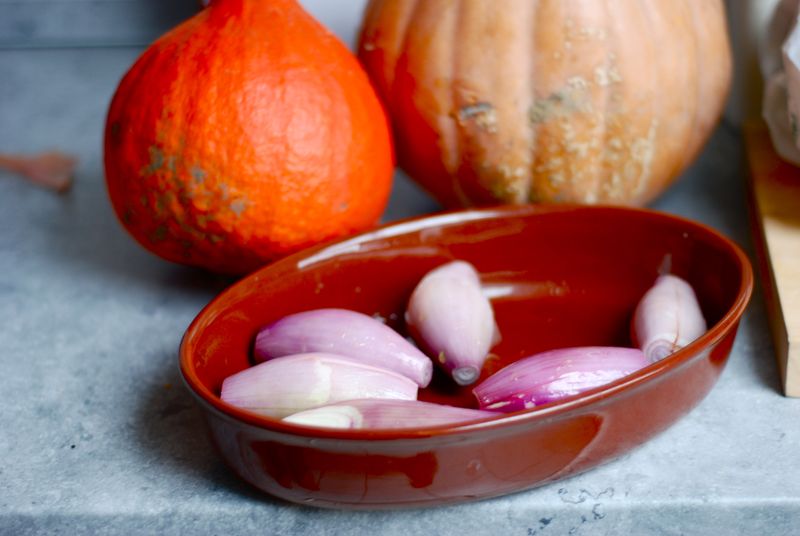
    The other day, on the (fruitless) hunt for fresh cranberries at an organic grocery store in the south of Berlin, I came across a bin of lovely torpedo shallots from France. Isn't torpedo a good word? Torpedo, torpedo. The shallots are good, too. They have such good heft, such a nice shape. I like to just let slip around in my hands or skitter them around on the counter in an impromptu game of shuttlecock. When it came time to cook them, I took Molly's, or should I say Brandon's, lead, and roasted them with vinegar until the entire apartment smelled like a vinegar factory – and I mean that, quite literally, in the best possible way – and the shallots themselves had collapsed into the sweetest, slipperiest, most fragrant and wonderful version of themselves. I wish I had a photo for you, but they were gone so fast I could barely blink. I also had the distinct feeling that I could have made twice the batch and they would have gladly been eaten. We were all being rather polite at the table, I think. They're going to be a staple in our kitchen for a long time to come.

    DSC_4818

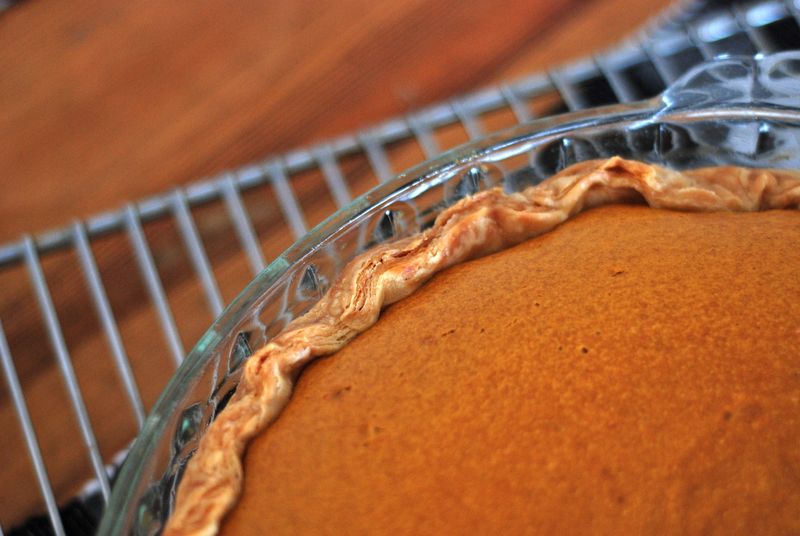
    And finally, I was in charge of desserts at our friends' German-American Thanksgiving this year, so I made my usual squash pie (with Hokkaido squash instead of butternut), but with the very best crust I've ever made, if I do say so myself. I cobbled it together from Deb's recipe here, but with Melissa's brilliant "think lima beans!" instructions from here. Check out the flake on that thing! People at the dinner party thought I had used puff pastry, it was so flaky. And I did it all by hand, armed only with two dinner knives and some high-fat German butter. It's my new go-to crust recipe.

    I'll tell you about the panforte (with candied quince!) in my next post, and then I have to divvy it up among the cookie tins, along with Spekulatius, some sort of nut brittle, snow-white Springerle and a few more things that have yet to be determined. Also, I have recently been bewitched by the sound of a hazelnut-prune tea cake that must be made mine, so stay tuned. And tell me, dear readers, what are you baking these weeks before Christmas? What's going in your cookie tin?

  • Are you, like me, thrilled every year when the time rolls around for the Internet to publish its Gift Guides, thereby lightening your load, getting your shopping done in one fell swoop, and making you feel creative, resourceful and thoughtful, even though you never left your desk? I find them to be such a relief (the ones from Design*Sponge, Cup of Jo, Oh Happy Day, and Mighty Goods are especially good).

    This year, I thought I'd try my hand at a gift guide, specifically tailored to things one might covet for the kitchen or the dining table or the cookbook shelf, in other words, any area of the home that involves cooking or eating or reading about cooking and eating, since, you know, that's all any of us really want to be doing at any given time, right? Right?

    Happy giving!

    ***

    1. Tell your little sister enough already with the paper napkins, even if IKEA does produce them in such adorable colors. These Skinny Laminx "Orla" napkins from South Africa will make her dinner table look grown up and smart.

    Sk-100-lg
    2. Any of the wooden cake stands that Herriot Grace makes are gorgeous (not to mention everything else in their shop). But there is one little problem: if you're lucky enough to get your hands on one (they're sold out at the moment, I'm sorry), I'm not sure you'll be able to give it away. Still, it'd get you in good with your mother for years, if she's the cake-baking type.

    _MG_2755

    3. Buy one of Amco's metal lemon squeezer for your dad, your father-in-law, your brother, heck, any of the men in your life. I don't know a single man who doesn't love this bright, clanky thing. I recently switched from a wooden reamer to this lemon squeezer and I do declare it to be my favorite kitchen utensil, hands down. It's so satisfying to use and the little inside-out lemons it leaves behind make everybody laugh.

    31Zj-1AWcLL._SL500_AA300_

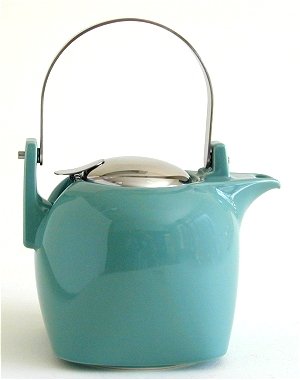
    4. Bee House's Kyoto teapot in day-brightening turquoise is just one of those artful objects that dress up any breakfast table or work spot, wherever your mother-in-law and her impeccable taste takes her spot of tea.

    Be 74


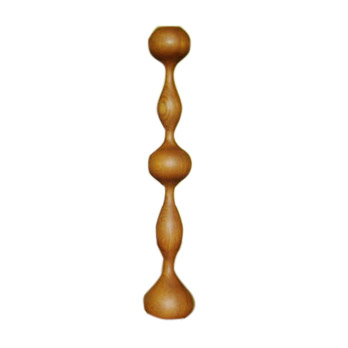
    5. A chic wooden Mayfair candlestick or two, for your brother's first apartment. Maybe it'll get him to turn off his halogen tower left over from college.Yhst-69328165909994_2131_101184340

    6. Would your mother rather be reading than baking cakes? Get her Milk by Anne Mendelson. It's a fascinating and comprehensive history of our relationship with milk, along with mouthwatering recipes from all over the world. She'll never drink milk the same way again. Who knows, she might even find herself elbow-deep in homemade cheese one day. But no pressure.

    20090527milk


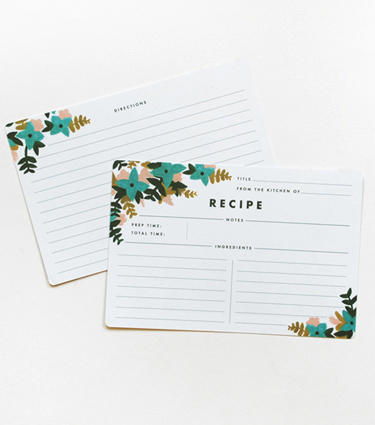
    7. This one's for the grandchildren. Be diligent about writing down your favorite recipes on these beautiful recipe cards from Rifle Paper Co. and one day you''ll have the best heirloom ever to pass on. (Here's the matching wooden box to store them in.)

    Rec_blue_m


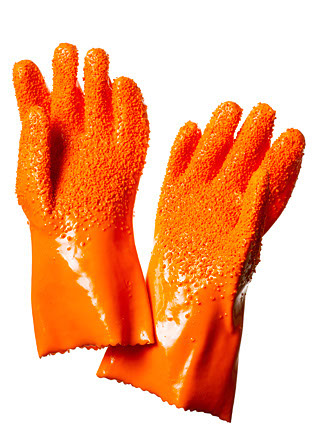
    8. I find scrubbing potatoes, squash and other vegetables to be rather mind-numbing work. But if you got to pull on a pair of fire-orange, rough-palmed, Cooper-Hewitt rubber gloves to do that work, or go even farther and peel those vegetables, wouldn't you feel like a million bucks? I thought so. A great gift for the reluctant cook in your life.

    Peeler_glove537_image2

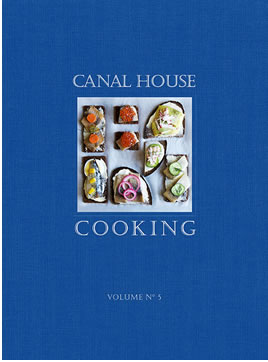
    9. Much has been written about the glory of the Canal House Cooking series, from the beautiful photography and food styling to the deeply delicious recipes, and all of it is true. These books are total gems and not so precious that you can't get them spattered in the kitchen and dog-eared by the bedside table. For your best friend still mourning the demise of Gourmet.

    TOC-thebook-vol5_r2_c2_s1


    10. The old Russian tea company, Kusmi, has been given a rather luxe makeover as of late. But their teas are still wonderful, either loose in pretty tins or packed into gorgeous little muslin tea bags. My favorite at the moment is Kusmi Boost, a spicy green tea blend packed with cardamom pods, ginger, and orange peel. For your boss or your favorite neighbor and, while you're at it, get a tin for yourself, too.

      Kusmi Tea BOOST 125g Dose

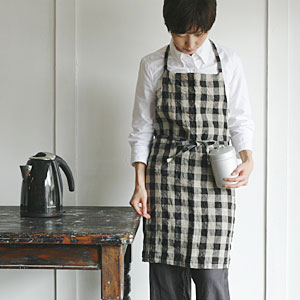
    11. Do you have a smallish person in your life who likes to cook? Chances are they've spent their entire cooking lives looking for an apron that will fit. So get them this Fog Linen apron, because good aprons for smallish people can be terrifically hard to find.

    LKA324-BKNC_1

  • 6a00d8341c660253ef01348802ec8c970c-800wi

    It's been almost a year now since I got back to Berlin. Or since I left New York, depending on how you see things. I've been through a long winter, a short, hot summer, a fall that went by too quickly and now we're narrowing in on Christmas. I found a place to live, I've made some friends, I've got a desk that's pretty good and a kitchen that's pretty great, and though I miss my people in New York every day, I like my life here so much. In fact, I love it. And finally, I'm starting to be able to see this city without the fog of newness and confusion that surrounds so much of settling in to a new place (even if it's new and old at once).

    I've promised a few, or more, of you a post about my favorite restaurants in Berlin for a while now. But the more I thought about it, and the more I ran around Berlin trying to find good food to eat, the more I felt frustrated by packing everything I'd like to say about food in Berlin into a single post. And even though, when the tiny kernel of the urge to start another blog, devoted to my favorite (and not-so-favorite) things to eat in Berlin, appeared in my mind the first time, I knew intellectually that between the book and this blog and trying to have that life that I like, no love, there was no way I had room in my world for a second blog. But that kernel wouldn't budge. Instead, it took hold and grew and grew, kicked my intellectual self gently in the ribs, and found room where I thought there wasn't any, which is, dear readers, how Berlin on a Platter was born.

    Berlin on a Platter is about the little discoveries I'm making in Berlin, about my favorite bakeries and snack stands, the hidden gems I might (or might not) find on my journeys around the city, gustatory wonders at the grocery store, a good restaurant in the East or a great one in the West. Consider it my personal culinary notebook for Berlin, a resource for those of you visiting this city or those of you who live here. I hope you like it.

    Guten Appetit!

  • DSC_4288

    When my beloved told me yesterday that we had to turn the clocks back this morning, it hit me like a small sack of lemons in the gut. But I haven't prepared!, I howled. I'm not ready for this to be the last time we still see daylight at 5:00 pm until next spring! But that's how it goes: one minute, you're tearing down a linden-perfumed street on a bicycle without a jacket, and the next thing you know, winter's knocking on your door. Don't worry, he said. November in Berlin is awesome. It's gray all the time.

    He makes me laugh.

    Now the time of panades and stews is upon us. We start making the Christmas cookie dough next week (it ripens on the balcony for a month), and Stollen isn't far behind. This year, I'd really like to make a proper English fruit cake and soak it in whiskey for at least a little while. There's apple butter to be made for presents and more yeast doughs to work on. Plus, I'm working on a potato dumpling recipe and goodness knows, you can't eat those on a regular basis as long as there are more than 6 hours of daylight available to you each day.

    (I've grown soft, you see. 15 years of living on the East Coast of the United States has made me weak. Give me another couple years up here in this latitude and I'll be back to where I was when I was 12, giddy about the fact that I used to wake up in the dark and eat dinner in the dark. Who needs daylight, anyhow? Vitamin D is for suckers!)

    I suppose at a certain point, then, we'll have moved on to sliced fennel salads or endive and blood oranges, staples of the winter table that somehow manage to balance all that heavy weight with some plain, sharp, bitter flavors. But until then, and as long as I'm still finding good, firm, fresh zucchini at the grocery store, I'll be making this salad which, in one soft green nudge, supplanted the carrot-harissa-feta salad of the summer (we seriously ate it all. Summer. Long).

    DSC_4294

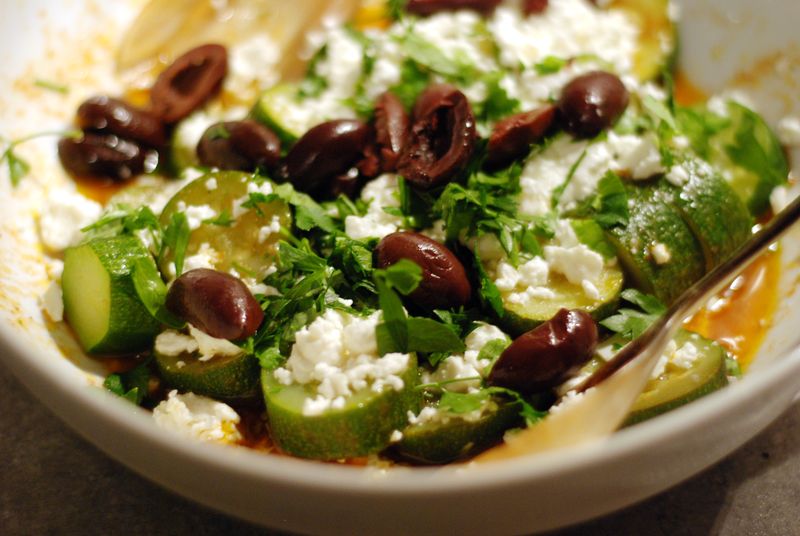
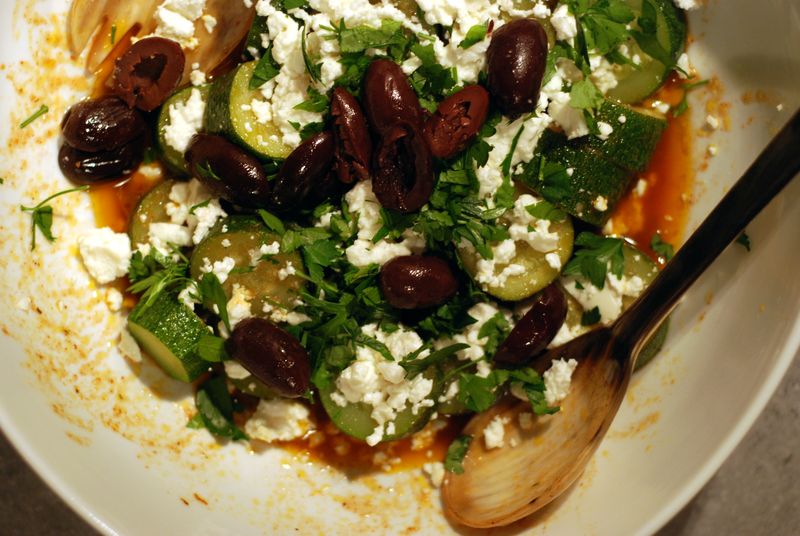
    This salad, well, it was love at first bite. Groan. What an idiotic expression, I know. But how else do I explain how hard and fast I fell for it with just one forkful? Imagine: zucchini steamed until soft and sweet as sweet can be, a spicy, garlicky dressing, the sharpness of olives and feta, the grassiness of olive oil and parsley. All in one bite, together.

    It's Gabrielle Hamilton's recipe and was published in the first Canal House cookbook. With that kind of pedigree, it's no surprise, then, that it turned out to be so addictively delicious. We ate it for dinner one night with a few slices of bread, the kind of dinner that follows a rather biggish lunch, when you're not hungry for much, but you need something in your belly before bedtime. It was spectacularly simple; a riot of colors and textures in the bowl; a one-bowl salad that was far, far more than the sum of its parts.

    You know when you start eating something and it sort of explodes in your mouth and your eyes widen and it's just so incredibly delicious and you try to put a figure on just what exactly is making the dish so darn perfect but you can't, so you take another bite and another and another and before you know it, in the blink of an eye, you are fighting rather unattractively to get another portion on your plate before someone else eats it and then you're wiping out the salad bowl with bread and eyeing your plate rather nervously – how did it empty so fast? – and scheming to make it again tomorrow and the day after and the day after that, too?

    That is what this salad is like.

    Soft Zucchini with Harissa, Olives and Feta
    Serves 4 as a side dish or 2 as a light dinner with bread
    Note: I've made a few small changes to the original recipe (using ground caraway, for example, as well as steaming the zucchini instead of boiling them, and using much less olive oil).

    1/8 teaspoon ground caraway seeds
    Juice of 1 lemon
    2 tablespoons harissa paste
    3 tablespoons extra-virgin olive oil
    1 clove garlic, peeled
    4 zucchini, sliced into thick rounds
    Handful Kalamata olives, pitted
    1/4 to 1/2 cup coarsely crumbled feta
    Small handful parsley leaves, chopped

    1. Put the ground caraway, lemon juice, harissa and olive oil in a serving bowl. Crush the garlic clove through a garlic press and add to the bowl. Whisk to combine.

    2. Fit a vegetable steamer in a pot with an inch or two of water and bring to a boil. Steam the zucchini until tender, about 5 to 7 minutes. They should not be falling apart. Add the zucchini to the serving bowl and gently toss with the harissa vinaigrette while still warm.

    3. Dress the zucchini with the olives, feta, and parsley. Serve immediately.

  • DSC_3457

    The fridge is full to bursting right now with various pots of jam, a silly amount of mustards in tubes and jars, two or three cheeses and a bunch of homemade fruit syrups (raspberry! elderflower! apple-currant, too!), but, as I stood in front of it with a gnawingly empty stomach today, there was nothing in it for lunch. We had no bread to make impromptu grilled cheese sandwiches, and no vegetables to do a simple stove-top sauté. The last of the rice was used up last night and I thought if I even so much as looked at another potato I'd hurl it at a wall. (Potato pancakes, potato dumplings, potato cake, I think we need to talk.)

    When this happens to you, do you usually throw in the towel and go out for lunch? Or do you scrounge around until you find something suitable to eat, even if that means canned sardines on top of instant polenta with toasted sesame oil for flair? If I had not still been wearing my pyjamas at lunchtime (uh, one of the benefits of working from home, yes), I would have thrown in that towel and made someone else make me lunch. But vanity and laziness made me resourceful. You see, we did have a small jar of anchovies in oil and a can of my very favorite pomodorini di collina and an obliging parsley plant on the balcony.

    Suddenly, things were looking up.

    DSC_3448

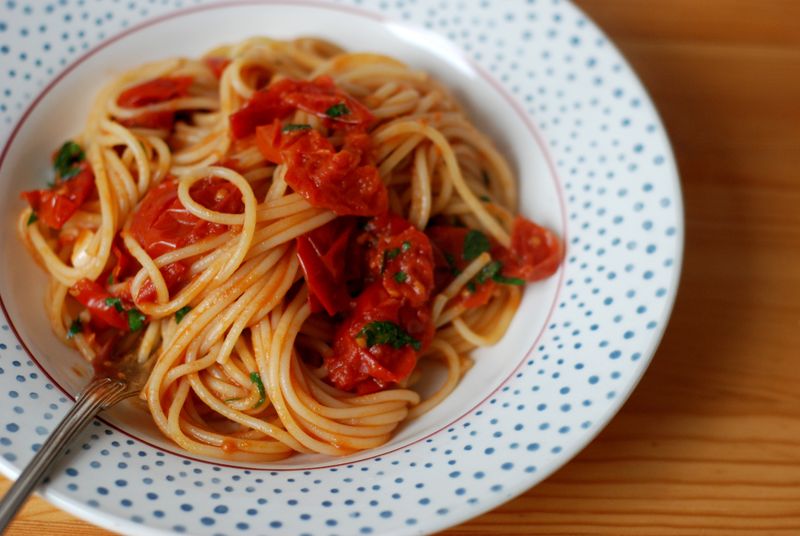
    I first read about this sauce on Rachel's mouthwatering blog earlier this year. It's Marcella Hazan's recipe and seems to be almost like the devastating Sofia Loren to her more Jayne Mansfield-like tomato-butter-onion cult. You melt a few anchovies in some olive oil, throw in a bit of garlic (I leave mine in chunks big enough to fish out, but you could mince it, too), and then simmer a can of tomatoes in that dark, funky base until the sauce is reduced and thick enough to coat a panful of spaghetti. I find it needs a bit of chopped parsley to make it feel like a proper lunch, but that's about it. You barely need any salt, you certainly don't need any grated cheese on top and the sauce's richness (not fishiness, don't worry) makes for a very satisfying meal.

    With a square or two of chocolate for dessert, of course. One needs something special to book-end a scrounge-y meal like this, after all.

    So, tell me, readers: what do you eat when there's "nothing" at home to eat?

    Tomato and Anchovy Sauce
    Serves 2 or 3

    1 clove garlic, peeled and halved (or minced)
    3 tablespoons olive oil
    5 flat anchovy fillets
    1 16-ounce can imported Italian cherry or plum tomatoes
    2 tablespoons chopped parsley

    1. Heat the oil in a skillet and gently brown the garlic over low heat. Add the anchovies and, stirring constantly, allow the anchovies to melt into the oil.

    2. Add the tomatoes and bring the sauce to a low simmer. Let simmer, uncovered, for 20 to 25 minutes. Taste for seasoning. In the meantime, bring a pot of water to the boil and cook enough spaghetti for two or three people. Drain the spaghetti, toss with the sauce and sprinkle with parsley. Serve immediately.

  • Frequently Asked Questions

    ******************************  


    Q: Why is your blog called The Wednesday Chef?

    A: It’s not because I only post on Wednesdays, or only cook on Wednesdays. Wednesdays were the day that newspapers used to publish their food sections. And since my blog task, as I defined it for myself when I first started, was to cook my way through all my recipe clippings, I wanted my blog name to reflect that in some way. A little secret: I actually think my blog name is kind of corny, but it’s way too late to fix it now and, in any case, other people seem to like it. Thank goodness!

    Q: Do you have any advice on starting a food blog?

    A: Sure! Post regularly and often. Learn how to shoot photos in natural light (never, ever use your flash). Be passionate about what you’re blogging about – whether it’s cheese-making or popcorn, you’ll find your audience if your passion has free reign. Make yourself part of the blog community – read other blogs, comment generously – and you’ll find readers and, more importantly even, friends. If you’re starting a blog to get rich and famous, I’d look into another line of work – do it because you love to write or take photos or connect with other people (or all of the above).

    Q: How did you get into cookbook publishing? What advice do you have for people wanting to get into that line of work?

    A: See this post for answers.

    Q: What kind of camera do you use?

    In the early years of the blog, I used a little point-and-shoot Panasonic Lumix, but since 2008 I’ve used a Nikon D80. I have a 50 mm fixed lens on it and although I keep talking about getting a wide-angle one next, the fixed lens serves me really well. It shoots beautifully in low light.     

    Q: Can I use one of your photos on my site? Can I use one of your blog posts on my site?

    Everything on this site – photos and text – is protected by copyright. If you would like to publish one of my photos on your site, please have the courtesy to credit me and link back to my site. Please do not republish my writing on your site.   

    Q: I’m coming to Berlin. What restaurants do you recommend?

    Head on over to my Berlin blog, Berlin on a Platter, for my latest restaurant recommendations. You can also check out these articles on my favorite cafés and bakeries and brunch spots that I wrote for the Guardian.

    Q: I have a blog. Can we do a link exchange?

    I don’t do link exchanges and, as my friend Deb says, neither should you. I only link to websites that I love to read and visit regularly. But if you’d like to email me or leave me a comment pointing me to your blog, please do so! I love discovering all the amazing blogs, writers, photographers, and general creative geniuses out there.

    Q: Do you accept advertising on your blog?

    A: After years of being in an ad network, I recently decided to handle my own advertising. I value my readership very highly and will only work with an advertiser if I already use your product or think it is a good fit with my blog and my readers. If you’d like to discuss a collaboration, please send me an email.

    If I haven’t addressed your question here, feel free to email me at wednesdaychef[at]hotmail[dot]com.


    Press

    ******************************


    “highly amusing…” – The Los Angeles Times, January 25, 2006

    “Two of America’s most notable newspaper food sections get a proper licking in this clever culinary blog. …Whatever recipe Weiss takes on, she chronicles the outcome with an honest, no-holds-barred writing style. And in less than two years she’s gathered quite a loyal and vociferous readership. – Culinate.com, April 19, 2007

    “The Wednesday Chef has such a unique angle. Weiss’ writing [is] is really enjoyable…[and] she is very honest. You can trust her. Weiss will be the first to tell you if something (gulp) does not impress.” – MSN City Guides, August 2007

    “My favorite of the moment is The Wednesday Chef…a New York writer who chronicles her attempts at cooking recipes clipped over the years from The New York Times and the LA Times. I admire how regularly and ambitiously she cooks and posts, usually with plenty of yummy pictures. Reading it is almost enough to get me through until the weekend, when I might be able to cook again.” – Food & Wine, September 2007 

    Number 3 on the Times of London’s list of 50 of the world’s best food blogs – February 2009

    “New York-based Luisa Weiss started this blog as a way of documenting her trawl through clippings of recipes from the New York and LA Times. A mix of recipes and humorous anecdotes…it’s a charming blog packed with information (indeed, a whole 700 words about coleslaw).” – The Times of London, February 2009

    “I love thewednesdaychef.com, written by Luisa Weiss, a book editor living in Queens, New York. [Her blog] is very American, so full of a particular brand of warmth and honesty…There are also some great recipes ( Turkish-style pasta with beef and yogurt, or banana and crystallised ginger cake). This blog is about life and – as another blogger, Heidi Swanson of 101cookbooks.com, puts it – the recipes that ‘intersect’ it.” –Telegraph, July 2009

    “Luisa Weiss [is the] mastermind of The Wednesday Chef. These women engage their readership with food-related narratives and storytelling techniques, garnering comment counts in the triple digits and cultivating a community of loyal fans.” –PBS.org’s Need to Know, July 2010 

    Number 8 of The Top 100 Culinary Blogs – July 2010. “The result [is] a blog charming not only for its recipes, but also for humorous anecdotes from Luisa’s personal life.

    Number 6 of Olive‘s Top Ten Bloggers – October 2010. “Cooking with humor – Luisa Weiss’s trawl through a decade of recipes clipped painstakingly from American newspapers.”

    Seen on:

    Design*Sponge
    Elizabeth Street

    Leite’s Culinaria
    Serious Eats
    momfilter
    üBerlin
    Popmatters
    Gourmet.com
    Epicurious.com

    Yumsugar.com
    Slashfood.com
    Studio Fifteen
    Food in Jars
    Slow Travel Berlin
    Seven Spoons
    Sweet Amandine
    Moveable Feasts

    Featured in:

    The Wall Street Journal
    Santa Cruz Sentinel
    East Bay Express
    The Boston Globe
    The South China Morning Post
    The Seattle Times
    delicious
    Magazine
    Publisher’s Weekly
    The Christian Science Monitor
    The Oregonian
    Milwaukee-Wisconsin Journal Sentinel
    KOMO News
    Tufts Magazine
    EasyJet Magazine
    Emotion (Germany)
    Zitty (Germany)
    Tip (Germany)
    Harper’s Bazaar Germany

    Heard on:

    Conversations on the Coast
    The Leonard Lopate Show
    Berlin Stories for NPR
    Bayern 3 (in German)

    Seen on:

    KATU TV
    Deutsches Haus at NYU

  • DSC_2408

    I am sitting here in my office right now, the sky as dull as a washed-out t-shirt outside the window, rain leaking from above, feeling very far away indeed from the sultry colors in the photo above. In fact, it almost feels sort of cruel to post it; it's like a taunt from the last beautiful days of summer, strutting around all triumphant in fancy heels and a perfect summer dress, while you – autumn – have given up and retreated to the bedroom in saggy sweatpants and itchy woolen socks. Let's kick summer in the teeth, shall we? Now is the time of apple picking and pretty scarves, Sunday afternoons at the movies and hard work, after all. Nothing to be ashamed of!

    Also, summer, this sauce doesn't belong to you.

    Okay, so remember my friend Alessandro? His mother, Gabriella, is quite possibly the very best cook I know, and I happen to be blessed with a lot of good cooks in my life. She is from Bologna, the culinary heart of Italy, and she creates magic at her stove, from delicate breadcrumb soups to lusty pigeon sauces and briny octopus-potato salads. She's the woman who taught me how to make real ragù Bolognese and a mean lasagna.

    Also, ragù di pesce. Fish sauce, if you're wondering. Though "fish sauce" sounds rather…fishy, and wan.  Like something beige and sticky you'd see napped on boiled potatoes so old they've grown skin at a German university canteen. And the fish sauce, er, ragù di pesce (pronounced rah-GOO dee PESH-eh) I'm talking about is a spicy, briny, fantastical thing that you toss with spaghetti, grabbing your heart at first bite.

    DSC_2424

    It is my not-so-secret hope that one day, I will be able to spend enough time in Gabriella's kitchen that she'll cook her way through her entire canon with me. In August, we started modestly: with grilled, stuffed tomatoes (I'm saving the recipe, my darlings, for the book) and this ragù. (Well, there were also a tray of gratinéed mussels and grilled fresh anchovies, tossed in herbed breadcrumbs, but those were more incidental lessons than anything else. Still, are you hungry yet? I just had breakfast and my stomach is growling.) And because sharing is giving, it is too good to keep to myself. May your September be rich in ragù di pesce!

    DSC_2321

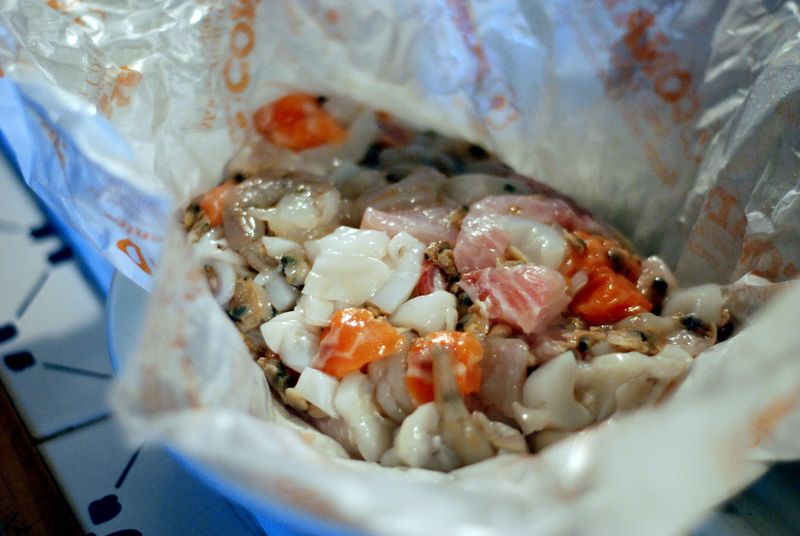
    You begin, appropriately, with the fish. At the fish market in the next town over from the village where my mother and our friends live, near the Adriatic coast of Italy, you can buy a little mixture specially made by the fishmongers for ragù. It's got bits of salmon and monkfish, tiny shucked clams, chopped squid, and some shrimp cut into it. You can make your own fish mix in places without such a lovely service by simply buying a couple of different fillets of fish, a few shrimp and octopus, and a handful of clams, and then chopping and shucking everything up at home. You'll want about a pound in total.

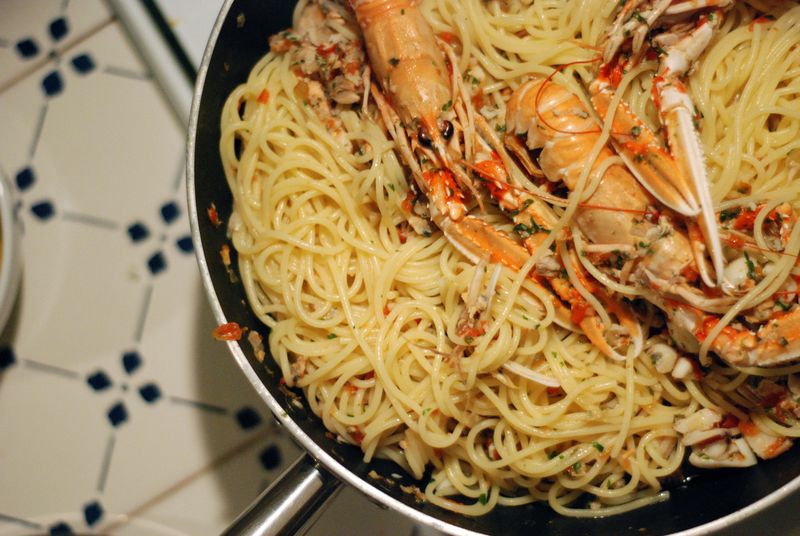
    To make things a little special, you can also buy some fancy scampi to serve on top of the plate of spaghetti. But that's just if you have guests that you really want to impress. If it's just a regular old Tuesday night, skip this step. Gabriella also bought cannochie, a specialty of that part of the Adriatic. I'd never seen them anywhere else before, but the Internet says they're called mantis shrimp in English. Have you ever heard of them? Anyway, they look sort of goofy and they're spiny to no end, but once you get past their shell, the flesh is sweet and fresh and almost lobster-like in consistency. Except, there's a lot less of it.

    DSC_2327

    Are you the kinds of people to do a proper mise en place before you start cooking? I always wish I would be, but I never am. New Year's resolutions and so on, let's make pretend we're doing a mise. Assemble an onion, some garlic cloves, a big pile of minced fresh parsley, two or three plum tomatoes, a bottle of white wine, a box of spaghetti, some hot red pepper, salt, and…the fish? I think that's it.

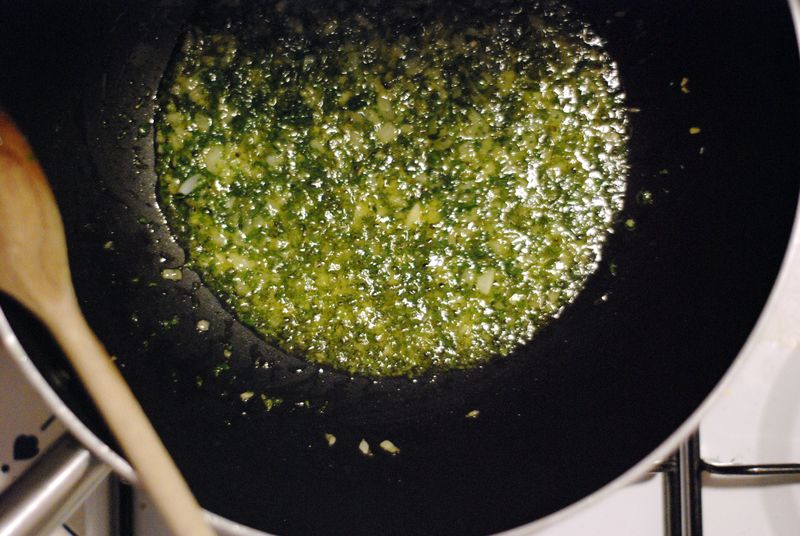
    Now, feeling all virtuous with your organization skills, put on an apron and finely dice the onion and a garlic clove or two. In a wide, deep pan, sauté them togther gently in olive oil, along with several spoonfuls of the minced parsley. You want this mixture to get wonderfully fragrant, but without burning. So monitor the heat and keep moving everything around the pan.

    DSC_2337

    When it's done, about 7 minutes later, add the chopped fish mixture and stir well to distribute the oil and onion and garlic and herbs. Let that cook for a few minutes, stirring almost constantly, until you see the very edges of the shrimp start to go gray.

    DSC_2344

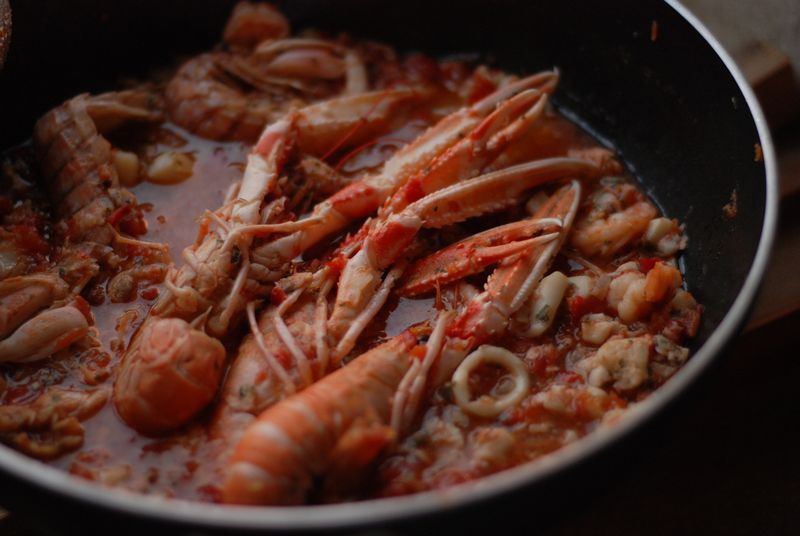
    Add the scampi and mantis shrimp, if using, and then add about a cup of dry white wine. Mix well and let it cook down for several minutes. In the meantime, seed and chop two plum tomatoes. Actually, three. Pour yourself a glass of that white wine.

    DSC_2357

    Add the tomatoes to the pan and stir. If it's looking like it needs a little more color, add a few spoonfuls of pureed canned tomatoes. And salt. A good amount! More than you think. Gabriella says that's the trick about seafood, it needs a lot of salt. And a nice pinch of red pepper flakes, if you want a little heat. (I always do.)

    DSC_2369

    Let the sauce come to a low boil and busy yourself with other things for a little while, like filling a pot with water for the spaghetti (the sauce as depicted here makes enough for a 454-gram box, which should be plenty for four to five people) and bringing it to a boil. Set the table, if you don't have small children to do it for you, or if your spouse is busy making the rest of dinner on the grill in the garden, teaching that girl with the camera his most precious secrets.

    DSC_2802

    When the sauce is, well, saucy, meaning, when the sloshiest part of the liquid has reduced, and the sauce feels thickish, about 10 minutes later, turn off the heat, stir in the rest of the parsley, taste for seasoning and then deal with boiling the spaghetti. As a visual aide, the sauce should look about it how it does in the first photo of this post. When the spaghetti is nice and al dente, drain it and add it to the pan with the ragù, tossing to distribute the little bits of fish and sauce evenly. You want to work quickly so that the spaghetti doesn't turn gummy. It'll absorb a bit of the sauce's liquid in the hot pan, which makes for forkfuls that truly taste of the sea.

    DSC_2421

    Command everyone to the table. In fact, if you got them well-trained, they'll know to be waiting, fork in hand, napkin in lap, raptly for you to dish steaming hot plates of spaghetti up in front of them.

    DSC_2445

    The fish bits fall apart in the sauce, infusing the tomato sauce with briny flavor. The wine gives depth to the sauce, which is, as these things go, quite a contender for fancy fast food. The parsley adds freshness and a bit of color. But really, calling out the individual elements of the dish is sort of beside the point, because what makes this so delicious and special is how it all comes together on the plate.

    And even though it's possible to make this ragù at any point during the year now, I think it tastes best when eaten with eyes closed, dreaming of the summer, remembering skin hot from the beach, hearing crickets chirping at night.