• DSC_5984

    Hey, so, I kind of need you to do me a favor. It's no big deal, really. Just a little favor. Leetle.

    What are you doing Sunday morning? Want to come over for breakfast? Please?

    See, the thing is, I just figured out how to make bagels. I spent my whole life convinced that they were complicated and difficult to make at home, that there was no point in even trying, that bagels were just one of those things best left to the experts. My whole life! And now I'm trying to make up for lost time. Thirty-three years' worth, to be exact.

    Because – because! – it turns out that making bagels is about as difficult as tying a shoelace. Or washing your hair. Or licking a stamp. I'm only exaggerating a tiny bit, I promise.

    All you really need is Peter Reinhart's recipe. Oh, sure, it says you have to use fancy bread flour, but I made this with the plain, old all-purpose in my pantry, and the bagels were perfection: chewy on the inside, crisp on the outside. It also asks for barley malt syrup, but I was far too lazy to go out hunting for that when I had honey in the pantry (which Baker Reinhart says is an acceptable replacement) and the bagels were delicious as can be. You can even do it all by hand, needing no stand-mixer or food processor or anything of the like.

    Easy. So easy! I can't get over it.

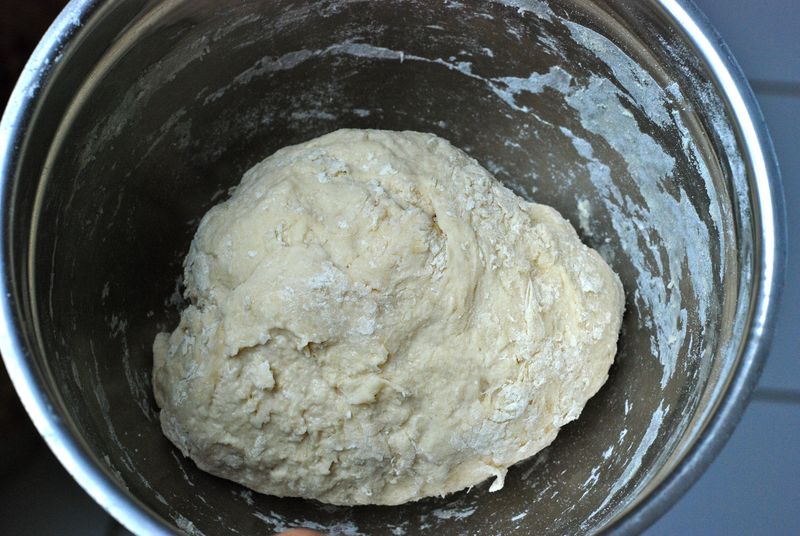
    Here's what happens. You make a stiff little dough just by mixing together the flour, water, yeast, honey and salt. It'll look a little coarse when you get it all together, kind of like this:
    DSC_5923

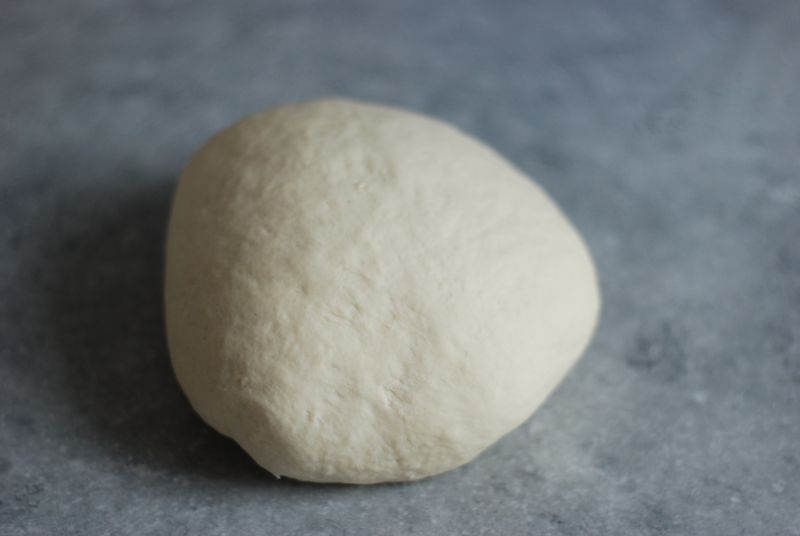
    You let that sit for a few minutes, just to relax. Then comes the fun part: kneading! Don't worry, it's just for a little bit, two, three minutes, tops. A few slip slap, slip slaps and you've got this:
    DSC_5925

    I don't know about you, but to me a gorgeous ball of bread dough, luminous and glowing in the late-winter light, is a thing of beauty. I could sit and gaze at it for hours, so full of promise and possibility. And the way it feels! Satiny smooth, like the underside of my grandma's arms. Some people have Apple products, others have automated vehicles; me, I've got dough to moon over.

    Once you've finished gazing at your ball of dough adoringly, you pop it in an oiled bowl and refrigerate it for a while. For example, if you wanted fresh bagels for Sunday morning breakfast, you could make the dough on Saturday around lunchtime, pop it in the fridge until just before bedtime and then shape the bagels and refrigerate them before going to sleep.

    Let's say you're doing it that way and it's now Saturday evening and the dough's been in the fridge since lunch. You take the dough out of the fridge and gently remove the now-puffed dough from the bowl. Divide it into six or eight pieces. (I made eight bagels out of this batch and I loved the modest size of them, but my mother complained that her bagel wasn't big enough. So if you like puffier bagels, just make six.) This next bit is really the most complicated part of the whole deal:

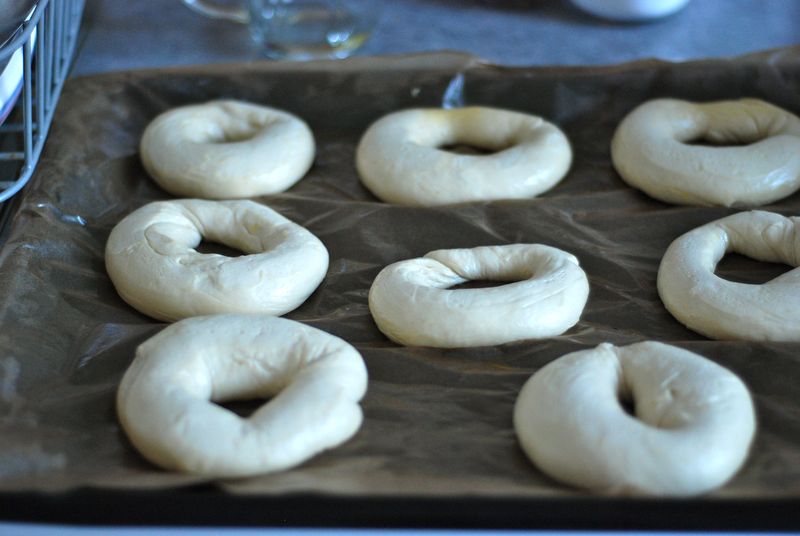
    Take each piece of dough and roll it out into a snake. Form the snake into a ring, pressing and working the ends of the dough into each other so that the ring doesn't come apart. This takes more pressure than I expected and I kept thinking, as I squeeeezed, that I was hurting the bagel dough or something like that. (Maybe I should spend less time gazing lovingly at dough balls and more time telling myself that anthropomorphizing dough isn't the best use of my critical faculties.) You'll get the hang of it. Luckily, bread dough is pretty forgiving. Plop your pretty little rings on an oiled piece of parchment paper, cover them with plastic wrap, stick them in the fridge and go do something fun with the rest of your evening.
    DSC_5959

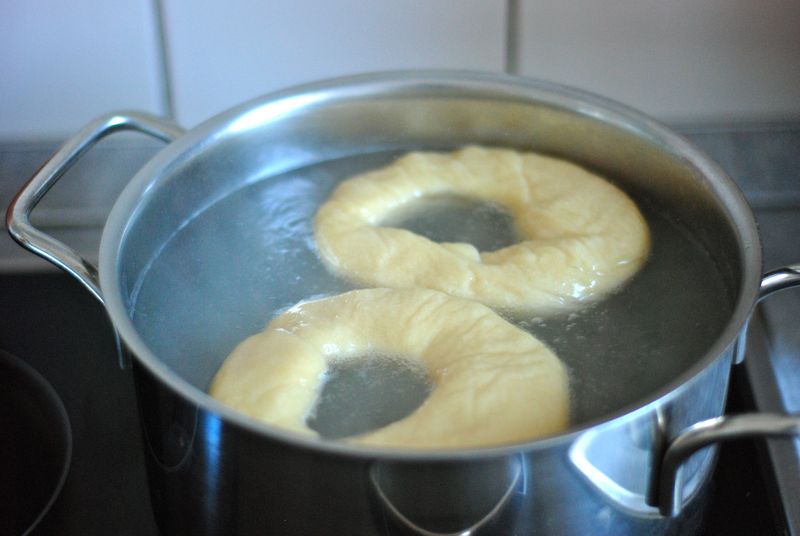
    The next morning, get up a little earlier than everyone else. Take the dough out of the fridge and let it warm up to room temperature. The best part is right around the corner, I'm so excited for you! Boil some water and add baking soda and salt to the water. Then gently slide the bagels, all puffed and wondrous under your fingertips, into the water (just a few at a time, unless you're working with a cauldron). In the water, the bagels expand a little and develop a bit of a skin. You turn them around, letting the other side have a go as well, and then you take them out and put them back on the baking sheet.
    DSC_5966

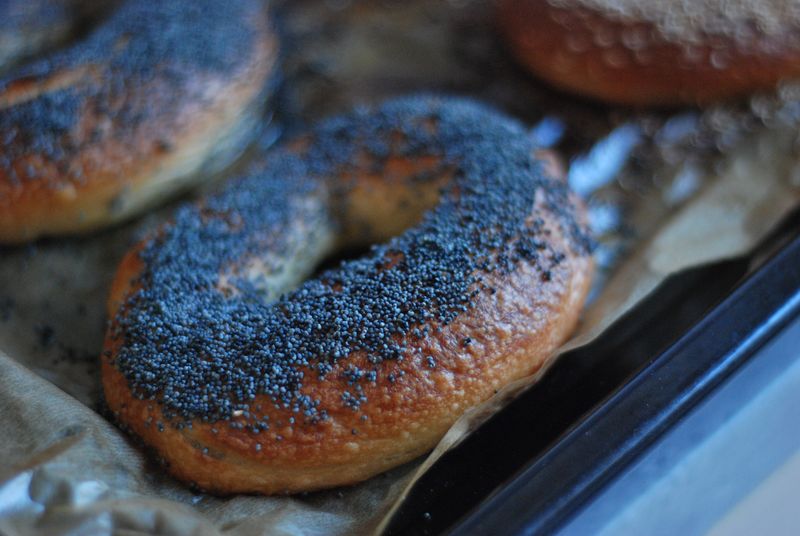
    I happen to think poppy seeds were put on this earth to be paired with bagels, but you can do whatever you like with the bagels at this point. Sesame seeds, poppy seeds, nothing at all, this is up to you. (Only the cinnamon sugar route should be done after baking – check the original recipe for more on this.)
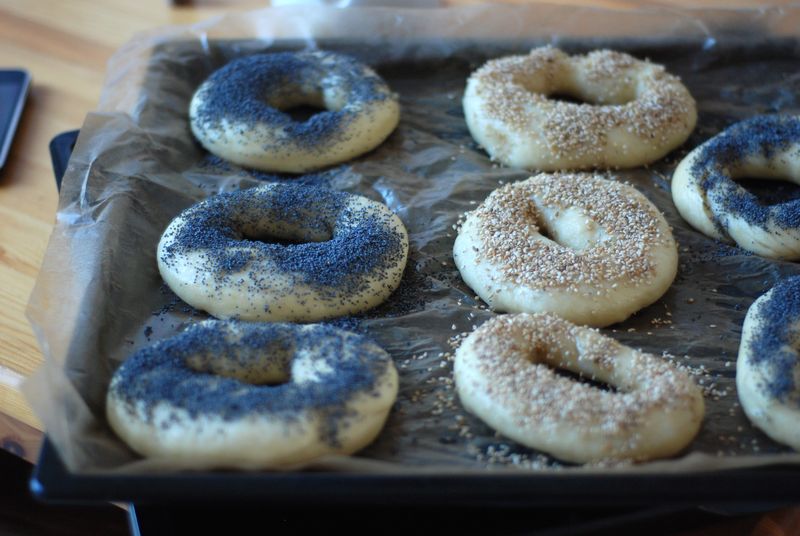
    DSC_5970

    Just looking at these photographs is flooding me with warm, fuzzy feelings. I want to hug Peter Reinhart! I want to festoon myself with bagels! And I want to have you all over for Sunday breakfast so I can make a triple batch of these again!

    Once the boiled bagels are adorned with their cap of seeds, slide the baking sheet into a hot oven and get the breakfast table ready. Lox! Cream cheese! Butter! I hope you are prepared. Rouse those sleepy heads who have no idea just how good they've got it, or not yet, in any case.
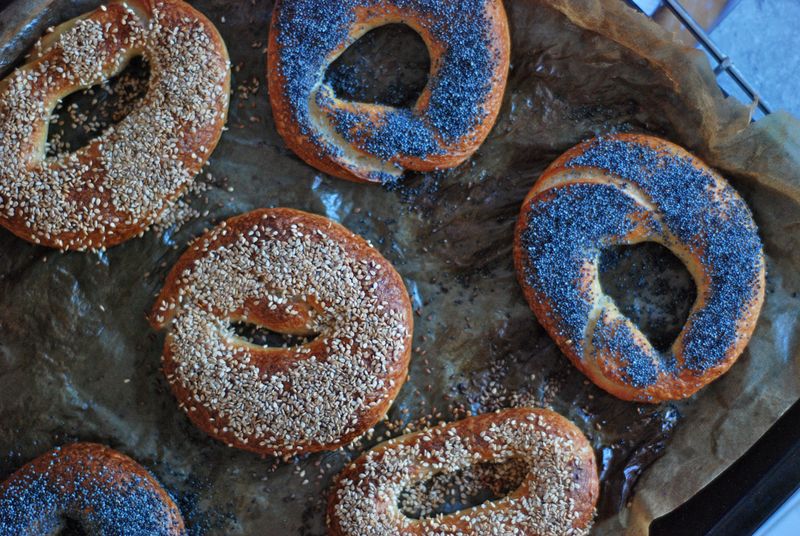
    DSC_5988

    Because just about 15 minutes later, you're going to have a tray of gorgeously brown and crisp-skinned bagels in your kitchen, making your house smell like H&H (I used to live across the street from their 80th Street outpost – I know that smell like I know my own mother's). It will seem barbaric, completely inhumane, but you have to force yourself to wait about thirty minutes before slicing open a bagel and eating it for breakfast. Busy yourself with other things, like buying stock in a flour company.

    Excruciatingly, the minutes will somehow tick by and then, finally, you can throw yourself at your table and have yourself a bagel so good you will not believe your mouth. They're chewy in all the right places, their crust is speckled with the tinest, prettiest blisters, they have little pockets just waiting to be filled with a smear of cream cheese. And you made them. From scratch. Unbelievable.

    I swear to all that is holey (har) that these bagels are so good you won't even need H&H anymore. No, not even you, New Yorkers! I know you might not believe me. But that's what brings me around to my original question. What are you doing on Sunday morning?

    Bagels
    Makes 6 to 8 bagels

    3 1/2 cups (1 pound) unbleached flour (bread or all-purpose)
    3 teaspoons salt, divided
    3/4 teaspoon instant yeast
    1 tablespoon honey or barley malt syrup, if you've got it
    1 cup plus 2 tablespoons water
    1 teaspoon baking soda
    Poppy or sesame seeds

    1. By hand, mix the flour, 2 teaspoons salt, the yeast, honey and the water until the ingredients form a stiff, coarse ball of dough (about 3 minutes). If necessary, add a little more water. Let the dough rest 5 minutes.

    2. Knead the dough on a lightly floured surface until the dough feels stiff yet supple, with a satiny, slightly tacky feel, 2 to 3 minutes. If the dough seems too soft or too tacky, sprinkle over just enough flour as needed.

    3. Place the dough in a lightly oiled bowl, cover tightly with plastic wrap, and place it in the refrigerator for at least 1 hour and up to several hours. Keep in mind that the bagels must be shaped before proofing overnight.

    4. When ready to shape the bagels, line a baking sheet with lightly greased parchment paper or a silicone baking mat.

    5. Remove the dough from the refrigerator and divide it into 6 to 8 equal pieces. Form each piece into a loose, round ball by rolling it on a clean, dry work surface with a cupped hand; do not use any flour on the surface. If the dough slides around and won't ball up, wipe the work surface with a damp paper towel and try again – the slight amount of moisture will provide enough "bite" for the dough to form a ball. When each piece has been formed into a ball, you are ready to shape the bagels.

    6. Using your hands and a fair amount of pressure, roll each dough ball into a "rope" 8 to 10 inches long. (Moisten the work surface with a damp paper towel, if necessary, to get the necessary bite or friction). Slightly taper the rope at the ends so that they are thinner than the middle. Place one end of the dough between your thumb and forefinger and wrap it around your hand until the ends overlap in your palm; they should overlap by about 2 inches. Squeeze the overlapping ends together and then press the joined ends into the work surface, rolling them back and forth a few times until they are completely sealed.

    7. Remove the dough from your hand and squeeze as necessary to even out the thickness so that there is a 2-inch hole in the center. Place the bagel on the prepared sheet pan. Repeat with the other pieces. Lightly wipe the bagels with oil, cover with plastic wrap and place in the refrigerator overnight.

    8. Remove the bagels from the refrigerator 90 minutes before you plan to bake them. Fill a large stockpot with 3 quarts of water (be sure the water is at least 4 inches deep), cover with a lid, and slowly bring the water to a boil. When it comes to a boil, add the remaining teaspoon of salt and 1 teaspoon of baking soda, reduce the heat and simmer with the lid on.

    9. Thirty minutes before baking, heat the oven to 500 degrees.

    10. Test the bagels by placing one in a bowl of cold water. If it sinks and doesn't float to the surface, return it to the sheet, wait 15 minutes and then test it again. When one bagel passes the float test, they are ready for the pot.

    11. Gently lift each bagel and drop it into the simmering water. Add as many as will comfortably fit in the pot. After 1 minute, use a slotted spoon to flip each bagel over. Poach for an extra 30 seconds. Using the slotted spoon, remove each bagel and return it to the lined baking sheet. Continue until all the bagels have been poached. Generously sprinkle each bagel with a topping.

    12. Place the baking sheet in the oven and reduce the heat to 450 degrees. Bake for 8 minutes and then rotate the sheet (if using two sheets, also switch their positions). Check the underside of the bagels. If they are getting too dark, place another sheet under the baking sheet. Bake until the bagels are golden brown, an additional 8 to 12 minutes. Remove from the oven and transfer the bagels to a rack for at least 30 minutes before serving.  

  • DSC_6265

    The first time I went to Spain was ten days after 9/11. I worked in Rockefeller Center that year, as an assistant at Simon & Schuster. When I got to the office that morning, oblivious to all that had already happened while I was at the gym, in the shower, on the subway, a girlfriend of mine in the marketing department, whose father was a firefighter, was standing next to the elevator bank in the lobby and sobbing. She was the one who told me about the first airplane. I remember thinking that none of it made any sense. Don't worry, I tried to soothe her. I'm sure it was just an accident. As I rode up to the 14th floor, I thought that maybe a window washer, hanging outside on the face of the building, had startled the pilot of a small prop plane and the accident had ensued from there. I suppose your mind goes in absurd directions when it's forced to take in the incomprehensible.

    Up on my floor, half the office was missing, stranded in Brooklyn while the subways ground to a halt across the city, the island sealing itself off. The people who had made it in stood in my boss's office, the only one with a television set, and we watched the coverage together, staring in disbelief, some people making terrible noises, as the towers crumpled and fell in real time before our eyes. One man left and made a beeline for his office, closing the door behind him. His wife worked part-time on the 96th floor, I found out later. That Tuesday had been one of her days in the office. They had three small boys at home, beautiful children who sometimes stopped by the office and smiled shyly at me. She never did come home that day. Months later, they found her remains.

    I had a secret boyfriend at the office those days. We tried to be discreet about our relationship, not wanting to be water-cooler gossip, but I think we fooled only a few. We'd long had plans to take a trip in September together, settling on a 10-day journey from Madrid, for a friend's wedding, to Seville, Cordoba and Granada in the south of Spain. In those horrifying, paralytic days after the 9/11 attacks, when I could barely bring myself to get on a subway, much less an airplane, we had to decide whether to cancel our trip or whether to go. Maybe it was peer pressure, maybe it was all that idiotic "don't let the terrorists win" mentality, but we decided to fly. I was half-mad with fear on the way over the Atlantic. I remember my boyfriend telling me, trembling before takeoff, that it wasn't too late to get off the airplane and go home. But I forced myself to be brave.

    In Spain we were treated like war heros. Everywhere we went, when people found out we were New Yorkers, there were free glasses of sherry, long, sympathetic looks, even a mortifying standing ovation at the wedding we attended. We watched footage from New York on the Spanish news, saw Giuliani's grainy image here, there and everywhere. I looked away when the airplanes flew into the towers again and again.

    It's surprising, in retrospect, that I remember anything about the food. But three things I do remember. Unwieldy chunks of chorizo in red wine at a tapas bar near the train station, salty and sour. A leg of jamon behind a bar, with plump, fat-lined slices on a plate in front of us, next to our water-beaded glasses filled with pale yellow sherry. And pan con tomate for breakfast, salted and drizzled with olive oil. In another frame of mind, I would have loved that breakfast, so foreign to me, so new. But heartbroken and angry is really no way to go out into the world. I resented the stale bread, the mealy tomatoes, the pockets of oil first thing in the morning. All I wanted was a nice bowl of American cereal with milk for breakfast and to be home again, back in New York, with my people and my grief and that gaping wound at the south of the city.

    DSC_6217

    Back in New York, my boyfriend and I didn't last long. That was the thing about 9/11, it threw a lot of things into relief. You had to make decisions about what you wanted if today was going to be your last day, or tomorrow. That was one of the last trips I took with a film camera and after I got the rolls developed, I packed the photos away without even looking at them. It would be years before I unpacked them and had a look. I'm still a little baby-faced, standing in a tiled room in the Alhambra. Sitting by the banks of the Guadalquivir in a mini-skirt and flip flops. Smiling gamely in front of the grand Cordoba mosque.

    I didn't eat any ham for a long while after that trip. Couldn't face potatoes or eggs or any of the other things we ate ad nauseam whilst in Spain. It would be years before I went back to a tapas bar in New York. In the meantime, though, through cooking I discovered smoked paprika and Marcona almonds, I fell in love with Manchego cheese and quivering slices of membrillo and the sour little boquerones that Zabar's carried. I made paella and golden potato soup and eventually went back to Spain, under much happier circumstances.

    But the truth remains that I can't really eat Spanish food without thinking of our September vacation. And I can't think of that trip without thinking of that Tuesday and all that we lost. As improbable as it is, the two are forever linked in my head. Just like the rest of life, really. The sweet and the salty, joy and despair.

    Janet Mendel's LA Times piece on the importance of chickpeas in the Spanish diet included this little purée garnished with shreds of toasted, garlicky bread and salty, chewy bits of bacon or jamòn. It's the kind of soup you can make with your eyes closed, really, just a simple weeknight soup made a little bit special with a crunchy, savory topping of fried bread and ham. I like how the crusty bits of bread fight back against the hot, smooth soup, nicking the insides of your mouth. You're supposed to use dried chickpeas, but I used canned ones and it was still very nice.

    And I liked how, as I cooked, the aroma of the food on the stove made me think back to everything that happened all those years ago and how lucky I am to get to call all this the fabric of my life, sometimes vibrant, sometimes wrenching, but always, always worth living.

    Chickpea Soup with Crisp Croutons (Crema de garbanzos con pan frito)
    Serves 6
    Note: 1 cup dry chickpeas makes 2¾ cups cooked. Soak the dried chickpeas in water for 8 hours. Put them to cook in hot water and simmer until tender, about 3 hours.

    2 tablespoons plus 1½ tablespoons olive oil, divided
    1/4 cup diced pancetta or jamòn
    1 cup sliced carrot
    1 cup chopped onion
    1 clove garlic, chopped
    1 boiling potato (8 ounces), peeled and cut in pieces
    2 3/4 cups cooked chickpeas (I used a 28-oz can)
    1/4 cup tomato puree or sauce (not paste)
    2 quarts water, broth or chickpea cooking liquid
    Pinch of cayenne
    Salt
    Freshly ground black pepper
    Pinch of dried thyme
    1 bay leaf
    1 cup diced bread, cut into ½-inch pieces
    1/2 teaspoon coarsely chopped garlic
    1/4 teaspoon smoked hot pimentón

    1. Heat 2 tablespoons of oil in a soup pot over medium-high heat. Fry the pancetta or jamòn until the fat is rendered and the pork is crisp, about 2 minutes. Remove the pot from heat and tip the pot so fat drains to one side. Skim out the pork bits and reserve.

    2. Return the pot to the heat and add the carrot, onion and garlic. Sauté over medium heat until softened, about 4 minutes. Add the potato and cook 1 minute. Add the chickpeas, tomato puree and water. Season with cayenne, salt, pepper, thyme and bay leaf. Bring the mixture to a boil, cover, then reduce the heat and gently simmer until potatoes and carrots are tender, about 20 minutes. Discard the bay leaf.

    3. Purée the soup in batches in a blender. If desired, sieve the purée. Sieving the soup after it is puréed eliminates the chickpea hulls and makes for a smoother soup. I didn't bother.

    4. Shortly before serving, reheat the soup. In a small skillet, heat the remaining 1½ tablespoons of oil. Toss the diced bread in the oil until lightly toasted, 2 minutes. Add the chopped garlic and the reserved pancetta or jamòn and sprinkle with the pimentòn. Fry briefly to crisp.

    5. Serve the soup in shallow bowls. Scatter the croutons, garlic and pancetta over the soup and serve.

  • DSC_4958

    Dearest readers, spring has sprung here in Berlin and it feels so, so good. To celebrate, I want to inaugurate a new Friday tradition of doing a little round-up of what I'm reading, watching and cooking, along with other favorite discoveries across the web each week. I hope you like it.

    What are you all up to this weekend? I get to be my mother's date at the Berlin Philharmonic and I've been invited to a dinner party for 12 (how will they do it?) with some new friends. I also can't wait to sit in the sunshine at an outside café with a warm drink in my hand and stretch my legs in the park across the street.

    Here goes:

    I love Coralie Bickford-Smith's beautiful cover designs for classic Penguin food books. Look at the little fork and knife in the penguin's flippers!

    I've only recently discovered the joys of home-popped popcorn (I know, where have I been?) and now I can't wait to try this spicy, savory mixture.

    Also via Saveur (I'm loving all their new features), an interesting way of kneading bread. That teacher! Hubba hubba.

    We've been thinking of honeymooning up the old Pacific Coast Highway. These photos of Big Sur give me serious wanderlust.

    I need to make this whisky marmalade.

    A fantastic post on the nitty-gritty of food blogging, from the inimitable David Lebovitz.

    My friend Suzy's daughter turned two a few weeks ago and to celebrate, we ate Suzy's killer quiche with tomatoes, fennel and goat cheese. Best. Quiche. Ever.

    Michiko Kakutani thinks Gabrielle Hamilton's Blood, Bones & Butter is "brilliantly written".

    And finally, an interview with me over at Berlin Hair Baby, in which I talk about the biggest surprise about moving back to Berlin and my personal style.

    Have a lovely weekend, folks!

  • DSC_6164

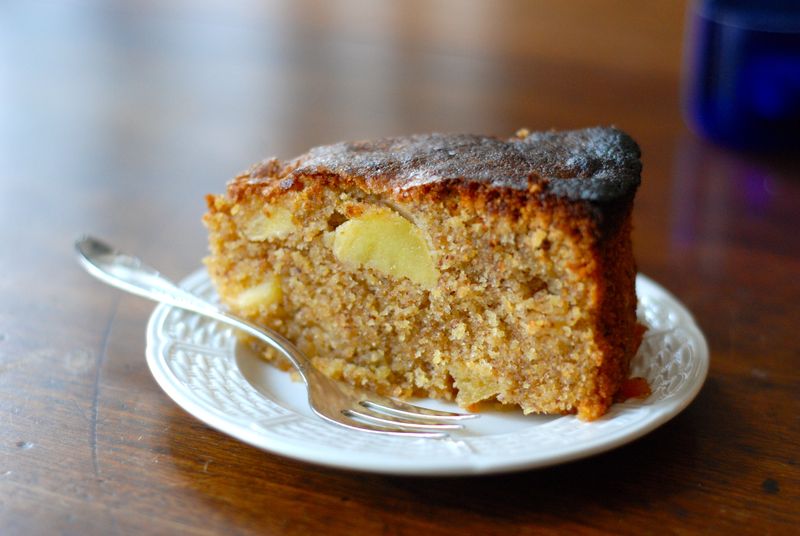
    That slice of cake up there. Looks so innocent, so pure. Right? Rustic, grainy, apple-studded; why it couldn't harm a fly if it tried.

    Yeah. Except, let me tell you. This rustic, grainy, apple-studded cake is one two-faced little minx. Underneath that homely interior is a cleavage-flashing, loose-morals-toting, floozy of a cake, capable of reducing grown men to quivering fools and accomplished bakers to white-flag-waving quitters.

    It even made my electric mixer start to smoke.

    DSC_6128

    It starts out innocently enough. A bowl full of almond meal, fragrant and nubbly, whole-wheat flour, sunny cornmeal and a bit of all-purpose for good measure.

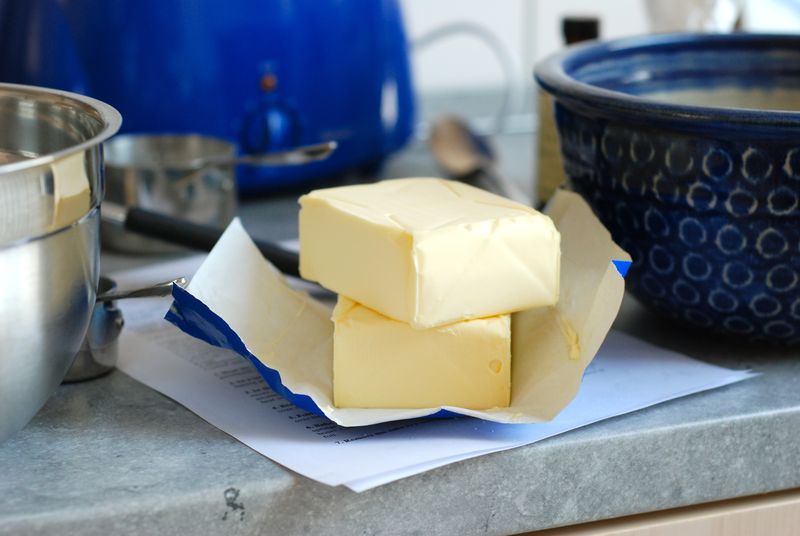
    And then, bam!, along comes one whole pound of butter (breathe, breathe) plus a whole pound of sugar (see what I mean?) and Eight. Whole. Eggs. to drag that bowl of good intentions right down a one-way street to damnation.

    DSC_6134

    If you, like me, are using an electric mixer that predates your birth, I'd advise you to skip this recipe unless you like it when the motor begins to emit a high whine, then a thin stream of smoke and then becomes uncomfortably hot in your hands. I don't ever actively wish I had a stand mixer (counter space real estate is precious, no matter what city I live in), but this cake changed all that. In a flash.

    Strumpet!

    Also, you're going to need the biggest bowl you own for this cake, along with the biggest pan you can muster. This cake, man. Take it from me, it's like a baby kitten that looks all sweet and tiny at the pound and then grows up to be a coon cat, capable of opening sliding doors with handles once fully grown.*

    I'm just trying to warn you, is all. I guess I was forewarned, too, what with phrases like "unabashedly rich" and "no shortage of butter" rolling around the description of Huckleberry's apple butter cake, but I must not have been paying attention or something. Or, more likely, I let myself get snowed by all those virtuous other ingredients. (Baby kitten eyes.) I can be so naive.

    DSC_6156

    This cake is the biggest, baddest thing I've baked in a while. It is intensely rich and not for the faint of heart. In fact, I think it should come with a warning sign: "Only to be eaten in slices less than 0.5 inches in thickness." Any bigger than that and you'll be fighting with the food sweats before you're done with one slice. Take it from me; I actually saw this happen.

    The cake does also happen to be delicious. Which is nice. The texture is wonderful, grainy, toothsome and firm, and the moist little pockets of cooked apple are a welcome relief. In fact, the cake could even handle a little more apple than called for in the original recipe (noted below). Nutty and sweet (you should leave off the sugar topping, also noted below), the vanilla notes really pop between all those apples and butter. Hoo boy, this most definitely is not your average simple apple cake.

    Keep it filed away for those days when you've got to bake for a crowd, when you know you'll have at least 10 eaters to help whittle away the enormous, buttery, burnished round. Or, you know, if you're surreptitiously trying to kill your oldest kitchen appliance so that you simply have no choice but to buy a shiny new stand mixer. Or! If you're entering a contest for Foxiest Apple Cake Ever. You'd totally win. Totally.

    *True story!

    Whole-Wheat Apple Butter Cake
    Makes 1 10-inch cake

    Cooked apples

    2 tablespoons butter
    1.5 to 2 pounds apples, peeled and cut into large chunks (about 4 or 5 cups)
    1/4 cup sugar
    1/4 teaspoon salt

    In a large sauté pan, melt the butter over medium heat. Stir in the apples, then the sugar and salt, tossing to coat completely. Cook, stirring often, until the apples are just softened, about 6 minutes. Remove from heat and spread out the apples on a rimmed baking sheet to stop the cooking process. Set aside to cool.

    Cake assembly

    2 cups (7 ounces) almond meal
    1 cup (4.5 ounces) whole-wheat flour
    3/4 cup plus 1 tablespoon (3.5 ounces) all-purpose flour
    1/2 cup plus 1 tablespoon (2.5 ounces) cornmeal
    2 1/4 teaspoons baking powder
    2 1/2 teaspoons salt
    1 pound butter
    2 1/4 cups (1 pound) sugar
    8 eggs
    2 tablespoons vanilla extract
    Cooked apples

    1. Heat the oven to 350 degrees. Grease a 10-by-3-inch round cake pan and line bottom with parchment paper.

    2. In a large bowl, sift together the almond meal, whole-wheat flour, all-purpose flour, cornmeal, baking powder and salt. Set aside.

    3. In the bowl of a stand mixer using the paddle attachment, or in a large bowl using an electric mixer, beat the butter until softened. With the mixer going, beat in 1 pound sugar until the mixture is light and fluffy, 3 to 5 minutes. Beat in the eggs, one at a time, until combined, then beat in the vanilla.

    4. Beat in the dry ingredients, a spoonful at a time, just until incorporated. Be careful not to over-mix.

    5. Fold in the cooked apples by hand. Spoon the mixture into the prepared cake pan.

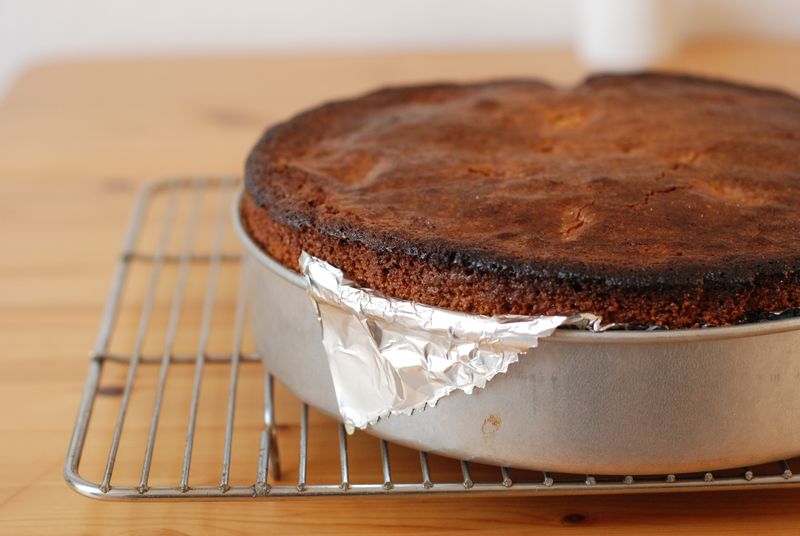
    6. Bake the cake in the center of the oven until the cake is risen and a rich golden brown on top, springs back when touched, and a toothpick inserted in the center comes out clean, about 11/2 hours. Check the cake after 1 hour; if it browns too quickly, loosely tent the top with a piece of foil.

    7. Remove the cake to a rack. Cool for 15 minutes before removing the cake.

  • DSC_6113

    I found myself staring into the salad plate today at lunch, wishing I had a silk shirt in exactly the color of that vinaigrette. Or maybe a stiff little canvas skirt with a bit of swing, perfect with tucked-in white tee-shirts and flat sandals. Better yet, a wedding bouquet made of peonies in this hue, or a little nosegay of ranunculus, my very favorites.

    This winter has dragged on long enough when you start seeing your spring wardrobe in the communal salad plate, methinks. And cruelly, a few weeks ago, while New York was still digging out from under all their snow, we actually had warm winds and bright sun. It felt like spring and, leaning out of my bedroom window one morning, I saw buds on the majestic chestnut tree that lives in our courtyard and whose branches frame the morning sky for me every day. But then, in one fell swoop, Arctic winds and their accompanying temperatures befell us again.

    But you know what those Arctic winds brought along with them, besides the cold wind? A whole lot of sunshine, every day this week. Which puts me in the very odd position of actually being grateful for something so cold that it sears the top layer off my skin every day.

    DSC_6109

    You know what else is nice? Discovering a new salad to eat multiple times a week. I found this one the other night when we had friends over for dinner. Another dinner party, yes! But I stuck to my guns and made only what I wanted to eat, which happened to be a cauliflower soufflé (after making this one in London last weekend with one of my besties and realizing just how awesome a soufflé dinner can be) and apple strudel with softly whipped cream flavored with vanilla sugar for dessert. We needed something cleansing and astringent between those two knockouts and I found the very thing nestled in the front pages of The Canal House's third volume, Winter & Spring.

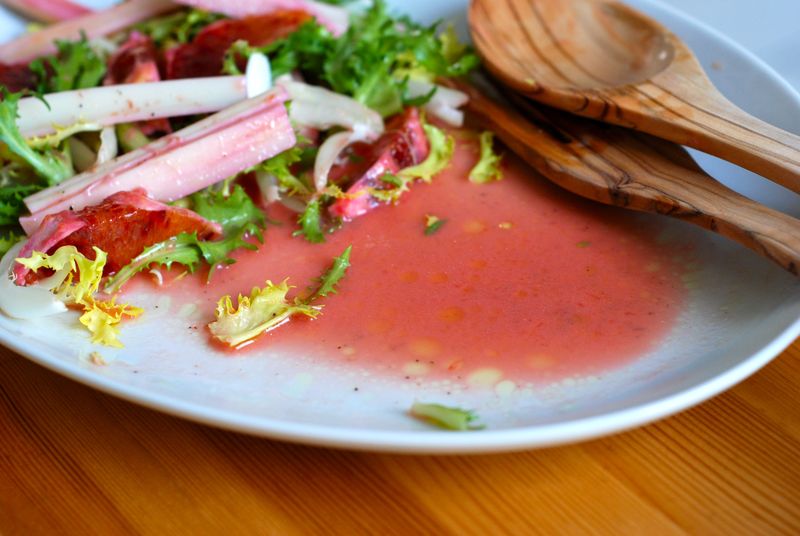
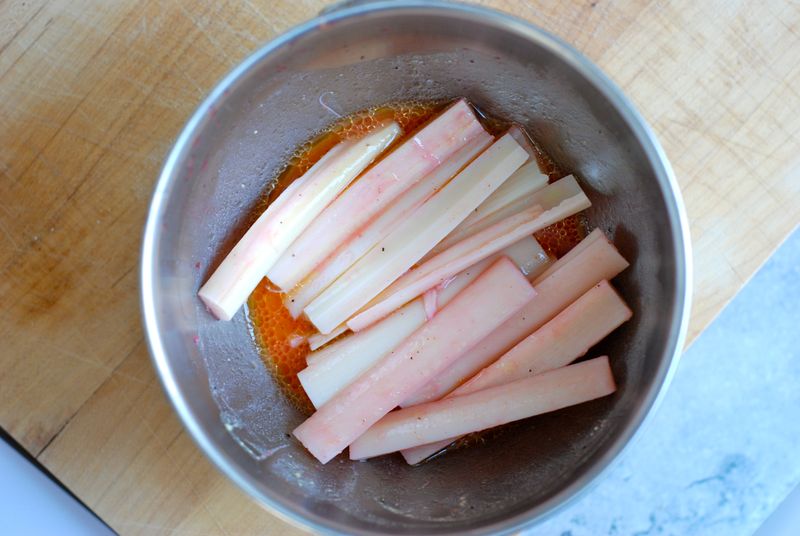
    You buy a jar of hearts of palm, locavorism be damned, a few blood oranges, which – now that I live just north of Italy – I feel I can eat with aplomb, and a head of frisée. Then you marinate the hearts of palm, ivory batons quartered lengthwise, in a vinaigrette made of little else besides mustard and blood orange juice and olive oil. Mixing it together, you'll see that lush pinkness swirl into existence. You might, like me, have to restrain yourself from using this as a dye.

    DSC_6099

    You cut little suprêmes from the oranges, meaning you hold a peeled orange gently in the palm of your hand and then, using a sharp knife and some care, you carefully slice the segments of the orange out from between their connective membranes. This is the fancy way of using oranges in this salad. If this seems like far too much fuss, you can also just peel the orange and cut it into slices crosswise. But there was something meditative and peaceful about the suprêming for me. I've spent all week in a fog of work and taxes and dirty sweatpants; standing over the counter cutting an orange into pretty segments was the most glamorous I got all week.

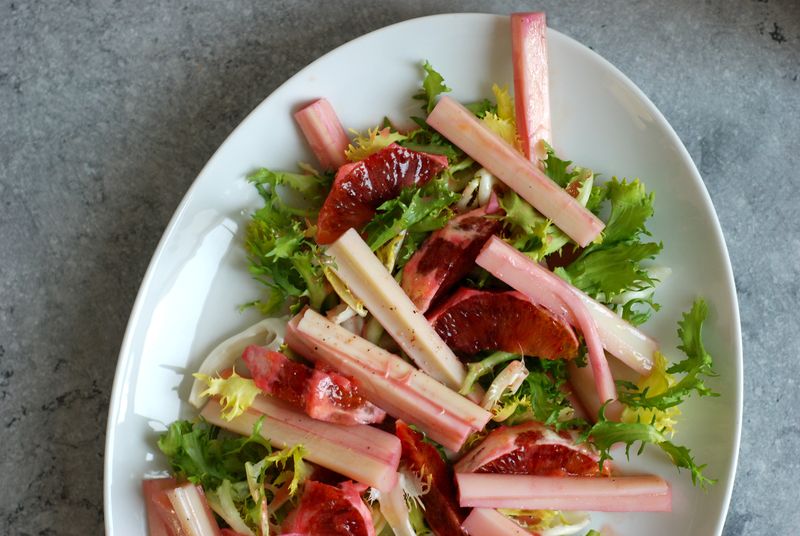
    That's really the hardest work, anyway. You put the washed and dried frisée (I like to rip it into bite-sized pieces) on a plate or in a bowl and then arrange the hearts of palm, stained the palest pink, and the orange segments on the salad, before drizzling the lot with the gorgeous vinaigrette. The hearts of palm, if you've never had them, feel squeaky and velvety at the same time under your teeth and work to tame the edge of the blood oranges and the bite of the frisée. They soak up the vinaigrette, transforming into the mildest of pickles, and are simply a joy to eat.

    It's such a simple little combination, but a welcome change from the usual soft lettuce-orange-avocado salad that I rely on in winter. This one's a little spunkier and a little more bitter, which I love. It's a winter salad with what I like to think of as a Caribbean soul. And will miracles never cease: I even found myself thinking, as I crunched through lunch today, that winter can stay a little longer, as long as it keeps us rich in hearts of palm and blood oranges.

    Hearts of Palm and Blood Orange Salad
    Serves 4

    2 blood oranges
    1/2 teaspoon Dijon mustard
    1 tablespoon fresh lemon juice
    Salt and pepper
    3 to 4 tablespoons extra-virgin olive oil
    1 teaspoon red wine vinegar, optional
    1 jar (14.8 ounces) hearts of palm, drained and quartered lengthwise
    Small head frisée lettuce

    1. Working with one orange at a time, peel the fruit, taking care to remove most of the pith. Working over a bowl, slice the orange into segments, letting the segments and juice fall into the bowl. Squeeze any juice from the leftovers in your hand into the bowl.

    2. Stir the mustard and lemon juice together in a wide bowl. Add some salt and pepper to taste, then stir in the reserved blood orange juice. Whisk in the olive oil. Taste for seasoning and add the vinegar, if using. Add the hearts of palm to the bowl and gently turn them in the vinaigrette. Set aside to marinate.

    3. Arrange the frisée on a serving plate or in a bowl. Place the hearts of palm and orange segments over the frisée and drizzle with the vinaigrette. Drizzle a little more olive oil over the salad and serve.

  • DSC_5943

    I made chicken stock the other day. Trudged down to the butcher to buy two organic soup chickens from France, ankles bound indelicately, skin cast in a yellowish hue. Passed the grocer on the way back home where I found wilting soup greens, as the Germans call that bundle of aromatics made up of two halves of a leek, a carrot, a slice of celery root and a spray of parsley tied together, in the dark recesses of a shelf close to the floor. At home again, I sliced an onion in half and charred each side in a pot with no oil, as every German recipe for chicken stock will instruct you to do, then filled up the pot with cold water, peppercorns, the yellow French chickens, bay leaves from my mother's garden in Italy and the soup greens, washed and peeled as best I could, plus a little bundled bouquet garni. The pot simmered away for hours, clouding up the kitchen windows, making the kitchen and my office smell like a Jewish grandmother's house.

    The stock lasted us all week. A ladleful in risotto here, a golden puddle with tiny semolina dumplings there, a jar for my mother, a container in the freezer. If I had a bigger freezer, I'd make stock once a month. There's something so elemental about cooking it (and if you have two chickens floating in the broth, you can salvage one after an hour to actually eat, dipped into HP Fruity sauce, for example, my little guilty pleasure) and finding yourself supplied with the groundwork for a great many delicious meals.

    DSC_5933

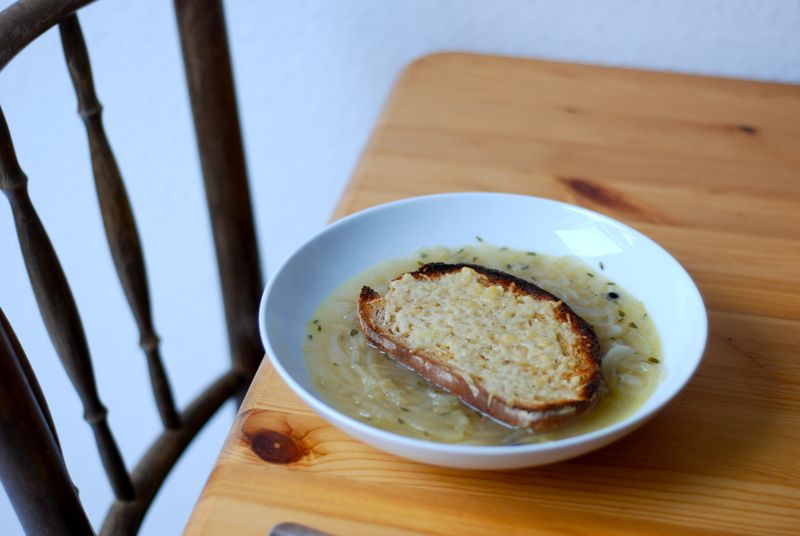
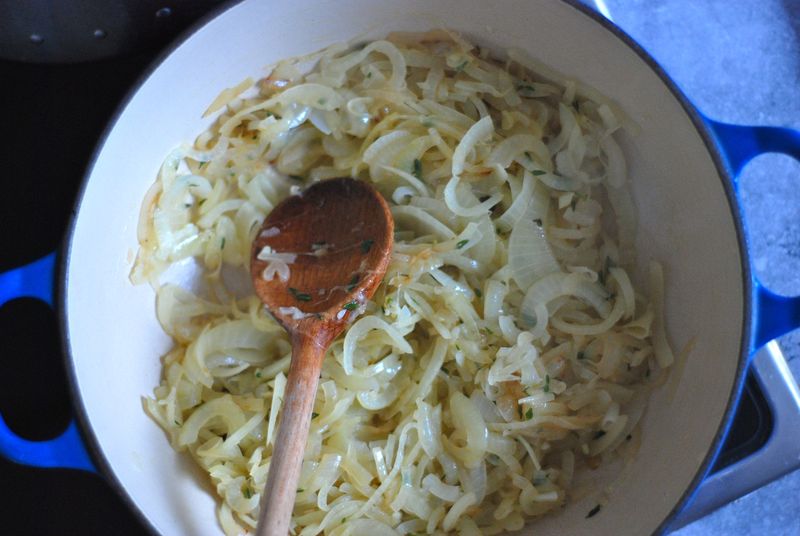
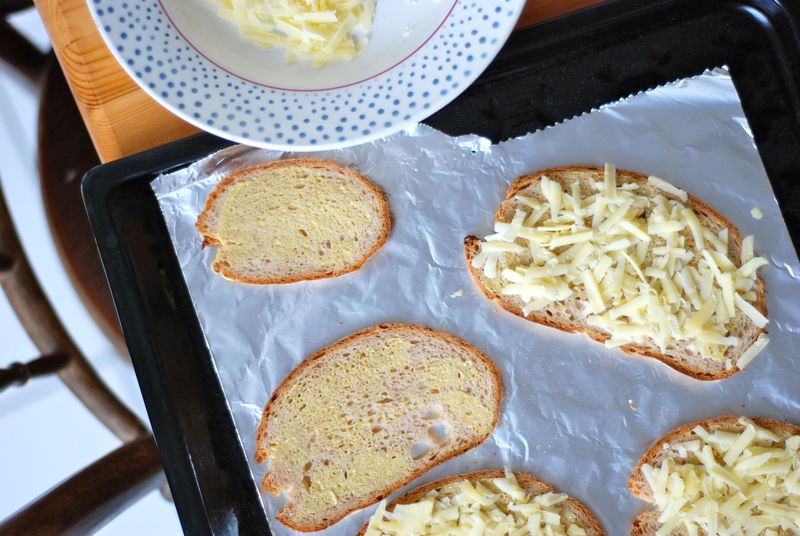
    The other day at lunch, inspired by a recipe from a German cooking magazine called essen & trinken, I sliced a small pile of onions thinly and cooked them in a little olive oil along with some unusal aromatics (star anise, juniper berries) until they were soft and translucent and going pale brown in the pan. A few sprigs of thyme from the balcony gave the onions an herbal touch. After a while, I poured a glug of dry white wine to deglaze the onions, then filled up the pot with some ladlefuls of chicken stock and let everything simmer away for a little while, while I sliced bread and spread the slices thinly with mustard before showering them with a carpet of grated Gruyère cheese. Under the broiler the bread slices went, until the edges were crisp and browning quickly and the cheese had melted and blistered in the heat.

    I filled each soup plate with onion soup, then floated a toasted cheese tartine on top. The soup softened the bread, turning the bottom-side custardy and easy enough to cut with a spoon. We slurped away as carefully as we could, marveling at the depth of sweetness in the soup, crunching away at the edges of the toasts before they sogged entirely.

    DSC_5937

    You always dream, when you work in an office, of being free one day, free to work in your pyjamas, free to be your own boss. It's a misleading little daydream, because the truth is that working from home for yourself is so much harder than being in an office. At least it is for me. I miss my commute to work, my colleagues, my office uniform. I spend too much time in my own head at home, feel far more oppressed under my own expectations of myself than I did under any employer. But in one respect, working from home really does beat everything else and that is the luxury of being able to emerge from the fog of work to cook my own lunch. To spend a half hour standing over the stove in the middle of the day, making a little salad, setting the table for the two of us, is bliss.

    In a few months, our lunchtime ritual is going to change. Max will be working far away during the week and I'll be left to my own devices, probably sentenced to a great many peanut butter sandwiches at midday. It's just not as much fun to cook for yourself than it is when you're sharing a meal, is it? That seems to be one of the great truths of a cook's life. So until then, I'm counting my blessings, boiling chickens and making onion soup.

    Simple Onion Soup
    Serves 2 for lunch

    3-4 tablespoons olive oil
    5 medium yellow onions, cut in half and sliced thinly
    1 star anise
    A few stalks of fresh thyme, minced
    10 juniper berries
    1/4 cup (100 ml) dry white wine
    4 1/4 cups (1 liter) chicken stock
    Salt, pepper
    4 slices country bread
    Dijon mustard
    Gruyère

    1. Put the oil in a heavy saucepan over medium heat and cook the onions, star anise, thyme and juniper berries slowly in the oil for 20 minutes, until the onions are limp, silky and starting to turn brown. Deglaze with the wine and let most of the alcohol cook off, stirring occasionally. Season with salt and pepper to taste. Pour in the chicken stock and let the soup simmer for another 20 minutes.

    2. Spread each slice of bread very thinly with mustard and top with a layer of grated Gruyère. Put the cheese toasts on an aluminum foil-lined baking sheet and slide under the broiler in your oven for a few minutes, just until the cheese is blistered and melting and the edges of the bread are toasted.

    3. Ladle the soup into deep soup plates and top each plate with a cheese toast. Serve immediately.

  • DSC_5906

    I've been lucky enough to eat a real pizza napoletana on a sidewalk in Naples, scarcely bigger than my two palms put together. Milky mozzarella bleeding into fruity, clean tomato sauce; heaven in three, four bites, gone as quickly as it came. I had the best pizza of my life at Pizzeria Mozza in Los Angeles, that sunswept, palm-studded city that so many New Yorkers love to hate, but that – deep inside my soul, my heart – feels like home to me. I loved the weird little pizzas at City Bakery before they started baking them on puff pastry; greasy slices in lieu of a proper dinner from the one-dollar joint down the street from my office; the glorious, glorious pies at Co. on 9th Avenue. And pizza al taglio is on my (very short) list of things you should eat before you die.

    Even for my birthday dinner in December, I had just one request: pizza, please. And a beer. (We went to Casolare, a grungy little restaurant by the side of a canal in Kreuzberg which serves pizza that is very good and on occasion so great that a slim young man with, yes, an oftentimes above-average appetite, can eat two entire pies by himself in one sitting. Ahem. As God is my witness. Also! It's a good place for people watching: last summer, I saw half the cast of Inglourious Basterds having dinner in the back of the restaurant.)

    In other words, I like pizza a lot. Probably like most of you out there, too. And there was a time when I let myself get swept up in the insanity that surrounds making pizza at home these days. You know, like cooking a pizza under the broiler on an upside-down cast-iron pan. Dealing with the weight of a pizza stone. Letting pizza dough proof for 24 hours for maximum flavor. Collecting recipes from pizzaioli far and wide to read about their favorite toppings. Sourcing Italian flour for the most authentic texture possible.

    And then I got so tired of it all. I realized that I didn't actually want to recreate my favorite restaurant pizza at home. I wanted to go to a restaurant and pay to be fed that pizza. At home, I was happy with a pizza made in less than two hours, with a chewy, flavorful crust and toppings I could calibrate myself. Turns out, when you let go and stop trying to create restaurant results in a home kitchen, you can find yourself making some pretty stellar pizza. It's just a matter of realizing that the two are totally different things.

    My favorite, holy grail dough is Jamie Oliver's pizza dough. It comes together in a flash and has the most incredible, floppy texture which translates to loose bubbles and a gorgeous, burnished bottom after a pass in the oven. Jamie's original recipe makes an enormous amount of dough so I halve it and between the two of us we usually manage to polish it off (did I mention the above-average appetite?). I don't bother using "00" flour or bread flour or the mixture of regular flour and semolina that he suggests. I use plain, old all-purpose flour with delicious, chewy results. Also, what I'm using here in Berlin is actually instant yeast and not active dry yeast since it can be added directly to the ingredients without needing to be proofed first. Score! One less thing to wash up afterwards. As for you, just use whatever yeast you've got.

    DSC_5895

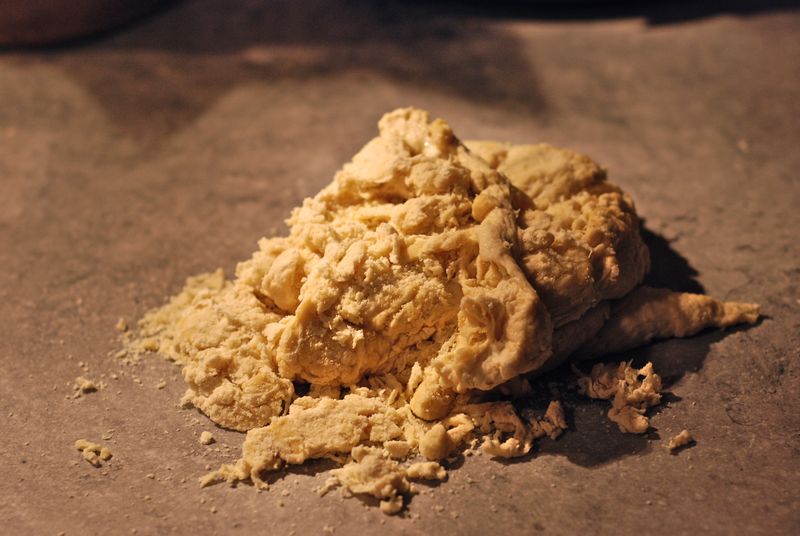
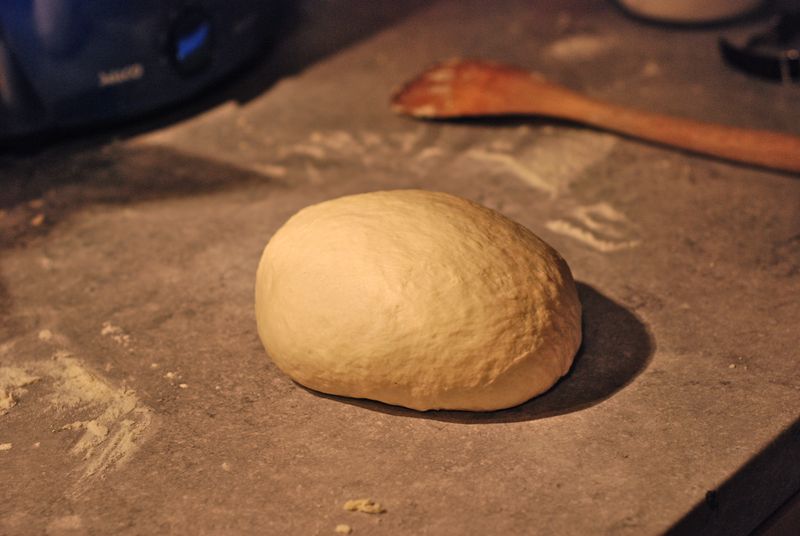
    You start out by making a rather shaggy mixture of flour, yeast, a bit of sugar, warm water, some olive oil and salt in a bowl. I stir this as best I can and then I give up, dumping the shaggy mess on the counter to knead it properly. Within a few minutes, I get a satiny-smooth, cool ball of dough. I let this rest while I quickly wash out the bowl, dry it and coat with a thin, thin film of olive oil.

    DSC_5899

    The ball of pizza dough goes into the bowl, I turn it lightly to coat it with the oil in the bowl and then I cover it with a cloth and slide it into my still-cold oven for one hour. That's it. Enough to finish up work, make a salad, shred a ball of mozzarella, and set the table.

    After an hour, I gently coax the dough – now puffed and fluffy – out of the bowl onto the floured counter. This may be one of my favorite things to do in the kitchen, handle freshly risen dough. It's so pure and expectant, somehow. And the texture of the dough is always so improbably light and bubbly. Plus, it smells like yeast and olive oil, which is a direct catapult to standing in the doorway of my favorite hole-in-the-wall pizza place in Urbino. At this point, I also turn on the oven as high as it will go.

    DSC_5907

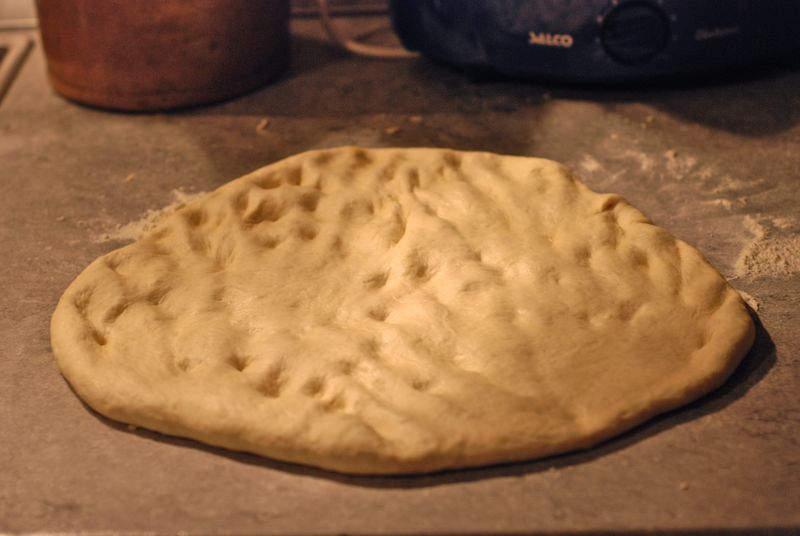
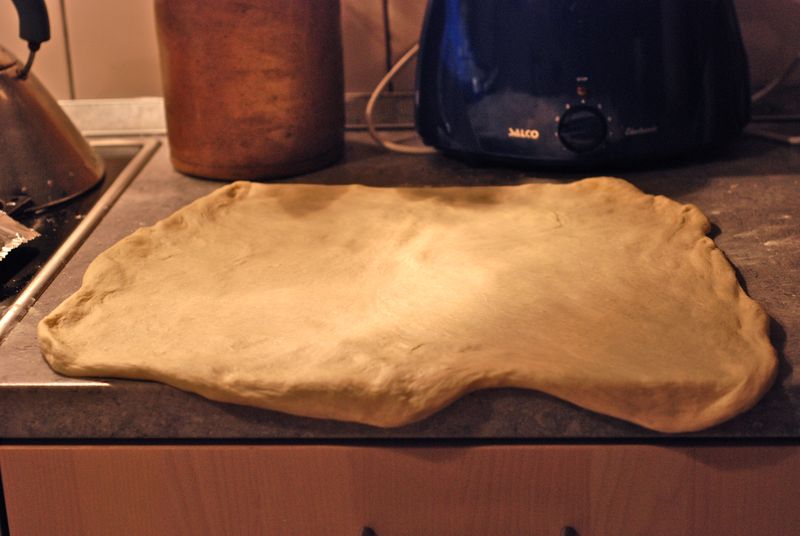
    I gently pat out the dough and it dimples agreeably under the pressure of my hands and then I gently, gently start to tug it into the shape I need for my sheet pan. I don't like to roll this dough – the light and puffy quality it has now will translate to a wonderfully blistered and airy crust in a few minutes – and besides, it is so easy to handle that it will flatten out with just a few judicious tugs and pats. If you like a thicker crust, pat the dough to fit your sheet pan (lined with oil-slicked aluminum foil). If you like a thinner crust, divide the dough in two and fit two sheet pans with it. You might find you'll need a rolling pin if you're aiming for a thin, thin crust. Or divide the dough into balls for individual pizzas.

    DSC_5911

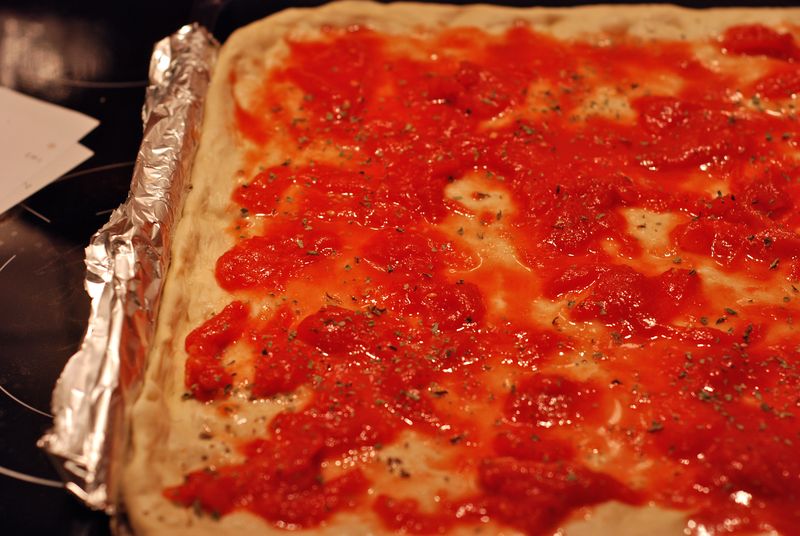
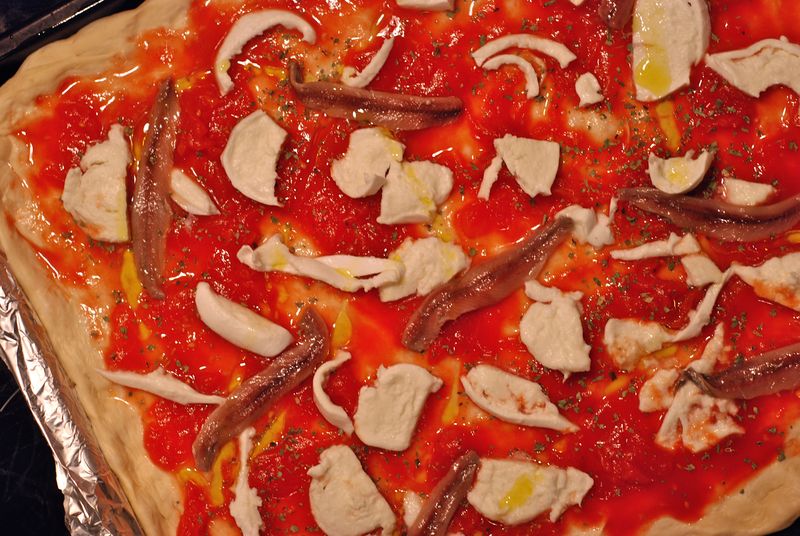
    For the topping, since we are purists and never stray from the classic trinity of tomato-mozzarella-anchovy, I open a can of peeled plum tomatoes, pour out half the juice (cook's snack!) and then, using my hands, shred and spread the tomatoes and remaining pulp and juice around on the dough evenly. I salt the tomato layer liberally and sprinkle with with dried oregano (make sure it's from Italy or Greece and it'll taste even better) and then strew the mozzarella I shredded earlier around evenly (don't use buffalo mozzarella as it's too wet and also a bit of a waste if not eaten whilst fresh and cool on your plate). I lay six to eight  anchovies in and around the cheese, give the pizza a quick drizzle of olive oil and then it's ready to go in the oven. My broiler is in my oven, not below it, so I put the pan in the top third of the oven and turn the broiler on. The uncooked tomatoes cook briefly while the flavor stays fresh and vibrant. (If you choose the thick pizza route and do this, you'll come uncommonly close to replicating my beloved pizza al taglio.) The cheese blisters and browns, the crust swells up, my stomach growls.

    And that, quite literally, is it.

    DSC_5915

    It always amazes me how quickly pizza can be made at home. Everything except the mozzarella is a pantry staple, really, and with just a few minutes of active work and ten minutes in the oven, you'll find yourself the proud producer of an ovenful of fresh, crusty pizza that's yeasty and salty and chewy and a total delight to eat.

    So now, tell me, lovelies: how do you top your pizzas?

    Pizza Dough
    Makes enough for one half-sheet pan (if you like a thicker-crusted pizza) or two half sheet pans if you like your pizza thin as can be)

    3 1/2 cups (1 lb) all-purpose flour (if you can find it, use Italian "00" flour)
    1 1/2 to 2 teaspoons fine sea salt (you might find you need more)
    1 packet (1/4 ounce) active dry yeast or 7 grams instant yeast (for those of you in Germany, this is one of those Trockenhefe packets)
    1 1/2 teaspoons raw or regular sugar
    2 tablespoons olive oil
    1 1/4 cups lukewarm water

    1. Put the flour into a large bowl and make a well in the middle. In a large measuring cup, mix the yeast, sugar and olive oil into the water and leave for a few minutes, then pour into the well. Using a fork, bring the flour in gradually from the sides and swirl it into the liquid. Sprinkle in the salt. Keep mixing, drawing larger amounts of flour in, and when it all starts to come together, work the rest of the flour in with your clean, flour-dusted hands. Knead until you have a smooth, springy dough.

    2. Wash out your bowl, dry it and oil it lightly. Place the ball of dough in the bowl and turn to coat it with oil. Cover the bowl with a damp cloth and place in a warm room or an oven (not turned on) for about an hour. The dough will have doubled in size.

    3. Now put the dough on a flour-dusted surface and gently deflate it with your hands – this is called punching down the dough. You can either use it immediately, or keep it, wrapped in plastic wrap, in the fridge (or freezer) until required. If using right away, simply pat out to the size of your half-sheet pan or divide in half and roll out to cover two pans. You can also divide the dough into little balls for individual  pizzas – this amount of dough is enough to make about three to four medium pizzas.

    4. Timing-wise, it's a good idea to roll the pizzas out about 15 to 20 minutes before you want to cook them. Then simply top them with your heart's desire and bake them in a very hot, preheated oven (turn your oven as high as it will go) for about 10 minutes for the thicker pizza and less for the thinner ones, until crisp and bubbling.

  • DSC_5728

    I had a dinner party a few months ago in which everything sort of felt wrong. Not in the way you'd think – my guests ate everything I cooked (two chickens! multiple pounds of vegetables! an entire cake! a whole liter of whipped cream! six poached quince!) and there were no leftovers. But – has this happened to you? – when I sat down to eat dinner with our guests I looked down at my plate and thought, "I don't want to eat any of this".

    It wasn't that the food didn't taste good, I guess. It's just that – and I'm having a hard time expressing just exactly what I mean, so bear with me here – it all felt so…strained, my relationship with what I'd cooked, I mean. I'd expended a lot of time and energy on planning the dinner and cooking the dinner and then once the food was in front of me it just felt so foreign, so far away from what I actually wanted to eat, from the things that make my mouth water. It was a sort of upsetting moment – to be surrounded by nine other people kindly devouring all that was laid before them and to feel so estranged from their experience and from the very food I'd spent all day working on.

    Does this sound totally trite? I actually wrote a whole long post about that evening, so long that I thought about turning it into a chapter for the book, but in the end I couldn't figure out just exactly how to work it in or how to express myself, really. I mean: I threw a dinner party! The guests loved it! I wished I could have had a peanut butter sandwich instead! What?

    For as long as I've been cooking in my own home, when time came to plan a dinner party, I'd spend days poring over cookbooks, trying to put together a menu that made sense (as old-fashioned as it may be, I adore cookbooks that include menu suggestions) and that would be a step up from the usual stuff I eat. But after that fatal dinner party I decided that I needed to approach menu planning differently. I needed to think about what I wanted to eat, first and foremost, when I had guests over. Does that sound like the most obvious thing ever? To me it wasn't.

    DSC_5719

    After the dinner party that made me lose my appetite, I decided that, actually, we eat pretty darn well around here when it's just the two of us. Why, when you get down to brass tacks, should we change that winning formula just because we have people coming over? In fact, wouldn't that be just the moment to stick with the greatest hits that make us happy, dinner guests or no dinner guests?

    And so, to celebrate my mother's birthday last week, along with several of her closest friends and my dad, we threw a dinner party with food so good, and so familiar, I wished I could have had thirds.

    Instead of wracking my brains to come up with a special menu, I decided to stay simple. I'd made Judy Rodgers's chard panade many times before just for the two of us and fell in love with it a little bit more each time. When I thought about my mother's birthday, I couldn't stop thinking about that panade. It felt like the perfect January meal – meatless yet still full of richness and flavor, shot through with dark greens for our mind, a little cheese for our soul. Simple yet celebratory.

    I decided to eschew an appetizer and serve a salad on its own, as a second course, so to speak. Soft butter lettuce and mâche were tossed with cubed avocados and slices of juicy oranges, bound together with a shallot vinaigrette from the Zuni Cafe cookbook, which is where the panade recipe is also from. We had a few good bottles of red wine to pass around and then, for dessert, a simple chocolate mousse from Dorie's new book.

    The dinner was a huge success. People took seconds, thirds, licked their plates, and – thrillingly – I joined in. It felt so easy, so effortless. And my mother, a tough critic, was still raving about the celebration days later.

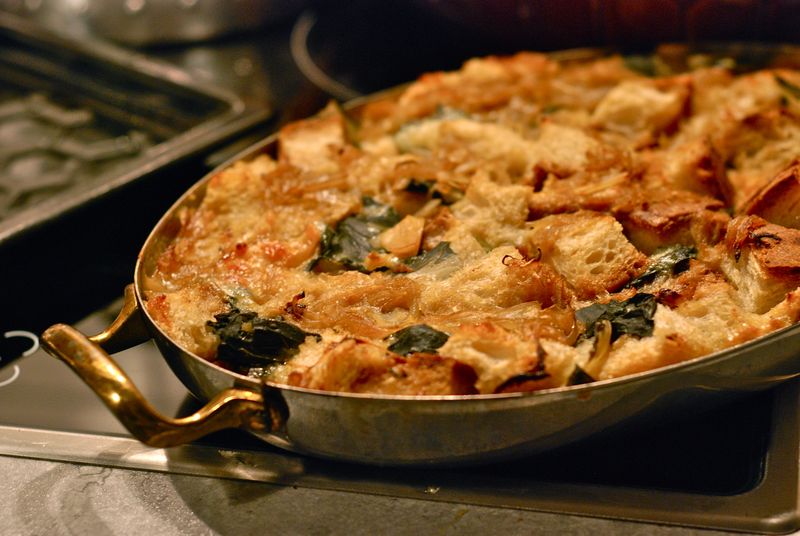
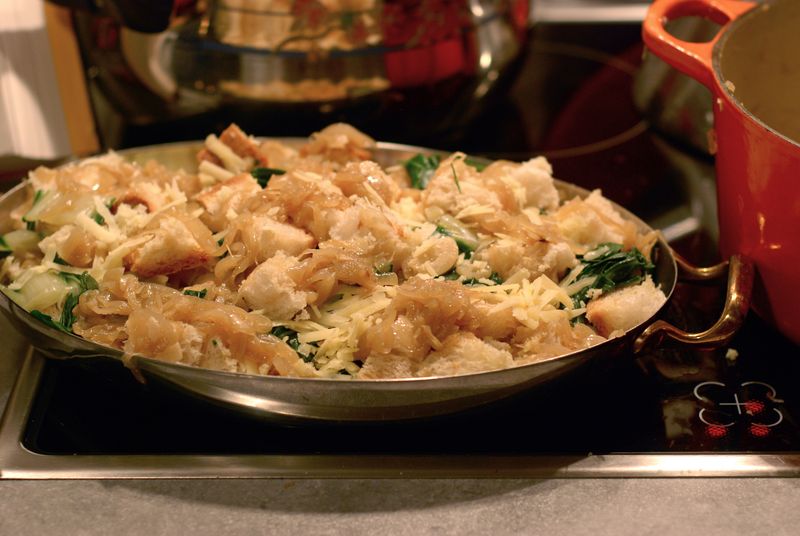
    If you haven't yet had the pleasure of knowing panade, it's a cross between a gratin and a bread pudding, but only sort of. You cook a whole mess of onions until meltingly soft and amber-hued. You cube stale peasant bread and toss it with salt and olive oil and a little bit of chicken stock. You sauté Swiss chard until barely limp and still vibrantly green. You grate a tiny mountain of fragrant Gruyère. And then you get to work, layering all four elements over and over until the baking dish is entirely filled. You soak the whole thing with good chicken stock (seriously, homemade stock pushes this dish into the sublime) and then bake it very slowly in the oven until it's plush and satiny, almost wobbling, the top crusted perfectly.

    Peasant food for the gods, if you will. And just the thing to make a hostess who, in truth, really does love throwing dinner parties, feel like a million dollars again.

    Chard and Onion Panade
    Serves 4 as a main course or 8 as a side dish

    1 1/2 pounds thinly sliced yellow onions
    Up to 1/2 cup mild-tasting olive oil
    6 cloves garlic, thinly sliced
    Salt
    1 pound Swiss chard (thick ribs removed), cut into 1-inch-wide ribbons
    10 ounces day-old chewy peasant-style bread cut into rough 1-inch cubes
    Up to 4 cups chicken stock
    6 ounces Gruyère, coarsely grated

    1. Place the onions in a deep 4-quart saucepan and drizzle and toss with oil to coat, about 1/4 cup. Set over medium-high heat and, shimmying the pan occasionally, cook until the bottom layer of onions is slightly golden around the edges, about 3 minutes. Stir and repeat.

    2. Once the second layer of onions has colored, reduce the heat to low and stir in the garlic and a few pinches of salt. Stew, stirring occasionally, until the onions are a pale amber color and tender but not mushy, another 20 minutes or so. If at any point the onions look as if they may dry out, cover them to trap some of the moisture in the pan. Taste for salt. You should get about 2 1/4 cups cooked onions.

    3. Preheat the oven to 325 degrees (or as low as 250 degrees, if it suits your schedule to stretch the cooking time from about 1 hour 45 minutes to 2 hours 45 minutes; the slower the bake, the more unctuous and mellow the results).

    4. Wilt prepared chard in batches: Place a few handfuls of leaves in a 3-quart saute pan or a 10-to 12-inch skillet with a drizzle of oil, a sprinkling of water (if you've just washed the chard, it may have enough on the leaves), and a few pinches of salt. Set the pan over medium heat until the water begins to steam, then reduce the heat and stir and fold leaves until they are just wilted, 3 to 4 minutes. Leaves should be uniformly bright green, the white veins pliable (the veins will blacken later if they are not heated through). Taste. The chard may be slightly metallic-tasting at this point, but make sure it's salted to your taste. Set aside.

    5. Toss and massage the cubed bread with a few tablespoons of olive oil, a generous 1/4 cup of the stock and a few pinches of salt, to taste.

    6. Choose a flameproof, 3-quart souffle dish or enameled cast-iron Dutch oven. Assemble the panade in layers, starting with a generous smear of onions, followed by a loose mosaic of bread cubes, a second layer of onions, a wrinkled blanket of chard, and a handful of the cheese. Repeat, starting with bread, the onions and so on, until the dish is brimming. Aim for 2 to 3 layers of each component, then make sure the top layer displays a little of everything. Irregularity in the layers makes the final product more interesting and lovely. Drizzle with any remaining olive oil.

    7. Bring the remaining 3 3/4 cups stock to a simmer and taste for salt. Add stock slowly, in doses, around the edge of the dish. For a very juicy, soft panade, best served on its own, like a soup or risotto, add stock nearly to the rim; for a firm but succulent panade, nice as a side dish, fill to about 1 inch below the rim. Wait a minute for stock to be absorbed, then add more to return to the desired depth. The panade may rise a little as the bread swells.

    8. Set panade over low heat and bring to a simmer; look for bubbles around the edges (heating it here saves at least 30 minutes of oven time; it also means every panade you bake starts at the same temperature, so you can better predict total cooking times). Cover the top of the panade with parchment paper, then very loosely wrap the top and sides with foil. Place a separate sheet of foil under the panade or on the rack below it, to catch drips.

    9. Bake until the panade is piping hot and bubbly. It will rise a little, lifting the foil with it. The top should be pale golden in the center and slightly darker on the edges. This usually takes about 1 1/2 hours, but varies according to shape and material of baking dish and oven. (You can hold the panade for another hour or so; just reduce the temperature to 275 degrees until 20 minutes before serving.)

    10. Uncover panade, raise temperature to 375 degrees, and leave until golden brown on top, 10 to 20 minutes. (If you aren't quite ready when your panade is, re-tent the surface with parchment and foil and reduce the heat to 275 degrees. You can hold it another half hour this way without it overbrowning or drying out.) Slide a knife down the side of the dish and check the consistency of the panade. Beneath the crust, it should be very satiny and it should ooze liquid as you press against it with the blade of the knife. If it seems dry, add a few tablespoons simmering chicken stock and bake for 10 minutes longer.

  • DSC_5677

    In winter, Berlin's vegetable offerings can be bleak, but cauliflower is one of the few things for sale at green markets and grocery stores that stands proud and tall, creamy white within its tightly furled green leaves. I like it steamed and served with a lemon vinaigrette or cloaked in a creamy mustard-dotted béchamel, roasted in the oven with capers and parsley or stewed on the stove-top with anchovies and mashed into a silky pasta sauce. But I'd never really thought of it for soup the way I do when I see a squash or a leek. Then a single spoonful of an ethereal cauliflower soup at a restaurant in Paris made it difficult for me to concentrate on anything else, so a few days after getting back from our holiday, I got to work.

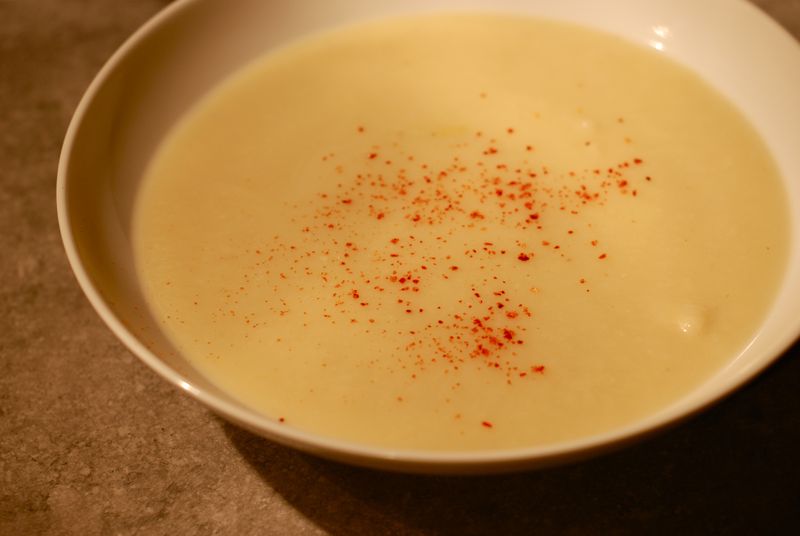
    Now, a word about appearances. Cauliflower soup will never win a beauty award. It will never enchant you with its looks. Unlike a glowing squash soup, for example, or a vivid spinach one, cauliflower soup is the quieter, younger cousin tending towards having bad posture. But that's kind of its appeal, too. It's quiet and unassuming, but deeply comforting and creamy (despite having nary of speck of dairy or animal fat in sight) and, actually, if dressed up in the right way – a sprinkling of Espelette pepper here, a pretty china plate there – it can be rather elegant.

    DSC_5694

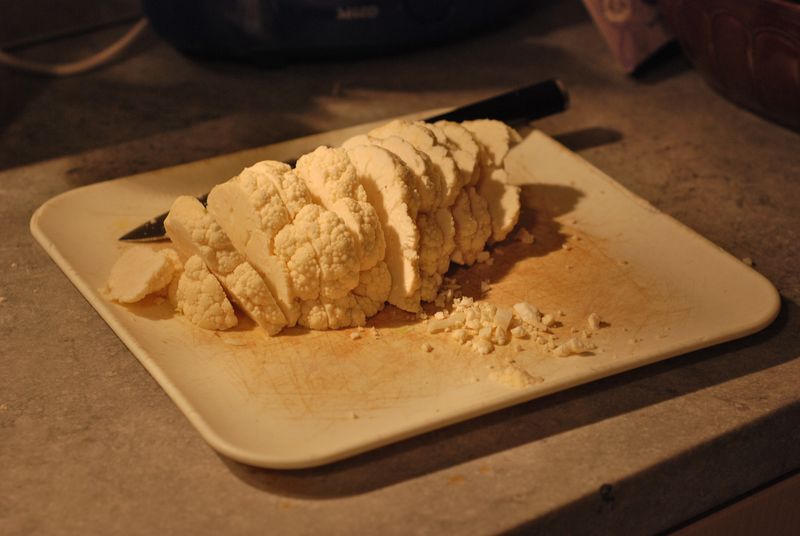
    Like all puréed vegetable soups, it barely requires a recipe. You stew a leek in olive oil until soft and translucent, though you could use an onion instead. You wash and slice your cauliflower roughly, tip the creamy florets into the pan for a little while, then add water and boil quietly until the cauliflower is soft and tender. What's important, I find, with cauliflower soup is that you must really lean on your immersion blender. You want the soup to be impossibly silky, free of the tiniest of lumps (unlike that little one lurking up there in the lower righthand corner). Purée until the soup takes on a gentle sheen and drips from the spoon like oil.

    Turn to your seasonings, which are nothing more than salt and half a lemon squeezed into the soup. For color, you can sprinkle piment d'Espelette on each serving, but it's hardly necessary. I like a few homemade croutons, chewy peasant bread that you've roasted with a little slick of olive oil and a sprinkling of salt in the oven for a while, floating on top. The crunch and toast are a nice contrast to that sweet, vegetal purée.

    Cauliflower Soup
    Serves 4 to 5

    1 leek or 1 onion
    3 tablespoons olive oil
    1 cauliflower, green leaves and trunk removed
    Water
    Salt
    1/2 lemon
    Piment d'Espelette, optional
    Homemade croutons, optional

    1. Peel and clean the leek and cut into thin slices, discarding the tough green tops. Warm olive oil in a heavy pot and gently sauté the leek in the olive oil until wilted, 5 to 7 minutes. In the meantime, wash the cauliflower and slice thickly. Add the cauliflower to the pot and stir to combine. After 2 to 3 minutes, add enough water to cover the vegetables.

    2. Bring the water to a boil, then lower the heat, cover the pot and simmer for 20 to 25 minutes. Remove from the heat and, using an immersion blender, purée until smooth and creamy. Add salt to taste and the juice of the 1/2 lemon.

    3. Serve dusted with piment d'Espelette or homemade croutons.

  • Shopping in Paris. Do you also have visions of impossibly chic little bags or dainty, bebowed shoes right now? A gossamer scarf or patent leather sandals? That used to be what I thought of when I thought about shopping in Paris. But then you start a food blog and write a book and spend most of your time at home in jeans or sweatpants, which makes shopping for clothes sort of lose its appeal at some point, and anyway, aren't French toast spreads and baking equipment so much more interesting than filmy blouses or St. Tropezian sandals? Aren't Monoprix, G. Detou and E.Dehillerin more thrilling than any Colette, Isabel Marant or Bon Marché? I thought you might agree.

    DSC_5632

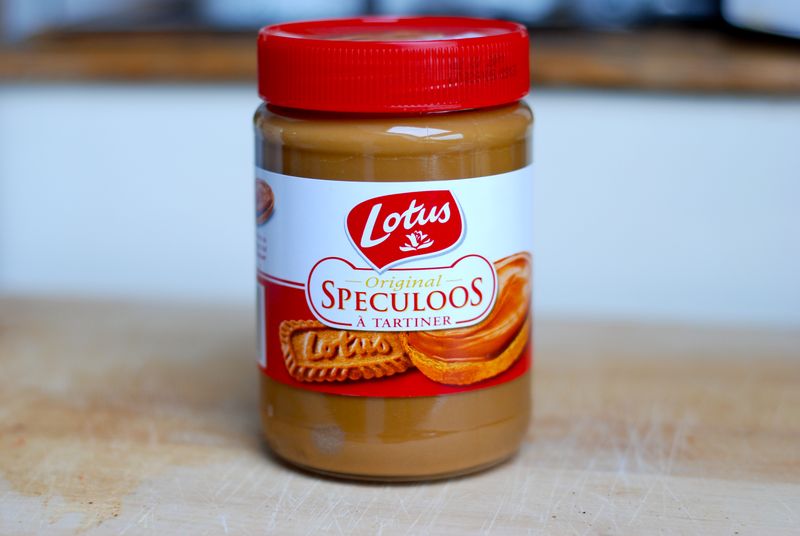
    I first heard about this spread that looks like peanut butter and tastes like molten Speculoos cookies from David and, to paraphrase him, holy cow, it is good. Buttery, toasty, not too sweet. Move over Nutella, indeed. You can find this at any chain grocery store for just a little over 2 euros. Expats in France! I have officially found your Christmas gift to all the members of your family and friends for the rest of your life.

    DSC_5636

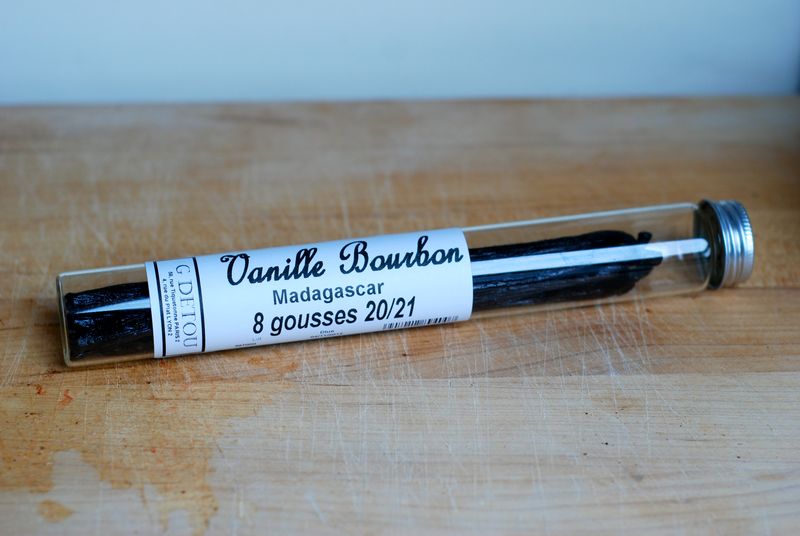
    G. Detou is one of those stores I had to move away from Paris to find out about – I think Chocolate & Zucchini was where I first read about this emporium for bakers, cooks and anyone in desperate need of industrial-sized packages of Valrhona chocolate. I bought a vial containing eight very plump, very fresh and moist vanilla beans for a whopping 6 euros and 40 cents, which – if you know your vanilla bean prices – is beyond a steal. They're practically giving them away! I'm going to use these for a fun project coming up soon that I can't wait to tell you about. One word: video.

    DSC_5642

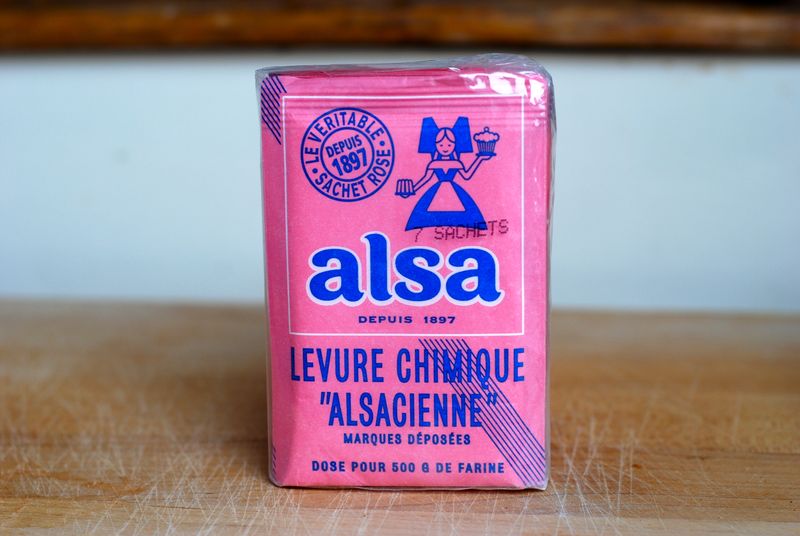
    I love weird packaging, I really do. This baking powder looks like it hasn't had a redesign since about 1951. And that pink! (Anyone know why the "Alsacienne" is in quotes? Is this levure meant only for Kugelhopf?)

    DSC_5640

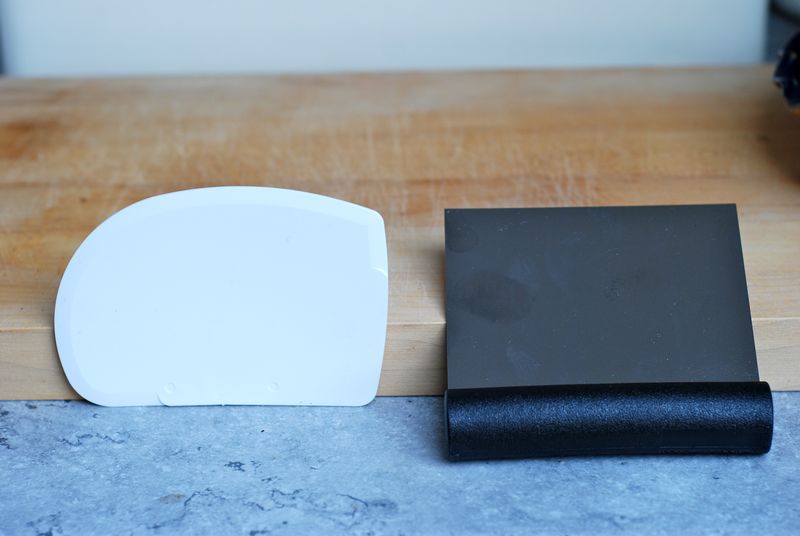
    At E.Dehillerin, I did an admirable job of performing restraint. Don't you think? I mean, I could have come out of there armed with more pastry rings than City Bakery could ever need, whisks for every size bowl I own, paring knives for an army, a vinegar vat, mustard crocks, not to even get started on the perfect copper bowls. Instead, I got a metal bench scraper and then, because Kim Boyce said so, a little plastic dough scraper. She uses them for scraping batter out of bowls or getting sticky dough off a counter and says she loves them more than fancy handbags or shoes. Isn't that sweet?

    DSC_5644

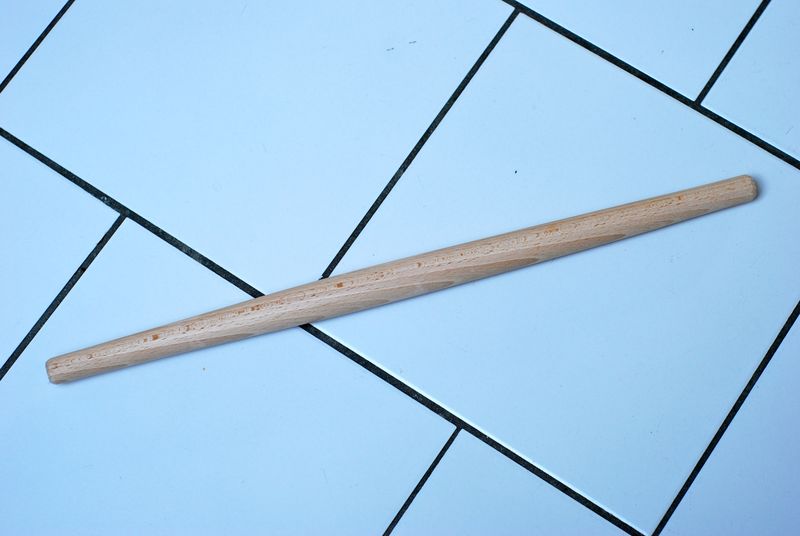
    And a tapered rolling pin. Because. It is beautiful. And smooth. And tapered. And beautiful. I was warned about the unfriendliness of the E.Dehillerin sales people and lo, they were indeed unpleasant. But a few minutes after leaving, beautiful rolling pin in hand, I'd mercifully forgotten all about them.

    DSC_5641

    At Fnac, where I could have spent hours poring over the cookbooks (Germany's cookbook sections in chain bookstores continue to be, for the most part, a demoralizing wasteland), I scored a cheap paperback copy of Christine Ferber's jam-making classic, Mes Confitures. There are so many recipes in this thing that I, quite possibly, may never need another jam book again. Shall we make a winter jam very soon? Yes? Yes.

    DSC_5656

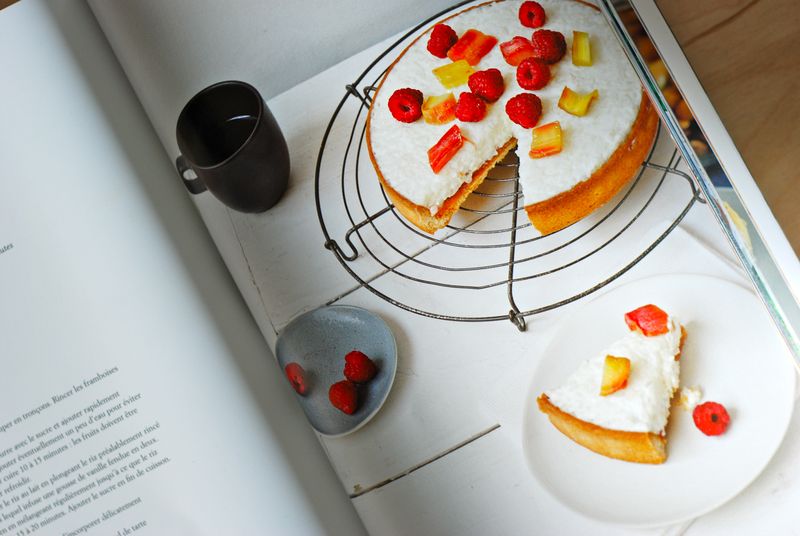
    And then, as I was leafing through Atelier Tartes by Catherine Kluger, my eye caught something wondrous: a rice pudding-rhubarb tart. Oh yes. Sweet tart pastry, fresh rhubarb filling, rice pudding on top. Rice pudding pie! Sold. It is killing me to have to wait until spring for rhubarb to try this. What do you say, is this an occasion to buy frozen rhubarb and give it a go? Yay or nay, folks? Are you as impatient as I am?

    Finally, because you cannot go to Paris and not buy tea, I braved Mariage Frères (insane, as usual) on an errand for my mother and spent a blissful hour at Le Palais des Thès (quiet, friendly, personable) browsing and sniffing teas to my heart's content. It's my favorite tea store, that place. Such a treat.

    DSC_5517

    There were only a few meals worth mentioning, in case you're going to Paris anytime soon. First of all, we had a very, very good lunch at Cafe des Musées on Rue de Turenne in the Marais. It's the kind of place where the waiter plonks a big crock of cornichons on the table for you to help yourself when you order the terrine to start. There was a gossamer cauliflower soup that made me want to go home and cook nothing else, and a French version of shepherd's pie (parmentier) made with delicious ground pheasant and topped with the most wonderful mashed potatoes.

    The ever-reliable Chez Shen on rue au Maire in the 3rd arrondissement is a good place to stop in for a bowl of Chinese soup and noodles for lunch if you're watching your budget and/or simply can't handle another rich meal. I have an emotional attachment to it since I used to come here all the time all those years ago. It's a little cleaner and brighter than it was ten years ago.

    If you happen to find yourself in the 19th arrondissement, near the Jaurès or Bolivar métro stations, Boris Portolan's bakery on Avenue Secrétan is worth a visit. His chausson aux pommes is a buttery wonder and it's filled with just the right amount of perfectly puckery applesauce.

    DSC_5535

    But, really, best of all is if you find yourself in Paris with a kitchen. Then you can go to the grocery store, buy a can of pale green flageolet beans and a can of peeled tomatoes and stew them together with some olive oil, garlic and salt for a while until you've got something savory and spoonable and perfect with that crusty baguette you bought just before dinner. Or you can make a whole meal out of a little salad you put together at the market and a bunch of cheese you bought from the affineur (St. Marcellin, I miss you!). You can buy a sack of incredibly flavorful, boiled crevettes rose from the fishmonger and make a mayonnaise at home for dipping. You can go to the market and buy great boiled beets, slipping out of their skins, to dice up and dress at home. You can buy a hot roast chicken from the boucherie and ask for a portion of the tiny football-shaped potatoes that have gone all brown and crusty below the rows of birds, soaking up several chickens' worth of juice and fat.

    Shopping for food in Paris is a treat far better than any restaurant, I find. It's hard to be disappointed by a green market or a grocery store in Paris, besides the fact that it keeps your budget down and allows you a wide variety of wonderful meals. And, nicest of all, it makes you feel, just for a little while at least, like you're a part of the glittering city, not just a tourist with a map in her pocket.