• P1110134

    In the last 62 hours, I have eaten:

    1. Six bags of mini pretzels on four different flights.

    2. Half a Subway sandwich whilst watching my cousin prepare for her wedding.

    3. My very first Quiznos sub, which I hope and pray will be my very last Quiznos sub, at the Denver airport.

    4. One steak dinner at the aforementioned wedding, while fielding far too many questions about my marital plans. (When your only female cousin gets married, prepare yourself for the hot seat, apparently).

    5. Half of the world's most delicious blueberry scone at Brick and Bell Cafe in La Jolla. (Seriously, World's Most Delicious Scone Ever. I need that recipe. Need need need. And the other half of that scone, too.)

    6. A bowlful of week-old cherries at 1:00 am this morning, standing up in the dark kitchen with eyes half-closed in exhaustion.

    My first home-cooked meal in a week tonight, then? Plain rice, steamed zucchini, and tofu. I glazed the tofu with an easy, little sauce of orange juice and spices, which was nice, though not as good as this one. We ate in relieved and silent exhaustion and made a vow never to fly to California for less than three days again.

    And if we do, we're bringing snacks. Vegetables and snacks.

    Pan-Glazed Tofu with Orange Juice and Warm Spices

    Serves 2

    1 one-pound package firm or extra-firm tofu
    1/3 cup orange juice
    1/3 cup chicken stock
    1 teaspoon brown sugar
    1/2 teaspoon paprika
    1/4 teaspoon ground cumin
    1/4 teaspoon ground cinnamon
    Cayenne pepper to taste
    Salt to taste
    1 tablespoon extra virgin olive oil
    Minced parsley or cilantro for garnish

    1. Cut tofu widthwise into eight 1/2-inch-thick slices. Blot tofu dry between layers of paper towels. Combine juice, stock, sugar, spices and salt in a small bowl and set aside.

    2. Heat oil in a large nonstick skillet until shimmering. Add tofu and cook over medium heat until golden brown, 6 to 7 minutes. Turn, and cook about 5 minutes more.

    3. Add orange juice mixture to pan and simmer, turning tofu once, until liquid reduces to a thick syrup, about 2 minutes. Transfer tofu to platter, and scrape pan glaze over tofu. Garnish and serve immediately.

  • I love this city, I hate this city, I love this city, I hate this city. The city loves me, the city loves me not, the city loves me, the city loves me not.

    How many other New Yorkers find themselves on this merry-go-round of affection and frustration? Does it happen to you daily, monthly, just on Mondays, or maybe when the weather’s taken a turn for the worse? Perhaps a rat crossed your path last night, or this morning the subway stalled in the tunnel for the fifth time this week, or maybe the deli around the corner gave you food poisoning and you just can’t take it anymore?

    It didn’t used to be this way. My first year in New York, I spent every day in a febrile state of joy: discovering the thrill of black-and-white movies in the afternoon at Film Forum, having Bloody Mary’s for dinner at the Tile Bar, shaking Bill Clinton’s handsome hand (have you seen them up close? those are some good-looking hands) at a book party, walking over the Brooklyn Bridge at sunset with goose-pimpled skin at the sight of a still-glorious Lower Manhattan, taking the bus all around town just so I could see each neighborhood all the way through, hearing the laconic subway conductor announce Times Square as the "crawwwss-roads of the world" on the way to work and seeing all my fellow passengers break out in a smile.

    These moments and others made me feel like I’d won the lottery. I lived at the center of the world. I belonged here. I loved it.

    After all, I’d dreamt of moving to New York since I was a kid – dinner at the Rainbow Room with my grandparents at the age of four (we had duck, I can still remember it), watching Henry V at the Paris Theatre the winter before I turned 13, seeing my father marvel at the kosher Indian vegetarian menu in Curry Hill, a Thanksgiving in college spent on the couch of a friend’s cousin (he had a sunken living room, polished hardwood floors and a set of dreamy casement windows, lucky man) when we weren’t criss-crossing the city in trains or walking through Central Park, feeling like characters in a Woody Allen movie – these moments all whetted my appetite for a life in The City.

    And then the shock and horror of September 11th changed everything. For months, the sight of people falling from buildings was burned in my mind, funerals with bagpipes left me weeping on sidewalks, and I couldn’t see an airplane overhead without my heart sinking in a sickening panic. Being here made me fiercely proud. But being here also made me enraged with grief. I read these obsessively. I couldn’t stop worrying. I imagined my own death.

    The wonders of the city couldn’t reach me anymore, not when my neighbors, my New Yorkers, my people, were still being collected from a burning pile of steel and jet fuel and hatred. They could have been me, I could have been them. This thought was all-encompassing. It sometimes still is.

    Another thought comes up, though: would the shiny, new excitement have simply started to fade anyway? Would
    the noise and the expense and the vermin eventually have become less easy to ignore? Was my love for this city like other forms of mad passion, eventually lessening and growing cold? Somewhere along the way, I got priced out of this city and a part of me is secretly relieved. I could use a break, I know it. But another part of me is terrified. I can’t imagine life, a happy one (an accidental 8 months spent in Park Slope in ’05 was nothing short of a disaster), outside of Manhattan. This is where I thought I’d always belong.

    But that, dear readers, is exactly where I’m heading. In a few weeks, we’re moving to Queens. It’s official: on August 1st, we’ll be living in Forest Hills, with more square feet than I can currently fathom, a balcony and trees out front, a kitchen with four whole walls and dear friends right upstairs (thank God). I’ll only be 15 minutes away, but when I go to sleep at night, I won’t need earplugs anymore.

    I don’t quite know what to think. I’m excited and I’m scared. Will I still belong to the city? Will it still belong to me? I’ve got new neighborhoods to explore: Flushing’s Chinatown and the Queens Botanical Garden, the eateries of Jackson Heights and what I hear is quite a nice museum. But what I really hope to find is some of the inner peace that has eluded me in the past few years. I don’t know if Queens is where I’ll find it. But what I know for sure is that I’m getting a new adventure. And maybe that’s all I need.

  • P1110039

    The wall of heat has arrived. Like a thick syrup, it's encircling the city. On days like this, what always surprises me is how strongly I seem to suffer from weather amnesia. It's been 98 degrees before – many times before, even – but when I first feel that wretched miasma of heat and filth, it's a shock to my system. And after I've gotten used to the sweltering sun, I wrack my brain to try to remember what winter feels like, but I'm not able to summon it. Because it's so hot right now that walking outside is an extreme sport and the existence of another time or place is like an impossibility.

    Food in its simplest forms feels unthinkably frivolous when it's like this. I wake up and can barely muster the interest in a cup of tea. Lunch rolls around and I have to force myself to eat a piece of tofu and some greens. This is strange behavior for someone who can set a watch to her stomach growls, but the heat takes it all out of me.

    And yet.

    In a last-ditch effort to save myself from eating cereal with (cool, blessedly cool) milk for dinner, I plucked this Thai-style salad from the pile. The gravitation towards Southeast Asia couldn't have been much of a surprise – I don't know where you'd find more experts on hot-weather food. I wasn't lucky enough to get my hands on any of the Indian mangoes that finally came our way earlier this summer, but I substituted them with a few of those smooth, yellow-greenish, Haitian mangoes and promised myself that when I finally get around to going on that vacation in India I've been meaning to take for the past six years, I'll eat all the mangoes I can get.

    (Was anybody else so lucky as to try an Alphonso or Banganpalli or Kesar when they were being allowed into the country? Those names alone! I'm bewitched.)

    In any case, Haitian mangoes diced up and dressed with a fiery, sweet-sour dressing, then punctuated with salt-frosted peanuts, cooling leaves of mint, the appealing crunch of bean sprouts, and bright, tender shrimp is quite the hot-weather meal. You'll barely break a sweat preparing it and, more importantly, will feel entirely refreshed as you eat it. (And if you've got leftovers, roll them up in leaves of butter lettuce the next day for lunch. I won't be so lucky.)

    Fridge-cold and hot-sour-salty-sweet – this salad was relief and pleasure in one.

    Mango and Shrimp Salad
    Serves 4

    Dressing
    4 tablespoons fish sauce
    2 tablespoons brown sugar
    2 tablespoons honey
    4 tablespoons fresh lime juice (from about 2 to 3 large limes)
    2 cloves garlic, minced
    2 to 4 seeded and minced Thai chiles (or 1 to 3 serranos), to taste

    1. In a small saucepan, combine the fish sauce, sugar and honey. Heat over medium heat, stirring constantly, until the sugar and honey dissolve and the mixture is syrupy, about 1 minute.

    2. In a blender or food processor, combine the sweetened fish sauce syrup, lime juice, garlic and chiles, and blend for about 30 seconds to a minute. Set aside. Makes two-thirds cup.

    Mango salad and assembly
    1 pound (medium to large) raw shrimp
    5 to 6 large firm mangoes (about 8 ounces each), peeled, pitted and cut into medium dice
    1 cup bean sprouts
    2 tablespoons minced shallot (about 2 large)
    About 1/2 cup stemmed cilantro, plus more for garnish
    About 1/2 cup small mint leaves (if leaves are large, tear them in half), plus more for garnish
    2/3 cup dressing, divided, or to taste
    4 teaspoons chopped peanuts (unsalted) for garnish
    Lime wedges

    1. Peel and devein the shrimp under cold, running water. Bring a large saucepan of lightly salted water to a boil. Reduce the heat to a slow simmer and add the shrimp. Poach the shrimp until just cooked (they will be pink and firm, and opaque throughout), about 2 to 2 1/2 minutes. Drain the shrimp; place them in a bowl of ice water to stop the cooking. Drain the shrimp again; set aside in the refrigerator.

    2. In a large bowl, combine the mangoes, sprouts, shallot, cilantro and mint and set aside.

    3. Mix about one-half cup of the dressing, or to taste, with the reserved mango mixture. Mound the mango mixture on four chilled plates. Toss the shrimp with the remaining dressing to coat. Divide the shrimp evenly on top of each salad and sprinkle about 1 teaspoon peanuts on top of each plate. Garnish with sprigs of mint and cilantro. Add lime wedges to each plate.

  • P1100893

    I thought you might like to know that traps have been set and I am spending the day avoiding my apartment. Hoping that by the time I go home (after seeing yet more apartments, heavens above) and meet Ben (back, finally, from his trip so he can attend to his mouse-corpse-removal duties), there will be something for him to pick up gingerly and discard while I prance blithely about in the background, making pretend that life is nothing but a string of bowl-full-of-cherry days and that our greatest worry is whether we'll be eating lobster rolls at Pearl's or Ed's tonight. (For my birthday. Yes, the one that happened 6 months ago.)

    Though, admittedly, the exterminator removed all sense of guilt that I had over the offing of this little creature by turning to me at some point this morning while he was shoving poison packs under my cabinets, and I was wringing my hands, and barking out of the corner of his scornfully pursed lips:

    "Ya'd rather get the hantavirus? That stuff's incurable, ya know."

    Um, well, nothankyouverymuch. And with that I am ending all discussion of mouse talk and the vile diseases they spread, because, ugh, I can barely even see straight anymore for all the grossness and I can't handle another dead faint, not when I've left my smelling salts at home.

    Besides, in far more interesting news, I've got to tell you that homemade butter, the kind that isn't cultured and therefore still mostly tastes like Land O'Lakes sans the nasty supermarket flavor bloom, makes for excellent tart crusts.

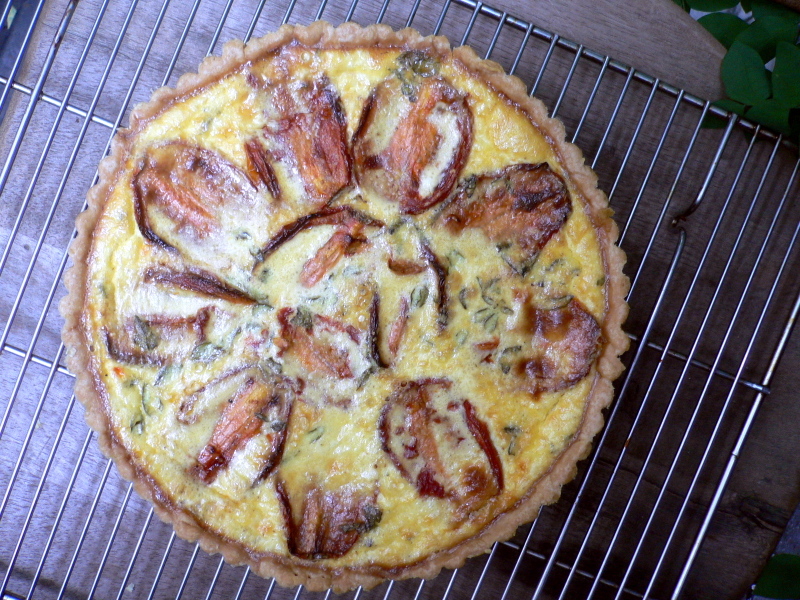
    Really, they're total perfection. At first, after the butter, flour and salt had whirred about in the food processor, I thought the dough looked too smooth and uniform, not pebbly enough. But chilled and rolled and pricked and parbaked and filled and baked again, the dough turned into this meltingly tender, delicious crust that held together well and melted in our mouths.

    Though I suppose I should also tell you that that tasty crust would have been nothing without a lining of grated farmhouse cheddar and a filling of roasted tomatoes suspended in a savory ricotta custard, infused with oregano leaves. The tart was airy and creamy and the silky tomatoes packed a wallop of concentrated flavor.

    I served this along with grill-blistered hot dogs and nicely charred hamburgers on Independence Day, before the rain came out and crowded us indoors, where we lined the walls of my narrow apartment, drinking beer, soothing babies, and discussing real estate (is there anything else we can talk about?). The tart disappeared long before the hot dogs did, which is saying something, since it seems that the Fourth of July is hardly even a holiday if there aren't hot dogs to be had. Wouldn't you say?

    So, yeah. Are you busy right now? Don't you think you should get yourself home to make this? I think you should, I really do.

    Tomato-Ricotta Tart
    Servings: 9 to 12

    Tart shell
    1 1/2 cups plus 2 tablespoons flour
    1/4 teaspoon salt
    1/2 cup plus 1 tablespoon cold unsalted butter, cut into 1-inch pieces, plus extra for greasing
    1 beaten egg yolk, divided (use half for the tart shell and reserve half for the filling)

    1. In a food processor, process the flour, salt and butter for about 5 to 8 seconds, so that some pieces of butter are left. Combine half of the egg yolk (saving the other half for the filling; set aside in the refrigerator) with one-fourth cup cold water and drizzle through the tube of the food processor while pulsing. Pulse until the dough forms a ball and pulls away from the sides.

    2. Alternatively, the dough can be mixed by hand. Put the flour and salt in a bowl, cut the butter into pieces and work it into the flour with your fingertips. Make a well in the middle of the flour and butter mixture and add the half egg yolk and one-quarter cup ice water. Stir quickly with a fork to start bringing the dry and wet ingredients together. When the fork can't do any more, use your hands just to bring the dough together. Don't knead or press — all you have to do is gather up the dry parts as quickly as possible. If your hands get too warm, put them under cold water for a few minutes.

    3. Wrap the dough in plastic wrap and chill in the refrigerator for at least 30 minutes, or up to 8 hours.

    4. Heat the oven to 350 degrees. Take the dough out of the refrigerator. Dust your work surface and rolling pin with flour and roll out the dough, lifting and turning it all the time so that it does not stick to the surface. Roll the dough out into a square about one-eighth-inch thick. Roll the dough around the rolling pin and gently lift it into the tart pan, gently pressing the dough into the bottom of the pan and up against the sides. Trim the edges. Chill again for about 30 minutes.

    5. Line the tart shell with parchment or foil and fill it with pie weights or beans and bake for 15 minutes. Remove the weights and the parchment or foil and prick the crust with a fork. Continue baking an additional 20 to 25 minutes until golden. Cool the tart shell on a rack.

    Cream mixture, filling and assembly
    6 plum tomatoes (such as Roma), halved
    Salt
    Freshly ground black pepper
    Olive oil
    1 cup half and half
    2 eggs
    1/2 egg yolk (reserved from making the tart shell)
    Pinch grated nutmeg
    1 tart shell
    1 cup packed grated farmhouse cheddar cheese
    3/4 cup ricotta cheese (I only used 1/2 cup, and I blended it in with the cream mixture)
    1/2 cup tender sprigs of fresh thyme or oregano

    1. Heat the oven to 350 degrees. Line a baking sheet with foil, place a rack in the baking sheet and roast the tomatoes skin-side up for about 2 hours, until the liquid has gone and the skins can be removed easily. Season the skinned tomatoes generously with salt and pepper and drizzle a little oil over them. Allow to cool to room temperature.

    2. In a mixing bowl, beat the half and half, eggs, egg yolk, one-fourth teaspoon salt and one-eighth teaspoon pepper and nutmeg until they are well mixed.

    3. Place the tart shell on a baking sheet and scatter the cheddar cheese over the base of the tart. Place the tomatoes on top of this and spoonfuls of ricotta in between the tomatoes.

    4. Pour in as much of the cream mixture as you can without it spilling over the top; you may have some cream mixture left over. Sprinkle with the thyme.

    5. Transfer carefully to the oven and bake for about 30 to 40 minutes until the filling has set and is lightly golden. Allow to cool slightly before serving.

  • P1100870

    These past few days have been my favorite kind of New York days. The air is crisp, odd for July, and the sun never gets too hot. The sky is a kind of piercing blue that we usually don't see until September and the puffy clouds floating across the heavens are as light and airy as marshmallows. At night, it's cool enough to pull a thin cardigan around my shoulders.

    The city empties out around holidays, which is always a treat. It's not that I don't like having my fellow New Yorkers around, but the calm that descends upon the city on a holiday is something that I'm loathe to share. The steady rumble from the streets dies down, the buzz of construction sites and the hum of air conditioners cease, and you can hear birds in Manhattan again.

    There's something kind of special about this other New York, the one that only those without summer shares and highway dreams have. When I pass the few people on my street who have stuck around as well, we smile at each other and nod. Usually, we don't even acknowledge each other's presence. But we're special now, we're in a club together – at home, in this city, on a holiday when everyone else has fled for clogged roads and beaches. The check-out girl at the supermarket where I've just bought five pounds of ground beef ignores me on most days, but today we're both having people over for a celebration, so she decides to share her mother's burger method with me and we share a conspiratorial smile.

    I don't care about fireworks and I'm doing my best to ignore the threat of a terror spectacular. This slowing down, this different pace, this is what the Fourth of July is all about for me. Trying not to break my rickety grill as we load it up with hot dogs and burgers, sipping a chilled beer with friends who've come from uptown, downtown, crosstown and Queens, (hoping that the mouse doesn't choose this particular moment to come out and play), introducing a little monkey named Charlotte to the pleasure of afternoon barbecue – this is how we'll be celebrating.

    As for the meatballs I'd so much looked forward to making, they were nothing more than just fine. Surprising, right? After all, you'd think that garlic oil and pancetta and red pepper flakes would have done quite a good job of perking up this rather pedestrian concept of a dish. Not to mention the tuna! But the meatballs were nothing special. You couldn't taste the pancetta (which never gets browned), the garlic was almost too faint to be noticed, and parsley was entirely the wrong herb to use alone here. The tomato sauce helped a good deal towards pepping them up, but I won't be making these again, not when there's Jamie Oliver's recipe for tuna meatballs that sounds like it will be far more satisfying.

    Wouldn't you agree? Happy Independence Day, everyone.

    Tuna Meatballs
    Serves 4

    3/4 cup bread cubes from stale baguette
    1/2 cup whole milk
    5 tablespoons extra virgin olive oil
    2 cloves garlic, thinly sliced
    1 1/2 pounds tuna, cut into 1-inch chunks
    2 ounces pancetta, finely diced (1/4 cup)
    1 large egg, lightly beaten
    1 tablespoon chopped flat-leaf parsley
    1/4 teaspoon red-pepper flakes
    Sea salt
    Freshly ground black pepper
    4 cups mild tomato sauce
    1 pound spaghetti

    1. Soak bread in milk in small bowl for 30 minutes. Place work bowl and blade of food processor in freezer.

    2. Heat 2 tablespoons of oil in medium pan over medium heat. Add garlic and stir occasionally until translucent, about 3 minutes. Set pan aside to cool.

    3. Squeeze bread to remove excess milk, put in chilled food processor bowl with tuna and pancetta. Pulse until just coarsely ground and combined. Refrigerate briefly. Add garlic and its oil, 2 tablespoons water, egg, parsley and red-pepper flakes. Season with 1/2 teaspoon salt and a few grindings of pepper. Lightly but thoroughly mix with hands.

    4. Make a small meatball and sauté in a bit of oil over medium-high heat to taste for seasoning. Adjusting seasonings if necessary.

    5. Heat sauce in a 6-quart pot over low heat.

    6. With moistened hands, form 20 meatballs, each about 1 3/4 inch in diameter (about 1 1/2 ounces). Heat remaining 3 tablespoons olive oil in pan on medium high until hot but not smoking. Cook meatballs in batches until well browned all around, 6 to 8 minutes. When done, transfer to sauce with slotted spoon. When all the meatballs are in sauce, partially cover pot and gently simmer for 1 hour, stirring carefully occasionally.

    7. Bring large pot of salted water to a boil and cook spaghetti until almost al dente. Drain and serve in bowl with sauce and meatballs spooned over.

  • P1100850

    Oh, readers. You are just the best. Can I count the ways your comments cheered me up this weekend? I cannot. They made me giggle and shudder and feel a lot less alone in the apartment. Thank you so much for all your help and sympathy – it was far better than the smelling salts I thought I'd have pressed to my nose all weekend in despair. A phone call made to the exterminator (who still hasn't shown up, by the way), watching Ratatouille, and spending a lot of time outside with friends also made me feel far more serene about the fuzzy interloper who knocked me sideways on Friday.

    I'll admit, I haven't bought traps just yet (I am a coward, that's all there is to it), because part of me is hoping that the little guy was scared stiff by my scream and is cowering in the walls until we move out in 29 days. Pretty please?

    (Oh God, that reminds me. 29 days and we still don't know where we're going. Perhaps a mouse-infested apartment is better than no apartment at all?)

    But I digress.

    Because, in other, far more important news, I spent the rest of the weekend basking in the warm glow of self-satisfaction. Pourquoi, you might ask? Well, ladies and gentlemen, I made my own butter. And let me tell you, there is absolutely nothing that is more astonishingly satisfying than that. Oh sure, baking your own bread certainly makes you feel all capable and strong and resourceful, even, but churning your own butter? It tops that, I swear.

    Daniel Patterson, he of the water-poached scrambled eggs, wrote about the glories of making your own butter in yesterday's New York Times Magazine. It all seemed rather serendipitous, because I'd been absolutely itching to make Melissa's cultured butter for days. If you didn't already know it, can I tell you how easy it is? It is so easy. So ridiculously easy.

    You take some heavy cream (I used Ronnybrook's), whip it in a bowl for as long as it takes (around 8 minutes) to go from being liquid to whipped to curdled and then to butter. The little bits of butter float in a milky liquid: buttermilk. I always thought buttermilk was just sour and thick (totally delicious, I might add), but as Daniel describes, this stuff is sweet and somewhat watery. (His recipes for using the buttermilk sounded quite good, but I used my buttermilk to soak stale bread for tuna meatballs – finally, yes! The story on those later. This week, though. I promise.)

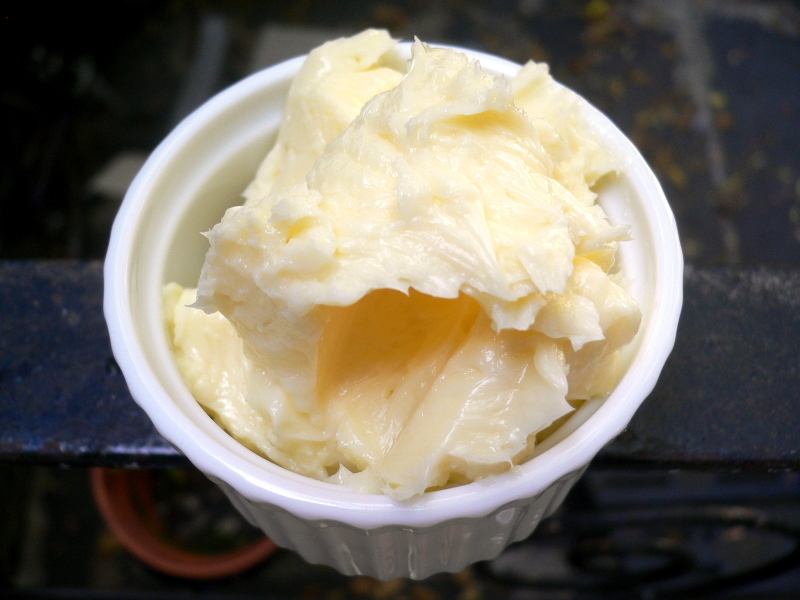
    I drained the buttermilk from the butter, then kneaded the butter in the strainer until it was silky and dense and most of the liquid had been squeezed out of it. I packed the butter in little ramekins and refrigerated it until it was firm but still spreadable.

    P1100847

    Spread thickly on a slice of raisin-oatmeal bread, it was a good afternoon snack. I'll be honest, the fact that I'd made that butter myself was largely why I was so enchanted with it. The butter was very mild, and tasted like the pure, clean version of the American butter widely available in supermarkets everywhere. It didn't have much of a flavor profile. I put a knife-tip of the butter on my tongue and could taste the sweet cream briefly, but the flavor evaporated in seconds. The mouthfeel was lovely – cold and creamy – but this wasn't the kind of butter I'd be excited to eat at a restaurant (or frankly, even for breakfast, because truthfully, I'm not really a butter girl, except when I'm in Berlin and can eat Lurpak on Schwarzbrot to my heart's content, though I did use it in the tomato sauce for the tuna meatballs, Marcella's famous one with butter and onion).

    So all of this means that later this week, I'll go back to the kitchen counter armed with another bottle of cream and a dollop of yogurt to try my hand at Melissa's recipe for cultured butter. I'm thinking that, on fire-roasted corn at our Fourth of July barbecue, it should taste pretty good, right?

    Homemade Butter
    Makes 16 ounces of butter

    6 cups organic heavy cream (I used one pint)
    Salt to taste (optional)

    1. Pour the cream into the bowl of an electric mixer fitted with a whisk. Tightly cover the top of the bowl with plastic wrap and start mixer on medium-high speed. The cream will go through the whipped stage, thicken further and then change color from off-white to pale yellow; this will take at least 5 to 8 minutes. When it starts to look pebbly, it’s almost done. After another minute the butter will separate, causing the liquid to splash against the plastic wrap. At this point stop the mixer.

    2. Set a strainer over a bowl. Pour the contents of the mixer into the strainer and let the buttermilk drain through. Strain the buttermilk again, this time through a fine-mesh sieve set over a small bowl; set aside.

    3. Keeping the butter in the strainer set over the first bowl, knead it to consolidate the remaining liquid and fat and expel the rest of the buttermilk. Knead until the texture is dense and creamy, about 5 minutes. Strain the excess liquid into the buttermilk. Refrigerate the buttermilk.

    4. Mix salt into the butter, if you want. Transfer to an airtight container and refrigerate.

  • The Management would like to inform its readers that the author of this blog will be, until further notice, incapacitated after seeing what is sometimes referred to as the "common" house mouse in her kitchen, though she adamantly insists there is nothing common about it. It is quite a miracle that she is now able enough to insist on such things, as her first reaction to the aforementioned mouse was to fall over in a dead faint and then bleat hysterically for several hours.

    Your regular content will resume as soon as the author can summon the strength to buy traps, bait them, and then remove them with the offending party captured therein. Any assistance in the removal of said traps would be desperately appreciated, as the man of the house is currently on what is often referred to as a "boys weekend" with his university companions and therefore cannot assist in this most gruesome of tasks.

    Please send strength and prayers. Oh, and an exterminator.

  • P1100825

    Instructions for a hot day:

    1. Go to a bar and have someone pour you a cold wheat beer. Drink it while beads of moisture collect on the glass, cooling the palms of your hand each time you take a sip. Sit in the window of the bar so you can see your fellow citizens pass by (incidentally, where do they find such cute sandals?). As you finish your beer, the knot of tension in your upper back will slowly disintegrate and you'll walk home in a pleasant fog.

    2. At home, find yourself the four smallest, firmest, freshest zucchini you can get your hands on. If you must pick them from a garden patch yourself, do so. Slice them lengthwise with a mandoline, if you've got the nerve, or a very sharp knife (I haven't used a mandoline since the Great Thumb-Slicing Incident of 1993, which I think still has my father traumatized, so let's hope this offhand mention doesn't incur some kind of PTSD in him. Stay cool, Pops.). Lengthwise, I said, not crosswise, like I did. Maybe you should wait a little before finishing your beer and then reading the recipe instructions. Definitely wait before using the mandoline.

    3. Dress the paper-thin zucchini slices with a lemon juice dressing and collapse on the couch, which is conveniently situated across from the air conditioner. Wait there until the beads of sweat on your brow and back and arms dry. Kill a millipede for the third time this week and thank your lucky stars to be vacating the apartment in a month. Open the door to the back patio and realize you only have a month to enjoy it. Find yourself torn between hatred for millipedes and love for your patio. Realize the Raid fumes might be getting to your head. Feel a twinge of embarrassment for killing a millipede with roach poison. Try to stop thinking about bugs altogether as they are killing your buzz and ruining your already miniscule appetite.

    4. Go back to the couch and sit there in the stream of cold air until goose bumps start to appear on your skin. During this time, you may a. read The New Yorker, b. watch an episode of Big Love, or c. try to imagine just exactly where you'd put the couch and hang the paintings in a two-bedroom dream apartment. Choice c. somehow ends up being the most entertaining.

    5. When you have tired of your virtual interior decorator, peel and thinly slice an avocado. Attempt to layer avocado slices along with the marinated zucchini slices on a plate. Artistically, if you may. Drizzle the dressing over the vegetables, then pluck little leaves of thyme off the stalk and drop them around the plate. Realize you don't have any pistachios. Briefly contemplate using salted peanuts. Decide against it. Beer hasn't incapacitated you that much. Sufficiently chilled from your wind-powered air conditioner, go out on the patio and eat your salad.

    6. Realize happily that raw zucchini are quite delicious, in a subtle, grassy way. With the faint crunch of sliced zucchini against the creamy avocado, punctuated by the herbal thyme, the salad is cooling and delicate and lovely. Think about when you lived down the street from Patricia Wells in Paris and how you used to dream about doing her dinner party dishes in return for cooking classes in Provence. Remember all the one-plate meals you ate in your little studio there, and how lonely you were, which makes you realize just how un-lonely you currently feel. Finish your delicate little dinner and sit in the heat for a few minutes longer. The air-conditioner can wait.

    Zucchini Carpaccio with Avocado
    Serves 4

    1 tablespoon freshly squeezed lemon juice
    1/2 teaspoon fine sea salt, plus additional as needed
    1/4 cup best-quality pistachio oil, almond oil or extra virgin olive oil
    4 small zucchini (about 4 ounces each), trimmed
    1 ripe avocado, peeled and very thinly sliced
    1/4 cup salted pistachio nuts
    4 sprigs fresh lemon thyme, preferably with flowers

    1. Stir together lemon juice and  1/2 teaspoon salt in small jar. Add oil, cover  and shake to blend.

    2. Slice zucchini lengthwise as thinly as possible, using mandoline or very sharp knife. Spread slices on platter and drizzle with lemon mixture. Tilt platter to evenly coat slices. Cover with plastic wrap and marinate at room temperature for 30 minutes to an hour.

    3. Alternate zucchini and avocado slices on individual salad plates, slightly overlapping each slice. Sprinkle with pistachio nuts. Season with salt to taste, garnish with lemon thyme, and serve

  • P1100817

    (Oh dear. This is awkward. I think I'm going to write this entire post in parentheses. You know, to mitigate the awkwardness. If it's in parentheses, then it's still sort of just a thought in my head and not an entirely un-take-back-able statement. Right? I don't know. Lord help me.)

    (So here's what happened. Last week, Russ Parsons published this article in the Los Angeles Times about waffles. Goodness knows we are a wafflefriendly household. And since there is no other waffle more talked about than Marion Cunningham's yeast-raised waffle (am I wrong?), I was quite excited to try my hand at this legendary recipe.)

    (You make a batter with active dry yeast and let it ferment overnight in the fridge. But I didn't get started until early Sunday morning – on Saturday, we were too busy looking at apartments out in faraway neighborhoods and getting into arguments about where we should live and how much we should pay and, oh, the joys of New York City living, they really are such a pleasure – so I let the batter ferment on my kitchen counter top for an hour or two instead. It doubled in size and smelled deliciously yeasty and had all these appealing bubbles and a gorgeous foamy top. Very promising, indeed – as was that one place out in Forest Hills, the one I can't stop thinking about and, holy hell, does that mean we should take it, help me, readers, help me.)

    (I heated up the waffle iron and we debated the merits of Bak-Kleene versus melted butter, but it turned out that neither was really that necessary. My non-stick waffle iron performed like a champ, spitting out waffles with nary a sticking corner in sight. It was impressive. Less impressive, however, were (gulp, double gulp) the waffles.)

    (Did I actually just say that out loud?)

    (…)

    (For starters, the waffles, while crisp and browned on the bottom, were flabby and a pallid, yellowish hue on top. Also, their insides were a little too batter-y. And lastly, they were buttery to the point of greasiness.)

    (We ate the first round in silence, chewing carefully. Ben tentatively ventured that they might not be the best waffles we'd ever made. With the second round, I tried flipping the waffles in the iron in the hopes that the pale, yellow side might get a little toastier. Hardly. With the third and fourth batch, I overfilled the iron, which resulted in the delicate lacy waffle you see in the photograph. The underside, however, still looked totally under-baked. The taste was better now, though, and Ben made the good point that the warm syrup-doused waffles tasted like French toast – it must have been the yeast, I think. I still found them far too buttery for my taste. Unpleasantly heavy, they sat in my stomach while I pondered the impossible.)

    (Could it be that I didn't like the world's most beloved waffle? Would anyone still take me seriously after this? What on earth would become of me?)

    (It's not really clear. We spent the rest of the day calculating rent budgets and train passes, imagining life in a spacious 2-bedroom apartment with leafy tree-tops instead of air shafts for a view, and weekends spent strolling down the West Side Highway. Which made me think – if there's room in this city for all the different folks we saw out yesterday, there must also be room for li'l ol' yeasted-waffle-disliking me. Right? Oh, pretty please!)

    Yeast-Raised Waffles
    Makes 16 waffles

    1 package active dry yeast
    2 cups milk
    1/2 cup (1 stick) butter, melted
    1 teaspoon salt
    1 teaspoon sugar
    2 cups flour
    2 eggs
    1/4 teaspoon baking soda

    1. Place one-half cup warm water in a large mixing bowl (the batter will double in volume) and sprinkle in the yeast. When dissolved, stir in the milk, butter, salt, sugar, flour and eggs and beat until smooth and blended. Cover the bowl with plastic wrap and refrigerate overnight.

    2. Just before cooking the waffles, beat in the baking soda. The batter will deflate and become about as thin as soft yogurt. Cook the waffles according to the manufacturer's instructions for your waffle maker. Serve with maple syrup.

  • P1100757

    Nostalgia for the Italian countryside is all well and good, but some things can happen only in New York.

    Consider this: walking down 17th Street at dusk last night, I saw a group of people clustered in front of a rug store. As I got closer, I heard strains of choral music and before I knew it, I was standing in the gutter in front of The Renaissance Street Singers, listening to a 15th century hymnal as pretty young things in bright frocks passed us by and a toddler noodled around on the sidewalk. I'd come from Union Square, populated by  21st century skateboarders and leggy models and red-faced suits, and passed directly into another time. A few minutes later, the singers dispersed and I headed home in the setting sun.

    It was kind of magical.

    All week long, I've been waking early in the morning, still adjusting to Eastern Standard Time. And each morning, I've rolled over and reached for a slim little book sitting on my bedside table. Edited by Jenni Ferrari-Adler (who was kind enough to send me a copy), it's a collection of essays about eating and cooking for one. Sandwiched between Laurie Colwin's famous "Alone in the Kitchen with an Eggplant" and Rosa Jurjevics's "Food Nomad" (Jurjevics is Colwin's daughter), the essays range from the strictly utilitarian (Marcella Hazan) to the unabashedly literary (Haruki Murakami).

    The collection's pretty charming: M.F.K. Fisher complains about her too-oft reliance on the "occasional egg" for dinner, Steve Almond waxes rhapsodic about an odd concoction called the Quesarito and Mary Cantwell fights for her right to dine out alone. Each essay is a pleasantly voyeuristic snapshot, like looking into someone's grocery basket. And it got me thinking about my own habits when I'm home alone, looking for dinner. Sometimes it means I get to buy the stingingly spicy hot & sour soup from the Sichuan restaurant up the street. Other times, it means I can make the sauteed cherry tomato-canned tuna pasta sauce that Ben just doesn't like. A simple green salad and a wedge of cheese, a broiled steak, or baked beans and broccoli – all of these, too, are my dinners for one.

    Last night, inspired by your comments and armed with a recipe that Judy Rodgers published in the New York Times five years ago, I made a funny little salad of spiky mizuna leaves, creamy potatoes, sharp slivers of shallots, boiled eggs, and a tangy dressing to bind it all together. I'll be honest, this wasn't my favorite meal. The mizuna was full-grown and untameable, so even cut into bite-sized pieces, I found myself fighting the leaves all the way. I think I'm more of a frisee kind of girl. Also, raw shallots leave me interminably thirsty. Anyone else? It's so odd. I prefer to avoid them.

    But, you know, despite the salad, it was a satisfying evening nonetheless. Sometimes it's just the little things. I had the apartment to myself, I was eating up the greens in my CSA box, clearing the pantry of old shallots and even older potatoes, I could giggle with my mouth full at The Office reruns, and daydream happily for the weekend. I had dinner on the table and a full sensation in my soul.

    And you? Tell me what you make when you're home alone with an eggplant, or without. I'd love to know. Something tells me you've got some interesting meals to share.

    Baby Mustard Greens with Potatoes and Shallot Vinaigrette
    Serves 4

    3/8 pound Yellow Finn, Bintje or German butterball potatoes, peeled and cut in irregular bite-size chunks
    Sea salt
    6 1/2 tablespoons extra-virgin olive oil
    2 tablespoons Champagne or white wine vinegar
    1 large shallot, slivered
    4 ounces baby red mustard greens or mizuna, rinsed and dried
    2 hard-cooked eggs, peeled
    1 teaspoon freshly crushed black peppercorns

    1. Place potatoes in a saucepan with cold water to cover. Season water liberally with salt. Bring to a simmer, cook just until potatoes are tender, 6 to 8 minutes, then drain. When potatoes stop steaming, transfer them to a wide bowl.

    2. Combine oil, vinegar and salt to taste, and drizzle about one-third of this dressing over potatoes. Add shallot. Fold together with a rubber spatula. Dressing will pick up creaminess from potatoes. Set aside.

    3. Place mustard greens or mizuna in a second wide bowl suitable for serving. Toss with half of the remaining dressing. Add potato mixture, and fold in gently. Halve eggs lengthwise, then cut in crosswise slices  1/8-inch thick. Scatter over salad, add remaining dressing, and fold once or twice very gently. Dust with crushed pepper, and serve.