• DSC_6162

    I don't remember exactly how I stumbled on this recipe, I'm remembering vaguely that I had too many zucchini knocking around in the fridge and a can of chickpeas gathering dust (by the way, Hugo doesn't like beans, what is up with that?) and I probably did a search for a recipe that would use them up together, but the point is that by some stroke of internet luck, I happened on quick-dinner-gold that you need to know about, especially now with end-of-summer zucchini flooding markets. (Those of you with access to fresh, sweet, lovely, tender, beautiful, local corn, ENJOY IT YOU LUCKY DOGS YOU WHILE THE REST OF US MAKE DO WITH CANS SOB).

    While I love the concept of vegetable fritters, I often find that in reality they aren't substantial enough for a dinner and they're too fussy for me to make as part of a larger meal. (I still think back almost weekly on the celestial tomato fritters that Max and I ate almost every night of our honeymoon in Greece, but refuse to attempt them at home because sometimes a memory has to be enough, you know?)

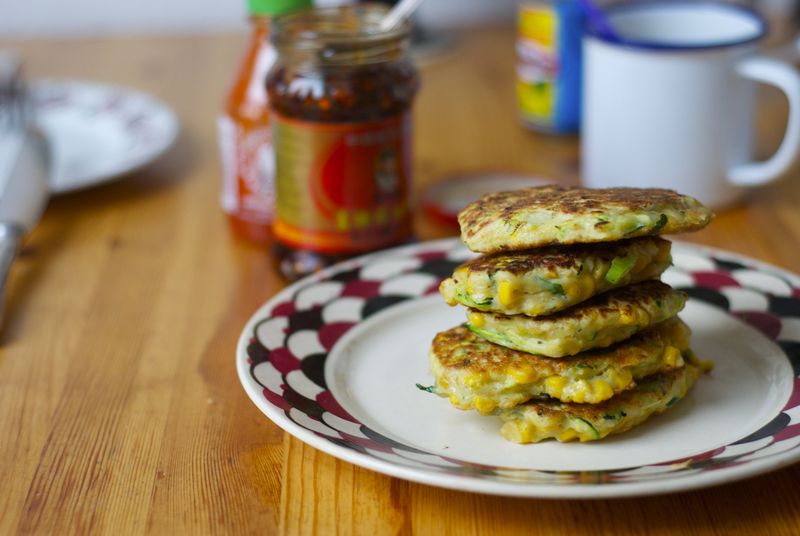
    But these fritters, thrillingly, are hefty enough to be the whole dinner. The base is made up of chopped chickpeas, milk and flour. Baking powder gives the fritters some lift. To this you add a grated zucchini, a can of corn, some fresh herbs (I liked a mix of mint, basil and parsley) and sliced scallions. Then you dollop little portions in an oil-slicked pan and cook the patties until golden-brown and fragrant and irresistible on both sides.

    You could serve these with garlic-spiked yogurt, but we ate them with hot sauce – Sriracha preferably, the sweet-hot-sour flavor livens up the fritters just perfectly. And to go out onto a limb, I imagine that a more bean-interested child would probably be happy to gobble these up unadorned, making this family-dinner material (wouldn't you say, Jenny?)

    Now I need to go contemplate what other vegetables one could stuff into these things successfully and craft plans to get Hugo to eat even just one chickpea. One! Could it be that hard?

    Corn, Zucchini and Chickpea Fritters
    Serves 3 to 4
    Note: The original recipe is Australian, hence the metric measurements. A 310-gram can of corn is approximately 11 ounces, so I'd suggest using 3/4 of a 15-ounce can of corn. You can of course use fresh or frozen corn instead.

    1 400-gram (15-ounce) can chickpeas, drained, rinsed
    1/2 cup milk
    2 eggs
    3/4 cup all-purpose flour
    1/2 teaspoon baking powder
    1/2 teaspoon salt
    1 large zucchini, grated
    1 310-gram can corn kernels, drained
    1 tablespoon chopped fresh mint leaves
    1 tablespoon chopped basil leaves
    3 sprigs chopped flat-leaf parsley
    3 scallions, thinly sliced
    Vegetable oil
    Sriracha sauce or other hot sauce for serving

    1. Process chickpeas until roughly chopped.

    2. Whisk milk and eggs in a measuring cup. Mix flour, baking powder and salt in a bowl. Gradually add milk mixture to flour, whisking until smooth. Stir in chickpeas, zucchini, corn, herbs and scallions.

    3. Cover a large frying pan with a thin film of oil. Heat over medium-high heat. Add 1/4 cup mixture to pan. Spread slightly with a spatula. Repeat to make 3 more fritters. Cook for 2 to 3 minutes each side or until golden and cooked through. Transfer to a plate. Cover to keep warm. Repeat with remaining mixture to make 12 fritters, replenishing the pan with oil between batches, if necessary. Serve with hot sauce.
  • How to Make Crostata

    Hello from the rolling Montefeltro hills! The verdict so far is that things are blissfully as they always are here: lazy, sunny, delicious, mosquito-filled.

    We have not done much since getting here. Which is sort of the whole point, of course. There have been a few dinners with friends, an excursion to the beach or two, and there has been beer with lunch and dinner almost every day so far (we are nothing if not livin'-on-the-edgers).

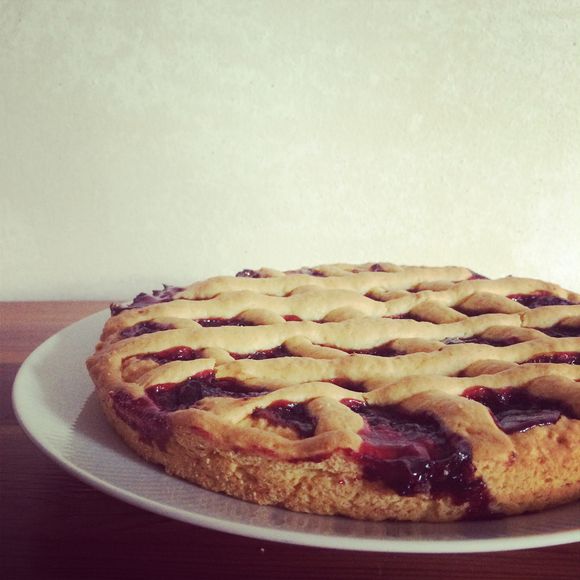
    Also, there has been a lot of crostata. Crostata is the very first thing I ever learned to bake. For a long while, it was the only thing I ever baked. It is, to explain, a jam-filled tart of sorts, except the dough is sort of cakey as well as crusty. It is eaten for breakfast and for dessert. It can be filled with any jam you like, though we are partial to sour ones like plum or sour cherry. A grade-schooler can master it and it requires nothing besides a countertop and a baking pan. I make one every couple of days since that's about how long they last.

    In the grand tradition of Italian desserts, crostata is a little dry and almost aggressively simple. I would urge you to resist attempts to fancy it up.

    I suppose it will be the first thing I teach Hugo how to bake one day. He is showing more and more interest in what I get up to in the kitchen these days. I plop him on the counter next to me and he watches as I knead pizza dough or helps measure oats when it's time for oatmeal. For now, though, he's content just eating crostata. And I'm happy to still be the one tasked with making it.

    How to Make Crostata

    A few notes on the recipe:

    1. I've given you both metric and US measurements, but I haven't tested it with the US ones yet.

    2. If you have access to Italian "00" flour, you can use that instead of all-purpose. If you don't, no sweat.

    3. The baking powder here in Italy is conveniently flavored with vanilla. If you happen to have access to Pane Degli Angeli baking powder, you need half a packet. If not, use 3/4 teaspoon (8 grams) of regular baking powder and then add either a spoonful of vanilla sugar or of vanilla paste/extract.

    4. The eggs here are smaller than in the US, so I've noted "medium" eggs. If you can't find those, you can use large but you may need to use a bit more flour as you go.

    5. The butter must be very soft to be able to be quickly incorporated by hand into the dough. Let it sit out overnight before making the crostata.

    6. My favorite jams in crostata are sour ones. Sour cherry, plum and apricot are all great choices. But you should feel free to choose whatever jam you like. You can even divide the crostata in half and fill it two different jams for variety. As for other fillings, there is such a thing as Nutella crostata, just FYI.

    Crostata
    Makes one 9-inch tart

    200 grams / 1.5 cups plus 2 tablespoons all-purpose flour
    Pinch of salt
    50 grams / scant 1/4 cup sugar
    8 grams / 3/4 teaspoon baking powder
    Grated peel of 1/2 organic lemon
    1/2 teaspoon of vanilla paste or extract if not using Pane Degli Angeli baking powder
    2 medium eggs, room temperature
    50 grams / 3.5 tablespoons unsalted butter, very soft
    About 1/2 jar sour cherry or plum jam

    1. Heat the oven to 180 C / 350 F. Dump the flour onto your work space and make a well in the middle. Sprinkle the salt, sugar and baking powder into the well, making sure to sift out any lumps in the latter. Add the grated lemon peel and vanilla flavoring, if using. 

    2. Crack the two eggs into the well and, using your finger, stir them gently to break up and start incorporating into the dry ingredients. Then add the very soft butter and continue to stir until a rough dough starts to come together. Knead gently until it is smooth and uniform. Try not to overwork or add too much additional flour, but don't overthink things either; this is not pie crust.

    3. Pull off a quarter of the dough and set aside. Pat the remaining dough evenly into a 9-inch pan and make sure to push the edges of the dough about 1/2 an inch up the sides of the pan to create a crust.

    4. Spoon the jam into the crust and spread out evenly. Pinch off small pieces of the remaining ball of dough and roll them out into strips of varying length that you lay on top of the jam to create a lattice top.

    5. Put the pan in the oven and bake for 20-25 minutes, until the tart is browned and the jam is bubbling. Let cool on a rack for an hour before turning out of the pan. Keeps for several days at room temperature.

  • DSC_5734

    Dearest readers, I did not mean to leave you hanging for, uh, almost three weeks. Please accept my apologies and my offering: a recipe for "barbecued" Korean chicken that I discovered in this cookbook that's been on my shelf since 2002 when I found it in the giveaway pile of an old job, but never actually cracked until a few months ago.

    I don't know how I landed on this one recipe seeing as there far too many to count in this book (it's sort of overwhelming, actually), but somehow I did and the first time I made it, Hugo ate almost the entire panful of chicken while Max and I desperately tried to pick off pieces for ourselves, fending off the screeching wild animal each time, and every time I've made it since then it's been nothing sort of a roaring success. So. You need to know about this. Consider it my penance.

    (more…)

  • Photo 3

    You spend 10 years in a city like New York and you consider yourself some kind of expert. You know how to get around the West Village without a map; every street corner means something particular to you; you start recognizing strangers miles away from the neighborhood from which you know them. That kind of thing. And then you leave.

    The city, of course, goes on (as do you). Restaurants open and close, people move away, new buildings go up. And you start to hear about new places that would have been the kind of place you would have loved, if you still lived there. But you don't anymore. Nuts to you. Cue cravings for things you've never even had the pleasure of tasting.

    One of these places for me was Saltie on Metropolitan Avenue in Williamsburg. I can't remember where I first heard about them; I think it was through Brian. But their sandwiches sounded totally beguiling. I mean, with names like the Captain's Daughter, the Scuttlebutt and the Spanish Armada, how could they not? Their funny names belied their aggressively straightforward composition, though: focaccia filled a slice of Spanish tortilla with aioli, focaccia swiped with hummus and piled with pickled vegetables; focaccia sandwiching scrambled eggs with ricotta. Every time I heard about Saltie, I got peckish, for sandwiches and for New York.

    Luckily for me, Saltie published a cookbook, which I bought on my last visit to Boston in the fall. Saltie's pedigree is illustrious – the joint owners and chefs come from Diner, the now-famous restaurant that put Williamsburg on the map. They care about high-quality ingredients and have cheffy standards, but apply them to humble sandwiches, soups and cookies. Their book is a quiet delight – full of bossy instructions (I love bossy instructions) and musings on a variety of subjects, including herb salads and Moby Dick.

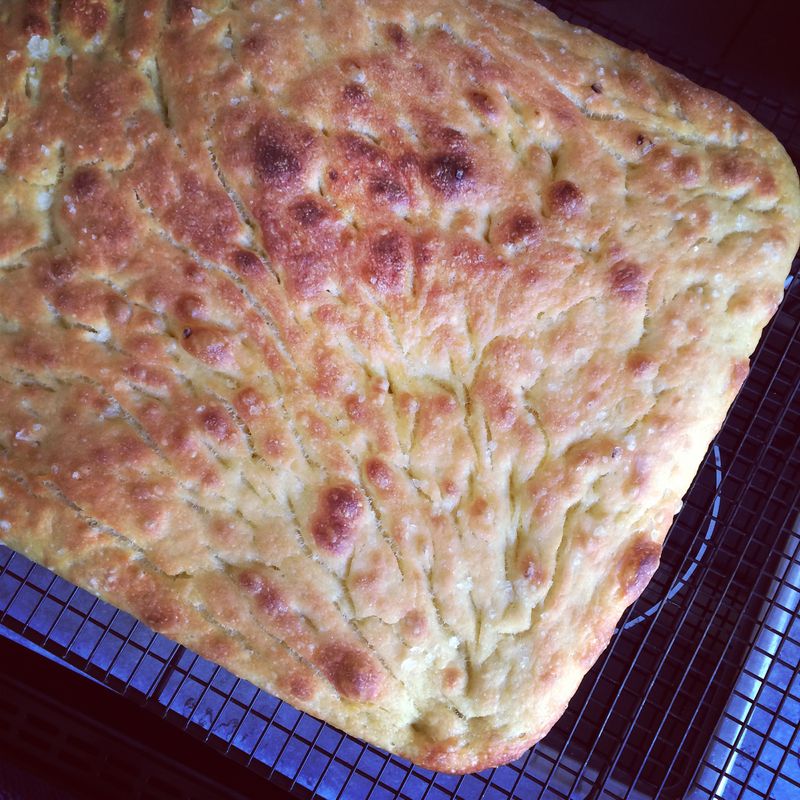
    It also makes you want to cook things as disparate as chicken salad, pickled red currants and perfect boiled eggs. But the crown jewel of the cookbook has to be the recipe for focaccia, the basis upon which the whole Saltie operation stands. I made it when Adam and Craig came to lunch and it is, in my opinion, the holy grail of focaccia recipes (I'm talking about focaccia genovese, meaning a flat "loaf" of bread about the size of a baking sheet, baked with so much oil that it's almost fried – for thick and fluffy focaccia pugliese, click here).

    Photo 1

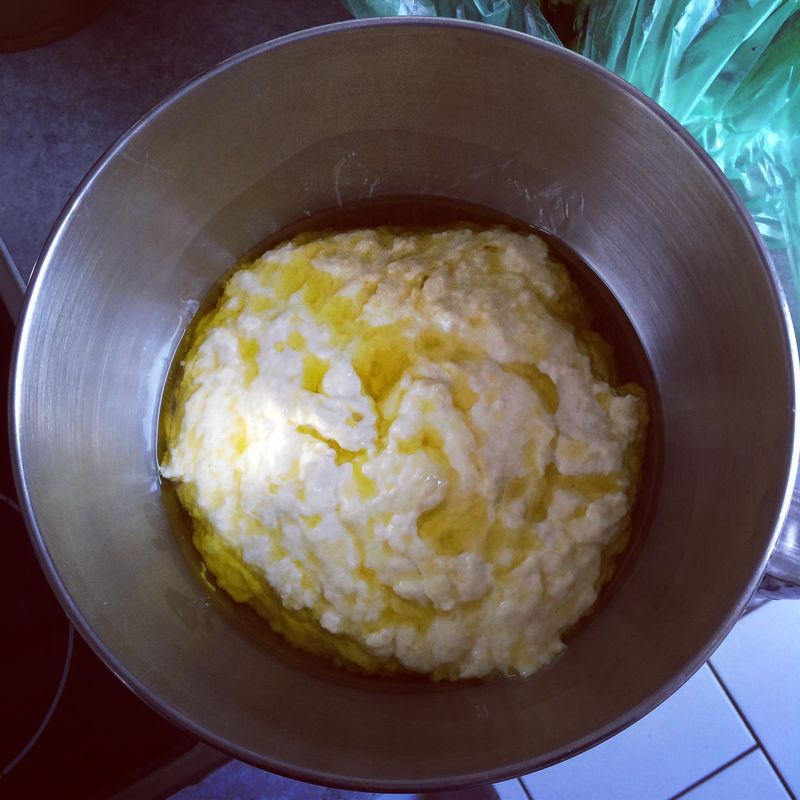
    This kind of focaccia is the ultimate no-knead bread – you stir together flour, salt and yeast (the original recipe calls for active dry, which I don't like, so I substituted instant yeast, at a 1:1 ratio), then you add water and mix it all briefly with a wooden spoon until combined. You pour a substantial amount of olive oil in a big (big) bowl, dump in the batter, which looks more like milky oatmeal than bread dough, and put it in the fridge for a good amount of time (a minimum of eight hours; I let it go for 24). That's it.

    The next day, or when you're ready to bake, you simply pour the risen dough, which reminded me most of all of a soft and yielding post-pregnancy belly, onto a baking sheet and push it gently out to the corners. You let it come to room temperature, sprinkle it with salt and put it in the oven. There is so much oil pooling around the edges and on the top and bottom of the focaccia that it partially fries in the oven.

    Photo 2

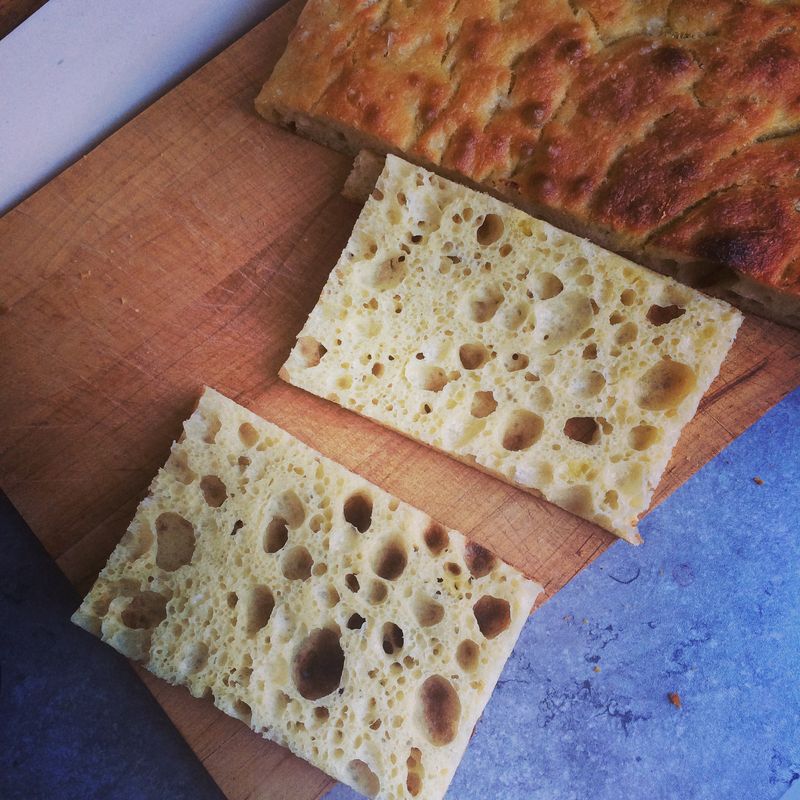
    It's pretty spectacular stuff, in the end. The top goes toasty, bubbly and brown and a rich, nutty fragrance fills the air. The focaccia, split open, has the most wonderful bubbly crumb, full of juicy holes to fill with mayonnaise or tomato drippings. I cut off the edges to prepare for our sandwich lunch and then snacked on those edges for a good long time – they are the platonic ideal of the cook's treat. Crisp and crunchy, salty and rich. Cocktail nuts who?

    Photo 4

    To make Saltie's Scuttlebutt sandwich for Adam and Craig, I filled the sandwiches with the cookbook's pimenton aioli, their pickled beets and herb salad, plus slices of feta and hard-boiled eggs. And it turned out that the whole concoction was just too rich and crazy for me (Adam and Craig liked it, though). But later that evening, I layered sliced tomatoes and a milky piece of mozzarella in a split piece of focaccia and found that I'd made myself a sandwich for the ages. Salty, simple, chewy, oily and juicy. What a home run.

    Put this one in your laminating pile, folks. And with that, I'm back to the rest of the World Cup final WHICH I AM NOT HANDLING WITH EQUANIMITY RIGHT NOW AAAAAH.

    Saltie's Focaccia
    Makes 1 sheet pan of bread

    6 1/4 cups flour
    2 tablespoons salt
    1 teaspoon instant yeast
    3 1/2 cups warm water
    1/4 cup extra-virgin olive oil, plus more for greasing and drizzling
    Coarse sea salt

    1. In a large bowl, whisk together the flour, salt, and yeast. Add the warm water to the flour mixture and stir with a wooden spoon until all the flour is incorporated and a sticky dough forms. Pour 1/4 cup olive oil into a 6-quart plastic food container with a tight-fitting lid (or a very large bowl, like the one from a standmixer). Transfer the focaccia dough to the container, scoop a little oil from the sides over the top, and cover tightly. (If you're using a bowl, wrap tightly and thoroughly in plastic wrap, making sure there's plenty of room in the bowl for the dough to rise.) Place in the refrigerator to rise for at least 8 hours or for up to 2 days.

    2. When you're ready to bake, oil an 18 x 13-inch baking sheet. Remove the focaccia dough from the refrigerator and pour onto the prepared pan. Using your hands, spread the dough out on the prepared pan as much as possible. Place the dough in a warm place and let it rise until it about doubles in bulk. The rising time will vary considerably depending on the season. (In the summer, it might take just 20 minutes; in winter, it can take an hour or more.) When the dough is ready, it should be room temperature, spread out on the sheet, and fluffy feeling.

    3. Heat the oven to 450° F. Pat down the focaccia to an even thickness of about 1 inch on the baking sheet, and then make a bunch of indentations in the dough with your fingertips — like you're playing chords on a piano. Dimple the entire dough and then drizzle the whole thing again with olive oil. Sprinkle the entire surface of the focaccia evenly with sea salt.

    5. Bake, rotating once front to back, until the top is uniformly golden brown, 25-30 minutes. Transfer to a wire rack to cool, then slide out of the pan. Use the same day or slice crosswise, cut into squares, wrap tightly in plastic wrap and freeze.

  • Fresh beets

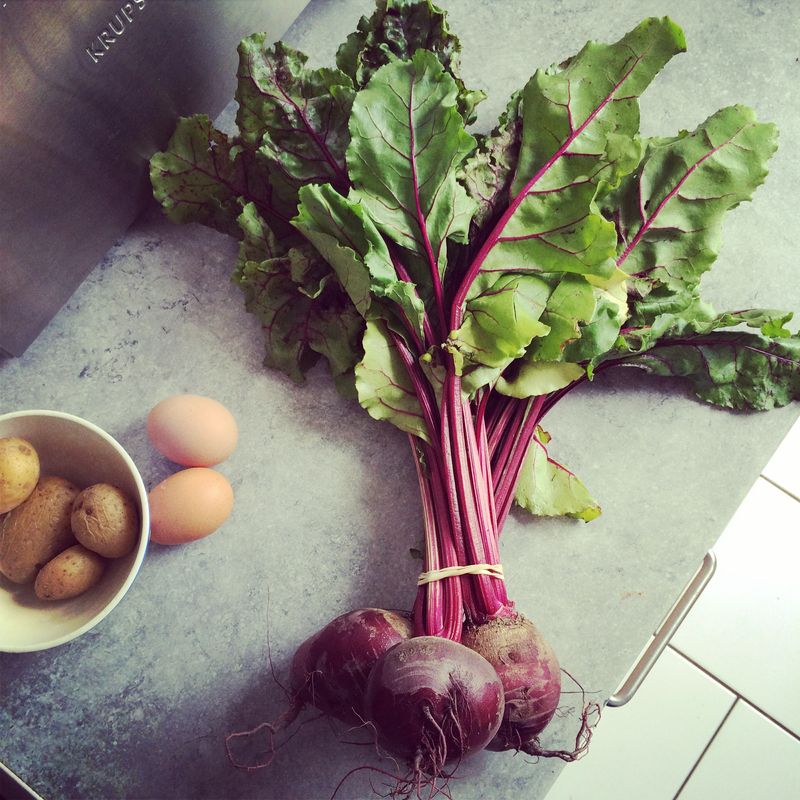
    It all started when the one local vendor at my Tuesday greenmarket had the most beautiful bunches of beets with vibrant, glossy, fresh greens (more on those later) last week. The minute I saw them, I felt a primal urge to make borscht. You know, the kind with beef shin or oxtail: hearty and warm, with little golden discs of fat floating on the surface. Definitely not the kind of meal you'd make on a warm summer's day, which it actually, surprisingly, happened to be. (Context break: With an exception or two, like my day of beets, our Berlin summer has been nothing but rainy and chilly and windy and gray. Here's something I never thought I'd say: I miss those hot and stinky New York City streets in summer something awful right now! My kingdom for a un-airconditioned subway car! For humidity! For sustained SUN! Anyway. Moving on.)

    So borscht with beef was out. And then I started thinking about cold summer borschts, the ones you eat with boiled potatoes and buttermilk. I first learned about cold borscht when I was going through my Holocaust phase as a kid. Yes, there was a period in my childhood when all I read were books about the Holocaust. I can't have been alone? I was completely and utterly obsessed. (I even had nightmares about it, really vivid and terrifying ones that I have still not forgotten.) I feel more than slightly weird confessing a food craving that is in any way even peripherally related to the Holocaust, but sometimes the mind works in strange ways. That nourishing soup – a gesture of kindness in one of many bleak moments in that grim parade of stories – made an impression on me in the midst of all that horror, I suppose.

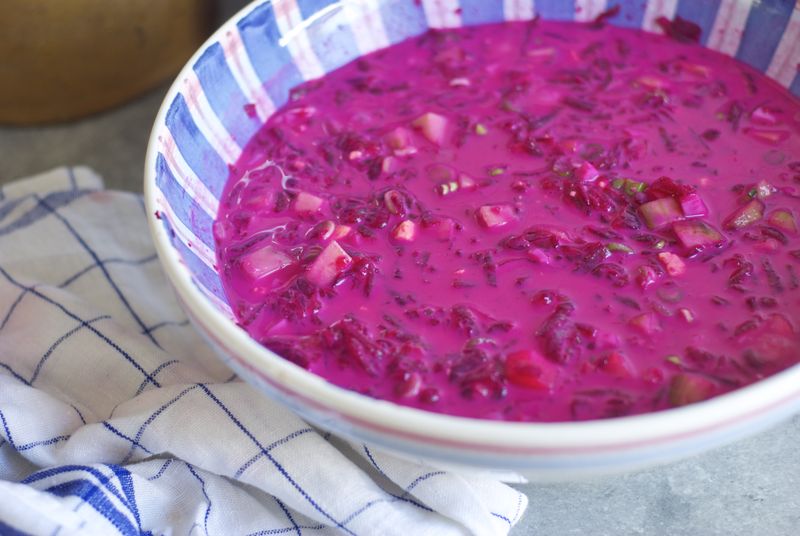
    Once the thought of sweet, silky beets combined with cool, sour buttermilk and little waxy cubes of boiled potato occurred to me, it was difficult to think of anything else. A quick Google search led me to this recipe, in which the only cooking involved boiling beets and two eggs. (I had a few small leftover boiled potatoes from the day before, so I added those two – maybe you guys can tell me if that's more a Ukrainian thing? The original recipe, a Lithuanian one, is without potato.). The rest of the soup's work just involved dicing up a cucumber and some scallions. Once the beets were cooled and peeled, I grated them into a bowl, added the sliced scallions and chopped cucumbers, diced eggs and cubed potatoes, and then poured in a quart of buttermilk and a quart of cold water, plus salt to taste. The color was electric, hallucinatory, utterly stunning.

    Lithuanian cold borscht

    I stirred in a little sour cream at the end for richness, then put the bowl in the fridge to cool for a while. I committed what is probably heresy in the world of borscht by leaving out the dill, but as you may know, it is the final bastion in the almost-conquered world of Things I Do Not Under Any Circumstances Eat. Feel free to put it in, if you like dill. But for those of you for whom dill is an absolute no-go (solidarity fist-bump!), rest assured that the soup was as delicious as can be without it. Sour, crunchy, creamy, silky, cold and refreshing.

    (As for the greens, I chopped them up, washed them verrrry carefully and then did a sort of Chinese stir-fry, with minced ginger and soy sauce and chile and garlic. They were delicious, especially with a fried egg on top. Yesterday I had another batch and made an aloo sag with them instead of spinach, which was also nice, but I messed up the potato-greens ratio and it was too potato-ey for my taste. My favorite use for them, actually, was in a frittata with a few sliced potatoes, chopped parsley and chunks of feta on top. I'm headed back to the greenmarket right now for another batch – have any other beloved beet green recipes to share?)

    Cold Summer Borscht
    Serves 6

    1 pound beets (2-3 beets)
    1 large potato (or 2-3 small ones)
    ½ English cucumber (or 2-3 baby cucumbers)
    2 large eggs
    4 scallions
    Small bunch of fresh green dill (optional)
    1 quart of kefir or buttermilk
    1 quart of cold water
    3 tablespoons of sour cream
    Salt to taste

    1. Put the washed beets and the potato in a pot of cold water and bring to a boil. Cook, covered, at a low boil until a knife inserted into the potato goes in without resistance (should take about 20 minutes) The beets will take longer, but should submit to the same knife test. (Time can vary according to size and freshness of the beets.) Drain and cool until easy to handle. In a separate pot, hard-boil the eggs. Drain and cool the eggs. Wash the scallions and peel the cucumber.

    2. When the beets have cooled sufficiently, peel them and grate them on the large holes of a box grater. Put the grated beets into a large soup bowl or pot. Peel and dice the eggs and the potato. Add both to the beets. Dice the cucumber and slice the scallions and add to the beets. Mince the dill, if using, and add to the vegetables.

    3. Mix 3 tablespoons of sour cream into the vegetables and season with salt to taste. Then add the kefir or buttermilk and the water. Mix carefully, cover and put in the fridge to let the flavors meld. Serve cold from the fridge.

  • Roasted strawberries

    Fact #1: Strawberries are at the top of my list of favorite summer fruits.

    Fact #2: Strawberry jam is at the bottom of my list of least favorite jams.

    Fact #3: My favorite strawberry-monger was selling half-pound baskets of Saturday's strawberries yesterday, at the rock-bottom price of 1 euro per basket.

    Fact #4: I am powerless in the face of cheap, delicious, local fruit.

    Fact #5: I bought a pound of strawberries and though they were cheap, they were also at peak ripeness and needed to eaten or processed that same day.

    Fact #6: While I probably could have eaten all the strawberries in the course of the day, I exercised exemplary restraint and ate only about a third. Standing up. With my fingers.

    It didn't seem worth it to make jam out of the remaining strawberries. Especially since I don't particularly love strawberry jam. (Does anybody else think it tastes a little like Band-Aids? Just me?) Instead I took to the internet, which informed me that everyone and their mother has moved on to roasting their surplus strawberries, duh, and so I decided to follow suit.

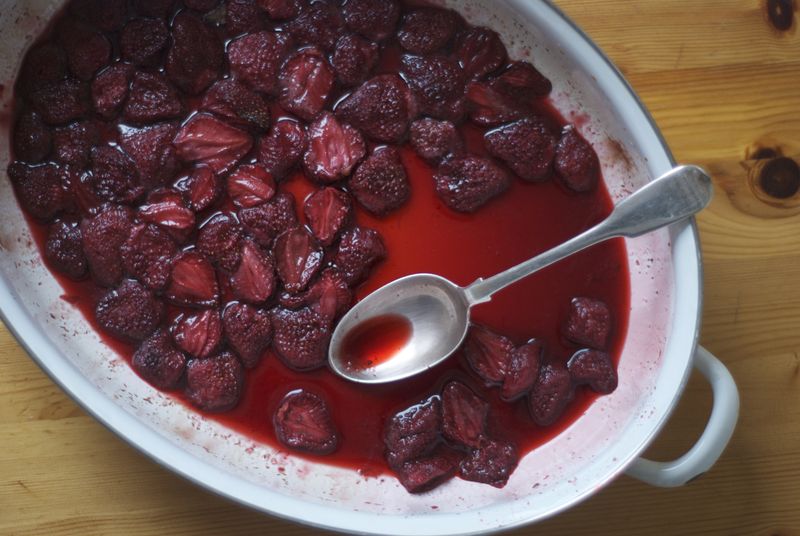
    I hulled the strawberries and cut them in half lengthwise, then dropped them in a large baking pan. I added about 1/4 cup of sugar (I'm guessing that I had about a 3/4 pound of strawberries) and one teaspoon of vanilla paste, something I acquired at a TJ Maxx in Newton Highlands on a recent trip to Boston and am still not entirely convinced by. Mixed up and then spread out evenly, the strawberries went into a 375 F oven (190 C) for an hour. I rotated the pan halfway through, but only sort of shook the strawberries a little instead of stirring them.

    Photo-5

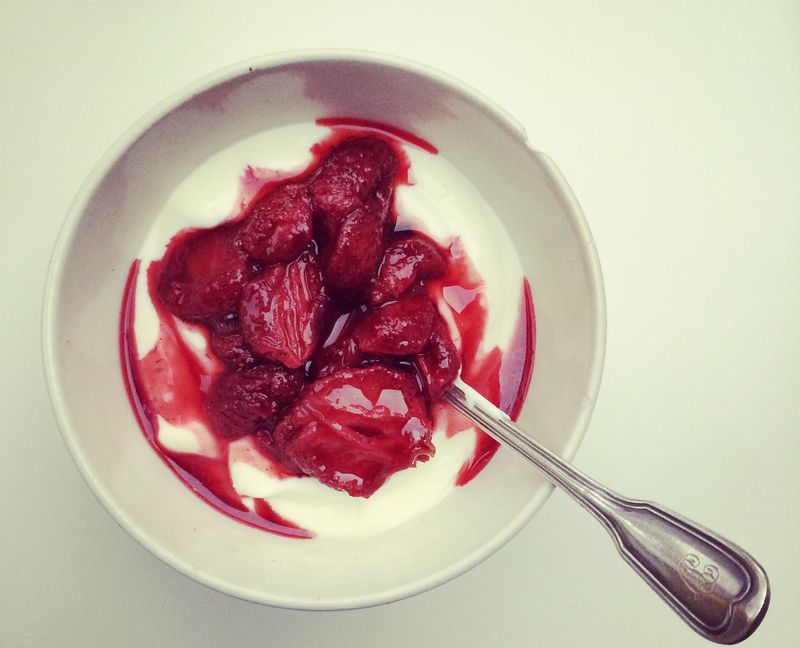
    At the end, the scent of roasting strawberries had filled the house. The fruits had given off a gorgeous claret syrup, but had stayed intact – shrunken, but intact. I let them cool, much to my son's chagrin, and this morning we ate them spooned over bowls of cool, creamy yogurt. The flavor of the strawberries had concentrated and deepened, of course, but gone darker too, into a richer, almost savory place. And the texture of the strawberries was wonderful – with just the barest heft, the seeds still crunching pleasantly in my teeth, the flesh silky and tender. They made our bowls of breakfast yogurt taste like dessert.

    When you make this (not "if"), you will probably want to adjust the amount of sugar you use. The strawberries I had were incredibly sweet and delicious on their own and more than 1/4 cup of sugar would have been too much. But you don't want to use too little sugar, either, because that strawberry syrup that collects at the bottom of the pan is pretty great stuff.

    Fact #7: We need more strawberries.

  • Joanie's picnic

    My friend Joanie celebrated her birthday a few weeks ago the way she does every year, gathering friends and family under a big oak tree in a park on the border between Berlin and Potsdam. It's a potluck thing and the spread each year boggles the mind. In fact, I'd go so far as to say that Joanie's picnic is my favorite meal of the year.

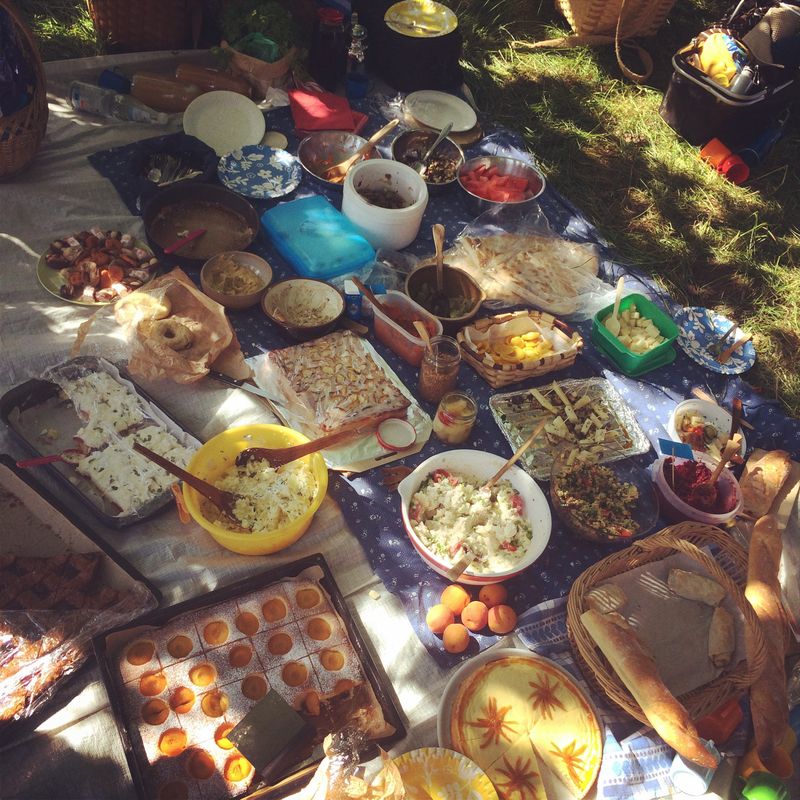
    The grasses in the park reach to your knee in June and Glienicker Park is a big and sprawling place, so it always feels like we've got the place to ourselves. Joanie and Dietrich bring tarps and blankets to make an enormous tablecloth and as everyone arrives, the table fills up with all manners of delicious things. It grows so much, in fact, that I couldn't capture all the dishes this year despite holding my phone over my head.

    I'll tell you, though: There were homemade bagels, two kinds of Turkish flatbreads and baguettes. There were two different potato salads and little skewers of pickled asparagus. There were baked phyllo packets filled with greens and feta. Bulgur and beet salad. A salad that Joanie makes every year with potatoes, tomatoes and Romano beans. Homemade baba ghanouj and hummus. Carrot, feta and harissa salad (Joanie's birthday request from me each year). Quinoa flavored with red pepper paste. Roasted vegetables. Meatballs. A platter of dried fruits stuffed with nuts and marzipan. Wedges of watermelon and fresh apricots. A baking sheet's worth of Linzer torte. Another baking sheet's worth of Austrian apricot cake (from yours truly, it'll be in the book). There was cheesecake decorated with orange peel. Brownies. Some sort of fresh strawberry cake topped with meringue flecked with mint leaves. There was wine and juice and water and iced tea. And instead of plastic cutlery, Joanie and Dietrich always bring metal flatware and reusable plastic cups that they've had as long as I've known them.

    The picnic starts in the afternoon and if we're lucky, it's sunny out. If we're even luckier, it's warm and sunny out. The big kids play soccer or climb the oak tree or go for a walk through the woods until they get to the water for a swim. The little kids run around in the tall grass or slip and slide on the tarps. The rest of us pile our plates high with delicious things and find a cozy seat to talk and eat. It feels warm and happy and easy – the ineffable comfort of being around people you've known for decades.

    With Hugo around now, we have to leave earlier than we used to. But the nicest thing is to just sit there for hours, high up in the park, feeling the sun sink slowly in the sky until it casts the dusky, fuzzy light that makes Berlin summer evenings so special. The sun filters through the tall grasses and the air grows a little cooler and then it's time to pack everything up again, shaking off the ants and the crumbs, shaking the drops of moisture out of the plastic cups, folding up the tarps and then walking back down through the park to the cars, along the dirt path, thinking that next year can't come soon enough.

  • Picstitch
    We are gripped in the throes of World Cup fever around these parts. The German team are my guys, but it's been great to see Italy and the USA doing so well so far. (SO FAR, ragazzi.) Hugo even has his very own soccer ball now (he turned two last week and the ball was his birthday present from his German grandparents) and has taken to tucking it into bed with him and other hilarities.

    Now I know it's been so long since I've done one of these, but there's just been so much good stuff around recently that I couldn't resist.

    First of all, this article on thriving Paris bistros made me happy. So much good stuff to bookmark for future visits (make sure to read the comments, too).

    This essay on Noma was an interesting read (via Sam Sifton).

    Rachel wrote beautifully and evocatively about her visit to the Anna Tasca Lanza cooking school. I was supposed to have been on the trip, but Hugo got very sick at the last minute, foiling my plans. Regret, I have nothing but regret! (He was scary sick. But still!)

    How to use up every last leafy green in your fridge.

    Famous chefs from around the world flew to New York in April to cook a surprise birthday dinner for Wylie Dufresne. Best birthday ever? I think I would have cried.

    Genius: How to salvage bad glazed doughnuts.

    I still need to tell you about Diana Henry's incredible new book, A Change of Appetite. This gorgeously vibrant recipe from the book is just a hint of all the good things she's come up with.

    Oh, and did you have a fancy wedding cake? I'm writing about Peggy Porschen (and attempting one of her cakes) for my column in the September issue of Harper's Bazaar Germany and now all I can think about are handmade fondant flowers and piped buttercream.

    Have a great weekend, everyone. I'll be practicing rosettes!

  • One of the most frequently asked questions I get, whether it's in my inbox or at a reading or at a random intersection of social circles, is how I got into cookbook publishing. I've long promised to lay it all out in a post. But each time I wanted to get started, I got overwhelmed by the prospect of telling people a story that is not at all a blueprint for how you should get into publishing; it's just my story. And I got a little overwhelmed at how long it might take me. And so I postponed and postponed and postponed, feeling guilty the whole time, instead of taking some time and just doing it and putting in all the necessary disclaimers, like "don't take this as the gospel, it's all sort of random, like a lot of life!" and "book publishing may be dying; you should become an engineer instead!" and "no, seriously, back away from the liberal arts degree RIGHT NOW, for the love of Pete." Silly me.

    So today, let's talk about how I got into cookbook publishing and my advice to you, should you want to attempt the same thing. This is going to be a longish post, so put on your reading glasses or whatever and get comfy.

    (more…)

  • Soba bowls with salmon

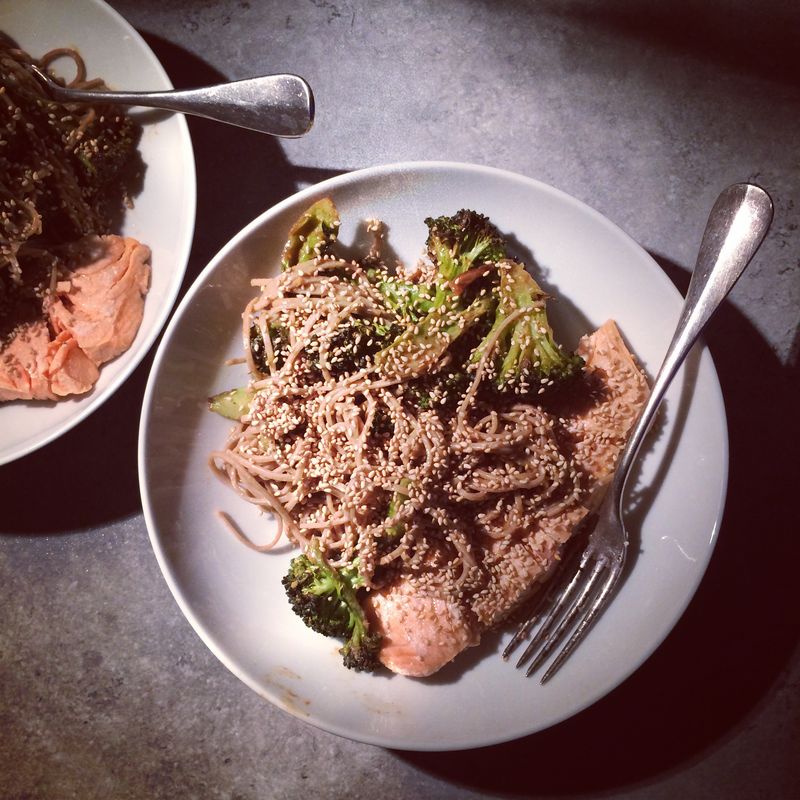
    I am chicken with no head, hear me roar. The washing machine just flooded the bathroom, I haven't started packing yet for a flight to London that leaves less than three hours from now and I still need to do about 67 things including mopping the bathroom between now and then, so forgive me for throwing this recipe at you so unceremoniously, but it's been sitting in my drafts folder for too long already and I just couldn't make it wait any longer.

    Now: Since I discovered these soba bowls with poached salmon (from Sara's The Sprouted Kitchen cookbook), I have made them more times than I can count and if a week goes by without them on the cooking plan, Max starts to get very itchy and plaintive. This is high praise indeed; I find it difficult to make the same recipes over and over again when there are so many other delicious things to discover. Don't you? But these lovely things are are silly easy, fantastically delicious, and even virtuous, if that's your thing, and I'm happy to make them every week. Oooh, I love them.

    The preparation seems a little fussy at first. You need three different cooking vessels: a pot for poaching the salmon, a pot for the soba noodles and a roasting pan for the broccoli. You also need a serving bowl that you mix the dressing in. But as long as you have a loving (or electric) dishwasher, this shouldn't dissuade you, because all these little steps are worth the trouble. And if you are even just mildly interested in Asian cooking, you probably have all the ingredients required. In fact, for us, the salmon is the most difficult thing on the ingredient list to source. (Sara's original recipe has you use green tea for the poaching liquid, but I skip that step because I never have any green tea bags lying around the house and I'm too cheap to use my fancy loose green tea for this.)

    My favorite part is spangling the top of each serving plate with toasted sesame seeds from a little plastic container I bought a few months ago from a Japanese shop. It sort of feels like one of those old-school green Parmesan cans, but instead of a questionable cheese product, out come toasted sesame seeds with a flick of the wrist. Happiness!

    And that's that! Off I go.

    Sara Forte's Soba Bowls with Poached Salmon
    From The Sprouted Kitchen
    Serves 4

    3 tablespoons toasted sesame oil
    2 tablespoons tahini
    2 tablespoons agave nectar
    Grated zest and juice of 1 lime
    3 tablespoons tamari or soy sauce
    2-inch piece of fresh ginger, peeled and finely grated
    1 bunch broccoli
    2 teaspoons extra-virgin olive oil
    1 clove garlic, minced
    Pinch of sea salt
    1 tablespoon peppercorns
    ½ cup mirin or dry white wine
    1¼ pound (preferably wild) salmon fillet
    1 (9.5-ounce) package soba noodles
    4 green onions, white and green parts, thinly sliced on the diagonal
    ½ cup coarsely chopped fresh cilantro
    ¼ cup white or black sesame seeds

    1. Preheat the oven to 425°F.

    2. In a small bowl, whisk together the sesame oil, tahini, agave nectar, lime zest and juice, tamari, and grated ginger until smooth. Set aside.

    3. Cut the broccoli into small florets, including some of the stems. Toss the broccoli in a bowl with the olive oil, garlic, and salt and then spread out on a rimmed baking sheet. Roast for 15 minutes, then remove from the oven.

    4. In a saucepan, bring 1 cup water to a gentle simmer. Add the peppercorns and mirin to the water. Gently slide in the salmon, skin side down. Cover and cook until the salmon is just barely cooked in the middle, 8 to 10 minutes, depending on the thickness of the fillet. If in doubt, it’s better to undercook the salmon a bit than overcook it. Remove the salmon to a plate, loosely cover with foil and set aside.

    5. Meanwhile, bring a large pot of salted water to a boil. Cook the soba noodles according to package instructions or until al dente.

    6. While the noodles cook, chop the roasted broccoli. Drain the noodles. In a large bowl, toss together the warm noodles, broccoli, dressing, green onions, and half the cilantro. Divide the noodles among four bowls, top with a portion of the salmon, and sprinkle the remaining cilantro and the sesame seeds on top. Serve immediately.